
 Worksheets
Unit 2 Exam: Ecology and Evolution Review
Total questions: 74
Worksheet time: 39mins
When more than one individual or population tries to use the same limited resource.
Competition
Resource
Abiotic
Population
A lion is a good example of a (an)...
limiting factor
abiotic
predator
prey
The numbers of predators and prey often follow cyclic ____ over time.
biotics
ecosystems
patterns
limits
Which of the following could be a limiting factor for a cat?
too many trees
just enough heat
not enough water
not enough dogs
All the members of one species living in a particular area at a particular time.
abiotic
population
resource
competition
All the biotic and abiotic factors in an area, and the interactions among them make up an ...
ecosystem
carrying capacity
resource
limiting factor
Competition is when two organisms need the same ...
ecosystem
biotic
resource
population

Some moth and flower species have evolved so that they depend on each other in a relationship in which they both
benefit, this is called _________________.
gradualism
Archaeopteryx
bottleneck
coevolution
A plant’s leaves are green because the color green is _________________back to our eyes.
Absorbed
Reflected
Transmitted
None of the Above
What part of the leaf is responsible for absorbing the sun’s energy?
Cell Wall
Veins
Chlorophyll
Nucleus
The stoma on the underside of the leaf allows ___________ to move in and out of the leaf.
Gases
Water
Nutrients
Soil
Glucose is a type of _______________.
Dairy Product
Protein
Salt
Sugar

Sun’s radiant energy falls under which part of the electromagnetic spectrum?
Ling-Waves
Gamma Rays
Visible Light
X-Rays
Photosynthesis happens both during the day and night in plants.
True
False
What are the products of photosynthesis?
carbon dioxide and glucose
oxygen and glucose
water and carbon dioxide
oxygen and carbon dioxide
What do plants need for the photosynthesis process?
soil, air, and oxygen
light, carbon dioxide, and water
roots, flowers, and bees
camera and a tripod
What part of the leaf allows Carbon dioxide in and oxygen out of the leaf?
Stomata
Xylem
Pholem
Chlorophyll
__________ energy from the sun is changed into __________ energy during photosynthesis
Electrical, Light
Chemical, Light
Physical, Chemical
Light, Chemical
Which part of the plant transports nutrients from the leaves to the rest of the plant?
Stoma
Phloem
Chloroplast
Chlorophyll

The ____________ is the most photosynthetic part of a plant.
Trunk
Flower
Stem
Leaf
The vascular tissue of the plant that transports water is the...
roots
stems
xylem
phloem
Which of the following is the correct equation for PHOTOSYNTHESIS?
CO2 + O2 + H2O --> Light+ Sugar
O2 + light + H2O --> CO2 + Sugar
CO2 + light + H2O --> O2 + Sugar
CO2 + sugar + H2O --> O2 + light
Which gas is removed from the atmosphere during photosynthesis?
Argon
Oxygen
Methane
Carbon Dioxide
What is photosynthesis?
The process in which humans eat their food
When a photographer takes a photo.
The process in which plants make their food.
To get your pictures from the photo lab.

If all four plants were watered daily but placed in a closet, receiving no sunlight, what process would NOT occur?
Photosynthesis
Respiration
Water absorption
Ingestion of Carbon Dioxide

Organisms that can make their own food are called
Consumers
Producers
Omnivores
Decomposers

Producers get their energy from
coffee
the soil
water
the sun

Organisms that have to eat other organisms are called
producers
autotrophs
consumers
prey

Another word for producer is
autotroph
heterotroph
carnivore
decomposer

An organism that cannot make its own food is called a(n)
autotroph
heterotroph
producer

___% of energy is passed from one organism to another.
1
10
100
1000


What is the carrying capacity of the graph?
1000
8000
800
600

What happens if a population grows past its carrying capacity?
The population keeps growing
The population starts to die off
The entire species will go extinct
The carrying capacity just increases
This may cause a population to increase
increase of food supply
removal of predators
removal of disease
all of these

Something that regulates the size of a population is called...
a limiting measure
a limiting factor
carrying capacity
biodiversity
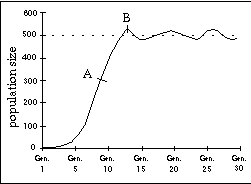
What is the carrying capacity of the graph?
around 500
more than 800
less than 300
around 700
When death rate is equal to birth rate...
population increases
population decreases
population stays the same.
population rapidly increases then becomes stable
When death rate is equal to birth rate...
population increases
population decreases
population stays the same.
population rapidly increases then becomes stable
When the death rate rises and the birth rate lowers...
population increases
population decreases
population stays the same
all of these
When birth rate is high and death rate is low...
population increases
population decreases
population stays the same
all of these
What is an Abiotic Factor?
A NON-living factor that can affect an ecosystem
A living factor that can affect an ecosystem
The carrying capacity of an ecosystem
What is a Biotic Factor?
The carrying capacity of an ecosystem
A NON-living factor that can affect an ecosystem
A living factor that can affect an ecosystem
Check all of the boxes that show examples of biotic factors.
Rain
Humans hunting
Predators
Wildfire
Check all of the boxes that are examples of abiotic factors.
Prey
Rainfall
A pack of wolves
A tornado
What is a limiting factor?
Factors that always increase a population
Factors that always decrease a population
Resources that are unlimited
Factors/resources that limit how many organisms can live in an area at the same time
Can a population go over its carrying capacity?
Yes
No
Maybe
What happens if a population goes over its carrying capacity?
It will continue to grow
It will eventually decrease due to a lack of resources
It will die immediately
It will get unlimited resources
Choose the 4 limiting factors.
Food
Water
Time
Space
Shelter
Which of the following would cause an increase in the omnivore population?
Increase in carnivores
Humans hunting
Increase in rain
Increase in competition

What is the overall trend of this population graph?
Increasing
Decreasing
Constant
No trend
What can cause a population to grow?
The birthrate become higher than the death rate
The birthrate stays the same, and the death rate increases
The birthrate becomes lower than the death rate
The birthrate and death rate remain the same
Which would be least likely to be affected by a density-dependent limiting factor?
a small, scattered population
a population with a high birthrate
large, dense population
a population with a high immigration rate
Number of Deaths 10
Number of Births 15
Immigration 3
Emigration 4
Does the population increase or decrease?
Increase
Decrease
Number of Deaths 10
Number of Births 15
Immigration 3
Emigration 4
How much does the population increase by?
5
4
18
16
Check the Density dependent factors
a hurricane reduces the spider monkey population
wolves capture and consume deer
two male cardinals compete for the same female
a disease wipes out 25% of the gopher population
Check the Density independent factors
a hurricane reduces the spider monkey population
wolves capture and consume deer
two male cardinals compete for the same female
a disease wipes out 25% of the gopher population

What type of growth chart is this?
Exponential
Logistic

What type of graph is this?
Exponential
Logistic
Both species benefit
symbiosis
parasitism
mutualism
commensalism
One species benefits, the other is unaffected
symbiosis
parasitism
mutualism
commensalism
One species benefits, the other species is harmed
symbiosis
parasitism
mutualism
commensalism
Barnacles create home sites by attaching themselves to whales. As the barnacle is a filter feeder, it also gets access to more water (and more food) due to the relationship. Whale is unaffected.
symbiosis
parasitism
mutualism
commensalism
Ostriches and gazelles feed next to each other. They both watch for predators. Because the visual abilities of the two species are different, they can each identify threats that the other animal may not see as readily.
symbiosis
parasitism
mutualism
commensalism
Mistletoe extracts water and nutrients from the spruce tree to the detriment (ill effect) to the spruce
symbiosis
parasitism
mutualism
commensalism
Tapeworms reside in human intestine and take nutrients from the human
symbiosis
parasitism
mutualism
commensalism
E. Coli is a bacteria that lives in the gut of humans. The human provides the ideal habitat for e coli reproduction and the e coli provides the extra vitamin K that we use.
symbiosis
parasitism
mutualism
commensalism
Oxpeckers (bird) feed on the ticks found on a rhinoceros. The oxpecker gets food and the rhino gets rid of a parasite
symbiosis
parasitism
mutualism
commensalism

