Wayground logo

Free Printable Worksheets

Font size

S
M
L
XL
Worksheets

Quiz #4 Review

Total questions: 118

Worksheet time: 2hrs 58mins

Name
Class
Date
1.
The scientific theory of evolution is supported by different types of evidence. The diagrams below show the skeletons of two different animal species. How does comparing the skeletons of these animals provide support for the scientific theory of evolution?
a)
 It provides information about the organisms' habitats.
b)
 It shows possible common ancestry between organisms.
c)
It provides information to determine the organisms' ages.
d)
It shows possible chromosomal similarities between organisms.
2.
The diagram illustrates an embryonic stage of two organisms.Which of the following can be determined by observing the embryos shown in the diagram? 
a)
The organisms share a common ancestry.
b)
The organisms belong to the same genus.
c)
The organisms are native to the same geographic areas.
d)
The organisms will grow into anatomically similar adults.
3.
Which occurrence represents an example of evolution?
a)
 Exposure to radiation reduces the rate of mutation in leaf cells.
b)
A mutation in a liver cell causes a person to produce an enzyme that is less efficient.
c)
 Cells in a zygote eventually change into bone cells or skin cells
d)
Some antibiotics are almost useless, because pathogens have developed a resistance to these antibiotics.
4.
______ _________ explains how two or more organisms could evolve similar traits even though they are not related to each other.
a)
convergent evolution
b)
reproductive isolation
c)
derived characters
d)
hybrid vigor
5.
______________ is the process by which populations change in response to their environment.
a)
natural selection
b)
adaptation
c)
reproductive isolation
d)
divergence
6.
__________ enable an organism to survive in its environment.
a)
adaptations
b)
natural selections
c)
divergence
d)
extinctions
7.
________ structures are reduced in size or function.
a)
vestigial
b)
homologous
c)
cladistic
d)
phylogenic
8.
Mutations are important because they bring about
a)
death of the organism in which they develop
b)
genetic variation needed for a population to evolve
c)
benefits for the individual, not for the population
d)
Hardey-Weinberg equilibrium within a population
9.
What is the process in which humans breed organisms for certain traits?
a)
natural selection
b)
inheritance
c)
artificial selection
d)
descent withOUT modification
10.
Some organisms that share a common ancestor have features that have different functions, but similar structures.  These are known as
a)
vestigial structures
b)
analogous structures
c)
homologous structures
d)
fossil structures
11.
The gradual change in species over time is...
a)
Evolution
b)
Nucleotide 
c)
Adaptation
d)
Natural Selection
12.

Natural selection is the process that passes down ____________________ traits.

a)

Same

b)

Old

c)

Useless

d)

Favorable

13.

A mistake or change that occurs in the DNA sequence is called a ______________________.

a)

Extinction

b)

Speciation

c)

Mutation

d)

Genetic Variation

14.

When there is a difference in population based on genes, it is said to be a _______________.

a)

Mutation

b)

Speciation

c)

Extinction

d)

Genetic Variation

15.
Group of organisms capable of interbreeding and producing fertile offspring.
a)
species
b)
gene pool
c)
population
d)
homologous structure
16.
Group of organisms all of the same species, living in the same place at the same time.
a)
gene pool
b)
population
c)
species
d)
evolution
17.
mechanism by which individuals that have inherited beneficial adaptions produce more offspring on average than do other individuals 
a)
Fitness
b)
Natural Selection
c)
Evolution
d)
Artificial Selection
18.
measure of an organisms's ability to survive and produce offspring relative to other members of a population 
a)
Natural Selection
b)
Adaptation
c)
Fitness
d)
Variation
19.

A population of rabbits grows rapidly from one year to the next. Then one year, a disease strikes approximately one fourth of the adult rabbits. The disease remains with the population in the years that follow.

As explained by Darwin’s theory, which of these conditions allows the rabbit population to evolve by natural selection?

a)

The disease affects adult and juvenile rabbits equally.

b)

The disease reduces the ability of the rabbits to reproduce.

c)

Some rabbits are resistant to the disease, and they pass the resistance to their offspring.

d)

No rabbits are resistant to the disease, and all die when the disease strikes them.

20.

The graphs below show the changes in crab color at one beach.

Which of the following is most likely to have caused the change in the distribution?

a)

A new predator arrived that preferred dark-tan crabs.

b)

A new predator arrived that preferred light-tan crabs.

c)

A change in beach color made medium-tan crabs the least visible to predators.

d)

A change in beach color made medium-tan crabs the most visible to predators.

21.

The figure shows how natural selection of a single-trait gene affects lizard survival.

Which of the following most likely causes the changes in allele distribution?

a)

The allele for light gray coloration disappears from the population. This may be because light gray lizards are more visible to predators and therefore they might be less likely to survive and reproduce.

b)

The allele for black coloration decreases fitness and becomes less common. This may be because black coloration keeps the lizards cool during hot summer temperatures.

c)

Medium gray coloration in lizards appears to be a neutral mutant allele that allows the lizards to hide better from predators. This leads to increases in phenotype and allele frequency of gray coloration.

d)

Because black and medium gray lizards are less visible to predators, these alleles are neutral to natural selection and therefore will not disappear from the population of lizards.

22.

Grass plants in a population range in height from 6 cm to 25 cm. The short plants receive little sunlight, and the tall plants are eaten by grazing animals. Which statement best describes the effect of natural selection on the grasses?

a)

Because average height grass plants are favored, stabilizing natural selection is occurring.

b)

Because average height grass plants are favored, disruptive natural selection is occurring.

c)

Because tall grass plants are favored by the animals that eat grass, directional selection is occurring.

d)

Because short and tall grass plants are favored, normal natural selection is occurring.

23.

What is the most likely explanation of the data shown below?

a)

There has been a drought in the area that is affecting all life forms.

b)

The population of natural predators of the moths has gotten smaller.

c)

The moths are living in an environment with light trees.

d)

The moths are living in an environment with dark trees.

24.

Which of the following statements best describes what will most likely occur to the moth populations in the image above?

a)

The light moths will be captured by predators more easily than the dark moths, and the population of dark moths will rise.

b)

The light moths will be captured by predators more easily than the dark moths, and the population of light moths will rise.

c)

The dark moths will be captured by predators more easily than the light moths, and the dark moths will probably go extinct.

d)

The light moths will change their wing color to match that of the dark moths.

25.

Why are advantageous traits more likely to be passed onto offspring?

a)

Because they are more likely to survive and reproduce.

b)

Because they come from dominant alleles.

c)

Because they come from recessive alleles.

d)

Because the organism knew it needed that trait, survives, and passes it on.
26.
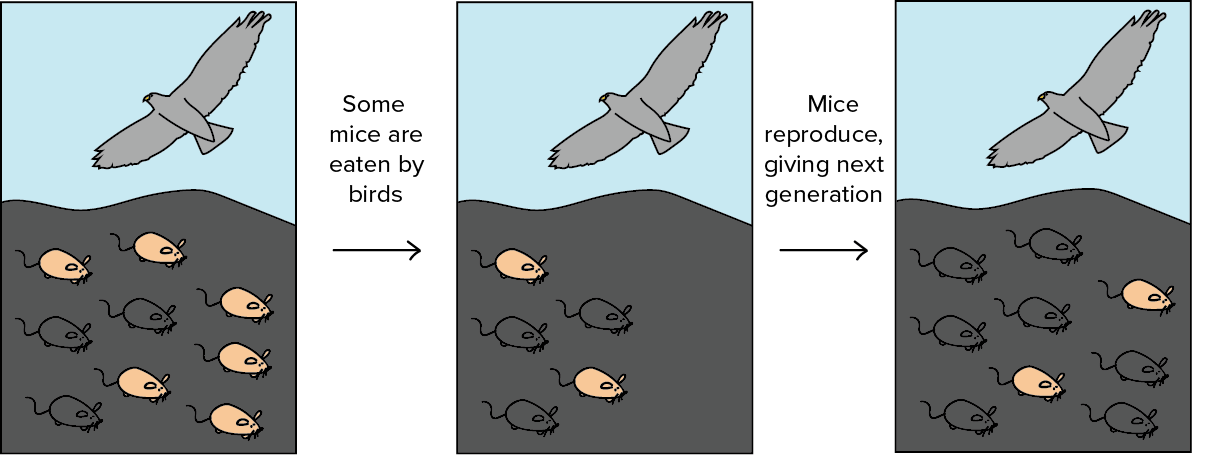
Why is the mouse population changing over time?
a)
The light mice can reproduce more successfully than the dark mice
b)
The hawks eat more dark mice than light mice because the dark mice taste better
c)
The hawks eat more light mice than dark mice because they can see the light mice more easily
d)
The hawks eat more dark mice than light mice because they can see the dark mice more easily
27.
Which best describes the role of mutations in natural selection?
a)
Mutations help an organism to better survive in their environment
b)
An organism may acquire a helpful mutation by interacting with the environment
c)
A mutation may result in an adaptive trait that makes an organism more likely to survive and reproduce
d)
Organisms with certain traits are more likely to win competitions for mutations
28.

All rabbits of the same species living in a particular area would be an example of a(n)

a)

population

b)

species

c)

community

d)

ecosystem

29.

The more genetic variation a population has,

the more likely it is for some individuals to

a)

evolve

b)

migrate

c)

survive

d)

mutate

30.

Mutations are important because they bring about

a)

death of the organism in which they develop

b)

genetic variation needed for a population to evolve

c)

benefits for the individual, not for the population

d)

changes in genotype, but not phenotype

31.
Why do frogs and other organism reproduce so many eggs or offspring?
a)
so that their babies can have friends to play with
b)
the more offspring the more likely the offspring will survive
c)
the more offspring the less likely offspring will survive 
d)
the more offspring the less competition
32.
Do organisms "decide" to evolve and change?
a)
Yes, they know they need to change to survive 
b)
No, they change because of natural selection
33.

Why is competition important for natural selection?

a)

It shows which variations are more successful, allowing the organisms with those variations to survive.

b)

It causes organisms, regardless of which traits they have, to die out, reducing the population size.

c)

It causes organisms to get stronger due to having to outcompete other species.

d)

Competition is not important for natural selection.

34.
Which statement is true about evolution?
a)
Individual organisms can evolve during a single lifespan.
b)
Darwin and Wallace both came up with the idea that species can transform into different species over time
c)
Humans evolved from chimpanzees
d)
Only the strongest survive
35.
Natural selection and evolution work on what level of life organization?
a)
individuals
b)
biomes
c)
populations
d)
ecosystems
36.
Organisms with traits that are favorable to their survival and reproduction are ________ likely to pass on their genes to the next generation, and thus ________ common in the population
a)
more, less
b)
more, more
c)
less, less
d)
less, more
37.
For natural selection to impact evolution, which condition is not required?
a)
selection pressures
b)
inheritance of traits
c)
genetic variation within a population
d)
each population occupies its own niche
38.
Why are advantageous traits more likely to be passed onto offspring?
a)
Because they are more likely to survive and reproduce.
b)
Because they come from dominant alleles.
c)
Because they come from recessive alleles.
d)
Because the trait is an acquired phenotype.
39.
Which of the following is NOT an example of natural selection? 
a)
People selectively breeding hamsters.
b)
Insect populations developing resistance to certain pesticides.
c)
Bacteria becoming resistant to antibiotics.
d)
Male birds of certain species developing colorful feathers to attract female mates.
40.

individuals with alleles for an extreme type are more likely to survive and reproduce

a)

stabilizing selection

b)

directional selection

c)

disruptive selection

d)

genetic drift

41.

the selection pressure favors the extreme phenotypes, dividing the population into 2 distinct groups

a)

directional selection

b)

stabilizing selection

c)

geographic selection

d)

disruptive selection

42.

Individuals with intermediate traits are more likely to survive and reproduce

a)

stabilizing selection

b)

directional selection

c)

adaptive radiation

d)

disruptive selection

43.

Tall kelp have a distinct advantage over shorter kelp in receiving needed sunlight in their ocean environment

a)

directional selection

b)

disruptive selection

c)

stabilizing selection

d)

sexual selection

e)

artificial selection

44.

Aspen trees that are over 25 m tend to blow over in high winds; aspen that are under 15 m don't get enough sun

a)

directional selection

b)

stabilizing selection

c)

disruptive selection

d)

artificial selection

e)

sexual selection

45.

male elk use their antlers and size to compete with each other for the ability to mate with female elk

a)

directional selection

b)

stabilizing selection

c)

disruptive selection

d)

artificial selection

e)

sexual selection

46.

modern corn plants are the descendants of teosinte, a wild corn plant that has been selectively bred for over 1000 years.

a)

directional selection

b)

stabilizing selection

c)

disruptive selection

d)

artificial selection

e)

sexual selection

47.

On average, human newborns weigh 7.2 pounds.

a)

directional selection

b)

stabilizing selection

c)

disruptive selection

d)

artificial selection

e)

sexual selection

48.

Labradoodles and cockapoos are different varieties of domestic dogs that can be purchased from dog breeders.

a)

directional selection

b)

stabilizing selection

c)

disruptive selection

d)

artificial selection

e)

sexual selection

49.

Female water frogs tend to be attracted to the males with the loudest and most distinctive mating call (an acoustical display).

a)

directional selection

b)

stabilizing selection

c)

disruptive selection

d)

artificial selection

e)

sexual selection

50.

Producing 1000 cactus spines requires too much energy, but producing <500 leaves the plant open to predation

a)

directional selection

b)

stabilizing selection

c)

disruptive selection

d)

artificial selection

e)

sexual selection

51.
Robins typically lay fours eggs. If more then four eggs are produced then the baby chicks are malnourished while smaller egg numbers result in no viable (able to live) baby chicks. This is an example of
a)
stabalizing
b)
disruptive
c)
direction
d)
none of the above
52.
What is the correct explanation for what is happening in this graph?
a)
There are a lot of average-sized beaks
b)
There are no beaks
c)
There are a lot of small beaks only
d)
There are a lot of small and large beaks, but not average-sized ones
53.
Human babies don't do well if they are born too small. If they are too big complications can occur during birth. Baby size should then be selected for by which method?
a)
stabilizing
b)
directional
c)
disruptive
d)
Beyonce is having twins
54.
What is the advantage of having different shaped beaks?
a)
To look different from other species.
b)
To be able to eat the food readily available in the environment.
c)
To protect itself against predators.
d)
To protect itself against prey.
55.
When taken to a new habitat, non-native plants often threaten native plants of the new habitat.  Why do they do this?
a)
Non-native plants are able to mutate rapidly
b)
Non-native  plants cause native animals to relocate
c)
Non-native plants are able to be used for medicine
d)
Non-native plants compete with native plants for resources
56.
If a blue catfish is introduced and eats the large fish who eat the smaller fish, what will happen to the population of the smaller fish?
a)
Increase
b)
Decrease
c)
Stay the same
d)
No affect on smaller fish
57.
A population of an organism will only grow exponentially if:
a)
The resources are unlimited
b)
They want to
c)
The resources are limited
d)
They do not like to compete
58.
Invasive species have a negative impact on...
a)
the ecosystem
b)
the economy
c)
Both the ecosystem and the economy
d)
None of these
59.
Exotic or invasive species leads to all of these problems except
a)
increased biodiversity
b)
loss of biodiversity
c)
disease
d)
loss of native species
60.
How do invasive plants damage the environment?
a)
Compete with native species
b)
Change plant community
c)
Alter diversity
d)
All of these
61.
Why can an invasive species be bad for an ecosystem?
a)
They can provide too much food for the other organisms.
b)
They can disrupt the natural ecosystem. 
c)
They can fight with other animals.
62.

Why do the populations of invasive species grow so quickly?

a)

Invasive Species are native to an area.

b)

Invasive species are prey to many animals.

c)

Invasive species have no natural predators.

d)

Invasive species keep the ecosystems in equilibrium.

63.
All of the living and nonliving things in an area that interact with each other are called a/an ______.
a)
community
b)
habitat
c)
population
d)
ecosystem
64.
The non-living part of an ecosystem
a)
Ocean
b)
Lava Flow
c)
Birds
d)
Abiotic
65.
The living part of an ecosystem
a)
Biotic
b)
Abiotic
c)
Mother Earth
d)
Flowers
66.
The study of how living things interact with one another and with their environment.
a)
Biology
b)
Lithology
c)
Ecology
d)
Farmacology
67.
What is the ultimate source of energy for all ecosystems?
a)
the Sun
b)
plants
c)
secondary consumers
d)
primary consumers
68.
The energy pyramid below shows a possible amount of energy, in kilocalories, available in the organisms at each trophic level in an ecosystem.  According to the law of conservation of energy, energy can neither be created nor destroyed.  If this is true, why is there less energy in the top of the energy pyramid than there is in the bottom of the energy pyramid?
a)
Energy is lost between each trophic level as heat.
b)
The law of conservation of energy does not apply to ecosystems.
c)
Organisms in the top of the energy pyramid use up energy the fastest.
d)
The extra energy in the bottom is slower to reach the top.
69.
Which of the following interactions is an example of symbiosis?
a)
an insect acts as a pollinator for a plant species
b)
a population of hummingbirds migrates during the summer
c)
a tropical bird performs a courtship dance for a mate
d)
a mother bear feeds and protects her cubs
70.
A farmer plants two species of grass with similar nutrient needs on the same small plot of land.  What kind of interaction will most likely occur between the two species?
a)
parasitism
b)
competition
c)
commensalism
d)
mutualism
71.
The graph below shows population data for two species.  What can be said about the relationship between species 1 and species 2?
a)
When the population of species 1 increases, the population of species 2 decreases.
b)
The population of species 1 and species 2 stay the same over the time period shown.
c)
The population of species 1 is not influenced by the population of species 2.
d)
When the population of species 1 increases, the population of species 2 increases.
72.
Grazing cows disturb the grass and cause insects to fly around the cows as they eat. In turn, birds swoop in and eat the insects. This type of feeding relationship is an example of
a)
commensalism.
b)
mutualism.
c)
parasitism.
d)
predation.
73.
In a simple food chain, small fish eat algae; bigger fish eat the smaller fish; bears eat the bigger fish. 
Using the above scenario, which of these would have the largest amount of energy?
a)
algae
b)
bears
c)
big fish
d)
small fish
74.

The number of pythons found throughout Everglades National Park has increased in recent years. These huge snakes are not native to Florida and are believed to have been released into the wild by pet owners. Wildlife biologists have initiated attempts to capture and remove these pythons. Which statement best explains the biologists’ reason for removing these pythons from the Everglades?

a)

The pythons could upset the territorial boundaries of native organisms.


b)

The pythons could adapt to overcome diseases common to native snakes.

c)

The pythons could prey on native organisms and cause native populations to decline.

d)

The pythons could begin to interbreed with native snakes and produce a more successful species.

75.

A new species of snake was introduced to a tropical region. Scientists then noticed a steady decline in the presence of field mice and an increase in the number of snakes. Which of these is the most likely explanation about why the population size of each animal changed?

a)

The snakes introduced to the region dominated the habitat, forcing the mice to find another place to live.

b)

The mice became prey to the introduced snakes, allowing the snake population to increase but decreasing the mice population.

c)

The snakes introduced to the region competed with the mice for food, allowing the snake population to increase but decreasing the mice population.

d)

The people in the surrounding area set traps that killed the mice, allowing the snakes to live without any predators and therefore to increase in number.

76.

Each step in a food chain is called a trophic level. What percentage of energy available at one trophic level is transferred to organisms at the next level?

a)

about 2 percent

b)

about 10 percent

c)

about 25 percent

d)

about 50 percent

77.
A human & a Tape Worm: The tape worm gets a place to live in the intestines of the human and food from the human. The human loses weight and nutrients from the tape worm.
a)
Mutualism
b)
Commensalism
c)
Parasitism
78.
What type of symbiosis?  Hummingbirds feed on nectar from flowers.  The flowers are pollinated by hummingbirds as they move from flower to flower.
a)
commensalism
b)
mutualism
c)
parasitism
d)
predation
79.
Tree kangaroos live in the upper branches of trees in the rainforests of Queensland, as well as on the island of New Guinea. This is an example of the tree kangaroos ___.
a)
niche
b)
habitat
c)
community
d)
population
80.
What is the name of an animal that is hunted and eaten by other animals?
a)
producer
b)
prey
c)
predator
d)
decomposer
81.
The concept that predators can affect the size and distribution of other animals is known as 
a)
predation
b)
herbivory
c)
tolerance
d)
limitation
82.
What is the term for each step in the transfer of energy and matter within a biological community?
a)
energy path
b)
food web
c)
trophic level
d)
food pyramid
83.

Food webs are models that show

a)

one sequence of producers and consumers.

b)

complex networks of feeding relationships.

c)

stored energy in food chains

d)

only primary consumers in an ecosystem

84.
Rabbits and deer eat lettuce leaves from a garden.
What ecological interaction describes the relationship between rabbits and deer?
a)
Mutualism
b)
Competition
c)
Commensalism
d)
Predation
85.
What does the graph represent?
a)
Emigration
b)
Exponential growth
c)
Immigration
d)
Logistic Growth
86.
Which limiting factor would increase due to the number of individuals in a population?
a)
Unusual weather
b)
Natural disaster
c)
Births
d)
Disease
87.
Which limiting factor is independent of the number of individuals in a population?
a)
competition
b)
parasitism/disease
c)
stress
d)
natural disasters
88.

What point on the graph represents the carrying capacity?

a)

A

b)

B

c)

C

d)

D

89.
As a population grows, it will most likely stop growing at what size?
a)
Growth limit
b)
Exponential limit
c)
Carrying Capacity
d)
It won't stop growing
90.
Which factor is a density-dependent limiting factor on the population of a species?
a)
seasonal variation
b)
natural disasters
c)
unusual weather
d)
predation
91.
No two species can occupy the same niche
a)
Competitive Exclusion Principle 
b)
Limiting Exclusion Theory
c)
Competitive Limiting Principle
d)
Limiting Competitive Theory 
92.

What point on the graph does the population slow down tremendously due to limiting resources as it approaches the carrying capacity?

a)

A

b)

B

c)

C

d)

D

93.
If the number of births in a population is the same as the number of deaths in a population, what will happen to the growth of the population?
a)
It will increase.
b)
It will decrease.
c)
It will stay the same.
d)
It will fluctuate.
94.
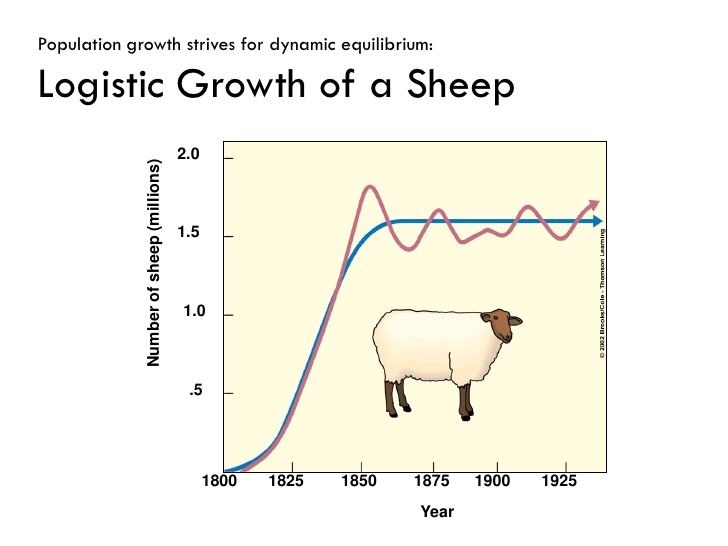
What is the carrying capacity for this sheep population?
a)
1.8 million
b)
1.25 million
c)
1.6 million
d)
1.o million
95.
When a population grows past the ecosystem's carrying capacity, what happens to the population?
a)
Continues to grow
b)
The population starts to die off to return to carrying capcity
c)
The population will go extinct due to lack of resources
d)
The population grows then finds a new carrying capacity
96.
Food, water, sunlight, shelter, and space are resources that are often __________.
a)
limiting factors
b)
wet
c)
messy
d)
found in rocks
97.
which statement sounds accurate based on the graph data. 
a)
The zebra and lions do not affect each other
b)
when lions population increases, so does the zebra population
c)
When the zebra population increases, it causes the lion population to also increase
d)
when zebra populations go down, the zebra population goes up. 
98.
Which kind of growth does the human population follow? It is described as a J-shaped curve.
a)
Exponential Growth
b)
Logistic Growth
c)
Outstanding Growth
d)
Minimal Growth
99.

Which of the following are density dependent factors?

a)

competition for resources

b)

predation

c)

disease

d)

natural disasters

100.

Which of the following are examples of a density independent factors?

a)

forest fire

b)

seasonal cycles

c)

storms

d)

disease

101.
An organism that produces its own food supply from inorganic compounds is called a(an)
a)
heterotroph
b)
consumer
c)
detritivore
d)
autotroph
102.
What is the original source of almost all energy in most ecosystems?
a)
carbohydrates
b)
sunlight
c)
water
d)
carbon
103.
An organism that needs to eat other organisms to obtain energy is known as a:
a)
Autotroph
b)
Producer
c)
Consumer
d)
Mutualist
104.

Plants that convert energy from the sun are also called

a)

decomposers

b)

primary consumers

c)

secondary consumers

d)

producers

105.

What are the abiotic factors in this image?

a)

water, sunlight, dirt, air

b)

birds and plants

c)

birds, water, dirt

d)

plants, water

106.

The role an organism plays in its environment is known as its

a)

ecosystem

b)

habitat

c)

niche

d)

biosphere

107.

The physical place where an organism lives is known as its

a)

niche

b)

habitat

c)

community

d)

biome

108.

These organisms must eat to obtain their energy

a)

autotrophs

b)

heterotrophs

c)

producers

d)

niche

109.
True or False:  It is possible for a carnivore to be a producer.
a)
False
b)
True
110.
An organism at the second trophic level would be considered a...
a)
Top carnivore
b)
Producer
c)
Herbivore
d)
Carnivore
111.
What does a food web represent?
a)
All connections of energy flow throughout all organisms in a habitat.
b)
The specific ways that mutualism is carried out.
c)
A single pathway or energy flow between organisms. 
d)
How carnivores get their food. 
112.
A living relationship between two species in which one organism is harmed is called...
a)
mutualism
b)
commensalism
c)
parasitism
d)
niche
113.
symbiotic relationship in which both organisms benefit
a)
competition
b)
Mutualism
c)
nitrogen fixation
d)
energy pyramid
114.
In the energy pyramid here, which organisms have the most energy available?
a)
Producers
b)
Carnivores
c)
Herbivores
d)
Top Predator
115.
All food webs and food chains begin with _________________.
a)
primary consumer
b)
producers
c)
secondary consumers
d)
predators
116.
If 20,000 kcal is available to producers, how much is passed on to primary consumers?
a)
20 kcal
b)
200 kcal
c)
2,000 kcal
d)
20,222 kcal
117.
Which level of a trophic pyramid would have the fewest number of organisms?
a)
primary consumers
b)
producers
c)
tertiary consumers
d)
secondary consumers
118.
Which of the following would most likely be a carnivore with no natural predators?
a)
producer
b)
primary consumer
c)
secondary consumer
d)
tertiary consumer