
 Worksheets
Unit 1-3 Review
Total questions: 145
Worksheet time: 2hrs 30mins
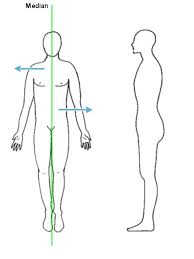
Which directional term refers to the middle of the body?
fine
lateral
medial
superior
Which direction term refers to the back of a human body?
posterior
anterior
cepahilc
media
The study of body function
anatomy
microbiology
biology
physiology


[The eyes are _______ to the brain].

The shoulder is the
axillary
acromial
appendage
cervical
Tarsal and Carpals are
hands and feet
ankle and wrist
Heads and tails
arms and legs
The calf is also known as the
crural
sural
Femoral
Brachial

Respiratory System

The pinky finger is ______ to the thumb in anatomical position.
posterior
superior
lateral
medial
Which structure is most medial?
nose
ears
heart
femur


close to the origin of a body part (point of attachment)
inferior
proximal
dorsal
distal
the elbow is _____ to the fingers
distal
superficial
deep
proximal
the nose is ____ to the forehead
posterior
anterior
inferior
distal
toward the head end
anterior
posterior
superior
inferior
the knee is ____ to the thigh
proximal
distal
lateral
ventral
the arms are _____ to the chest
distal
posterior
superficial
lateral
the heart is ____ to the arm
lateral
inferior
superior
medial
away from the head end
posterior
anterior
inferior
ventral
the navel is ______ to the breastbone
medial
posterior
lateral
inferior
The bones are _____ to the skin
superficial
anterior
lateral
deep


1) The nose is _____________________ to the mouth.
inferior
superior
medial
lateral
The nose is inferior and ________________________ to the eyes.
inferior
superior
cranial
medial
If a structure is on the outer surface of the body it is said to be:
inferior
superior
superficial
deep
What section will cut an organ into EQUAL right and left parts?
sagittal
mid-sagittal
transverse
coronal
In the _________________________ position, the body is upright, directly facing the observer, feet flat and directed forward. The upper limbs are at the body's sides with the palms facing forward.
inferior
superior
frontal
anatomical
Which body plane divides the body into anterior and posterior portions?
transverse
sagittal
frontal
occipital

Name this body region:
femoral
gluteal
posterior
inguinal

Name this body region:
gluteal
inguinal
femoral
pelvic
The anterior knee is called the:
popliteal region
peroneal region
patellar region
antecubital region
The heart, lungs, and mediastinum are located in what body cavity?
cranial
spinal
abdominopelvic
thoracic
This term refers to the arm
Brachial
Carpal
Clavicular
Bilateral
This term refers to the region around the collar bone
cervical
thoracic
palmar
clavicular
This term refers to the stomach region
acromial
abdominal
ocular
thoracic
This term refers to the eyes
cranial
cervical
clavicular
ocular
This term refers to the elbow
brachial
cubital
palmar
acromial
This term refers to the neck region
geniculate
carpal
cervical
unilateral
This term refers to the wrist
palmar
carpal
brachial
cubital
This term pertains to the sole of the foot
plantar
pubic
femoral
unilateral
This term refers to the thigh region
pelvic
pubic
plantar
femoral
This term pertains to the palm of the hand
pedal
plantar
palmar
pelvic


Thumb
Carpal
Pollex
Digital
Brachial
Which part of the cell is made up of a network of filaments that maintains the cell structure?
Cytoplasm
Endoplasmic reticulum
Cytoskeleton
Vacuoles
Which filaments are built from molecules of protein actin?
Microtubules
Microfilaments
Intermediate filaments
Cilia and flagella
Which of the following is the main function of intermediate filaments?
Cytoplasmic streaming
Cellular motility
Separate chromosomes in dividing cells
Fix organelles in place
Intermediate filaments are found in what structure?
The mitotic spindle
Desmosomes
Cilia
Centrosome
Microfilaments play major role in:
Formation of nuclear lamina
Cleavage furrow
Chromosomes movements
All of the above
Which of the following is microtubule function?
Chromosomes movements
Cleavage furrow formation
Formation of nuclear lamina
None of the above
Which of the following intercellular junction contains keratin?
Tight junction
Gap junction
Desmosomes
All of the above
Microtubules are formed of the protein ……..
Dynein
Keratin
Tubulin
Actin
What of the following is mismatch with tight junctions?
forming continuous seals around the cells.
prevent leakage of extracellular fluid.
small molecules and ions pass through.
connect epithelial cells.
Junctions are necessary for comunications between cells in many types of tissues including animal embryos and heart muscles.
Tight junctions
Desmosomes
Gap junctions
All of the above
Responsible with protein myosin in muscle cell contraction
Actin filamints
Tubulin polymers
Intermediate filamints
None of the above

WHat type of tissue is this
transitional
simple cuboidal
simple squamous
complex squamous

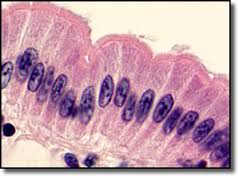
What type of tissue is this
simple cuboidal
stratified epithelium
stratified cuboidal
simple columnar

stratified columnar epithelium
simple columnar epithelium
pseudostratified columnar epithelium
non of the above



Epithelial tissue regenerate really quickly
True
False
What type of gland is the sebaceous glad of the skin?
Apocrine
Merocrine
Holocrine

