wayground logo

Free Printable Worksheets

Font size

S
M
L
XL
Worksheets

Fall Semester Exam Review Physics

Total questions: 94

Worksheet time: 2hrs 13mins

Name
Class
Date
1.

Newton's first law is also called the:

a)

law of inertia

b)

law of mass

c)

f = ma law

d)

law of forward momentum

2.

What force causes downward acceleration?

a)

applied force

b)

normal force

c)

friction force

d)

gravity force

3.

Which formula would you use to find the acceleration of a bike rider with a mass of 50kg who pushes off with a force of 25 Newtons.

a)

f = ma

b)

a = f *m

c)

m = f * a

4.

What is the answer for the acceleration of a bike rider with a mass of 50kg who pushes off with a force of 25 Newtons.

a)

100 m/s2

b)

2 m/s2

c)

0.5 m/s2

d)

0.125 m/s2

5.

What is the net force?

a)

800 N

b)

600 N

c)

400 N

d)

400 N down

6.

What is the SI unit of force?

a)

Joules

b)

kilograms

c)

Newtons

d)

Isaac

7.

What does stationary mean?

a)

moving

b)

not moving

8.

If an object is stationary, how can you measure its inertia?

a)

force

b)

gravity

c)

mass

d)

density

9.

What type of friction acts between your bike tires and the ground as you ride?

a)

fluid friction

b)

static friction

c)

sliding friction

d)

rolling friction

10.

Two objects collide. Which of the following is true according to Newton's THIRD law?

a)

the force on each is equal in magnitude and the same direction

b)

the force on each is equal in magnitude and opposite in direction

c)

the more massive one has a bigger reaction

d)

the more massive one has more inertia

11.

Which of the following has the most inertia?

a)

a semi truck

b)

an SUV

c)

a person

d)

a grasshopper

12.

Which of the following has the least inertia?

a)

a semi truck

b)

an SUV

c)

a person

d)

a grasshopper

13.

Your foot pushes on the floor as you walk, and the floor pushes back. This is an example of:

a)

Newton's first law

b)

Newton's second law

c)

Newton's third law

d)

Newton's fourth law

14.

When forces are acting in the OPPOSITE direction, you ____ them to find the net force

a)

add

b)

subtract

c)

multiply

d)

divide

15.

If you increase the force you use to roll a bowling ball, so it accelerates faster. This is an example of:

a)

Newton's first law

b)

Newton's second law

c)

Newton's third law

d)

Newton's fourth law

16.

This is measured in Newtons

a)

mass

b)

weight

c)

both

d)

neither

17.
Newton's First Law of Motion can best be defined by which statement.
a)
Force (N) equals the mass of an object times the acceleration of the object.
b)
For every action there is an equal and opposite reaction.
c)
A body at rest tends to remain at rest. A body in motion tends to remain in motion unless acted on by a separate force.
d)
Inertia, the first law is only about inertia nothing else but inertia.
18.
Newton's Third Law of Motion is best defined by which statement?
a)
A body at rest tends to remain at rest.
b)
A body in motion tends to remain in motion unless acted on by another force.
c)
For every action there is an equal and opposite reaction.
d)
Inertia, it is all about inertia and speed and motion.
19.
Newton's Third Law of Motion is best defined by which statement?
a)
A body at rest tends to remain at rest.
b)
A body in motion tends to remain in motion unless acted on by another force.
c)
For every action there is an equal and opposite reaction.
d)
Inertia, it is all about inertia and motion.
20.
Newton's Second Law of Motion can be defined by using the following formula.
a)
Momentum = mv
b)
Force (N) = ma
c)
Speed = d/t
d)
Velocity = d/t with a direction
21.
In physics, what is a reference point?
a)
A fixed point to compare a moving object too.
b)
A point on a map used for reference.
c)
The point at the end of your pencil.
d)
A statement made about motion.
22.
In physics, what is a reference point?
a)
A fixed point to compare a moving object too.
b)
A point on a map used for reference.
c)
The point at the end of your pencil.
d)
A statement made about motion.
23.
In physics, what is the action and reaction in observed by in this photograph?
a)
rocket sitting still and then blasting off.
b)
rocket fuel exploding and rocket moving.
c)
rocket moving and moving up.
d)
rocket payload moving into orbit.
24.
A force can simply be explained by these words.
a)
Inertia and momentum.
b)
Speed and Velocity
c)
Reference point and motion
d)
A push or a pull on an object.
25.
What is another name for the first law of motion that was described by Newton when he created his laws of motion?
a)
Inertia
b)
reference point
c)
motion
d)
Momentum
26.
Balanced forces cause objects to
a)
move.
b)
remain in place.
c)
fall downward.
d)
rotate and spin in circles.
27.
Unbalanced forces cause objects to
a)
remain still.
b)
remain motionless.
c)
move and accelerate.
28.
The image and statement represent which law of motion? A meteor traveling through outer space in a straight line for 100 million years entering the upper atmosphere above the Earth and falling towards the ground as a meteorite.
a)
Newton's First Law - A body tends to remain in motion unless acted on by a nother force.
b)
Newton's Second Law - Force is mass times acceleration
c)
Newton's Law of Apples - One hit him on the head.
29.
A ball being dropped from a tower and falling towards the ground is acted on by these forces:
a)
balanced forces
b)
frictional forces
c)
friction and gravity forces
d)
may the force be with you
30.

The ______ is a combination of all the forces acting on an object.

a)

net force

b)

Soell force

c)

negative force

d)

air force

31.

Maggie is taking her dog Nalu for a walk. Nalu pulls on the leash with a force of 15 N to the left and Maggie pulls back on the leash with a force of 10 N to the right. What is the net force?

a)

25 N

b)

5 N

c)

150 N

d)

1000 N

32.

A (n) ______ force will cause motion to occur.

a)

balanced

b)

unbalanced

33.

_____ is an object's resistance to a change in its motion.

a)

gravity

b)

force

c)

inertia

d)

A Newton

34.

Newton's ___ law states that an object's acceleration depends on its mass and the net force acting upon it.

a)

1st

b)

2nd

c)

3rd

d)

4th

35.

Lily throws a football that has a mass of 2 kg and the football's acceleration is 5 m/s/s. What is the force that Lily threw the football at?

a)

10 N

b)

100 N

c)

1,000 N

d)

10, 000 N

36.

What happens to an object when the forces on it are balanced?

a)

The object accelerates

b)

The object doesn't move or stays at its constant speed.

c)

The objects changes direction

37.

Why does the skydiver fall slowly?

a)

The force of drag opposes gravity.

b)

The force of drag is stronger than gravity.

c)

The force of gravity is equal to force of drag.

38.

What happens if the player on the right has more force than the player on the left?

a)

They will move to the right (→)

b)

They will move to the left (←)

c)

The will not move.

39.
a)

True...at 1s the velocity is 4 m/s

b)

True...at 2s the velocity is 8 m/s

c)

True...the velocity is constant.

d)

True... This graph shows increasing velocity.

40.
a)

The Green line is faster than the red line

b)

The Blue line shows constant speed.

c)

The Red line shows decreasing speed.

41.
a)
b)
c)
d)
42.
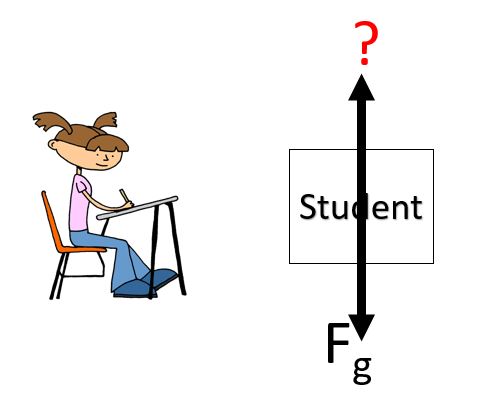
Name the missing force....
a)
weight force
b)
normal force
c)
frictional force
d)
tension force
43.
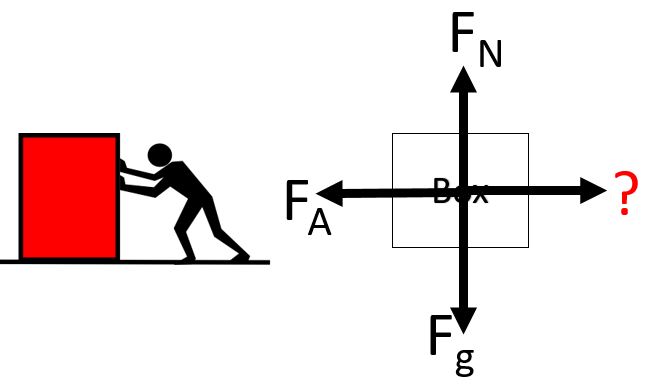
Name the missing force...
a)
frictional force
b)
weight force
c)
thrust
d)
buoyant force
44.
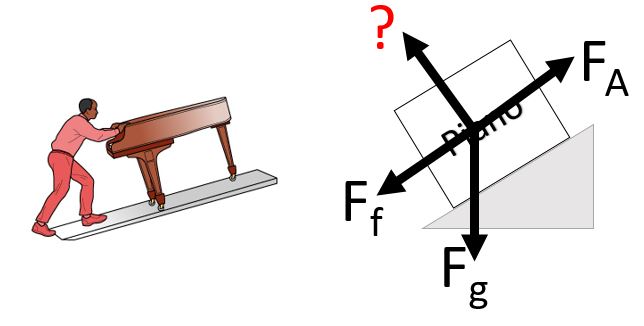
Name the missing force...
a)
normal force
b)
applied force
c)
frictional force
d)
tension force
45.
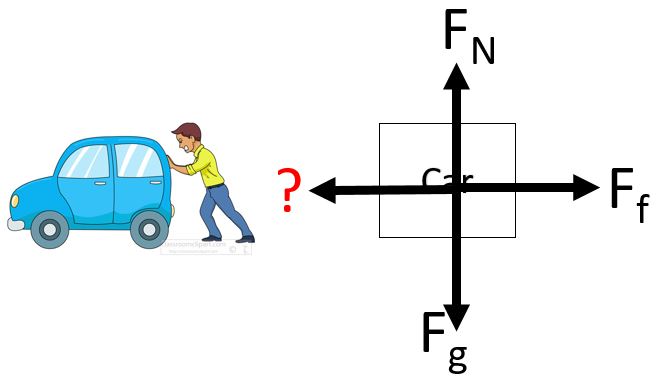
Name the missing force...
a)
applied force
b)
weight force
c)
tension force
d)
drag
46.

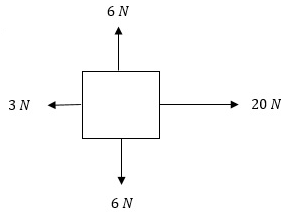
What is the NET FORCE of this diagram?

a)

17 N, right

b)

17 N, left

c)

23 N, right

d)

12 N, up

47.

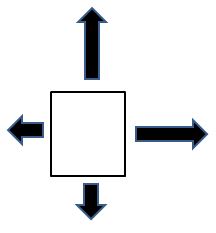
This object would be moving (pick all that are correct):

a)

up

b)

down

c)

left

d)

right

48.

What forces are on a leopard laying on a log?

a)

Fg & Fapp

b)

Fb & Fg

c)

Fg & FN

d)

Ff & FN

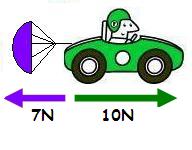
49.
What is the net force?
a)
17 N Right
b)
3 N Right
c)
3 N Left
d)
17 N Left
50.
What is the curved path that an object follows when thrown or launched near the surface of the Earth?
a)
Terminal Velocity
b)
Projectile Motion
c)
Free Fall
d)
Gravity
51.

What is the difference between speed and velocity?

a)

speed is a change in velocity

b)

speed is velocity with a direction

c)

speed is no change in velocity

d)

velocity is speed with a direction

52.

The momentum of an object depends upon the object's ___________&_____________.

a)

size and shape

b)

mass and inertia

c)

mass and veloctiy

d)

mass and energy

53.
What is the volume of the liquid in this graduated cylinder?
a)
19 mL 
b)
35 mL 
c)
24 mL 
d)
1.9 mL
54.
What is the scale on this graduated cylinder?
a)
.1 mL per line
b)
.2 mL per line
c)
.5 mL per line
d)
1 mL per line
55.

How close a measurement is to the accepted value is called..

a)

Accuracy

b)

Precision

c)

Significant

d)

Estimate

56.
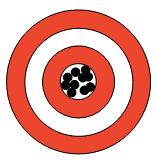
This bullseye demonstrates...
a)
High Accuracy & High Precision
b)
High Accuracy & Low Precision
c)
Low Accuracy & High Precision
d)
Low Accuracy & Low Precision
57.
?
a)
High Accuracy & High Precision
b)
High Accuracy & Low Precision
c)
Low Accuracy & High Precision
d)
Low Accuracy & Low Precision
58.
A set of data are all close to each other, and they are close to the actual value.  This set of data can be described as...
a)
accurate
b)
precise
c)
both precise and accurate
59.

How many sig figs are found in 2000 miles?

a)

1

b)

2

c)

3

d)

4

60.
Which statement describes a vector?
a)
It has magnitude but no direction
b)
It has direction but no magnitude
c)
It has both direction and magnitude
d)
It has constant magnitude but no
 direction
61.
What is the formula to calculate speed?
a)
S = t/d
b)
S = d/t
c)
S = d x t
d)
S = t x d
62.
What is speed?
a)
how far you go
b)
how much distance is covered over a period of time
c)
how fast you accelerate
d)
the change in the location of a object
63.
What is velocity?
a)
the quickness of an object
b)
the location of an object
c)
acceleration
d)
speed in a specific direction
64.
A change in velocity over time is known as:
a)
acceleration
b)
constant speed
c)
average speed
d)
displacement
65.
Velocity is both ____ and _____. 
a)
speed , direction 
b)
direction, mass
c)
volume, density 
d)
direction, magnitude 
66.
The unit we use to measure acceleration is ___. 
a)
meters / second 
b)
meters 
c)
seconds 
d)
meters / second / second 
67.
The speedometer on your car tells you
a)
average velocity
b)
instantaneous velocity
c)
average speed
d)
instantaneous speed
68.
What is this graph representing?
a)
Constant Speed
b)
Acceleration (speeding up)
c)
Deceleration (slowing down)
d)
No motion
69.
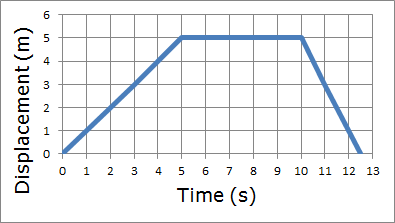
At 60 seconds, how far had this object traveled? 
a)
0 m
b)
10 m
c)
20 m
d)
40 m
70.
What is the person doing from 5 seconds to 10 seconds?
a)
Walking 
b)
Running
c)
Standing Still 
d)
Walking Fast
71.
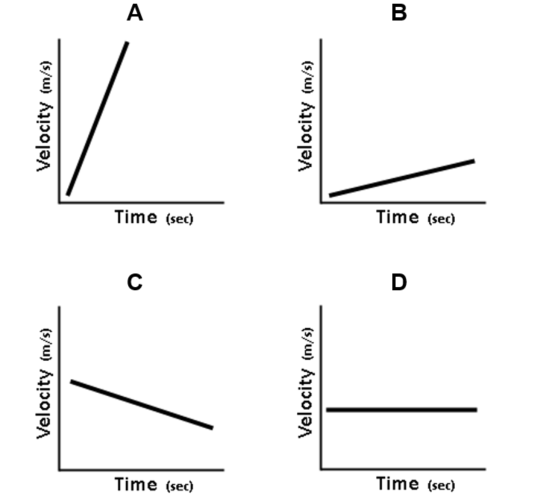
Which graph represents zero acceleration (constant velocity)?
a)
A
b)
B
c)
C
d)
D
72.
You run from your house to a friend's house that is 3 km away. You then walk home. The distance you traveled is 6 km. What is your displacement? 
a)
6  km
b)
0 km
73.

What is the average velocity of the object between 0 and 10 seconds?

a)

6.0 m/s

b)

1.5 m/s

c)

-4 m/s

d)

0 m/s

74.
An object can be moving for 10 seconds and still have zero displacement.
a)
True
b)
False
75.
does acceleration always mean speeding up?
a)
yes. FACTS.
b)
no. Fake news. 
76.
Why does the equation for acceleration have the 'Vf - Vi' part?
a)
To bamboozle you
b)
To hoodwink you
c)
To create appropriate units for the final answer
d)
Because acceleration is a change in velocity
77.
How is constant velocity different from constant acceleration?
a)
constant velocity is the same as constant acceleration
b)
constant velocity means changing velocity, constant acceleration means same velocity
c)
constant velocity means no change in rate of motion, constant acceleration means constant change in rate of motion
78.
if there were no air resistance, what would happen to falling object?
a)
They would fall at different rates because they weigh differently
b)
all objects would fall at the same rate
c)
there is always air resistance, the question is irrelevan
79.
When can we assume a projectile is at its max height?
a)
after the rocket has reached its destination
b)
half the total time the object was in the air
c)
when it has stopped going up and is about to come back down
80.

A car going 50mph accelerates to pass a truck. Five seconds later the car is going 80mph. Calculate the acceleration of the car

a)

6

b)

500

c)

16

d)

10

81.

Which angle causes the projectile to go the greatest distance?

a)

45⁰

b)

15⁰

c)

60⁰

d)

75⁰

82.

Which angle causes the projectile to go the shortest distance? (pick 2 answers)

a)

45⁰

b)

15⁰

c)

60⁰

d)

75⁰

83.

Tension stores potential energy by

a)

Being in a state of stretch ready to release

b)

Being in a twisted state ready to release

c)

Humans stretching elastic bands

d)

Using gravity to bring projectiles back to earth

84.
 If a lab experiment is not completed, you should 
a)
make up some results
b)
come in during lunch and finish while eating lunch
c)
sneak in after school and work alone
d)
discuss the issue with your instructor
85.
You have been injured in the laboratory (cut, burn, etc.). First you should
a)
apply first aid yourself
b)
tell the science instructor at once
c)
see a doctor after school
d)
visit the school nurse after class
86.

Theory or Law? Tectonic ________ of Geology: the surface of the earth is made of tectonic plates, which move slowly. Explains why mountains are formed, earthquakes happen, etc.

a)

Theory

b)

Law

87.

Which description defines the variable in a scientific experiment?

a)

a set of possible outcomes for an experiment

b)

any factor that can change in a controlled experiment

c)

a question being explored by an investigation

d)

a range of values for a particular quantity in an experiment

88.

The findings of an experiment are generally not accepted by the scientific community if the results are not...

a)

able to be published in an important journal

b)

able to be replicated by other scientists

c)

proven by the scientist conducting the experiment

d)

highlighted in the newspaper

89.
Theory or Law???  Predicts what will happen in the natural world.
a)
Law
b)
Theory
90.
Theory or Law???  Changes with new observations.
a)
Theory
b)
Law
91.
Theory or Law???  Explanation of a wide range of observations?
a)
Theory
b)
Law
92.

Newton's 2nd Law of Motion states that the force acting upon an object is equal to the product of the object's mass and acceleration (F=ma). Which statement correctly explains why this is a law?

a)

Laws are descriptions of how nature works, and theories are explanations of why a natural process happens.

b)

Scientific theories that are not proven are accepted as laws.

c)

Scientific laws are proven by experimentation and approved by scientists.

d)

Theories are a descriptions of how nature works, and laws are explanations of why a natural process happens.

93.
It is a measure of how close measurements come to each other when they are made in the same way
a)
Accuracy
b)
Precision
c)
Error
d)
Extrapolation
94.

How close a measurement is to the accepted value is called..

a)

Accuracy

b)

Precision

c)

Significant

d)

Estimate