
 Worksheets
AP Bio Unit 4 (Cell Communication and Cell Cycle)
Total questions: 100
Worksheet time: 2hrs 31mins
Cells can communicate with one another via:
chemical messengers
hormones
gap junctions
all of these
I. Response
II. Amplification
III. Reception
IV. Transduction
Which of the following represents the sequence of events in a typical signal transduction pathway?


Which of the following best describes the role in which the G protein is most intimately involved in the process shown above?
Type of cell signaling where the ligand is released and will affect cells in its "neighborhood"
autocrine signaling
juxtracrine signaling
paracrine signaling
endocrine signaling
Type of cell signaling where the ligand is produced at a location distant from its target cell(s)
autocrine signaling
juxtracrine signaling
paracrine signaling
endocrine signaling

What is being depicted in the image?
Amplification of the signal molecule
Enzymatic proteins inhibiting process of the signal transduction pathway
Kinase groups adding dimer groups to other enzymes
Diffusion of molecules within the cell due to the signaling molecule
Testosterone does not affect all cells of the body because __________.
testosterone cannot cross the plasma membrane
not all cells have cytoplasmic receptors for testosterone
not all cells in the body have membrane receptors for testosterone
it is a local regulator
it affects only cells that have ion-channel receptors
The general name for an enzyme that transfers phosphate groups from ATP to a protein is __________.
protein dehydrogenase
protein kinase
protein phosphatase
peptidase
protein cyclase
The source of phosphate for a phosphorylation cascade is __________.
cAMP
protein kinase
GTP
ATP
protein phosphatase
Receptors for signal molecules __________.
all work via protein kinases
are never found in the nucleus of a cell
may be found embedded in the plasma membrane, or found within the cytoplasm or nucleus
all work by opening ion channels
are only found associated with the plasma membrane
What is Apoptosis?
Cell programmed Death
Inflammation of cell
Phagocytosis
Plasmolysis
Why is apoptosis required?
Glycolysis
Cell division: Meiosis and mitosis
Growth and elimination of threats such as viruses and DNA damage
Which of these is a pro of an enzymatic cascade?
It leads to regulation
It amplifies the response of a single binding molecule
It decreases the response of a single binding molecule
Because it is unregulated, it provides a variety of responses
Growth factors are a family of proteins that bind to receptors with the main purpose of proliferating and/or differentiating?
True
False
Membrane receptors can be classified into different families based on their structures, their kinase activity, and the ligand they bind to.
True
False
Which item listed below is not involved in some way in signal transduction for the cell?
Protein kinase
Small cyclic nucleotide
Membrane receptor protein
phosphorylated protein
None of the above
Which chemical molecule below would be a common theme amongst the signaling pathways to turn on or off a protein?
PO4
SO4
CLO4
AMP
None of the above
Signal amplification is most often achieved by
an enzyme or phosphorylation cascade
binding of multiple signals
branching pathways
action of adenylyl cyclase

What does a protein kinase do?
removes phosphates
transfers phosphates from ATP to proteins
activates an enzyme
What does a protein phosphatase do?
removes phosphates
transfers phosphates from ATP to proteins
activates an enzyme
Hormones, both protein and steroids, are typically synthesized and sent out through the blood stream to reach far-off parts of the body. Therefore these are being used in ____ signaling.
endocrine
juxtacrine
autocrine
paracrine
How do bacteria sense local population density?
quorum sensing
bacteria sensing
signal sensing
population sensing
Local signaling in animals is called what?
paracrine
endocrine
hormone
Long distance signaling in animals is called what?
paracrine
endocrine
hormone
gap junctions
An example of DIRECT cell communication is:
White blood cells bumping into each other sharing antigen info
Neurons communicating across a synapse/synaptic space
Hormones traveling through the blood stream to target tissues
An example of LOCAL cell communication is:
White blood cells bumping into each other sharing antigen info
Neurons communicating across a synapse
Hormones traveling through the blood stream to target tissues
A cell converting a chemical signal into a cellular response is known as __.
energetics
transduction
ligand response
transformation
Describe what occurs when a protein ligand binds to a membrane receptor.
conformation change of the shape of the receptor
ligand passes through the membrane
phosphorylation of ligand
receptor binds additional ligands

cAMP is considered a "secondary messenger" which takes the original message (from the ligand) and _____________.
amplifies it (spreads/grows it)
shuts it off
simply transfers the message to one kinase molecule
Epinephrine is a protein hormone found in many animals. Epinephrine stimulates a signaling pathway that results in the breakdown of glycogen to glucose in the liver cells. Which of the following describes the initial steps in the process whereby epinephrine stimulates glycogen breakdown?
Epinephrine binds to a cell-surface receptor; the activated receptor stimulates production of the second messenger, cAMP
.
Epinephrine binds to a cell-surface receptor; the activated receptor catalyzes the conversion of glycogen to glucose.
Epinephrine diffuses through the plasma membrane; the hormone dimerizes in the cytosol.
Epinephrine is taken into the cell by endocytosis; glycogen is converted to glucose in the endocytotic vesicle.
Cell communication is critical for the function of both unicellular and multicellular eukaryotes, and is largely dependent on specific protein molecules for signal reception and transduction. Which of the following is likely true of cell signaling?
Cell signaling uses the highest molecular weight molecules found in living cells.
Cell signaling has largely been replaced by other cell functions in higher mammals.
Similar cell signaling pathways in diverse eukaryotes are evidence of conserved evolutionary processes.
Cell signaling functions mainly during early developmental stages.
When glucose levels in the blood rise, your brain sends a signal to your pancreas. The pancreas releases insulin, which opens channels in cell membranes to allow glucose to enter the cell, lowering blood sugar levels. This is an example of a:
Positive Feedback Loop
Negative Feedback Loop
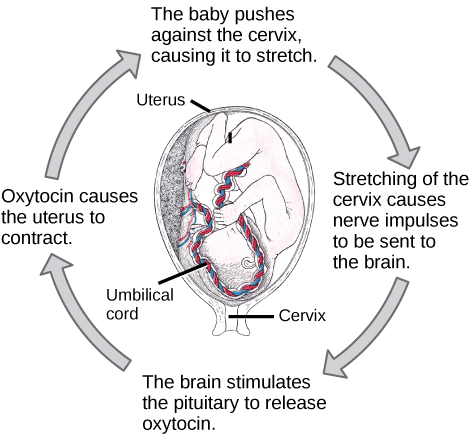
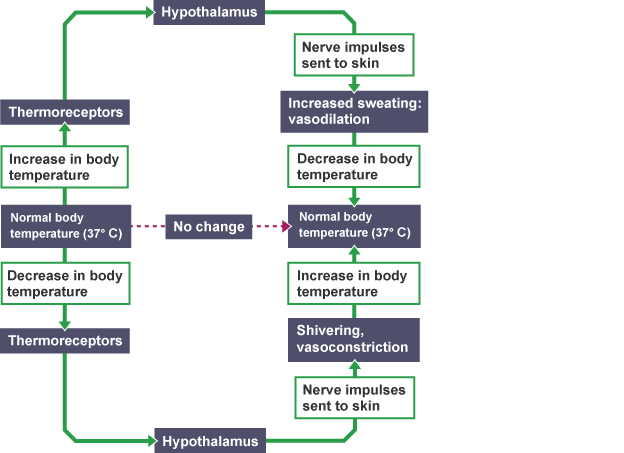
When you get cut, your skin cells release hormones that signal platelets to come and stop the bleeding. Platelets then release more hormones that signal even more platelets to help stop bleeding. The hormone signals continue until the cut is closed. This is an example of what type of feedback?
Positive Feedback Response
Negative Feedback Loop
If the calcium in your blood decreases below homeostasis levels, a gland in the brain will sense the decrease and send a chemical message to your bones. Your bones will release calcium into the blood, bringing blood calcium levels back up. This is an example of what type of feedback?
Positive Feedback Response
Negative Feedback Loop
As you get dehydrated, your blood becomes thicker and harder to pump. Your kidneys will respond by stopping urine production, sending the water from urine into your bloodstream to thin your blood back to normal level. This is an example of what type of feedback?
Positive Feedback Response
Negative Feedback Loop
reverses the direction of change
positive feedback
effector
hypothalamus
negative feedback
increases or speeds up original change
negative feedback
positive feedback
endotherm
ectotherm


Identify the stage of the cell cycle while looking at the picture.
Early Prophase
Metaphase
Anaphase
Interphase

The arrow is pointing to the:
Spindle fibers
Equator
Cleavage Furrow
Chromosomes

The arrow is labeling:
Nuclear membrane
Chromatin
Chromosomes
Centrioles

The circle is labeling:
Nuclear membrane
Chromatin
Chromosomes
Centrioles
Apoptosis is
programmed cell death
mysterious cell death
programmed cellular mutation
mysterious cellular mutation
The cell mutated in the previous cycle, which is prohibiting the daughter cells to enter the S phase. Since they cannot go further, the cells will go through apoptosis and die.
True
False

Which of the following is FALSE in regards to cyclin and CDK?
Cyclins bind to Cdk's
Cyclins and Cdk's are negative regulators (stop the next phase from beginnning)
Different types of cyclins increase during specific phases in order to encourage that phase to begin.
CDK stands for cyclin dependent kinase

G1 is associated with what event?
doubling of cell content
DNA replication
The beginning of mitosis
breakdown of the nuclear membrane
The amount of DNA in a cell is measured right after mitosis and found to be 8 picograms. How many picograms of DNA would be found in a nucleus in the G2 phase?
4
8
16
24

Why do cells such as neurons divide very rarely?
They no longer have active nuclei
They have entered G0
they can no longer break down cyclins
They no longer produce MPF
Cells from cancerous tumors usually have an unusual number of chromosomes, and unusual looking chromosomes. What could explain this?
cancer cells are in G0
cancer cells are arrested in the S phase
cell cycle check points are not in place
transformation introduces new chromosomes to cells
What two components make an active MPF (mitosis promoting factor, a protein complex that makes mitosis start)?
a growth factor and a mitotic factor
ATP synthetase and a protease
cyclin and tubulin
cyclin and a cyclin-dependent kinase
A diploid cell has ____ the number chromosomes as a haploid cell.
half
twice
one-fourth
four times

C (each of these is called)
Kinetochore
Chromosome
Sister Chromatids
Centromere
Cleavage Furrow
D (located ON this structure, one side)
Kinetochore
Chromosome
Sister Chromatids
Centromere
Cleavage Furrow
E (whole structure)
Kinetochore
Chromosome
Sister Chromatids
Centromere
Cleavage Furrow
Which of these may be assessed by various proteins during a "checkpoint"? CHECK ALL THAT APPLY
Ensure that all chromosomes have lined up in the center of the cell before sister chromatids separate
Ensure that spindle fibers have attached to all centromeres before cell division
Ensure that DNA has been replicated properly

