Wayground logo

Free Printable Worksheets

Font size

S
M
L
XL
Worksheets

CRHS Biology Midterm 2020

Total questions: 79

Worksheet time: 1hrs 11mins
Name
Class
Date
1.
Building blocks of proteins are
a)
Simple sugars
b)
Amino acids
c)
Monosaccharides
d)
Polysaccharides
2.
Two structures present in plant cells but NOT animal cells are:
a)
Chloroplasts and centrioles
b)
Chloroplasts and cell wall
c)
Chloroplasts and cell membrane
d)
Chloroplasts and ribosomes
3.
Controls what goes in and out of the cell
a)
Cell membrane
b)
Cell wall
c)
Chloroplasts
d)
Nucleus
4.
One of the main difference between prokaryotic and eukaryotic cells is that - 
a)
eukaryotic cells have a more advanced cellular organization
b)
eukaryotic cells have a smaller cell nucleus
c)
prokaryotic cells do not have a plasma membrane
d)
prokaryotic cells are always much larger
5.
If a toxic chemical destroys the ribosomes, which cellular activity would be affected first?
a)
Energy storage
b)
Movement
c)
Protein production
d)
DNA synthesis
6.
Which is NOT TRUE about a prokaryotic bacteria?
a)
It stores its genetic information in DNA
b)
It has ribosomes to make proteins
c)
It has a cell membrane
d)
It has a membrane-bound nucleus
7.
What organelle is used to store food?
a)
Chloroplast
b)
Mitochondrion
c)
Vacuole
d)
Nucleus
8.
The organelle that provides energy for the cell and acts like the "power house" is the
a)
Nucleus
b)
Lysosome
c)
Golgi bodies
d)
Mitochondria
9.
The passive transport of water across a selectively permeable membrane is called___
a)
Osmosis
b)
Facilitated diffusion
c)
Active transport
d)
Exocytosis
10.
Sugar, starch and cellulose are examples of
a)
Lipids
b)
Carbohydrates
c)
Proteins
d)
Nucleic Acids
11.
Fats, oils and waxes are examples of 
a)
Nucleic Acids
b)
Carbohydrates
c)
Lipids
d)
Proteins
12.
Diffusion is the movement of molecules from____
a)
an area of low concentration to an area of high concentration
b)
an area of high concentration to an area of low concentration
c)
an area of equilibrium to an area of high concentration
d)
no movement at all
13.
What is the difference between aerobic and anaerobic environments?
a)
Anaerobic uses oxygen and aerobic does not
b)
Aerobic and anaerobic environments both use oxygen
c)
Aerobic uses oxygen and anaerobic does not
d)
Aerobic and anaerobic both do not use oxygen
14.
Photosynthesis uses solar energy from the sun to create
a)
High energy sugars like glucose
b)
High energy proteins
c)
High energy lipids
d)
High energy nucleic acids
15.
How are photosynthesis and cellular respiration related processes?
a)
Both provide plant cells with energy
b)
Both provide animal cells with energy
c)
The reactants of respiration are the products of photosynthesis.
d)
The reactants of respiration are the reactants of photosynthesis.
16.
Which of the following describes transcription?
a)
tRNA is made from a DNA template.
b)
tRNA is made in the ribosome.
c)
mRNA is made in the ribosome.
d)
mRNA is made from a DNA template.
17.
A segment of DNA has the following code: T-A-C-G-C-A-A-C-T. What is the correct mRNA sequence?
a)
A-T-G-C-G-T-T-G-A
b)
A-U-G-C-G-U-U-G-A
c)
U-A-C-G-C-A-A-C-U
d)
T-A-C-G-C-A-A-C-T
18.
A segment of DNA has the following code: T-A-C-G-C-G-A-A-T. Which represents DNA replication correctly?
a)
U-A-C-G-C-G-A-A-U
b)
T-A-C-G-C-G-A-A-T
c)
A-U-G-C-G-C-U-U-A
d)
A-T-G-C-G-C-T-T-A
19.
Which of the following is NOT a difference between DNA and RNA?
a)
DNA is double-stranded, RNA is single-stranded.
b)
DNA contains the sugar deoxyribose, RNA contains the sugar ribose.
c)
DNA contains uracil, RNA contains thymine.
d)
DNA contains thymine, RNA contains uracil.
20.
What is the difference between passive and active transport?
a)
Active transport does not require energy.
b)
Passive transport does require energy.
c)
Passive transport does not require ATP energy, but active transport does.
d)
Active transport does not require ATP energy, but passive transport does.
21.
Facilitated diffusion allows large molecules to pass through the cell membrane with the help of protein channels, but does not require energy. It is a ________ process.
a)
Passive
b)
Active
c)
ATP
d)
Protein
22.
What is the purpose of DNA replication?
a)
To copy DNA
b)
To copy RNA
c)
To use DNA to make mRNA
d)
To use DNA to make tRNA.
23.
Which organelle provides your body the energy it needs to function?
a)
Chloroplast
b)
Lysosome
c)
Mitochondria
d)
Golgi apparatus
24.
Which level of organization is the most complex?
a)
organism
b)
population
c)
community
d)
ecosystem
25.
Multiple organisms of the same species describes a
a)
organism
b)
population
c)
community
d)
ecosystem
26.
Which of the following is the correct order of organization in living things from most basic (simple) to most complex?
a)
a.  Organism, cell, tissue, organ, organ system
b)
a.  Organ system, organ, tissue, cell, organism
c)
a.  Cell, tissue, organ, organ system, organism
d)
a.  Cell, organ, tissue, organ, organism, organ system
27.
The smallest level of organization of life in an organism
a)
tissue
b)
cell
c)
organ
d)
organ system
28.
The cell is the building block of all living things.
a)
True
b)
False
29.
This is a example of........ 
a)
organ system
b)
cells
c)
organ
d)
tissue
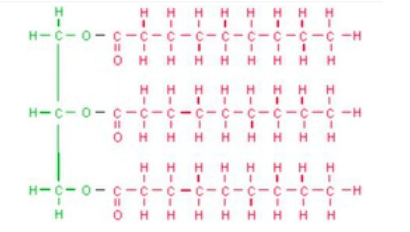
30.
Which biomolecule is this a picture of?
a)
Protein
b)
Nucleic Acid
c)
Lipid
d)
Carbohydrate
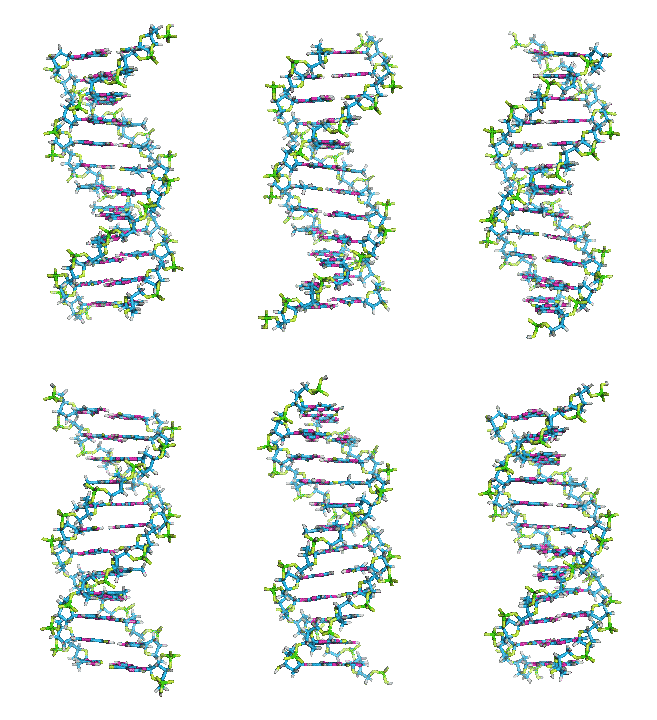
31.
Which biomolecule is made of nucleotides and include your DNA? (Hint: they carry genetic information)
a)
Carbohydrate
b)
Lipids
c)
Protein
d)
Nucleic Acid
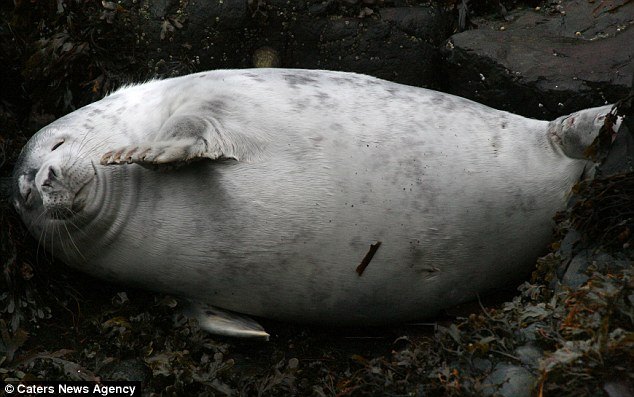
32.
Which biomolecule is responsible for insulation and LONG term energy storage?
a)
Proteins
b)
Nucleic Acids
c)
Lipids
d)
Carbohydrates
33.
Which biomolecule includes sugars and starches? (Hint: simple or complex)
a)
Lipids
b)
Proteins
c)
Carbohydrates
d)
Nucleic Acids
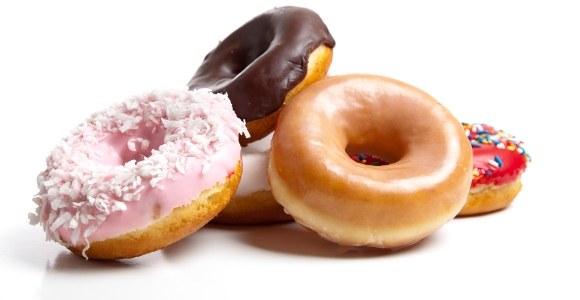
34.
Which biomolecule group includes fats, oils, and waxes?
a)
Proteins
b)
Nucleic Acid
c)
Lipids
d)
Carbohydrate
35.
The monomer (building block) of a nucleic acid is
a)
Monosaccharide
b)
Amino Acid
c)
Nucleotide
d)
Polysaccharide
36.
ALL polymers (large molecules) are made up of...
a)
monosaccharides
b)
monomers
c)
proteins
d)
None of these
37.
Lipids can be digested into what smaller subunits?
a)
nucleic acids
b)
amino acids
c)
fatty acids
d)
glucose
38.
What is the function of nucleic acids?
a)
Stores energy
b)
Stores genetic information
c)
Movement
d)
Physical structure
39.
What biomolecule do enzymes belong to? 
a)
Carbohydrate
b)
Lipid
c)
Nucleic Acid
d)
Protein
40.
Which biomolecule is a main source of quick energy?
a)
Nucleic Acid
b)
Protein
c)
Lipid
d)
Carbohydrate
41.

Which biomolecule helps form muscles?

a)

Nucleic Acid

b)

Carbohydrate

c)

Protein

d)

Lipids

42.
Enzymes are considered to be 
a)
Lipids
b)
Carbohydrate
c)
Protein
d)
Nucleic Acid
43.
What is the purpose  of an enzyme?
a)
give permission for the reaction
b)
raise activation energy
c)
speed up reactions
d)
control how many reactions occur
44.
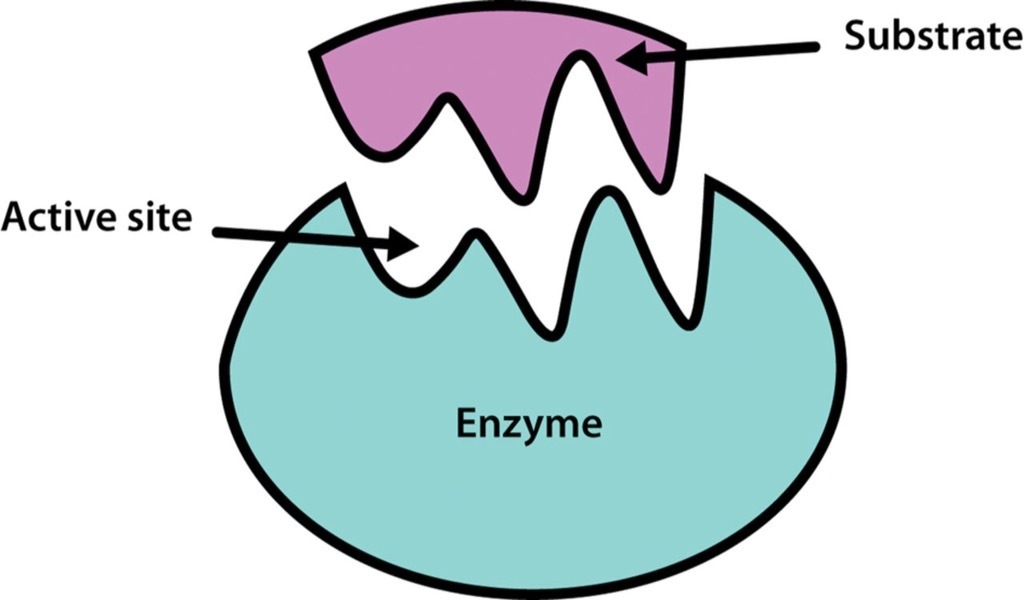
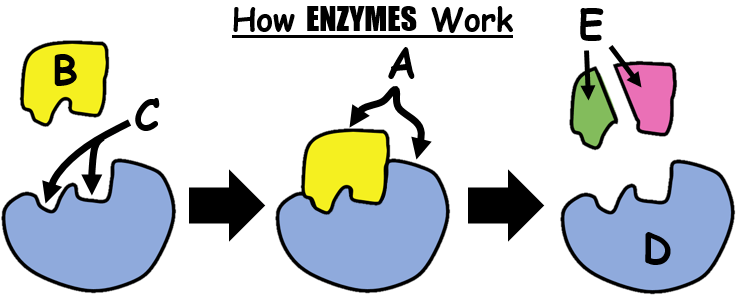
Letter D...
a)
active site
b)
enzyme
c)
substrate
d)
products
45.

The substance that binds to an enzyme is called a?

a)

Polypeptide

b)

Co-enzyme

c)

Vitamin

d)

Substrate

46.

Which of the following best explains why enzymes are necessary for reactions in our cells?

a)

The reactions are too slow to meet the needs of the cell if enzymes are missing.

b)

Enzymes supply the oxygen necessary for the reactions.

c)

Enzymes change reactants from solid to liquid during the reactions.

d)

The reactions take up too much space in the cell if enzymes are missing.

47.

Changes in pH and temperature can ___________________ an enzyme which causes it to lose its shape and affects its function.

a)

puncture

b)

denature

c)

double

d)

delete

48.

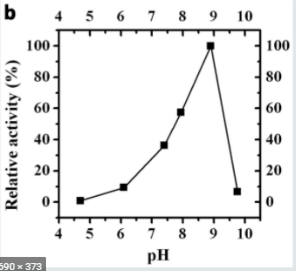
What is the optimal pH for this enzyme?

a)

6

b)

10

c)

9

d)

7

49.

The ____________________ mechanism describes how each substrate must fit into the enzyme.

a)

lock and key

b)

hammer and nail

c)

jigsaw puzzle

d)

seesaw

50.

Where do substrates bind to an enzyme?

a)

calcium channels

b)

active site

c)

receptor molecules

d)

voltage-gated channels

51.

Enzymes are _______________ that _____________________ chemical reactions by ____________ the amount of activation energy required to start the reaction.

a)

carbohydrates, slow down, lowering

b)

proteins, speed up, increasing

c)

lipids, speed up, lowering

d)

proteins, speed up, lowering

52.

Which letter represents the product?

a)

A

b)

B

c)

C

d)

D

53.
Which structures are found in every living cell?
a)
cell membrane and cytoplasm
b)
chloroplasts and mitochondria
c)
a cell wall and nucleus
d)
chloroplasts and cell wall
54.
Chloroplasts in plant cells allow the plant to perform a function that animal cells cannot do.  What is the main function of the chloroplasts found in plant cells?
a)
to absorb light energy and manufacture food
b)
to remove waste materials by active transport
c)
to manufacture chemical energy from food
d)
to control the shape of the cell
55.
What is the function of a cell wall?
a)
to protect and support the cell
b)
to perform different functions in each cell
c)
to prevent water from passing through it
d)
to prevent oxygen from entering the cell
56.
In what part of the plant cell does the process of photosynthesis take place?
a)
nucleus
b)
mitochondria
c)
chloroplasts
d)
vacuoles
57.
Cells with a nucleus and membrane-bound organelles are called ____________________.
a)
prokaryotes
b)
eukaryotes
c)
bacteria
d)
protists
58.
Which of the following is not part of the cell theory?
a)
cells must contain DNA 
b)
all living things are made from cells
c)
cells can only come from other cells
d)
cells are the basic unit of life
59.

"Small organs" of the cell that carry out specific functions

a)

Organelles

b)

Organs

c)

Cell Wall

d)

Cell

60.

builds proteins, each cell contains thousands, found on ER and floating throughout cell

a)

Ribosomes

b)

Nucleus

c)

Vacuole

d)

Golgi Body

61.

moves materials around in the cell, two types: smooth and rough

a)

Cytoplasm

b)

Nucleus

c)

Vacuole

d)

Endoplasmic Reticulum

62.

packages proteins and moves them throughout the cell

a)

Cell Theory

b)

Golgi Body

c)

Vacuole

d)

Endoplasmic Reticulum

63.
What does "bilayer" mean?
a)
one layer
b)
two layers
c)
laminated
d)
bilateral
64.
What is embedded in the phospholipid bilayer?
a)
Proteins
b)
Salt
c)
Water
d)
Worms
65.
True or False:  Regulating what enters and leaves the cell helps the cell maintain homeostasis. 
a)
True
b)
False
66.
Hydrophilic means...
a)
water-loving
b)
water-fearing
c)
nonpolar
d)
lipid soluble
67.
The picture is an example of...
a)
active transport
b)
passive transport
c)
diffusion
d)
osmosis
68.
What does a cell need to transport particles by active transport?
a)
Sun
b)
Wind
c)
Energy
d)
Channels
69.
Small, non-polar molecules like CO2 and O2 and NO can pass through the cell membrane using what type of transport?
a)
Diffusion
b)
Osmosis
c)
Facilitated Diffusion
d)
Endocytosis
70.
Something is ___________ ____________
when some molecules can cross the membrane while others cannot. 
a)
Selectively (or Semi) Permeable 
b)
Totally Transparent
c)
Liquid Licorice 
d)
Heavily Patrolled 
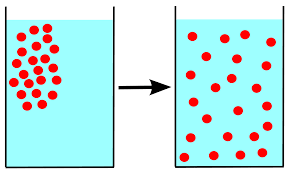
71.
The picture below is an example of _________________.
a)
osmosis
b)
isotonic
c)
diffusion
d)
active transport
72.
Osmosis is the movement of _____ across a membrane.
a)
food
b)
energy
c)
oxygen
d)
water
73.
When both inside and outside of a cell have the same amount of water it is said that the cell has reached a state of
a)
Osmosis
b)
Diffusion
c)
Equilibrium
74.
The cellular process in which materials are moved across a membrane from an area of low concentration to an area of high concentration is called
a)
Osmosis
b)
Simple Diffusion
c)
Active Transport
d)
Passive Transport 
75.
During photosynthesis, what gas do plants release?
a)
oxygen
b)
carbon dioxide
c)
water
d)
nitrogen
76.
Gas exchange through the stems or leaves of a plant takes place through the.....
a)
stomata
b)
chloroplasts
c)
roots
d)
underside of the leaves
77.
Photosynthesis is important because....
a)
plants need air to breathe
b)
it makes the plants green
c)
it is the process by which plants make their own food
d)
without it the Earth would all be a desert
78.
The process by which cells use oxygen to produce energy from food is called?
a)
photosynthesis
b)
transpiration
c)
cellular respiration
d)
germination
79.
What gas do plants take in to make food?
a)
natural gas
b)
oxygen
c)
carbon dioxide
d)
oxygen and carbon dioxide