Wayground logo

Free Printable Worksheets

Font size

S
M
L
XL
Worksheets

Bio Midterm Review

Total questions: 77

Worksheet time: 3hrs 43mins

Name
Class
Date
1.

This term refers to the fact that water is attracted to itself.

a)

Adhesive

b)

Cohesive

c)

Surface Tension

d)

Hydrophilic

2.

This term refers to the fact that water is attracted to other molecules

a)

Adhesive

b)

Cohesive

c)

Surface Tension

d)

Hydrophilic

3.

This term refers to how difficult it is to break the surface of water.

a)

Adhesion

b)

Cohesion

c)

Surface Tension

d)

Hydrophilic

4.

When molecules have an affinity for water, they are said to be

a)

Adhesive

b)

Cohesive

c)

Hydrophobic

d)

Hydrophilic

5.

When molecules do not have an affinity for water, they are said to be

a)

Adhesive

b)

Cohesive

c)

Hydrophobic

d)

Hydrophilic

6.

Based on this storyboard, what type of solution is has this cell been in?

a)

Hypertonic

b)

Hypotonic

c)

Isotonic

7.

Which direction will water move?

a)

From inside the cell to outside the cell

b)

From outside the cell to inside the cell

8.

If a molecule is hydrophobic, then that means

a)

it must have a charge

b)

it is polar or charged

c)

it must be polar

d)

it is not polar or charged

9.

When water freezes or boils its chemical composition changes.

a)

True

b)

False

10.

Viruses

a)

can replicate without infecting a host cell first.

b)

have a simple cellular structure.

c)

only infect animals.

d)

replicate, but only within a host cell

11.

A molecule that diffuses down a concentration gradient goes from an area of ______ concentration into an area of ______ concentration.

a)

high, low

b)

low, high

c)

passive, active

d)

active, passive

12.

Passive transport requires no

a)

concentration gradients

b)

osmosis

c)

motion

d)

energy

13.
This example of passive transport is the diffusion of water.
a)
osmosis
b)
concentration gradient
c)
isotonic
d)
facilitated diffusion
14.
The higher the concentration of dissolved particles in a solution (solute), the _______ the concentration of water molecules in that solution. 
a)
higher
b)
greater
c)
lower
d)
smaller
15.
This solution has the highest concentration of particles.
a)
hypertonic
b)
hypotonic
c)
isotonic
16.
This solution has the highest concentration of water molecules.
a)
hypertonic
b)
hypotonic
c)
isotonic
17.

Compared to a cell, the solution has the same concentration of water molecules and particles.

a)

hypertonic

b)

hypotonic

c)

isotonic

18.
In facilitated diffusion, molecules move
a)
Down a concentration gradient
b)
Against a concentration gradient
19.
Controlling what goes into or out of the cell with the help of energy is called
a)
active transport
b)
endocytosis
c)
passive transport
d)
exocytosis
20.
This brings in fluids and solutes into a cell during active transport.
a)
pinococytosis
b)
phagocytosis
21.
This brings in food or others cells into a cell during active transport.
a)
pinococytosis
b)
phagocytosis
22.

This process gets rid of large wastes.

a)

endocytosis

b)

exocytosis

c)

osmosis

d)

diffusion

23.
The movement of molecules down a concentration gradient is all of the following except: 
a)
simple diffusion
b)
facilitated diffusion
c)
active transport
24.
Most active transport proteins use energy from the breakdown of:
a)
nucleus
b)
cell membrane
c)
ATP
d)
mitochondria
25.
In which solution will water move out of the cell resulting in the cell shriveling up?
a)
Hypertonic
b)
Isotonic
c)
Hypotonic
26.
In which solution will water move into the cell resulting in the cell bursting?
a)
Hypertonic
b)
Isotonic
c)
Hypotonic
27.

What is the monomer of a carbohydrate?

a)

fatty acid

b)

amino acid

c)

monosaccharide

d)

nucleotide

28.

The process of breaking down polymers into monomers is called....

a)

metabolism

b)

chemical reaction

c)

dehyradation synthesis

d)

condensation

e)

hydrolysis

29.

Enzymes are mostly part of which group?

a)

carbohydrates

b)

lipids

c)

proteins

d)

nucleic acids

30.

If you see the elements C,H,O,N,P in a molecule, it is a

a)

Carbohydrate

b)

Lipid

c)

Protein

d)

Nucleic acid

31.
DNA is replicated during the ______ phase of the cell cycle.
a)
G1
b)
Synthesis
c)
G2
d)
G0
32.
Fruit fly body cells have 8 chromosomes. After mitosis, you would expect a resulting fruit fly daughter cell to have ...
a)
16 chromosomes.
b)
46 chromosomes.
c)
8 chromosomes.
d)
4 chromosomes.
33.
Structure B is pointing to the _____. 
a)
chromosome
b)
centromere
c)
DNA
d)
chromatid
34.
Identify the phase of mitosis.
a)
prophase
b)
metaphase
c)
anaphase
d)
telophase
35.
Which phase comes NEXT?
a)
prophase
b)
metaphase
c)
anaphase
d)
telophase
36.

What phase of the cell cycle is this?

a)

Prophase

b)

Interphase

c)

Anaphase

d)

Telophase

37.

What phase of the cell cycle is this?

a)

Cytokinesis

b)

Interphase

c)

Anaphase

d)

Metaphase

38.

What phase of the cell cycle is this?

a)

Anaphase

b)

Cytonkinesis

c)

Interphase

d)

Prophase

39.
The enzyme that unzips the DNA to prepare for replication
a)
helicase
b)
replicase
c)
polymerase
d)
synthase
40.
DNA replication results in two DNA molecules,
a)
each one with two original strands
b)
each one with two new strands
c)
each one with one new strand and one original strand
d)
one with two new strands and the other with two original strands
41.
In what phase of the cell cycle does DNA replication take place?
a)
G1
b)
S
c)
G2
d)
M
42.
Which of the following is required for DNA replication to occur?
a)
DNA helicase
b)
DNA ligase
c)
DNA polymerase
d)
all of these
43.

Direction that DNA is BUILT

a)

3' to 5'

b)

5' to 3'

44.
Nitrogenous bases are joined by which type of bond?
a)
polar bonds
b)
ionic bonds
c)
covalent bonds
d)
hydrogen bonds
45.

Which enzyme is responsible for forming bonds between the Okazaki fragments?

a)

Ligase

b)

Helicase

c)

DNA Polymerase 1

d)

DNA Polymerase 3

46.
What type of RNA carries the DNA message out of the nucleus to the ribosomes?
a)
mRNA
b)
tRNA
c)
RNA
d)
DNA
47.
What do we call the process of turning DNA into mRNA?
a)
Translation
b)
Transcription 
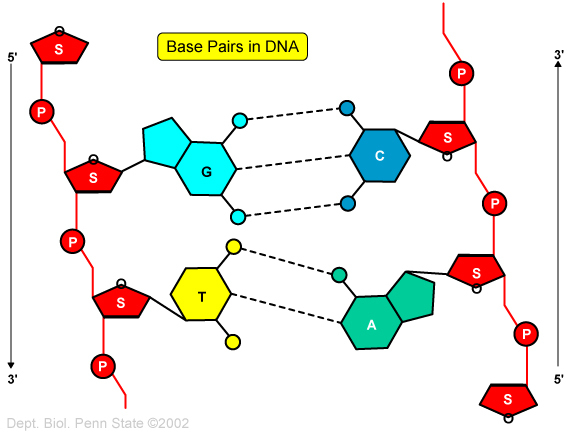
c)
Replication
48.
When DNA is transcribed to RNA.... 
a)
A pairs with U
b)
C pairs with U
c)
A pairs with T
d)
C pairs with T
49.
When the RNA gets to the ribosomes, which molecule transfers to the mRNA to amino acids?
a)
DNA
b)
mRNA
c)
tRNA
d)
Replicated RNA
50.
Amino acids are the building blocks of... 
a)
DNA
b)
RNA
c)
Atoms
d)
Proteins
51.
The job of tRNA is to...
a)
carry amino acids to the ribosomes 
b)
carry ribosomes to the ER
c)
carry mRNA out of the nucleus
d)
carry glucose to mitochondria
52.
Which RNA bases would pair with TACGAA in transcription? 
a)
AUGCUU 
b)
ATGCTT
c)
GCATCC
d)
GCAUCC
53.

Where does Translation occur?

a)

Proteins

b)

Mitochondria

c)

Ribosomes

d)

Cytoplasm

54.
When translating mRNA to amino acids, which codon do you ALWAYS begin with?
a)
GGA
b)
AUG
c)
CUA
d)
ACC
55.
What is the correct sequence?
a)
RNA --> DNA --> Protein
b)
Protein --> RNA --> DNA
c)
DNA --> RNA --> Protein
d)
DNA --> Protein --> RNA
56.
Three mRNA bases that are read together are known as what?
a)
Codon
b)
Anticodon
c)
Triplet
d)
Amino acid
57.
What stops the process of translation?
a)
DNA polymerase stops adding bases at a random time
b)
mRNA transcript falls apart
c)
A stop codon is reached
d)
The ribosome moves on to another protein
58.
Which of the following is true?
a)
RNA is usually single stranded
b)
DNA is usually single-stranded
c)
DNA contains uracil
d)
RNA contains Thymine
59.

How would you write a homozygous dominant genotype?

a)

AA

b)

Aa

c)

aa

d)

either AA or Aa

60.

Which of the following best describes the genotype "Rr"?

a)

recessive

b)

heterozygous

c)

purebred

d)

all of the above

61.

If brown eyes are dominant and blue eyes are recessive, what color eyes do the parents in this Punnett Square have?

a)

one has brown eyes and the other has blue eyes

b)

they both have blue eyes

c)

they both have brown eyes

d)

there's no way to tell based on this information

62.

Which of these Punnett squares represents a cross between a homozygous dominant parent and a heterozygous parent?

a)
b)
c)
d)
63.

If both parents have the genotype Aa, what is the chance their offspring will also have the genotype Aa?

a)

0%

b)

25%

c)

50%

d)

75%

e)

100%

64.

In humans, being able to curl your tongue is a dominant trait and NOT being able to curl you tongue is a recessive trait. If a mom with the genotype Rr has a child with a dad with the genotype Rr, what is the probability that their child will be able to curl its tongue?

a)

0%

b)

25%

c)

50%

d)

75%

e)

100%

65.

Cody crosses a plant producing wrinkled peas with a plant producing smooth peas. Weeks later, he discovers that all the offspring plants have smooth peas. Cody drew the Punnett square above to show the genotypes of the offspring plants. Which is the dominant phenotype in the pea plants used in Cody’s experiment?

a)

smooth

b)

wrinkled

c)

RR

d)

Rr

66.
This is an example of ___________?
a)
Incomplete dominance
b)
Co-Dominance
67.
This is an example of ___________.
a)
 Incomplete Dominance
b)
 Codominance
68.
How are Incomplete Dominance and Co Dominance different than a normal Mendelian cross?
a)
There is no difference
b)
The heterozygous genotype has a unique phenotype
c)
There is no heterozygous genotype
d)
There is only one phenotype regardless of genotype.
69.

The different forms of a gene are called ---

a)

traits

b)

hybrids

c)

alleles

70.

The blending of two traits is known as ---

a)

incomplete dominance

b)

codominance

71.

A condition in which both alleles for a gene are expressed so that both traits are visible is known as ---

a)

Codominance

b)

Incomplete dominance

72.

Snap dragon color is a incomplete dominant trait. A red flower (RR) is crossed with white flower (WW)? What color are flowers that are RW?

a)

Red and white

b)

Red

c)

Pink

73.
Colorblindness is a sex-linked recessive disorder. A normal woman whose father was colorblind marries a man with normal color vision. What percentage of their sons will be colorblind?
a)

0%

b)

25%

c)

50%

d)

100%

74.
Colorblindness is a sex-linked recessive disorder. If the daughter of a couple is colorblind, what are the two possible genotypes of her mother?
a)

XAXA and XAXa

b)

XAXA and XaXa

c)

XAXa and XaXa

d)

Cannot be determined

75.
If a trait shows up more commonly in men than women it is probably
a)
not inherited
b)
on the x chromosome and dominant
c)
on the x chromosome and recessive
d)
on a normal body chromosome
76.
What percentage of the female offspring will be a carrier for this recessive disease?
a)
0%
b)
50%
c)
100%
d)
25%
77.
Which of the following genotypes belongs in the red box in the Punnett square?
a)

XBXb

b)

XbXb

c)

XbY

d)

XBY