
Font size
 Worksheets
A&P 1st Semester Final: Nervous System & Special Senses
Total questions: 55
Worksheet time: 3hrs 45mins
The organs of HEARING are located here:
Cochlea
Vestibule
Semicircular canals
Organ of Corti
What is the insulating membrane that surrounds parts of the axon that helps the impulses travel faster called?
Axon
Dendrites
Node of Ranvier
Myelin Sheath
Drugs such as Oxycodone and Heroine block production or release of some neurotransmitters. These are examples of what?
Antagonists
Agonists

What happens to the neurotransmitters after they are released into the synapse?
They remain attached to the receptor site until another action potential happens.
They are broken down by enzymes or are reabsorbed by the terminal buds.
They are absorbed into the bloodstream
They continue to flow through the next neuron.

The receptor on the 'receiving neuron' is located on this neuron structure.
Cell Body
Axon
Dendrite
Neuron

What process is being observed on the right side of this image?
Diffusion
Reuptake
How does an inhibitory neurotransmitter work
It works by making the neuron more negative and thereby more likely to have an action potential
It works by making the neuron more positive and thereby more likely to have an action potential
It works by making the neuron more negative and thereby less likely to have an action potential
It works by making the neuron more positive and thereby less likely to have an action potential
Why is a neuron's "Threshold" important to neurotransmission?
Threshold is the electrical charge inside the neuron that must be reached in order for an action potential to occur
Threshold is the electrical charge of a neuron that has been depolarized
Threshold is the point at which sodium channels open and allow sodium ion to enter the neuron, allowing for neurotransmission to occur
Threshold is the point at which potassium channels open and allow potassium ion to enter the neuron, allowing for neurotransmission to occur
If you have a disease that increases the amount of sodium ions inside a neuron, what are the resulting "downstream" effects at the Axon Terminal? (hint: the number of open voltage-gated calcium channels depends upon the amount of membrane depolarization)
less synaptic vesicles will be released and more action potentials will be created on the secondary neuron
more synaptic vesicles will be released and more action potentials will be created on the secondary neuron
more synaptic vesicles will be released and less action potentials will be created on the secondary neuron
less synaptic vesicles will be released and less action potentials will be created on the secondary neuron
A condition in which the inside of the cell membrane is more positively charged than the outside.
Resting Potential
Depolarized
Polarized
Repolarized
The rapid skipping of an action potential from node to node on myelinated neurons.
Saltatory conduction
Myelinated Conduction
Neurotransmission
Skipping Conduction
Found at the posterior base of the cerebrum and is in charge of balance and coordinating movements:
Thalamus
Reticular Formation
Hypothalamus
Cerebellum
The cerebral cortex is made of
white matter
gray matter
brain matter
Responsible for heart rate, body temperature, and blood pressure
medulla olongata
midbrain
thalamus
pons
Responsible for the "sleep/wake" cycle.
Medulla Oblongata
Pons
Midbrain
Thalamus
Which type of receptor is used by our senses of taste and smell?
chemoreceptors
mechanoreceptors
photoreceptors
thermoreceptors
The photoreceptors that are responsible for giving us fine details and color vision in bright light are...?
rods
cones
Which part of the eye constricts and dilates based on the environment?
Pupil
Cornea
Sclera
Iris

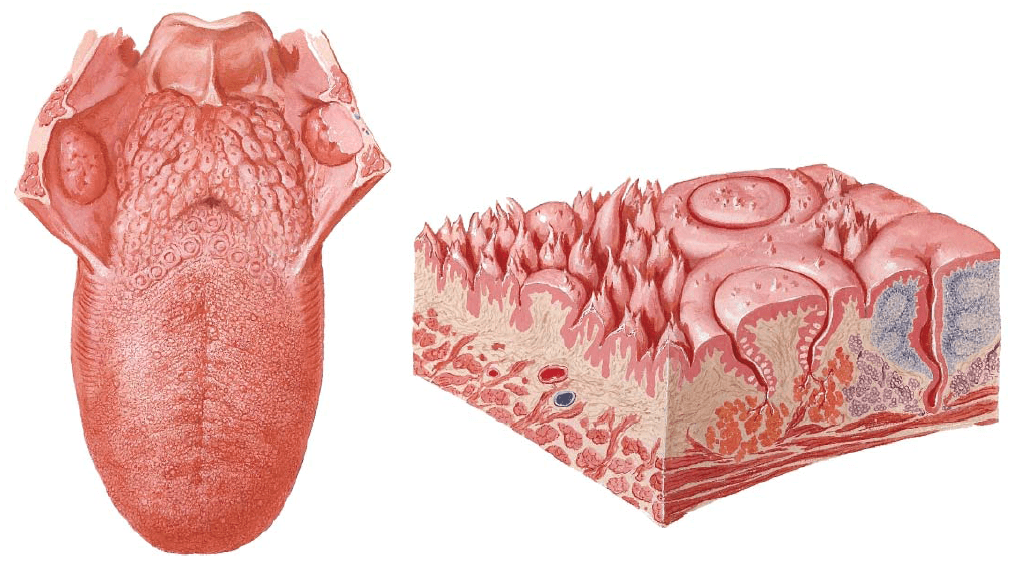
Small projections located on the tongue’s surface where taste buds are located are known as:
papillae
gustatory cells
olfactory epithelium
mucous producing glands

Pictured is a cross section of an ear. Which part is labeled with the letter B?
Tympanic Membrane
Auditory Ossicles
Auditory Canal
Cochlea
The fluid that surrounds the brain and spinal cord and acts as a shock absorber
meninges
cerebral spinal fluid
lymph
blood
The lens is clear and flexible in order to ....
allow the eyes to have 20/20 vision
allow the eye to see objects up close and far away
allow the eye to see objects around the room
to allow light to pass through to the retina
Why is the olfactory epithelium important?
small, dime-sized section of epithelium on the superior surface of your oral cavity that is responsible for the sense of taste.
small, dime-sized section of epithelium on the superior surface of your nasal cavities that is responsible for the sense of taste.
small, dime-sized section of epithelium on the superior surface of your oral cavity that is responsible for the sense of smell.
small, dime-sized section of epithelium on the superior surface of your nasal cavities that is responsible for the sense of smell.
What is neural adaptation?
Sensory adaptation refers to an increase in sensitivity to a stimulus after constant exposure to it
Sensory adaptation refers to the "learning process" your senses goes through; where your brain "stores" senses into your memory so you don't have to learn new senses again and can focus your attention on new sensations.
Sensory adaptation refers to a reduction in sensitivity to a stimulus after constant exposure to it
Sensory adaptation refers to the "un-learning process" your senses goes through; where your brain "removes" senses from your memory in attempt to make room for any new sensations that you experience.
What is the function of the Auditory Tube?
connects your Pinna to your Tympanic Membrane
connects your Middle Ear to your Pharynx
connects your Cochlea to your Oval Window
connects your Middle Ear to your Inner Ear
The receptors that detect changes in "Dynamic Equilibrium" are _________________.
Maculae
Semicircular Canals
Crista Ampullaris
Vestibule
What parts of your brain process smells?
Amygdala
Frontal Lobe
Hippocampus
All of the above
The order of Auditory Ossicles (from outside to inside)
Malleus, Incus, Stapes
Incus, Stapes, Malleus
Malleus, Stapes, Incus
Stapes, Malleus, Incus
What is Broca's Area responsible for?
Language Comprehension
Language Organization
Speech Production
Speech Organization
Where does Depolarization/Repolarization occur in a myelinated neuron?
Schwann Cells
Node of Ranvier
Node of Cristof
Myelin Sheath
The somatic nervous system is responsible for?
digestion
pupil dilation
bicep movement
breathing/heart beating
The vision receptors are located on this structure in the eye: _____________ and are primarily grouped as follows: _________________________.
the retina; rods medially and cones laterally
the scelra; rods medially and cones laterally
the retina; rods laterally and cones medially
the sclera; rods laterally and cones medially
Dendrites are part of a neuron that carries electrical signals _______ the cell body.
to
away
in between
True or False: the right side of the brain controls the right side of your body, while the left side of the brain controls the left side of your body.
True
False
Pauline has a conductive hearing loss, which can be caused by (select all that apply)
auditory nerve damage
an infection in external auditory canal
a ruptured tympanic membrane
damage to the cochlea
The thick, tough, white outer covering of the eyeball is called the __________________.
sclera
lens
pupil
cornea

Name the type of the vision defect
Astigmatism
hyperopia
myopia
presbyopia
What is the type of lens that is suitable to make a correction for person who experiences myopia?
curved lens
convex lens
bifocal lens
concave len
When you put food on your tongue, the molecules in the food bind to and thereby stimulate the gustatory (taste) receptors. The different types of receptors for the different tastes are:
spicy, sour, bitter, fatty
sour, sweet, spicy, bitter
salty, sweet, sour, bitter
sour, fatty, sweet, spicy


Which cerebral lobe is this?
frontal
parietal
occipital
temporal
The cerebrum deals with planning, recalling information, and decision making.
True
False

