wayground logo

Free Printable Worksheets

Font size

S
M
L
XL
Worksheets

Biology I Final Review 20-21

Total questions: 100

Worksheet time: 2hrs 40mins

Name
Class
Date
1.
What are the three components of a nucleotide?
a)
sugar, hydrogen, nitrogen base
b)
sugar, oxygen, nitrogen base
c)
sugar, phosphate, nitrogen base
d)
sugar, phosphate, protein
2.
The following picture must be
a)
DNA because it's double stranded
b)
RNA because it's single stranded
c)
DNA because it's single stranded
d)
RNA because it's double stranded
3.
RNA contains the sugar
a)
ribose
b)
deoxyribose
c)
glucose
d)
lactose
4.
What is the difference between DNA and RNA in terms of bases?
a)
RNA contains uracil in place of thymine
b)
RNA contains uracil in place of adenine
c)
RNA contains uracil in place of guanine
d)
RNA contains uracil in place of  cytosine
5.

Name this structure

a)

double helix

b)

nucelotide

c)

twisted ladder

d)

hydrogen bond

6.
How is the instructions for your traits carried on a DNA molecule?
a)
Sequence of the nitrogen bases
b)
In the 5 Carbon Sugar
c)
In the bond between the phosphate and the sugar
d)
In the phosphate group
7.

The DNA code is a sequence of nucleotides that carry ___________.

a)

RNA

b)

genetic information

c)

structure

d)

function

8.
The enzyme that unwinds the DNA to prepare for replication
a)
helicase
b)
replicase
c)
polymerase
d)
synthase
9.
order of replication
a)
3, 4, 2, 1
b)
3, 1, 4, 2
c)
2, 1, 4, 3
d)
3, 4, 1, 2
10.

Which enzyme is responsible for adding nucleotides?

a)

Helicase

b)

DNA Polymerase

c)

Ligase

d)

DNA Monomerase

11.
The process of DNA replication is called semi conservative because it results in
a)
none of these
b)
Two DNA molecules.  One original molecule and one with two new strands
c)
two exact copies with new strands
d)
two identical molecules, each with 1 original strand and one new.
12.

When replicated, the strand, CAT TCA CTG would have a complementary strand of ____.

a)

ATG TGA CAG

b)

TAC ACT GTC

c)

GTA AGT GAC

d)

CAT TCA CTG

13.
Where does transcription take place?
a)
nucleus
b)
cytoplasm
c)
ribosome
14.
What is occurring in this picture?
a)
Translation
b)
Replication
c)
Translocation
d)
Transcription
15.

What is a mutation?

a)

A mistake during respiration

b)

A change in sequence of alleles

c)

Any change in the genetic code

16.

A parent that has a mutation to their skin cells can pass this mutation to their offspring

a)

True

b)

False

17.
The process by which the genetic code of DNA is copied into a strand of RNA is called
a)
translation
b)
transcription
c)
transformation
d)
replication
18.
Which phase of which process does this picture show?
a)
Transcription
b)
Translation
c)
Replication
d)
Cloning
19.

What is the correct amino acid for the following codon:

CAA

a)

Arginine

b)

Methionine

c)

Glutamine

d)

Valine

20.

A mutation that changes GAU to GAC changes the amino acid that would be translated.

a)

True

b)

False

21.
An inherited characteristic that increases an organism's chance of survival
a)
adaptation
b)
fitness
c)
variation
d)
evolution
22.
Ability of an organism to survive and reproduce in its environment
a)
evolution
b)
adaptation
c)
fitness
d)
speciation
23.
Process by which individuals that are better suited to their environment survive and reproduce most successfully
a)
adaptation
b)
evolution
c)
natural selection
d)
fitness
24.
Why are advantageous traits more likely to be passed onto offspring?
a)
Because they are more likely to survive and reproduce.
b)
Because they come from dominant alleles.
c)
Because they come from recessive alleles.
d)
Because the trait is an acquired phenotype.
25.
What are the variations of mice in this environment?
a)
white and grey
b)
short and tall
c)
red and green
d)
long fur and short fur
26.
What variation is best for survival?
a)
white
b)
grey
c)
red
d)
short
27.
WHY is this variation is best for survival?
a)
longer claws for fighting
b)
longer legs for running faster
c)
bigger ears for better hearing
d)
fur color that blends in to it's environment
28.
How will this mice population most likely change in the future?
a)
The white mice will go extinct.
b)
The grey mice will go extinct.
c)
All of the mice will grow longer fur.
d)
All of the mice will grow longer claws.
29.
The similarities of the bones in the diagram provide evidence that---
a)
The organisms shown lived in the same natural envionrment
b)
The organisms shown may have developed from a common ancestor
c)
The organisms shown have the same genetic diseases
d)
All vertebrate species have identical forelimbs
30.
Two organisms that are closely related would have
a)
very similar DNA sequence
b)
exactly the same DNA sequences
c)
no proteins in common
d)
completely different DNA sequence
31.

If two organisms have similar traits of DNA they probably share a common...

a)

ancestor

b)

environment

c)

population

32.

True or False: Species are more closely related if they have a more recent common ancestor.

a)

True

b)

False

33.
These are natural differences within a species.
a)
Evolution
b)
Genetic variation
c)
Biological diversity
d)
Populations
34.

The five salamanders are the same kind, but live in different areas. Which term describes the difference between them.

a)

overproduction

b)

successful reproduction

c)

genetic variation

d)

struggle for existence

35.

A group of many living things of the same species living together in the same environment makes up a...

a)

individual

b)

population

c)

community

36.

To be able to produce viable and fertile offspring, organisms must ____.

a)

be the same species

b)

have the same DNA

c)

occupy the same niche

d)

compete for the same resources

37.

Two populations of zebras, Equus zebra and Equus grevyi can reproduce, but their offspring is sterile (their offspring cannot reproduce). This is because they ___.

a)

are different species

b)

live in the same place

c)

have intraspecific competition

d)

have different adaptations

38.
succession that occurs in an area with no soil
a)
ecological succession 
b)
primary succession 
c)
secondary succession
d)
pioneer speciles
39.
succession that occurs in an area where soil is already present
a)
ecological succession 
b)
primary succession 
c)
secondary succession
d)
pioneer speciles
40.
The picture shows what type of succession?
a)
primary
b)
secondary
c)
tertiary
d)
quadanary
41.
Natural disasters such as flooding and tornadoes are linked to ________________.
a)
primary
b)
secondary
c)
old field
d)
ecosystem
42.
Around 2.2 billion years ago, bacteria started producing ________ by photosynthesis.
a)
oxygen
b)
nitrogen
c)
carbon dioxide
d)
iron oxide
43.
What were the first cells in the early earth?
a)
prokaryotic cells
b)
eukaryotic cells
44.

A species of rabbit lives in a meadow where grass plants are readily available during summer months. The rabbits do not stray far from the meadow because the plants supply food and protection from predators. One summer, a fire destroys the plants in the meadow. As a result of the absence of plants in the meadow, the rabbit population will probably...

a)

decrease in size

b)

increase in size

c)

increase reproduction

d)

switch to a different type of food

45.

What happens to the amount of available energy in the pyramid as it moves up through the different levels?

a)

it increases

b)

it decreases

c)

it remains the same

d)

it decreases, then increases

46.
A __________ includes all living and non-living things in an environment. 
a)
population
b)
niche
c)
abitotic
d)
ecosystem
47.
Temperature, light, air, water, and soil are all  _____  parts of the environment
a)
alive
b)
biotic 
c)
abiotic
d)
living
48.
Organisms that make up the living part of an ecosystem.
a)
abiotic
b)
biotic factors
c)
ecology
d)
ecosystems
49.

Most of the energy on Earth ultimately comes from what source?

a)

Water

b)

Sun

c)

Consumers

d)

Oxygen

50.
What factor would cause animals of the same species to begin competing with one another?
a)
increase in precipitation         
b)
the presence of decomposers
c)
the introduction of a new food source
d)
limited supply of resources
51.
Different species are most likely to compete for resources in an ecosystem if both species attempt to –
a)
occupy the same niche.
b)
successfully reproduce.
c)
live in different habitats.         
d)
find different food sources.   
52.
Which of these describes a mutually beneficial relationship between two organisms?
a)
A dog with worms in its intestine
b)
A turtle and a snail that both eat grass live in a river
c)
A honeybee pollinating a plant and receiving nectar for food
d)
A small fish attached to a shark, eating tiny pieces of the shark's food as it floats
53.
Which pair of organisms listed below are competitors for the same natural resources?
a)
Ticks and dogs
b)
Lions and leopards
c)
Honeybees and flowers
d)
Salmon and brown bears
54.
Relationship where both organism benefit
a)
Competition
b)
Commensalism
c)
Mutualism
d)
Parasitism
55.
Relationship where one organism benefits and the other is neither harmed nor helped
a)
Commensalism
b)
Parasitism
c)
Mutualism
d)
Competition
56.
Cattle egrets forage (feed) in fields among cattle. The egret gets easy access to flying insects stirred up by the cattle, and the cattle don't care if they are there or not.
a)
mutualism
b)
commensalism
c)
competition
d)
parasitism
57.

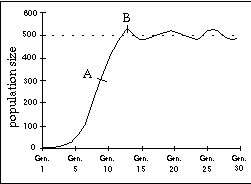
What is the carrying capacity of the graph?

a)

1000

b)

8000

c)

800

d)

600

58.

This may cause a population to increase

a)

increase of food supply

b)

removal of predators

c)

removal of disease

d)

all of these

59.

What occurs when ecological niches overlap and multiple organisms seek the same resources?

a)

Symbiosis

b)

Mutualism

c)

Competition

d)

Predation

60.

Which of the following would likely be a limiting factor to a population?

a)

Abundance of food

b)

Living near a water source

c)

Presence of a natural predator

d)

Multiple sources for shelter

61.
If the number of births is greater than the number of deaths in a population, what will happen to the growth of the population?
a)
It will increase.
b)
It will decrease.
c)
It will stay the same.
d)
It will fluctuate.
62.
If the number of births in a population is the same as the number of deaths in a population, what will happen to the growth of the population?
a)
It will increase.
b)
It will decrease.
c)
It will stay the same.
d)
It will fluctuate.
63.

What is one adaptation animals have for temperate forests?

a)

Animals are able to survive in year-round freezing temperatures

b)

Animals have learned how to live without trees

c)

Animals have learned to live in 1 temperature all year

d)

Animals can survive both cold winters and hot summers

64.

The size of the human population began to increase exponentially after the

a)

bubonic plague

b)

development of plowing and irrigation

c)

Industrial Revolution

d)

development of the first cities.

65.
Why has the world population dramatically increased?
a)
Better medicine
b)
Better sanitation
c)
Better technology
d)
All of the above
66.
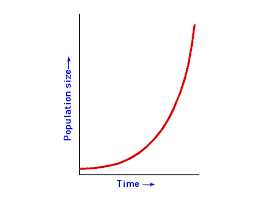
What type of growth is shown in the diagram?
a)
exponential growth
b)
logistic growth 
c)
predator-prey cycle
d)
boom-bust curve
67.
Which of the following would most likely occur if a population exceeded the carry capacity of the environment?
a)
The birth rate would likely increase.
b)
Birth rate would be equal to the death rate.
c)
The death rate would increase.
d)
Immigration would increase.
68.
When humans burn fossil fuels, most of the carbon quickly enters the                       as carbon dioxide.
a)
Water
b)
Atmosphere
c)
Sun
d)
Air
69.
Which of the following removes carbon from the atmosphere?
a)
Combustion
b)
Respiration
c)
Photosynthesis
d)
Death
70.
If the plant population decreased, the amount of carbon would _________.
a)
Stay the same
b)
Increase
c)
Decrease
71.
The average temperature of the surface of Earth has increased approximately 1°C in the past century. Which reason best explains this increase in temperature?
a)
lower levels of ozone in the atmosphere
b)
lower levels of nitrogen in the atmosphere
c)
higher levels of carbon dioxide and other greenhouse gases in the atmosphere
d)
higher levels of oxygen in the atmosphere
72.
The number of different species in an area is referred to as its _______________.
a)
population
b)
genetic diversity
c)
biodiversity
d)
Niche diversity
73.

Genetic diversity is important to the stability of species.

a)

True

b)

False

74.
A species is defined as endangered when it
a)
suffers from damage to its habitat.
b)
suffers from disease or predation.
c)
when there are hazards to the continued life of the species.
d)
all of the above
75.
In this energy pyramid, which organisms have the most energy available?
a)
Producers
b)
Carnivores
c)
Herbivores
d)
Top Predator
76.
In this ecological pyramid which type of consumer gets only 10% of the energy stored in plants?
a)
Herbivore
b)
Carnivore
c)
Omnivore
d)
Secondary Consumer
77.
The diagram represents a pyramid of energy in an ecosystem.  Which level would most likely contain organisms that do photosynthesis?
a)
A
b)
B
c)
C
d)
D
78.
All food webs and food chains begin with _________________.
a)
primary consumer
b)
producers
c)
secondary consumers
d)
predators
79.
An organism that eats the secondary consumer.
a)
Primary Consumer
b)
Secondary Consumer
c)
Tertiary Consumer
d)
Consumer
80.
Organisms that need to eat other organisms to obtain food are called
a)
autotrophs 
b)
hungry
c)
producers
d)
heterotrophs
81.
Organisms that use energy from the sun to make their food are called
a)
heterotrophs
b)
consumers
c)
autotrophs
d)
carnivores
82.

Consumers that eat other consumers are called

a)

decomposers

b)

herbivores

c)

carnivores

d)

omnivores

83.

Secondary consumers would feed on ___.

a)

tertiary consumers

b)

producers

c)

carnivores

d)

herbivores

84.

Using food web which of the following is a secondary consumer?

a)

snake

b)

worm

c)

butterfy

d)

squirrel

85.

Using the food web which of the following is a tertiary consumer?

a)

frog

b)

bird

c)

eagle

d)

worm

86.

Using the food web what would happen if the eagle became extinct?

a)

The frog population would decrease.

b)

The frog population would increase.

c)

The butterfly population would increase.

d)

The snake population would decrease.

87.
Bacteria, fungi, and earthworms are examples of: 
a)
scavengers
b)
predators
c)
prey
d)
decomposers
88.
If the grasshopper were to be removed completely from the food web, what organism would be most effected?
a)
The squirrel
b)
The shrew
c)
The deer
d)
The rabbit
89.
How do decomposers help other living things in ecosystems?
a)
They release oxygen into the atmosphere
b)
They turn sunlight into energy
c)
They release matter and nutrients back into the soil
d)
They get rid of dead animals so they don't smell bad
90.

What is the carrying capacity of the graph?

a)

1000

b)

8000

c)

800

d)

600

91.

What is the carrying capacity of the graph?

a)

around 500

b)

more than 800

c)

less than 300

d)

around 700

92.
Why are advantageous traits more likely to be passed onto offspring?
a)
Because they are more likely to survive and reproduce.
b)
Because they come from dominant alleles.
c)
Because they come from recessive alleles.
d)
Because the trait is an acquired phenotype.
93.
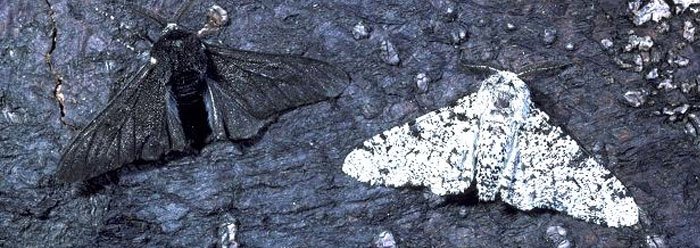
The trees these moths used to live on were white, but have been covered in soot from coal factories. Which moth will be more successful in this environment?
a)
Dark moth
b)
Light moth
c)
Both will be equally successful
d)
Neither will be successful
94.
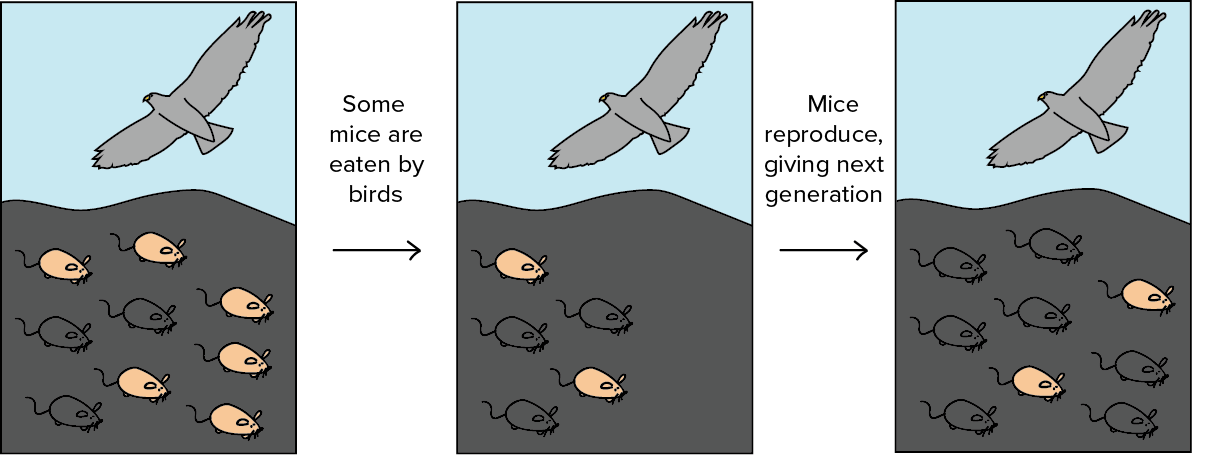
Why is the mouse population changing over time?
a)
The light mice can reproduce more successfully than the dark mice
b)
The hawks eat more dark mice than light mice because the dark mice taste better
c)
The hawks eat more light mice than dark mice because they can see the light mice more easily
d)
The hawks eat more dark mice than light mice because they can see the dark mice more easily
95.
These moths are all the same species. The differences between their wings is an example of ________________
a)
Natural Selection
b)
Variation
c)
Homeostasis
d)
Extinction
96.
Which of the following explains adaptation.
a)
An individual organism changes to meet its needs in the environment. These changes pass down to their offspring.
b)
The species as a whole changes their characteristics.
c)
Beneficial traits allow organism to survive and pass on those traits
d)
New characteristics arise in a species as needed.  If these traits are helpful, they are passed down.
97.
A group of orangutan have become very similar after a series of drastic changes in their environment.  This similarity is likely the result of
a)
selective breeding
b)
random mutaion
c)
inbreeding
d)
natural selection
98.
a)

The overall trend in the data would be best described as increasing

b)

The overall trend in the data would be best described as decreasing

c)

The overall trend in the data would be best described as unchanging

d)

The overall trend in the data would be best described as unrelated

99.
Transcribe this sequence:  ACTGTTC
a)
UGACAAG
b)
TGACAAG
c)
TGUCUUG
d)
AGUCUUG
100.

The scatterplot shows the amount of rainfall during six thunderstorms and the length of time that each storm lasted. Based on the scatterplot, which statement is true?

a)

During each storm that lasted longer than 1 hour, there was less than 1 inch of rain.

b)

During each storm that lasted longer than 1 hour, there was more than 1 inch of rain.

c)

No storms produced more than 2 inches of rain.

d)

No storms lasted longer than 1 hour.