
 Worksheets
Nervous System Pretest
Total questions: 70
Worksheet time: 36mins




This part of the neuron receives chemical messages from the neurotransmitters of other neurons. It is labeled A in the diagram.
Dendrite
Axon
Axon Terminal
Cell Body
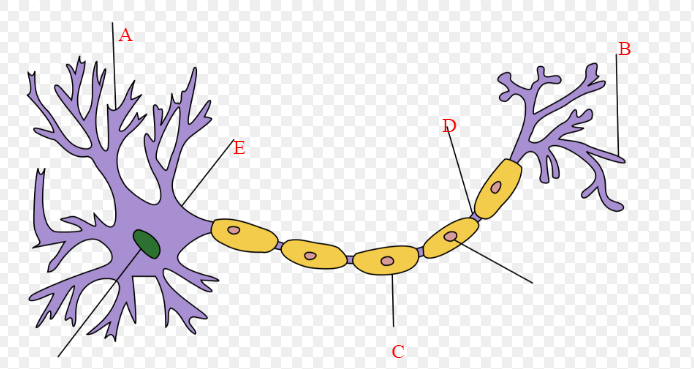
Which part sends nerve impulse to the next cell?
Dendrite
Axon
Axon Terminal
Cell Body

The long, fiber like part of a neuron which the cell sends information to receiving neurons. Labelled D in diagram.
Synapse
Axon
Axon Terminal
Dendrite

What is this? It coordinates muscle movements.
Cerebrum
Cerebellum
Brain Stem
Diencephalon
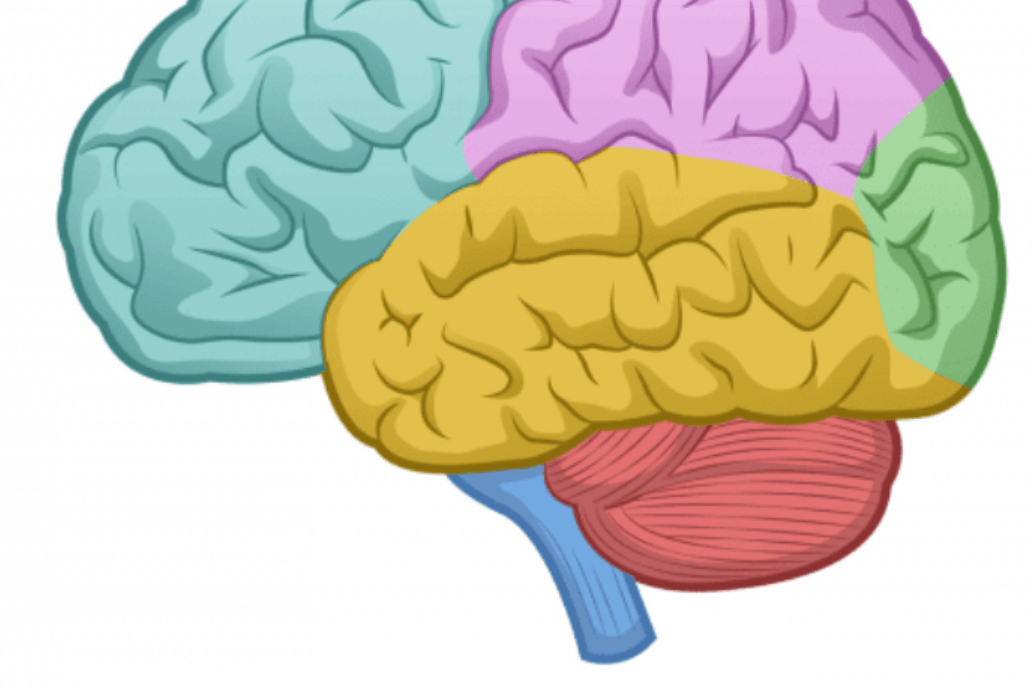
What structure is bright blue and located at bottom of the brain and controls the information sent between brain and rest of the body?
Cerebrum
Cerebellum
Brain Stem
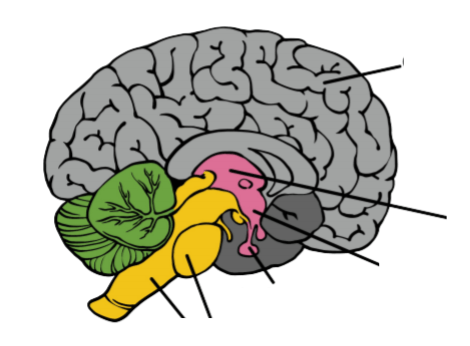
What structure is grey in this picture. It controls conscious thought and memory?
Cerebrum
Cerebellum
Brain Stem
What are the three parts of the nervous system?
brain, spinal cord, nerves
brain, lungs, spinal cord
heart, brain, nerves
brain, nerves, neurons
True or False: the cell body of a neuron has a nucleus.
True
False

The cerebellum is labeled as #...
1
2
3

The brain stem/medulla is labeled as #...
1
2
3

#1 is pointing to the...
cerebrum
cerebellum
medulla
Which part of the brain controls involuntary movements such as digestion and your heartbeat?
cerebrum
cerebellum
medulla/spinal cord
Which part of the brain controls senses, thinking, and memory?
cerebrum
cerebellum
medulla
Which part of the brain controls balance and coordination?
cerebrum
cerebellum
medulla
When the spinal cord responds in an emergency to a stimulus before the brain, this is called a...
response
synapse
cerebral response
reflex
Which of the following is NOT a sense?
hearing
nose
smell
touch
True or False: the right side of the brain controls the right side of your body, while the left side of the brain controls the left side of your body.
True
False
Someone who is "left-brained" is considered to be more....
logical
creative
An involuntary, automatic response to a stimulus controlled by the spinal cord is a ____.
stimulus
reflex
paralysis
cerebellum
The regulation of steady internal conditions in an organism is called ___.
homeostasis
reflex
paralysis
synapse
Nerve cells are called ____.
synapses
cerebrums
neurons
dendrites
The ____ connects the brain to the spinal cord.
cerebrum
cortex
synapse
brain stem
Part of a neuron that carries an impulse away from the cell body.
axon
nucleus
dendrite
neuron
The space between neurons is called a ____.
axon
cerebellum
synapse
dendrite
Nerves that cause muscles to move are ____.
axon nerves
motor nerves
sensory nerves
feeling nerves
The thick cord of nerve tissue in the center of the backbone is the ____.
dendrite
neuron
spinal cord
brain stem
Thread-like part of a neuron that receives impulses and sends them towards the cell body.
axon terminals
axon
dendrites
cell body

As organisms get more complex, cells become specialized to perform specific functions in the body. What is the function for the cell shown?
contract and shorten movement
provide coverage and protection
carry impulses around the body
connects parts together
The human brain is made of 100 billion neurons. Each neuron has a nucleus that contains genes. Many neurons bind together to form a nerve.
tissue
system
organ
cell
Which cell relays messages from one tissue to another?
Red Blood Cell-RBC
White Blood Cell-WBC
Neuron
Tissue
Neurons are primarily composed of this cell?
heart
skin
brain
skull
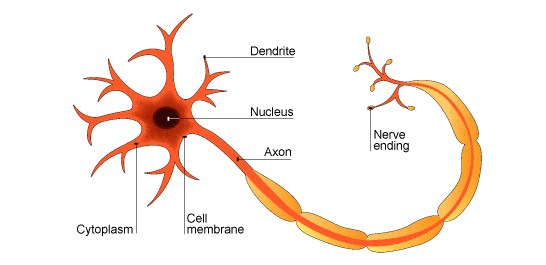
What level of structure is represented by the diagram?
organ
organ system
cell
tissue
The function of sneezing is to expel mucus containing foreign particles from the nasal cavity. A person sneezes when foreign particles pass through the nasal hair which triggers the release of chemical that activates body system causing sneezing. What body part is activated?
circulatory system
digestive system
nervous system
excretory system
Humans feel hungry when their empty stomachs contract and glucose levels in their body drop. Both of the situations stimulate neurons that send messages to the brain which are interpreted as hunger. What body systems are involved in this process as described?
digestive, muscular, integumentary, and respiratory
digestive, excretory, integumentary, and skeletal
circulatory, excretory, nervous, and skeletal
circulatory, digestive, muscular, and nervous
The urinary bladder is a muscular organ of the excretory system that collects urine excreted by the kidney. How does the nervous system help the urinary system in excretion?
it signals the urinary bladder to absorb more water from the urine.
It signals the urinary system to collect waste from the different parts of the body.
It signals the urinary bladder to hold and release urine at appropriate times.
It signals the urinary bladder to allow more urine to flow from the ureters.
The brain has 3 major sections that send and receive signals to control all the activities that keep a person functioning efficiently. Which major section controls breathing and heart beat?
cerebellum
cerebrum
brain stem
cortex
Which 2 body systems interact and initiate movement?
muscular and nervous system
skeletal and muscular system
respiratory and nervous system
circulatory and nervous system
The muscles in the wall of the blood vessels contract or relax to vary the blood flow. Which body system regulates the contraction and relaxation of the muscles?
digestive system
excretory system
skeletal system
nervous system
Protective bones which surround and protect the spinal cord.
vertebrae
brain
central nervous system
peripheral nervous system
The part of the brain that controls involuntary processes
medulla
cerebrum
cerebellum
spinal cord

An example of voluntary movement would be:
Dancing
heart beat
digestion
breathing
What are the senses that the nervous system receives messages from? (mark all that apply)
Vision
Hearing
Smell
Taste
Touch
List all that the brain controls. (mark all that apply)
Thoughts
Speech
Memory
Muscles Movement
None of the above
What does the cerebrum control?
Memory, language, and thoughts.
Heartbeat, swallowing, and blinking.
Coughing and sneezing
Standing, running, waving, and speaking.
The spinal cord is.....
The command center of the nervous system
The body's message and control center
A long bundle of neurons that sends messages to and from the brain and all parts of the body.
All of the above.
And injury to the spinal cord can lead to paralysis.
True
False
What is paralysis?
Loss of feeling or unable to move some body parts
Able to jump around
Able to run
None of the above.

