
 Worksheets
Unit 1 Microbiology Lesson Review
Total questions: 75
Worksheet time: 33mins
What is the MOST important reason that scientists classify living things?
It allows scientists to be lazy.
It helps scientists see how organisms are alike and different.
Plants are different from fungi because
plants reproduces through sexual reproduction
plants can make their own food
plants are made up of one cell
plants are prokaryotes
Fungi cannot ________.
have a nucleus
reproduce
belong to a domain
make their own food
An organism which is made up of more than one, often different, cells.
autotrophic
unicellular
heterotrophic
multicellular
When naming a organism with their scientific name, the family and genus is used.
True
False
The first characteristics a taxonomist will use to determine which kingdom an organism belong in is:
if they have a cell wall or not
if they are prokaryotic or eukaryotic
if the reproduce sexually or asexually
what chemicals are in their cell wall
Which statement best describes a bacterial cell?
It contains more than one cell
It is a complete organism
It is part of a larger organism
It contains different kinds of cells

A disease causing organism.
pathogen
poison
vaccine

What shape are these bacteria?
cocci
bacili
spirilla
linguine

What shape are these bacteria?
cocci
bacilli
spirilla
fusilli

What shape are these bacteria?
cocci
bacilli
spirilla
tortellini
Cells that lack membrane bound organelles such a nucleus are called
prokaryotic
eukaryotic
The scientist who discovered penicillin (a type of anitbiotic).
Bill Nye
Alexander Flemming
Edward Jenner
Bill Gates
What might happen if you didn't have bacteria in your digestive tract?
Your intestines would shut down
Your body couldn't break down certain types of food
You would never get sick
You wouldn't be able to eat vegetables
Which of the following is a true statement about bacteria?
Bacteria exist in only a few environments on earth
Bacteria can grow to extremely large sizes
Most bacteria are harmful to humans
Bacteria can be both harmful and helpful to humans
What term best describes the function of flagella in bacteria?
Locomotion
Digestion
Absorption
Reproduction
Prokaryotes are found in which domain?
Animalia
Plantae
Eukarya
Bacteria
Where are bacteria located?
No where.
Every where!
Only in the restroom.
On my hands only.
Known as the Father of Microbiology due to his work with "animacules" found on his own teeth is:
Jonas Salk
Robert Koch
Semmelweiss
Anton Van Leeuwenhoek
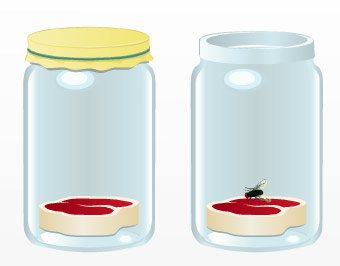
This scientist experimented with raw meat: one was sealed and the other was left to be exposed to flies; maggot growth was observed ONLY in meat that was exposed.
Antonie van Leeuwenhoek
Francesco Redi
Louis Pasteur
Robert Hooke
Robert Koch began his work with the Germ Theory of Disease with what agent
cholera
syphilis
anthrax
Tuberculosis
The bacterium for which Robert Koch proved Germ theory was
Bacillus
Bacillus anthracis
Bacillus subtilis
Bacillus megaterium
What word is Latin for Poison ?
Disease
Rabies
Bacteria
Virus
How do viruses reproduce
They take over the living cells machinery
They slide in the cell on their own
They can reproduce themselves
They put themselves in our bloodstream first
Are viruses alive ?
yes
no
How large are viruses ?
100-150 nm
300-600nm
20-200 nm
10-100nm
Viruses are not organisms, instead what are they ?
pathogens
diseases
bacteria
Infectious Particles
Protein shells covering viruses are also known as ________.
Capsid
Nuclei
Cell Envelope
Chemical Machinery
Small pox vaccine was first discovered by
Robert Koch
Louis Pasteur
Joseph Lister
Edward Jenner
Who performed the Swan neck experiment to disprove the theory of abiogenesis?
Lazzaro Spallanzani
John Tyndall
Francisco Redi
Louis Pasteur
Antiseptic surgery was discovered by
Joseph Lister
Robert Koch
Louis Pasteur
John Tyndall
Hand Washing to prevent childhood fever was introduced by
Joseph Lister
Robert Koch
Ignaz Semmelweis
Edward Jenner
The epidemic that infected Europe, Middle East and North Africa and killed tens of millions of people was known as the Black Death. The disease was caused by
Small pox
Anthrax
Bubonic plague
Spanish flu
This scientist experimented with raw meat: one was sealed and the other was left to be exposed to flies; maggot growth was observed ONLY in meat that was exposed.
Francisco Redi
Antony Von Leewenhoek
Louis Pasteur
John Needham
The science and the technology that researches living organisms that cannot be seen with naked eye is called ________
Microorganisms
Microbiology
Bacteriology
Microscience
How are thousands of tiny creatures that live in our environment called?
Tiny animals
Bacteria
Microorganisms
Microscope
Where can we find microorganisms on earth?
In the air
Inside water
On surfaces
All of the above
A small group of microorganisms that cause infectious diseases are called _____________
Pathogens
Bacteria
Fungi
Flu
Which one is NOT a benefit of microorganisms to our daily lives?
Live normally in different part of our body
Prevent exposure to other harmful microorganisms
Improve the quality of farming soil
Abundance of essential nutrients
Microorganisms help in the production of bread, cheese and yogurt.
True
False

_____________ breaks down waste products, and takes part in the synthesis of vitamin K.
Escherichia coli
Lactobacillus acidophilus
Bacillus anthracis
Streptococcus
Which of these is NOT a set of microorganisms ?
Bacteria, virus and fungi
Protozoa, fungi and parasites
Bacteria, insects and fungi
Bacteria, Protozoa and Parasites
Which one of these is NOT a communicable disease?
Diarrhea
Whooping cough
Chicken pox
Influenza

