
 Worksheets
BIOLOGY - SEM 2: FINAL EXAM '20-21
Total questions: 152
Worksheet time: 3hrs 47mins
Describe how energy and matter flow through ecosystems.
Matter & energy are recycled within and between ecosystems.
Matter flows in one direction & energy is recycled.
Matter & energy flow in one direction in ecosystems.
Matter is recycled & energy flows in one direction in ecosystems.

What is being shown in this picture?
condensation
evaporation
sublimation
transpiration
Snow, hail, sleet, and rain are all examples of ________________.
evaporation
condensation
accumulation
precipitation
The water, phosphorus, nitrogen, and carbon cycles have
a beginning and an end.
no beginning an no end.
only a beginning.
only an end.

Which stage does the #1 show in the diagram?
condensation
evaporation
precipitation
run off

During which stage does snow fall in the mountains?
condensation
evaporation
precipitation
The process in which nitrogen circulates and is recycled is called
The nitrogen cycle
The carbon cycle
The water cycle
The phosphorus cycle
Organisms that need nitrogen to survive.
only plants
only animals
only bacteria
all living things
How is nitrogen "fixed" into a usable form for plants?
Through action of bacteria only
Through lightning only
Through action of bacteria and lightning
Through photosynthesis
Gas that makes up 78% of our atmosphere.
Oxygen
Nitrogen
Hydrogen
Carbon Dioxide
What process occurs when dead plant and animal matter decomposes and nitrogen is released back into the atmosphere?
Assimilation
Fixation
Ammonification
Denitrification
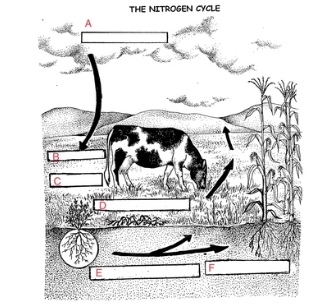
In the nitrogen cycle, what does label B in the diagram represent?
Bacterial Nitrogen Fixation
Uptake by producers
Denitrification
Nitrogen in the atmosphere
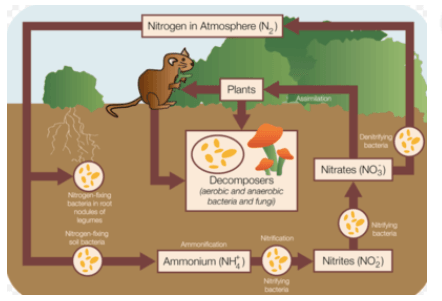
A correct path that nitrogen could take would be
air -> animals -> plants -> bacteria
animals -> air -> bacteria -> plants
bacteria -> air -> plants -> animals
air -> bacteria -> plants -> animals
Which groundwater contaminant contained in fertilizers and pesticides comes from farms?
calcium carbonate
carbonic acid
nitrates
bicarbonate
This is NOT a part of the phosphorus cycle.
Phosphate is incorporated into sedimentary rocks
Phosphate bound to soil
Atmospheric phosphate
Phosphate is absorbed from the soil by plants
Phosphorus is essential to all living organisms because it helps to form life-sustaining molecules such as...
*Select all that apply.
protein
RNA
carbohydrates
amino acids
DNA
Which of the following is an example of a decomposer?
Owl
Fish
Tree
Mushroom (fungus)
Which law states that matter cannot be created nor destroyed?
Law of Conservation of Energy
Law of Conservation of Matter
Law of Angular Momentum
Newton's Laws of Motion
All of the carbon in existence is continually recycled in the carbon cycle.
Which of the following do NOT contain carbon? *Select all that apply.
The atmosphere
Soil
Fossil fuels
sodium chloride
water molecules
Which compound(s) contain carbon atoms? *Select all that apply.
carbon dioxide
ammonium
calcium carbonate
methane
After the autotrophs absorb the CO2 from the atmosphere, what do they produce that CONTINUES the CARBON CYCLE?
glucose
ATP
water
oxygen
hydrogen sulfide

How does the carbon in grass become part of a PRIMARY CONSUMER?
The primary consumer eats the grass
Carbon from grass doesn't end up in a primary consumer.
The carbon ends up in the primary consumers food chain.
The primary consumer breathes in carbon given out by the plant.
Does deforestation contribute to global warming?
No, trees aren't that important
Sometimes because only the cutting down of Maple trees contributes to global warming
No, deforestation adds methane to the atmosphere, which makes the Earth cooler
Yes; less trees means less CO2 is turned into oxygen.
The largest carbon sink is ___________ and it's important because it ____________________________.
the desert; adds carbon to the atmosphere.
the ocean; removes carbon from the atmosphere.
the ocean; adds carbon to the earth's crust.
the forest; adds carbon to the atmosphere.
the forest; removes carbon from the atmosphere.
If decomposition did not occur, what would happen?
Carbon would not be recycled into the atmosphere.
Carbon would be locked in the waste and dead matter, leaving less and less CO2 for photosynthesis.
Wastes and dead organisms would pile up.
There would be more CO2 available because decomposers didn't break down wastes and decaying matter.
There would be more animals on the planet because the decomposers did not break them down.
Which of the following is/are NOT examples of the combustion of fossil fuels? (Select all that apply...)


____________________ is a part of oceans, air, rocks, soil, and all living things.
Nitrogen
Water
Carbon
Phosphorus
Substances below 7 on the pH scale are considered __________, pH 7 is ___________, and substances above pH7 are considered ____________.
acidic; neutral; basic (alkaline)
basic (alkaline); neutral; acidic
neutral; acidic; basic (alkaline)
acidic; basic (alkaline); neutral
basic (alkaline); acidic; neutral
What is the useful form of energy for all organisms?
glucose
ADP
ATP
starch
protein
Which of the following is/are NOT natural form(s) of combustion?
power lines sparking a wildfire
lightning sparking a forest fire
nuclear reactors generating electricity
burning fossil fuels to power factories
The burying of microscopic organisms that lived millions of years ago under conditions of extreme heat and pressure will NOT result in which of the following?
*Select all that apply.
oil
coal
natural gas
The _______________ is the sphere that contains the crust and core of Earth.
atmosphere
biosphere
hydrosphere
geosphere
A cell spends the majority of its life, actually __%, in this phase ___________.
100, interphase
10, cytokinesis
40, mitosis
90, interphase
The division of the cytoplasm is called
mitosis
interphase
cytokinesis
somatic
Cell Cycle


How many chromosomes do humans have?
46
21
10
23
Chromatin refers to DNA that is...
old and needs to be dissolved.
completely unzipped and ready for replication.
tightly bound into chromosome-like structures.
uncoiled in the nucleus; looks relaxed like a bowl of spaghetti.

Which phase is shown here?
anaphase
telolphase
metaphase
prophase
An individual living thing that is capable of responding to stimuli, growing, reproducing, and maintaining homeostasis is called a(n) ______________.
organism
virus
predator
cancer
Select all that apply to "Single Celled Organisms"
made up of eykaryotic cells
made up of a prokaryotic cell
reproduce through mitosis
reproduce through binary fission
can respond to stimuli, grow, reproduce, and maintain homeostasis
Select all that apply to "Multicellular Organisms"
made up of specialized eykaryotic cells
made up of a prokaryotic cell
reproduce through mitosis
reproduce through binary fission
can respond to stimuli, grow, reproduce, and maintain homeostasis

A female pig has 38 chromosomes in each of its somatic cells. How many would be present in its sex cells?
9
19
38
76
152
Which of the following cause genetic variation? *Select all that apply.
chromosomes lining up
crossing over of chromosomes
random fertilization
chromosomes pulling apart
independent assortment
Compare/Contrast Spermatogenesis & Oogenesis. *Select all that are FALSE.
Both produce haploid cells that are genetically different.
Spermatogenesis produces 1 gamete and 3 polar bodies.
Oogenesis produces 1 gamete and 3 polar bodies.
Both produce 4 cells that are used in reproduction
Both produce haploid cells that are genetically identical.
What type of cells store the genetic information that is passed to off-spring?
BODY CELLS
SOMATIC CELLS
EGG
SPERM
GAMETES
MEIOSIS... *Select all that apply.
REDUCES THE NUMBER OF CHROMOSOMES BY ONE HALF
PRODUCES 4 DIFFERENT SEX CELLS (n)
ALLOWS TRAITS TO BE PASSED TO OFFSPRING
INCREASES GENETIC VARIATION
NONE ARE TRUE
MEIOSIS
REDUCES THE NUMBER OF CHROMOSOMES BY ONE HALF
PRODUCES UNIQUE SEX CELLS-1N
ALLOWS TRAITS TO BE PASSED TO OFFSPRING
ALL ARE TRUE
INCREASE GENETIC VARIATION
If the diploid number of carrots is 18, the haploid number is
18
9
27
36


A mutation is defined as:
A change in the cell's structure
Anything that changes in an embryo
Any change in the physical features of a human
A change in the DNA sequence
Mutations are random.
True
False
Mutations are NEVER helpful to the organism.
true
false
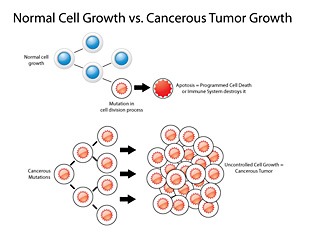
Which of the following are true about CANCER? *Select all that apply.
Uncontrolled cell growth
Cells no longer function correctly
Cells which have lost the ability to reproduce
Cells which create abnormal tissues
Cells that can metastasize
Stem cells can be obtained from... *Select all that apply.
embryos
some adult tissues
umbilical cord blood
all adult tissues
none of these
The reproductive process involving two parents whose genetic material is combined to produce a new organism different from themselves...
asexual reproduction
sexual reproduction
binary fission
mitosis
A method of reproduction that requires only one parent...
sexual reproduction
asexual reproduction
stem cells
cell cycle
Mutation that causes NON-CANCEROUS tumors that do not spread to the surrounding tissues...
malignant
benign
carcinogen
metastasis
Mutation that causes CANCEROUS tumors that invades the surrounding tissues...
malignant
benign
carcinogen
metastasis
Any substance that is known to cause cancer is called a
carcinogen
tumor
pathogen
virus
bacteria
An abnormal mass/group of cancer cells is called a
tumor
cyst
lesion
polyp
If cancerous cells travel throughout your body, the cells have...
metastasized
migrated
flowed
locomoted
Anything that can cause mutations or turn on cancer genes.
Examples: smoking, radiation, chemicals, poor diet
Risk Factors
Mutations
Tumors
Predispositions
What is a variation?
a difference between individuals of the same species
the same trait between individuals
What is a mutation?
No change in DNA
Any change in DNA
No change in RNA
Which of the following are ways genetic mutation can occur? *Select all that apply.
expression
addition
deletion
sex-linked
substitution
What are the effects that mutations can have?
only harmful effects
Harmful, helpful and neutral
only harmful and neutral effects
environmental
When can an acquired mutation be passed from parent to offspring?
only if the mutation occurs in sex cells
only if the mutation occurs in the y-chromosome
only if the parent has an acquired mutation in an autosomal chromosome
only if neither of the parents has the mutation in sex cells.
A mutation adds a single base pair at the beginning of a gene's coding sequence. How will this affect the protein made from the gene?
The protein will be non-functional.
The protein will work extra hard.
The protein will not exist
What advantage do organisms that reproduce sexually have or organisms that reproduce asexually?
Organisms that reproduce sexually can reproduce faster
Organisms that reproduce sexually don't need a mate
Organisms that reproduce sexually have a better chance of survival if the environment changes
Organisms that reproduce sexually are exactly like their parents.

Amoebas, hydras, and yeast reproduce asexually so
offspring is exactly like their parents
offspring is not like either parent
offspring take a long time to be born
offspring will survive if something wipes their parent out

Inherited traits are controlled by
nucleus
chromosomes
genes
cells
Which of the following is NOT a source of genetic diversity?
mutation
segregation of homologs
independent assortment of homologous pairs
mitosis
This law describes how each homologous pair separates independently of any other pairs during Anaphase I of meiosis. *Select all that apply
Law of Segregation
Law of Independent Assortment
Law of Gravity
Law of Mathematical Order
Law of Probability

Which type of mutation is shown in the image?
Substitution
Insertion
Inversion
Translocation
Deletion

Which type of mutation is shown in the image?
Substitution
Deletion
Insertion
Inversion
Translocation

Which type of mutation is shown in the image?
deletion
substitution
tranverse
insertion
translocation

Why are insertion and deletion mutations so harmful?
They change all of the codons from the mutation on down the line, which changes the amino acid sequence
They insert things that an organism doesn't need.
They often delete things that organisms need.
Insertion and deletions are not any more harmful than substitution mutations.
An abnormal mass/group of cells is called a _____________ if it doesn't spread to other tissues.
benign tumor
malignant tumor
benign lesion
malignant polyp
benign cyst
Cancer is caused due to
Controlled mitosis
Uncontrolled mitosis
Controlled meiosis
Uncontrolled meiosis
Example of mutagens
all are mutagens
x-rays
ultraviolet radiation
tobacco
pesticides
Chromosomes that are paired by size and content are called _______ chromosomes.
homeostasis
homologous
matching
sister
Cells that contain 2 sets of chromosomes are called _________ (2n).
diploid
haploid
triploid
polyploid
Which sequence of complementary DNA bases would pair with this partial strand AAG CCG GTA?
AAG CCG GTA
TTC GGC CAT
GAA GCC ATG
TTC GGG CAT
TTC GGC GAT
A process in which DNA has the unique ability to make an exact copy of itself.
Replication
Translation
Transcription
Protein Synthesis
What is the correct order to make a protein?
Protein, DNA, RNA
RNA, DNA, Protein
DNA, RNA, Protein
Protein, RNA, DNA
The physical expression of a genetic trait is called a
mutation
genotype
crossing over
phenotype
The following items are examples of __________.
Items: eye color, hair color, height
homozygous alleles
genotypes
heterozygous alleles
phenotypes
b= blue eyes
What is true about these two brothers that have brown eyes:
One has genotype BB the other Bb.

A haploid (n) cell of a whale has 21 chromosomes, how many chromosomes will you find in one of its somatic cells?
10.5
21
42
84
168
A haploid cell from a female snail has 12 chromosomes. What type of cell is this? Choose all that apply
Sperm
Egg
Heart Cell
Somatic
Gamete

A Tasmanian devil has 6 chromosomes in its gametes. What is the haploid number?
3
6
12
24
48
A gene pool consists of
all of the genes, including all the different alleles, that are present in a population
some of the genes, including the different alleles, that are present in a population
all of the genes that are present in all populations
all of the genes, including all the different alleles, that are present in all populations
A version or variation of a gene
trait
gene
allele
DNA

Two genetically identical plants were crossed. The genotypic ratios of offspring are seen in the Punnett square.
What percent of the offspring should NOT look like the parents?
0%
25%
50%
75%
Inherited traits are passed down from our parents to us, their offspring, by the information that is coded in our parents'
RNA
antibodies
chromosomes.
plasma.

Absent-mindedness is an inherited recessive trait. The Punnett square shows the genetic cross for absent-mindedness in the Smith family. If the Smith's have 3 children, how many could be absent-minded?
0
1
2
3
How are scientists able to compare DNA from bones or teeth to that found in hairs on a hairbrush?
They cannot and this is making body identification very difficult.
Each sample provides an exact karyotype for genetic identification.
DNA is the same in every cell of the body and does not change over time.
The DNA must all come from the hair in order to be accurate
In rabbits, the allele for black fur, B, is dominant over the allele for brown fur, b. Calculate the probability of a homozygous dominant (BB) offspring resulting from a cross between two parents with the genotype Bb. *Hint: Use scratch paper to solve the Punnett square.
10%
50%
25%
87.5%
Which of the following is a Homozygous Dominant Genotype?
Cc
ZZ
mm
Which of the following is a homozygous recessive genotype?
LL
ww
Which of the following is a heterozygous genotype?
Ee
Nn
ii
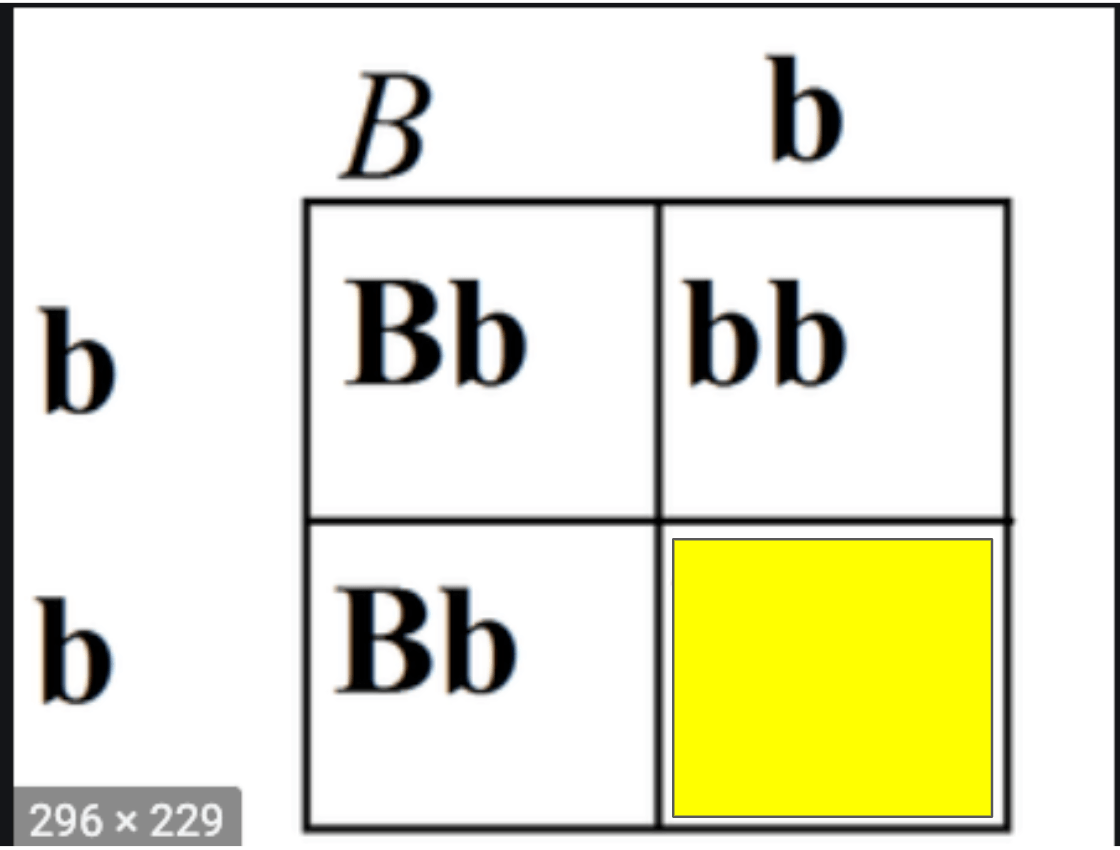
Which of the following would NOT go in the yellow box? *Select all that apply.
Bb
BB
bb
What is the chance the offspring born from this cross will have a homozygous recessive genotype?
0%
25%
50%
75%
100%
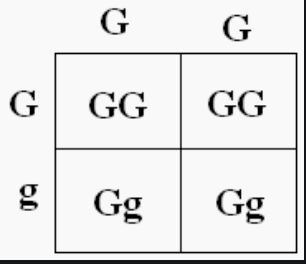
The Punnett square is used to tell the color of a frogs skin. "G" means green skin and "g" means brown skin. What is the chance the baby frogs will have green skin?
0%
25%
50%
75%
100%

What is the genotypic ratio of the offspring?
2:2
4:0
0:2:2
2:2:0
2:0:2

Based off this Punnett Square, what fraction of the offspring will have wrinkled, green seeds?
9/16
3/16
1/16
16/16
4/16
What fraction of offspring from the cross AaBB x Aabb will be homozygous recessive for trait "A" and heterozygous for trait "B."? *Hint: Use scratch paper to solve the Punnett square.
1/16
1/4
1/2
3/16
7/16

In cacti, long arms (A) are dominant to short arms (a). Suppose 2 heterozygous cacti are crossed. What percentage of their offspring are expected to have long arms? *Hint: Use scratch paper to solve the Punnett square.
0%
25%
75%
100%
What is the phenotypic ratio of the offspring?
2:2
4:0
0:2:2
2:2:0
2:0:2

