wayground logo

Free Printable Worksheets

Font size

S
M
L
XL
Worksheets

APH Biology Unit 3 (AP1)

Total questions: 111

Worksheet time: 2hrs 36mins

Name
Class
Date
1.

What did Gregor Mendel conduct his experiments on?

a)

Pea plants

b)

Rose flowers

c)

Apple trees

d)

Corn plants

2.
The observable traits of an organism are known as its
a)
allele
b)
dominance
c)
phenotype
d)
genotype
3.
If green is dominant over purple, then what is the genotype for this individual?
a)
Purple
b)
Green
c)
GG
d)
gg
4.
Each parent contributes one of the genes for a particular trait. The genes of the pair are called:
a)
variables
b)
gametes
c)
hybrids
d)
alleles
5.

The genotype 'Tt' is...

a)

homozygous dominant

b)

homozygous recessive

c)

heterozygous

d)

none of these

6.
If a pea plant were homozygous recessive for height, how would its alleles be represented?
a)
TT
b)
Tt
c)
tt
d)
tT
7.
Which of the following best describes a GENOTYPE?
a)
The allele/genetic makeup of an organism.
b)
The physical expression of a trait.
8.
The letters on the TOP AND SIDE of a punnett square represent ______________.
a)
The combination of alleles in offspring.
b)
The possible alleles given by the parents following meiosis.
c)
The genotype and phenotype of offspring.
d)
The results of genetic mutations in offspring.
9.

What is the predicted percentage of homozygous recessive offspring in this cross?

a)

0%

b)

25%

c)

50%

d)

75%

10.

The dominant trait in this punnett square is

a)

yellow peas

b)

green peas

c)

there is no dominant pea color

d)

They are codominant

11.

Two brown eyed parents (Bb x Bb) have a baby. What is the chance the baby is blue eyed?

a)

0 %

b)

25%

c)

50%

d)

75%

12.

Which term refers to an organism's physical appearance

a)

recessive allele

b)

dominant

c)

genotype

d)

phenotype

13.
Which of the following is an example of a heterozygous genotype?
a)
RR
b)
Rr
c)
rr
14.

a trait that is always expressed if present is _____________________

a)

Recessive

b)

Dominant

c)

Strong

d)

True

15.

a trait that is masked unless 2 copies are present is ________________________

a)

recessive

b)

dominant

c)

weak

d)

hidden

16.

Select all that would be considered phenotypes:

a)

Blonde

b)

Rr

c)

Short

d)

rr

17.

Select all that would be considered genotypes:

a)

Blonde

b)

Rr

c)

Short

d)

rr

18.

What genotype is homozygous dominant?

a)

RR

b)

Rr

c)

rr

19.

What genotype is homozygous recessive?

a)

RR

b)

Rr

c)

rr

20.
This image shows a...
a)
Punnett Square
b)
Phenotype
c)
Genotype
d)
Dominant allele
21.
A phenotype is the...
a)
letter combination
b)
dominant gene
c)
recessive gene
d)
physical appearance
22.
 Dominant alleles are-
a)
capital
b)
lowercase
c)
both
d)
neither
23.
 Recessive alleles are-
a)
capital
b)
lowercase
c)
both
d)
neither
24.
Which represents the genotype of a homozygous condition?
a)
Bb
b)
BC
c)
bb
d)
bc
25.
If a trait is heterozygous, the letters (alleles)are 
a)
The same 
b)
Different
26.
If a trait is homozygous the letters are the 
a)
Same
b)
Different
27.
How many PAIRS of chromosomes do humans have?
a)
23
b)
46
c)
1
d)
2
28.
An offspring will receive how many alleles from each parent to determine a specific trait?
a)
one
b)
two
c)
three
d)
five
29.
Looking at this pedigree, how many female family members are carriers?
a)
1
b)
3
c)
10
d)
7
30.
How many alleles does an individual have for each trait?
a)
1
b)
2
c)
3
d)
4
31.
I have 2 X chromosomes. What am I?
a)
Male
b)
Female
32.
I have 1 X chromosome and 1 Y chromosome. What am I?
a)
Male
b)
Female
33.

What percentage of peas will be homozygous?

a)

10%

b)

30%

c)

50%

d)

75%

34.

What type of trait is the color green in this problem?

a)

Dominant

b)

Recessive

c)

Repeating

d)

Nucleic

35.
How many people in this whole pedigree have the trait/disease?
a)
2
b)
3
c)
4
d)
6
36.
How many kids did the mother and father from the first generation have?
a)
2
b)
4
c)
5
d)
6
37.
A couple has 4 girls. What are the odds of the couple having a boy?
a)
1/4
b)
1/5
c)
1/2
d)
1/8
38.
What is the genotypic ratio in this cross?
R= round r= wrinkled
a)
3:1 (3 round to 1 wrinkled)
b)
1:2:1 (1 RR, 2 Rr, 1 rr)
c)
75% round, 25% wrinkled
d)
1:3 (1 round to 3 wrinkled)
39.

This little guy has a recessive trait. Choose the best statement.

a)

Both parents gave him an "h". (hh)

b)

He has one "H" and one "h".

c)

He will die without hair.

d)

He is a baby and his hair will grow in a few more days.

40.

Which genotype(s) would produce yellow wings if yellow wings are dominant?

a)

AA

b)

Aa

c)

aa

41.

True or False: Males always inherit their X chromosome from their mother

a)

True

b)

False

42.

Objective #13

This is a pedigree that follows blue eyes which is a recessive trait. What is the phenotype of the mother (circle) in generation 1?

a)

Brown

b)

Blue

c)

1 blue, 1 brown

43.

Objective #13

This is a pedigree that follows blue eyes which is a recessive trait. What is the phenotype of the father (square) in generation 1?

a)

Brown

b)

Blue

c)

1 blue, 1 brown

44.

Objective #13

On a pedigree how do we know if they have the trait?

a)

Not shaded

b)

Shaded

45.
Which individual in the first generation is a carrier?
a)
The male
b)
The female
c)
individual 1
d)
None of the above
46.
In the second generation-how many people have the disease or display the physical trait?
a)
2
b)
4
c)
5
d)
6
47.
How many people in this whole pedigree have the trait/disease?
a)
2
b)
3
c)
4
d)
6
48.
What is the mode of inheritance shown here?
a)
Autosomal Recessive
b)
Autosomal Dominant
c)
Sex Linked
49.

What does this pedigree symbol mean?

a)

Not affected Female

b)

Not affected Male

c)

Affected Male

d)

Affected Female

50.

What does this symbol mean on a pedigree?

a)

Not Affected Male

b)

Not Affected Female

c)

Affected Male

d)

Affected Female

51.

What is number 1 called?

a)

chromosome

b)

centromere

c)

sister chromatids

d)

chromatin

52.

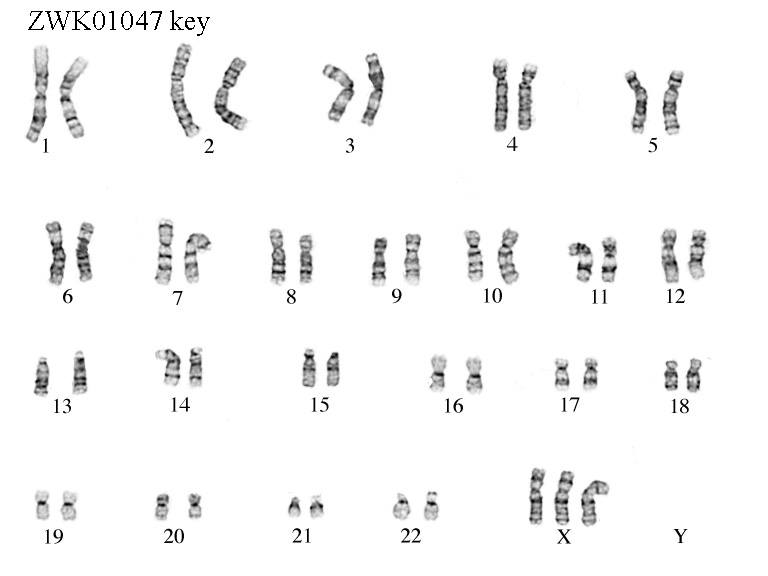
This picture which illustrates the structure and number of chromosome is called? (Hint: start with k...)

(a)  

53.

Down Syndrome is also known as _________.

a)

Trisomy 18

b)

Trisomy 21

c)

Monosomy X

d)

Trisomy 13

54.
What is the gender of the individual whose karyotype is seen in the image?
a)
Male
b)
Female
55.

Based on the karyotype, what is the sex of this baby?

a)

Male

b)

Female

56.
Is this Karyotype human?
a)
Yes
b)
No
c)
Impossible to Determine
57.

Based on the karyotype, can you guess the name of this genetic disorder?

a)

Curvy 3

b)

Jacob's syndrome

c)

Triple X

d)

Superwoman syndrome

58.

Who were the first people to build a model of a DNA molecule?

a)

Larry, Moe, and Curley Joe

b)

Watson and Crick

c)

Watson and Holmes

d)

Superman and Batman

59.

What are the four DNA bases?

a)

adenine, thymine, guanine, cytosine

b)

adenine, lysine, prolene, guanine

c)

arganine, cytosine, lysine, purine

d)

lysine, cytosine, lucine, guanine

60.

The shape of the DNA molecule is a double __________________?

a)

"S"

b)

double helix

c)

rope

d)

curve

61.

DNA is made from ______________, _______________ and bases.

a)

lipids, carbons

b)

sugars, phosphates

c)

nitrogens, oxygens

d)

nitrogens, sulfurs

62.
The sugar in DNA is ?
a)
sucrose
b)
glucose
c)
deoxyribose
d)
fructose
63.

DNA makes a copy of itself in a process called ________________________________?

a)

translation

b)

replication

c)

transcription

d)

division

64.
Adenine bonds with ______________.
a)
Guanine
b)
Thymine
c)
Cytosine
d)
Adenine
65.
Guanine bonds with ______________.
a)
Adenine
b)
Guanine
c)
Cytosine
d)
Thymine
66.
Which sequence of DNA bases would pair with this partial strand
ATG TGA CAG
a)
ATG TGA CAG
b)
TAC ACT GTC
c)
GTA AGT GAC
d)
CAT TCA CTG
67.

In eukaryotes, which organelle is DNA usually found in?

a)

cell membrane

b)

vacuole

c)

chloroplast

d)

nucleus

68.
Which shows the correct complementary base pairing for DNA?
a)
C-A, T-G
b)
A-G, C-T
c)
C-G, U-A
d)
T-A, G-C
69.
A long chain of amino acids is a/an
a)
protein
b)
nucleic acid
c)
tRNA
d)
mRNA
70.
If a DNA molecule consists of 29% Guanine, how much cytosine will it contain?
a)
29%
b)
58%
c)
21%
d)
I have no idea.
71.
What will the matching sequence be on a strand that reads AAGCTAT?
a)
AACGATA
b)
TTCGTTA
c)
CCTGATA
d)
TTCGATA
72.
DNA codes for...
a)
bases
b)
proteins
c)
amino acids
d)
phosphates
73.
How does RNA differ from DNA?
a)
RNA contains uracil and deoxyribose
b)
RNA contains ribose and thymine
c)
RNA contains uracil and ribose
d)
RNA contains adenine and ribose
74.
How would the DNA sequence GCTATA be transcribed to mRNA?
a)
GCUAUA
b)
CGATAT
c)
CGAUAU
d)
GCUTUT
75.
The process by which the genetic code of DNA is copied into a strand of RNA is called
a)
translation
b)
transcription
c)
transformation
d)
replication
76.
Which of the following describes RNA?
a)
RNA is usually double-stranded and contains the base thymine
b)
RNA is usually single-stranded and contains the base uracil
c)
RNA is longer than DNA and uses five bases to encode information
d)
RNA is made in the nucleus of eukaryotic cells and stays there to carry out its functions
77.
In messenger RNA, each codon specifies a particular
a)
nucleotide
b)
enzyme
c)
amino acid
d)
promoter
78.
The process of making proteins on the ribosome based on instructions from messenger RNA is called
a)
transcription
b)
transformation
c)
translation
d)
molecular biology
79.
In a strand of DNA, if it contains 20% of Thymine, then how much Guanine would be present?
a)
30%
b)
20%
c)
80%
d)
10%
80.
What is the difference between the sugars found in DNA and RNA?
a)
RNA contains glucose
b)
RNA contains sucrose
c)
RNA contains deoxyribose
d)
RNA contains Ribose
81.
RNA has how many strands?
a)
one
b)
two
82.

The nitrogen base pairs for RNA are

a)

A-T C-G

b)

A-U C-G

c)

A-C T-G

d)

T -U G-C

83.

The sugar in the backbone of ribonucleic acid is

a)

deoxyribose

b)

ribose

c)

dextrose

d)

sucrose

84.

There are three types of RNA

a)

False

b)

True

85.
What is the template for mRNA?
a)
DNA
b)
tRNA
c)
rRNA
d)
proteins
86.
How many nucleotides make a codon?
a)
1
b)
2
c)
3
d)
6
87.
What type of RNA carries the DNA message out of the nucleus to the ribosomes?
a)
mRNA
b)
tRNA
c)
RNA
d)
DNA
88.
When the RNA gets to the ribosomes, which molecule transfers to the mRNA to amino acids?
a)
DNA
b)
mRNA
c)
tRNA
d)
Replicated RNA
89.
When transferring tRNA to amino acids, the process cannot begin until it reaches a...
a)
Beginning codon
b)
Start codon 
c)
Initiator codon
d)
Anticodon
90.
The process of transferring the codons to the amino acids ends with what codon?
a)
Stop
b)
Terminal
c)
End
d)
Cancel 
91.
The job of tRNA is to...
a)
carry amino acids to the ribosomes 
b)
carry ribosomes to the ER
c)
carry mRNA out of the nucleus
d)
carry glucose to mitochondria
92.
Which RNA bases would pair with TACGAA in transcription? 
a)
AUGCUU 
b)
ATGCTT
c)
GCATCC
d)
GCAUCC
93.
Where does Translation occur?
a)
Proteins
b)
Mitochondria
c)
Ribosomes
d)
Cytoplasm
94.
What do we call the process of turning DNA into mRNA?
a)
Translation
b)
Transcription 
c)
Replication
95.
Which enzyme has the job of unzipping the double helix?
a)
Helicase
b)
Polymerase
c)
Ligase
d)
Primerase
96.
Which enzyme fixes the Okazaki fragments in the lagging strand?
a)
Helicase
b)
Polymerase
c)
Ligase
d)
Primerase
97.
If a strand reads:
3' A A A T T T C 5'
The matching strand would read...
a)
5' T T T A A A G 3'
b)
3' T T T A A A G 5'
c)
5' A A A T T T C 3'
d)
3' U U U A A A G 5'
98.
The enzyme that splits open the DNA creates what's called a fork - where the DNA separates into the lagging strand and the ______ strand.
a)
leading
b)
leveraging
c)
Okazaki
d)
ligase
99.
Polymerase is able to replicate the new DNA ______ along the leading strand.
a)
continuously
b)
only in short fragments
c)
very slowly
d)
prokaryotically
100.

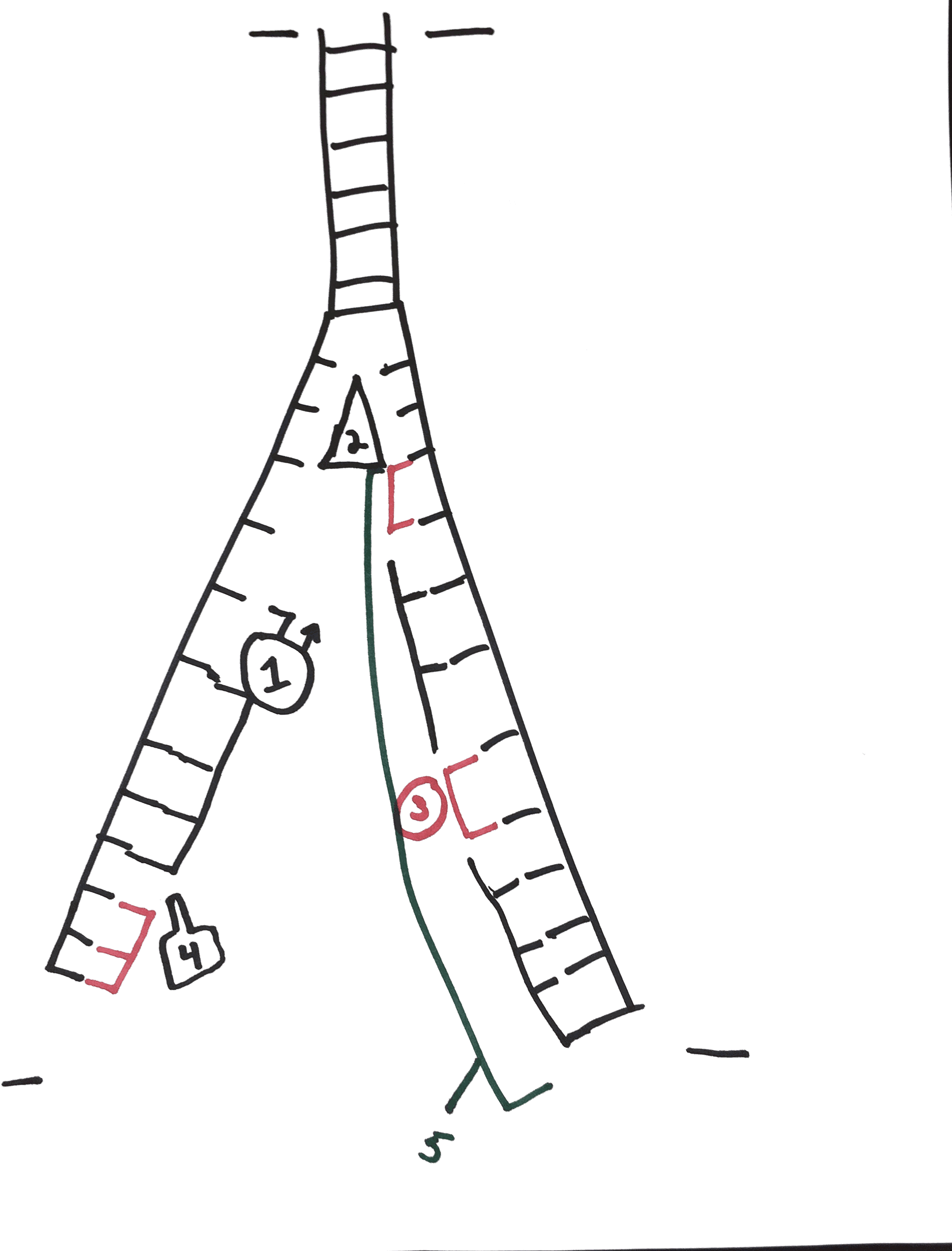
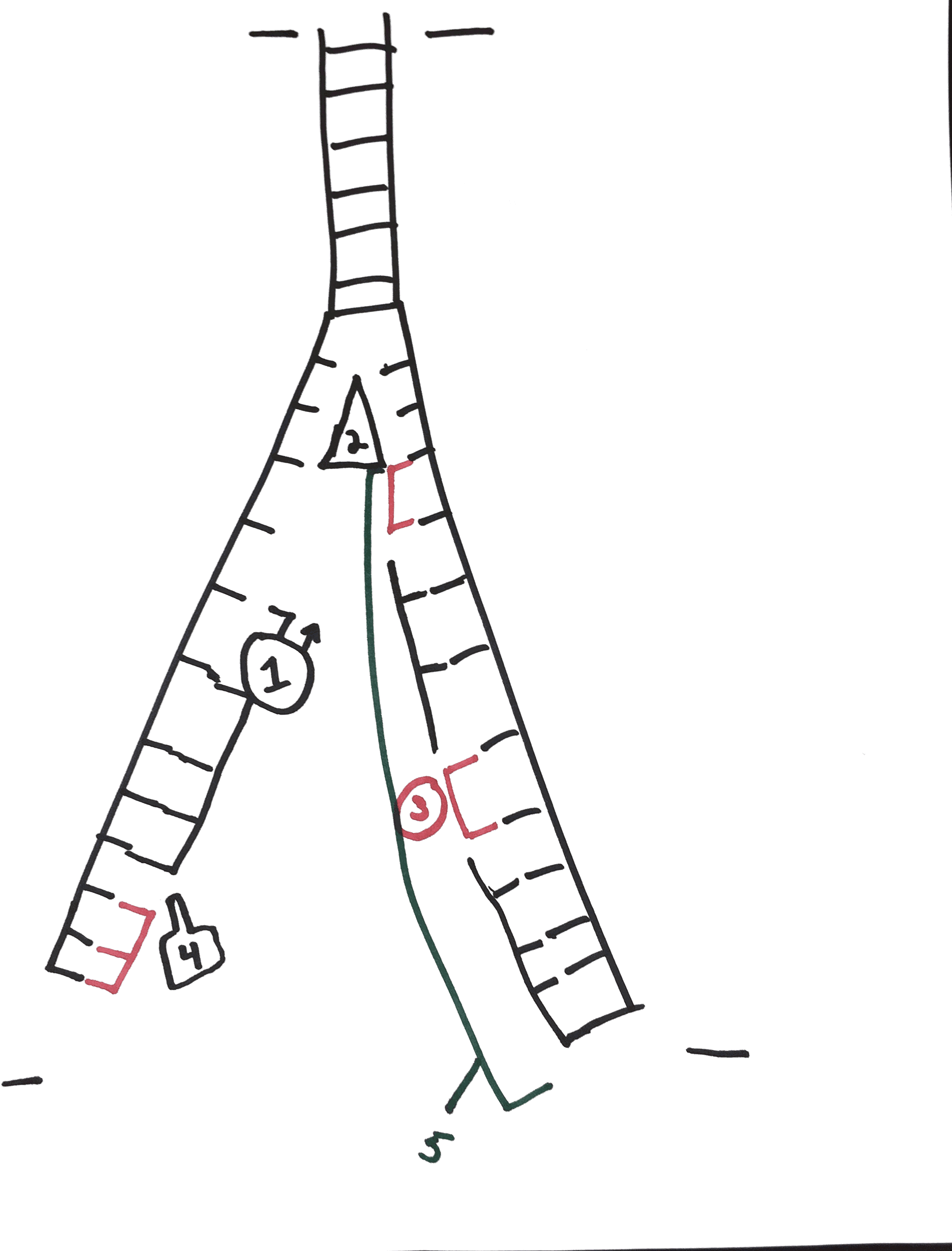
#1 in the picture above (builder)

a)

Helicase

b)

Primase

c)

Polymerase

d)

Ligase

101.

#3 setting Primers

a)

Ligase

b)

Helicase

c)

Polymerase

d)

Primase

102.

Which enzyme is responsible for adding the free nucleotides to the replicating DNA? ​

a)

DNA Helicase

b)

DNA Ligase

c)

DNA polyermase

d)

RNA Polymerase

103.

Which is the first step?

a)

DNA Helicase unwinds original DNA strand

b)

RNA Primase lays down RNA primer for new nucleotide bases.

c)

DNA polymerase builds new strands by bring in new nucleotide bases.

d)

Ligase knits together fragments on lagging strand

104.

Which is the second step?

a)

DNA Helicase unwinds original DNA strand

b)

RNA Primase lays down RNA primer for new nucleotide bases.

c)

DNA polymerase builds new strands by bring in new nucleotide bases.

d)

Ligase knits together fragments on lagging strand

105.

Which is the third step?

a)

DNA Helicase unwinds original DNA strand

b)

RNA Primase lays down RNA primer for new nucleotide bases.

c)

DNA polymerase builds new strands by bring in new nucleotide bases.

d)

Ligase knits together fragments on lagging strand

106.

Which is the fourth step?

a)

DNA Helicase unwinds original DNA strand

b)

RNA Primase lays down RNA primer for new nucleotide bases.

c)

DNA polymerase builds new strands by bring in new nucleotide bases.

d)

Ligase knits together fragments on lagging strand

107.

Which letter in the picture below depicts the leading strand in DNA replication?

a)

A

b)

C

c)

B

d)

None of the above

108.

Which letter in the picture below depicts the lagging strand in DNA replication?

a)

A

b)

C

c)

B

d)

None of the above

109.

Which letter in the picture below depicts the replication fork in DNA replication?

a)

A

b)

C

c)

B

d)

None of the above

110.

If a person suffered from a disorder where their DNA fragments were unable to fill in the missing slots in between the fragments of the lagging strand, they would most likely have a disorder that affected which enzyme?

a)

DNA Helicase

b)

DNA Ligase

c)

DNA polyermase

d)

RNA Polymerase

111.

Okazaki fragments appear on which strand of DNA during DNA replication?

a)

lagging

b)

leading