wayground logo

Free Printable Worksheets

Font size

S
M
L
XL
Worksheets

Classification and Diversity Review One

Total questions: 85

Worksheet time: 57mins
Name
Class
Date
1.
The scientific name for an organism is made from the:
a)
class and family name
b)
genus and species name
c)
domain and kingdom name
d)
kingdom and phylum name
2.
Term given to describe the 2 name naming system is:
a)
dichotmous key
b)
binomial nomenclature
c)
2 scientific names
d)
binomial key
3.
The 8 levels of classification, most broad to most specific.
a)
Domain, Genus, Family, Order, Class, Phylum, Kingdom, Species
b)
Domain, Species, Kingdom, Genus, Phylum, Family, Class, Order
c)
Domain, Kingdom, Phylum, Class, Order, Family, Genus, Species
d)
Order, Kingdom, Species, Domain, Phylum, Family, Class, Genus
4.
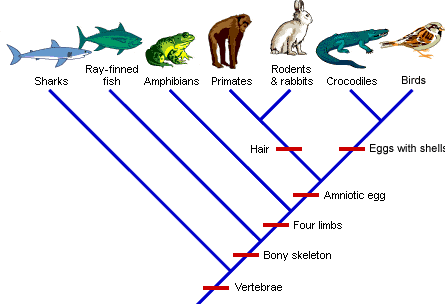
According to this cladogram, sharks are MOST closely related to which organism? 
a)
Amphibians
b)
Ray finned fish
c)
Crocodiles
d)
Birds
5.
According to this cladogram, birds are LEAST related to: 
a)
Amphibians
b)
Sharks
c)
Ray Finned Fish
d)
Crocodiles
6.

Who first proposed binomial nomenclature as a way of classifying organisms?

a)

Carl Linnaeus

b)

Karl Marx

c)

Charles Darwin

d)

Richard Owen

7.

Carl Woese developed the ‘three-domain system’ What are the three domains?

a)

Fungi, Archaea, and Viral

b)

Archaea, Bacteria, and Viral

c)

Archaea, Bacteria, and Eukaryote

d)

Eukaryote, Prokaryote and Bacteria

8.

Which is the only kingdom that can never have cell wall?

a)

Animal

b)

Plant

c)

Fungi

d)

Bacteria

e)

Protoctist

9.
What part of a virus is the protein capsule that houses the genetic material (DNA/RNA)?
a)
tail
b)
nucleus
c)
capsid
d)
glycoprotein
10.
Which viral life cycle allows viral genetic material to lay dormant while the host cell reproduces?
a)
lytic
b)
mitosis
c)
lysogenic
d)
S phase
11.
What is the first step of the virus reproduction cycle?
a)
The viruses genetic material (DNA) starts to take over the functions of the cell
b)
The host cell bursts open, releasing the new viruses
c)
The virus injects its genetic material into the cell
d)
A virus attaches to the surface of a host cell
12.
What do viruses need to reproduce?
a)
they need genetic material
b)
They need a host cell
c)
They need  bacteria
d)
They need insulin
13.
What is the purpose of surface marker on a virus
a)
As defense.
b)
They provide structural support.
c)
To allow the virus to move.
d)
To attach to the host cell.
14.
What part of the virus is number 4?
a)
Capsid
b)
DNA
c)
Surface Markers
d)
Envelope
15.

Bacteria come in which of the following shapes?

a)

rod, cone, spiral

b)

rod, sphere, spiral

c)

rod, sphere, cone

d)

sphere, cone, spiral

16.
Cycle of viral infection; results in replication of virus and cell destruction.
a)
Lytic Cycle
b)
Lysogenic Cycle
c)
Calvin Cycle 
d)
Denitrification
17.
Bacteria are prokaryotes which means they
a)
have a nucleus on their capsule
b)
do not contain a nucleus
c)
can live in environments with and without oxygen
18.
Name this bacteria shape
a)
coccus
b)
spirillum
c)
bacillus
19.
Name this bacteria shape
a)
bacillus
b)
coccus
c)
spirillum
20.
Name this bacteria shape
a)
coccus
b)
bacillus
c)
spirillum
21.
A structure that can help bacteria survive harsh conditions.
a)
capsids
b)
endospores
c)
pili
d)
DNA
22.
 A cell that contains a nucleus is
a)
prokaryote
b)
eukaryote
23.
Bacteria exchange genetic information during 
a)
asexual reproduction
b)
binary fission
c)
conjugation
d)
photosynthesis
24.
Superbugs can be prevented if people
a)
get rid of antibiotics
b)
take the antibiotics of another person
c)
do not follow the directions for taking prescribed antibiotics
d)
help people become aware of how to use antibiotics
25.
Archea differ from Bacteria in that the cell wall 
a)
contains peptidoglycan
b)
contains lipids
c)
contains oxygen
d)
contains nitrogen
26.
The bacteria seen in the picture is
a)
bacillus
b)
coccus
c)
spirilla
27.
Photoheterotrophs will use 
a)
oxygen or carbon dioxide for energy
b)
nitrogen or peptidoglycan for energy
c)
Organic compounds or light
d)
Chemicals or light
28.
During an experiment a scientist observed prokaryotes that lived near volcanic vents deep in the ocean.  The scientist must likely observed
a)
photoautotrophs
b)
chemoautotrophs 
c)
heterotrophs
d)
photoheterotrophs
29.
How many kingdoms are there?
a)
2
b)
3
c)
6
d)
8
30.
Archeabacteria...
a)
are eukaryotic
b)
live in extreme environments
c)
are non-living
d)
live in the soil
31.

Athletes foot are examples of this type of pathogen

a)

bacteria

b)

rickettsiae

c)

protozoa

d)

fungi

32.
What is a pathogen
a)
a doctor who specializes in curing diseases
b)
microbe that are beneficial when present
c)
a special machine that is used to grow microbes
d)
a small living organism that can cause disease
33.
aerobic bacteria require what to live?
a)
acid
b)
sun light
c)
oxygen
d)
plants
34.
A long, tail like structure that helps a bacterium to move is called a...
a)
cilia
b)
pili
c)
flagellum
d)
capsule
35.
All bacteria have DNA. 
a)
true
b)
false
36.
A disease causing organism
a)
pathogen
b)
poison
c)
vaccine
d)
prokaryote
37.
Bacteria undergo which type of reproduction? 
a)
asexual
b)
sexual
38.
The antibiotic resistance trait can be passed from one bacterium to another during:
a)
conjugation
b)
retaliation
c)
flagellination
d)
pili parties
39.

How does an amoeba move?

a)

It uses cilia.

b)

It uses a flagellum.

c)

It uses pseudopods.

d)

It cannot move.

40.
The word "pseudopodia" means
a)
small cell
b)
fake eye
c)
false foot
d)
first animal
41.
Identify the organism pictured.
a)
Amoeba
b)
Paramecium
c)
Euglena
d)
Plasmodium
42.
What type of protists exhibit positive phototaxis?
a)
autotrophic
b)
heterotrophic
c)
decomposers
d)
parasites
43.
Which of the following is true of ALL protists?
a)
unicellular
b)
eukaryotic
c)
prokaryotic
d)
heterotrophic
44.

Which structure stores this organism's genetic information?

a)

Structure A

b)

Structure B

c)

Structure C

d)

Structure D

e)

Structure E

45.

Which organelles found in algae are the sites of photosynthesis?

a)

eyespots

b)

mitochondria

c)

chloroplasts

d)

contractile vacuoles

46.
Protists are classified by how they obtain?
a)
Food
b)
Mates
c)
Oxygen
d)
Their habitat
47.
There are three main categories of protists:  animal like, plantlike, and _________  like ?
a)
bacteria 
b)
fungus
c)
virus
d)
slime
48.
The class of protists that are parasitic are the ?
a)
Zooflagellates
b)
Sporozoans
c)
Sarcodines
d)
Cillates
49.

A plant like protista is

a)

paramecium

b)

slime mold

c)

algae

50.

An animal like protista is

a)

Algae

b)

paramedium

c)

slime mold

51.

A fungi like example of protista is

a)

algae

b)

paramecium

c)

slime mold

52.

Cilia are

a)

false feet that give protista movement

b)

tiny hairs that give protista movement

c)

tails that give the protista movement

53.

Some plant roots grow with mycorrhizal fungi. The fungi absorb water and minerals and pass them on to the plant and receive carbohydrates from the plant. This is an example of -

a)

predation

b)

competition

c)

mutualism

d)

parasitism

54.

Fungi are like animals because they -

a)

have cell walls

b)

contain chitin

c)

are heterotrophic

d)

have filamentous bodies

55.

Fungi are like insects because they both -

a)

have cell walls

b)

contain chitin

c)

are autotrophic

d)

have filamentous bodies

56.

How are Fungi classified?

a)

How they get their energy

b)

How they reproduce

c)

Their sizes

d)

How they move

57.

The cell shown is most likely NOT a plant cell because -

a)

mitochondria is present

b)

no cell wall is present

c)

endoplasmic reticulum is present

d)

no nucleus is present

58.

Fungi and bacteria share which of the following similiarities?

a)

Members of both groups have cell walls made of chitin

b)

Members of both groups are decomposers

c)

Members of both groups are capable of photosynthesis

d)

Members of both groups are classified as eukaryotes

59.

which organism is NOT capable of photosynthesis?

a)

Cyanobacteria

b)

Shelf Fungus

c)

Green algae

d)

Euglena

60.

Fungi, such as mushrooms and molds, get their nutrition primarily by -

a)

parasitic relationships with plants

b)

producing food by chemosynthesis

c)

preying on other organisms

d)

decomposing dead organic matter

61.

Which characteristic do most adult fungi and plants share?

a)

They both are producers

b)

The both have cells with cell walls

c)

They both reproduce through binary fission

d)

They both have multiple nuclei in each cell

62.

Saprophytic fungi eat:

a)

Live plants

b)

Live animals

c)

Inorganic matter

d)

Dead/decaying organisms

63.

Fungal cells contain nuclei, which makes them classified as:

a)

prokaryotic

b)

eukaryotic

c)

parasitics

d)

saprophytic

64.

Fungi can exist as

I. saprotrophs

II. autotrophs

III. parasites

IV. mutualists

a)

I only

b)

I, II and III

c)

I, III and IV

d)

I, II and III

65.

Fungi can exist as

I. saprotrophs

II. autotrophs

III. parasites

IV. mutualists

a)

I only

b)

I, II and III

c)

I, III and IV

d)

I, II and III

66.

What type of fungus is this?

a)

Sac Fungi

b)

Club Fungi

c)

Toadstool

d)

Yeast

67.

What is this fungus called?

a)

A Morel

b)

A Puffball

c)

An Earthstar

d)

A Truffel

68.

What type of fungus?

a)

Sac Fungi

b)

Club Fungi

c)

Mildew

d)

Mold

69.
A typical fungus body is made of ?
a)
hyphae
b)
many cells
c)
flagella
70.
How do fungi get nutrients?
a)
photosynthesis
b)
ingest through mouth opening
c)
Absorb the nutrients across their cell walls.
71.
The part of the mushroom one can see above ground is the
a)
basidium
b)
flower
c)
sapling
d)
fruiting body
72.
Fungi obtain water and nutrients through hyphae.  What are hyphae?
a)
Hair-like structures to gather food in water environments
b)
Structures that help fungi to gather light.
c)
Structures that produce spores.
d)
Fibrous strands that will grow toward food or water.
73.
This part of the mushroom contains the reproductive structure
a)
gill
b)
stipe
c)
mycelium
d)
annulus
74.
Fungi were originally classified as plants but later they were classified separately.  Which of the following characteristics of fungi separates them from plants?
a)
They reproduce asexually.
b)
They are able to grow in dry conditions.
c)
They are unable to make their own food.
d)
They can move from one place to another.
75.

Where are spores formed?

a)

A

b)

B

c)

C

d)

D

e)

E

76.

Which structure gathers nutrients?

a)

A

b)

B

c)

C

d)

D

e)

E

77.

Where will sexual reproduction happen?

a)

A

b)

B

c)

C

d)

D

e)

E

78.

Which structure acts as an anchor?

a)

A

b)

B

c)

C

d)

D

e)

E

79.

Lichens are a combination of [...] and [...]

a)

Plants and Animals

b)

Algae and Plants

c)

Plants and Fungi

d)

Fungi and Algae

80.

On a phylogenetic tree, what do the branch lengths represent?

a)

The age of the organisms

b)

amount of genetic change since divergence

c)

amount of genetic change since convergence

d)

The age of divergence

81.

Fully grown parent cells split into two halves resulting in two daughter cells with the exact DNA as the parent.

a)

Binary Fission

b)

Budding

c)

Fragmentation

d)

Vegetative Reproductions

82.
In binary fission how does the DNA of the daughter cells compare to the DNA of the parent cell? 
a)
It is only half of the amount of DNA found in the parent.
b)
It is identical.
c)
It is a mix of the parent's DNA.
d)
It has some similarities and some differences.
83.
Endocytosis is defined as
a)
the movement of large molecules from the inside of the cell to the outisde of the cell using channel proteins. 
b)
the movement of large molecules from the inside of the cell to the outisde of the cell membrane vesciles. 
c)
 the movement of large molecules from the outside of the cell to the inside of the cell using membrane vesciles.
d)
the movement of large molecules from the outside of the cell to the inside of the cell using channel proteins. 
84.
Exocytosis is the movement of
a)
any type of substance from outside the cell to the inside of the cell. 
b)
very large substances from outside the cell to the inside of the cell. 
c)
any type of substance from inside the cell to the outside.
d)
very large substances from inside the cell to the outside.
85.
In this image, the cell is using which type of molecular transport?
a)
Osmosis
b)
Diffusion 
c)
Endocytosis
d)
Exocytosis