wayground logo

Free Printable Worksheets

Font size

S
M
L
XL
Worksheets

Solids, Liquids, Gases, Phase Changes, Diagrams, Graphs

Total questions: 60

Worksheet time: 45mins

Name
Class
Date
1.

The temperature at which a solid begins to liquefy is its ______ point.

a)

freezing

b)

boiling

c)

melting

d)

mass

2.

_______________ is an increase in the size of a substance when the temperature is increased.

a)

kinetic energy

b)

potential energy

c)

thermal point

d)

thermal expansion

3.

According to the kinetic theory of matter, all matter is composed of

a)

waves

b)

particles

c)

solid material

d)

plasma

4.

When the temperature of a substance is lowered, its particles

a)

vibrate more quickly

b)

stop vibrating completely

c)

escape the attractive forces of the other particles

d)

vibrate more slowly

5.

Why can people on one side of a room smell the scent of an air freshener sprayed on the opposite side of the room?

a)

The molecules of air freshener have thermally expanded

b)

The air pressure where the freshener was sprayed is greater than in the rest of the room

c)

The molecules of air freshener spread out until they are evenly distributed throughout the room

d)

The molecules of air freshener are amorphous

6.

An example of an amorphous solid is

a)

glass

b)

dry ice

c)

liquid crystals

d)

water

7.

An example of a substance that can undergo sublimation is

a)

glass

b)

liquid crystals

c)

water

d)

dry ice (frozen carbon dioxide)

8.

When a gas becomes a liquid it is called

a)

condensation

b)

evaporation

c)

sublimation

d)

freezing

9.

What state of matter is X?

a)

solid

b)

liquid

c)

gas

d)

supercritical fluid

10.
What state of matter is Y?
a)
solid 
b)
liquid
c)
gas
d)
supercritical fluid
11.
What state of matter is Z?
a)
solid 
b)
liquid
c)
gas
d)
supercritical fluid
12.
What is point A?
a)
triple point
b)
critical point
c)
equilibrium point
d)
normal melting point
13.
What is point B?
a)
triple point
b)
critical point
c)
equilibrium point
d)
normal melting point
14.
What change occurs from F to E?
a)
sublimation
b)
deposition
c)
melting
d)
condensation
15.
What change occurs from E to C?
a)
sublimation
b)
freezing
c)
melting
d)
boiling
16.
What change occurs from C to D?
a)
condensation
b)
vaporization
c)
melting
d)
sublimation
17.

The pressure is increased on a sample of water at 0 °C from 0 mmHg to 800 mmHg. In order, what changes occur?

a)

deposition, melting

b)

sublimation, melting

c)

condensation, freezing

d)

deposition, freezing

18.
What is true regarding CO2 for temperatures above 31 °C?
a)
It can never be liquified.
b)
It decomposes.
c)
It has a high pressure.
d)
It is a plasma.
19.
What would happen to the liquid substance if the pressure were decreased until a phase change occurred? It would undergo...
a)
melting
b)
vaporization
c)
condensation
d)
sublimation
20.
What is the normal boiling point of this substance?
a)
150 °C
b)
100 °C
c)
-50 °C
d)
0 °C
21.
What is the normal melting point of this substance?
a)
150 °C
b)
100 °C
c)
-50 °C
d)
0 °C
22.
Water exists as a _____________ at 700 mmHg and 50 °C.
a)
solid
b)
liquid
c)
gas
d)
supercritical fluid
23.
What would happen if the gaseous substance with a pressure of 10-3 atmospheres were cooled until a phase change occurred?
a)
condensation
b)
vaporization
c)
sublimation
d)
deposition
24.
The pressure is increased on a sample of water at 0 °C from 0 mmHg to 800 mmHg.  In order, what changes occur?
a)
deposition, melting
b)
sublimation, melting
c)
condensation, freezing
d)
deposition, freezing
25.
What phase change(s) may occur at pressures below 4.58 mmHg?
a)
sublimation/deposition
b)
melting/freezing
c)
all phase changes are possible at these pressures
d)
vaporization/condensation
26.
All changes in the state of matter of a substance requires
a)
vibration
b)
water
c)
permission
d)
energy
27.
5. What is it called when a solid turns directly into a gas?
a)
Sublimation
b)
Condensation
c)
Liquid
28.
What is the phase change of a solid to a liquid?
a)
freezing
b)
melting
c)
boiling
d)
condensation
29.
What happens to particles when they are heated?
a)
They speed up and spread out
b)
They slow down and compress
c)
They stop moving
d)
They move closer together and speed up
30.
The phase change from water vapor to liquid water is known as...
a)
evaporation
b)
precipitation
c)
condensation
d)
sublimation
31.

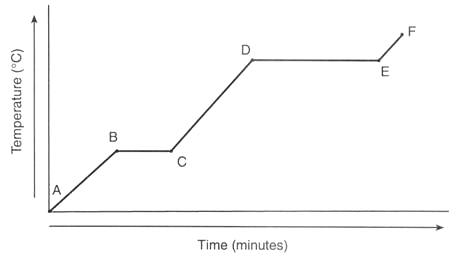
Between which two points is the solid cooling?

a)

A <---- B

b)

B <----> C

c)

C <---- D

d)

D <----> E

e)

E <---- F

32.

Between which two points is the gas heating up?

a)

A ----> B

b)

B <---- C

c)

C ----> D

d)

D ----> E

e)

E ----> F

33.

Between which two points is the gas condensing?

a)

A <---- B

b)

B <---- C

c)

C <---- D

d)

D <---- E

e)

E <---- F

34.
Between which points is the temperature of the substance remaining constant?
a)
A-B only. 
b)
A-B, C-D, E-F
c)
B-C only. 
d)
B-C, D-E
35.
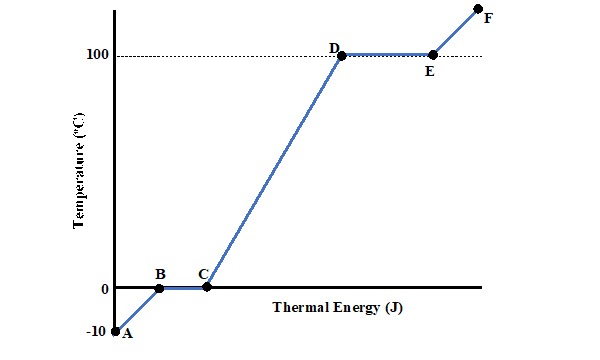
A substance's heating curve is shown in the graph.  What is its boiling point?
a)
100 C
b)
60 C
c)
80 C
d)
20 C
36.
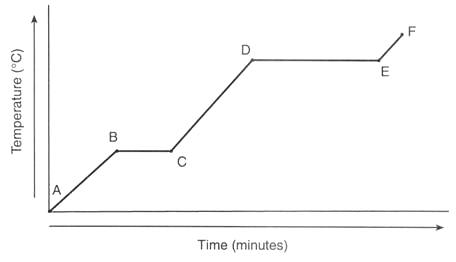
The graph shows a cooling curve for an unknown substance.  What is happening during segment DE?
a)
boiling
b)
condensation
c)
freezing
d)
melting
37.
In which segment is the kinetic energy remaining constant?
a)
A-B
b)
B-C
c)
C-D
d)
E-F
38.
This curve indicates what about the heat energy?
a)
heat energy is being added or absorbed
b)
heat energy is being removed
39.

What is happening to the particles in the substance between points A and B?

a)

Melting

b)

Freezing

c)

Speeding Up

d)

Slowing Down

40.

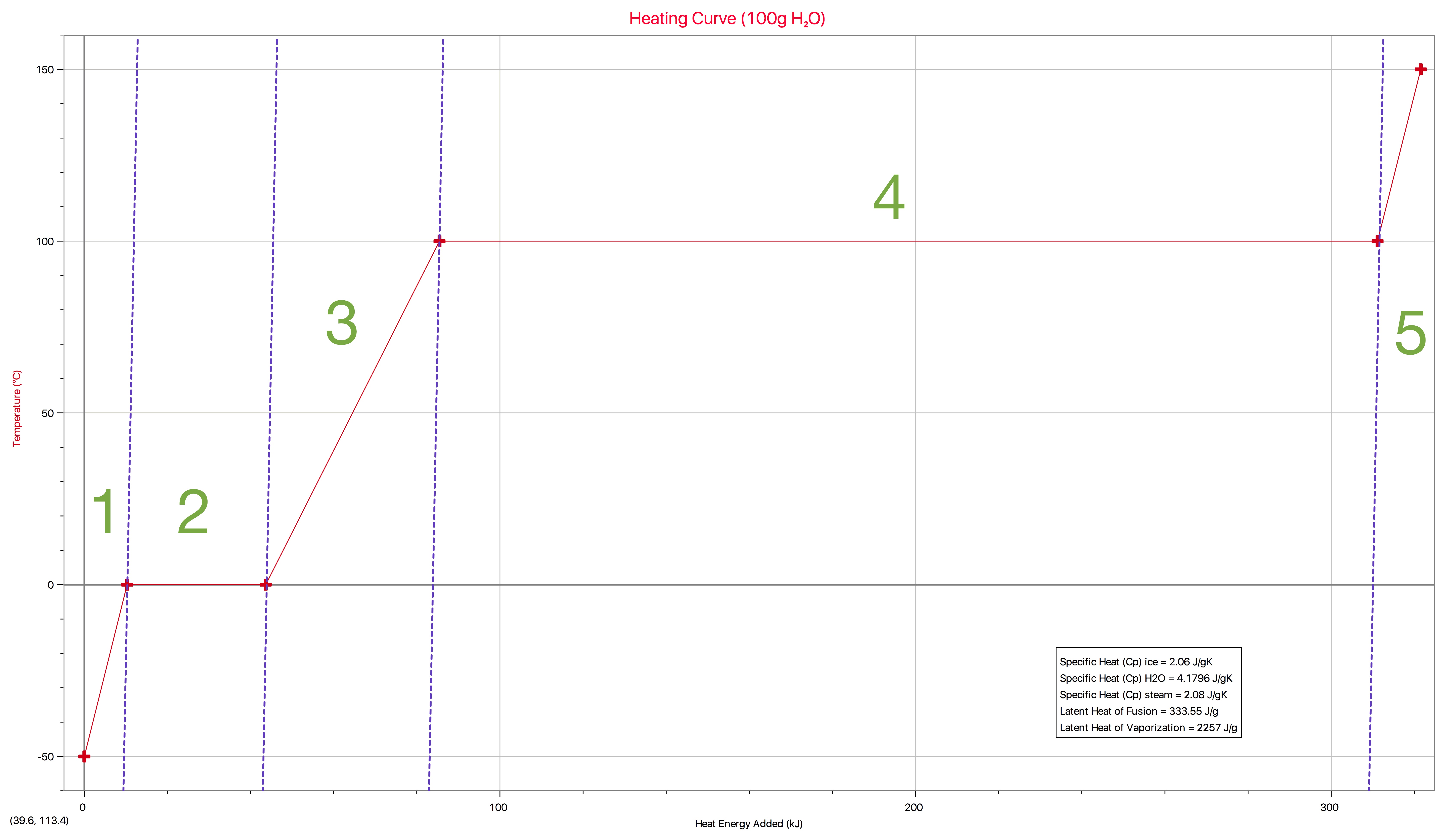
Where on the graph are phase changes taking place?

a)

1

b)

2

c)

3

d)

4

e)

5

41.

What line segment represents only the solid state? (Diagram F)

a)

A-B

b)

B-C

c)

C-D

d)

D-E

42.

Between which points is the temperature of the substance remaining constant? (Diagram F)

a)

A-B only.

b)

A-B, C-D, E-F

c)

B-C only.

d)

B-C, D-E

43.
True or false: melting and freezing occur at the same temperature!
a)
True
b)
False
c)
I don't know
44.

How long does it take this substance to change from a liquid to a gas? (Diagram E)

a)

1 minute

b)

2 minutes

c)

10 minutes

d)

15 minutes

45.

Gas pressure in a closed container is caused by

a)

gravity pulling on the particles

b)

collisions of particles with each other

c)

collisions of particles with the walls of the container

d)

attractive forces between the molecules

46.

The temperature of any substance is a measure of the average ________ of the particles.

a)

kinetic energy

b)

potential energy

c)

heat content

d)

calorie count

47.

The temperature at which a substance has no kinetic energy is

a)

-273 degree Celsius

b)

zero Kelvin

c)

absolute zero

d)

all of these

48.

Liquids have

a)

definite volume

b)

definite shape

c)

neither definite shape or definite volume

d)

both definite shape and definite volume

49.

Gases can be compressed because the particles are

a)

small

b)

large

c)

close together

d)

far apart

50.

The motion of the particles in a solid can be described as

a)

constant, rapid, random motion

b)

free to flow past each other

c)

vibrate in place

d)

no motion

51.

Solids with a highly ordered structure are

a)

frozen

b)

amorphous

c)

crystalline

d)

molecular

52.
7. All phase changes (changing states) requires energy to be added or taken away.
a)
True
b)
False
53.
Change from Gas to Solid is called........
a)
Sublimation
b)
Deposition
c)
Fusion
d)
condensation
54.

Which particles will have the greatest energy?

a)

Water liquid particles at 50oC

b)

Water vapour particles at 50oC

c)

Water liquid particles at 60oC

d)

Water vapour particles at 60oC

55.
The faster molecules move, 
a)
the higher the temperature
b)
the less temperature
c)
the same temperature
d)
I don't know
56.
The slower molecules move, 
a)
the higher the temperature
b)
the less temperature
c)
the same temperature
d)
I don't know
57.

Temperature is a measure of the average _____________ energy of the particles of a substance.

a)

potential

b)

kinetic

c)

gravitational

d)

heat

58.

These atoms are in a...

a)

solid.

b)

liquid.

c)

gas.

59.

These atoms are in a...

a)

solid.

b)

liquid.

c)

gas.

60.

These atoms are in a...

a)

solid.

b)

liquid.

c)

gas.