
NEW
Font size
 Worksheets
ES.9 Historical Geology Review
Total questions: 40
Worksheet time: 21mins

Which layer is the oldest?
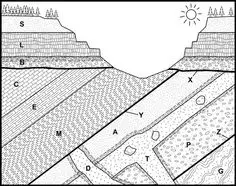
In the figure, "T" is _______?
an intrusion
a splitting spike
a contusion
an inclusion

A fossil found over a large area that only existed within a short time period:


All VA provinces have abundant fossils (and sedimentary rocks) EXCEPT ___________.

Absolute dating uses the ________ to determine the numerical ages of rocks & fossils.


The law of ________ states that older rocks are at the bottom, and younger rocks are at the top.
cross-cutting
intrusive relationships
superposition
original horizontality

The Earth is ______ years old.
4.6 million
4.6 billion
11.3 billion
3.5 billion

Dinosaurs, reptiles, and birds are the dominant life forms of this era:
"middle life"
Precambrian
Paleozoic
Mesozoic
Cenozoic

The end of an Era, and the end of life for most of organisms, is often caused by a:
Death
Mass extinction
Transition
Turning point

The end of the Mesozoic Era was most likely caused by?
A meteorite/asteroid
Too much oxygen
Lowering sea levels
An ice age

Which era best represents when humans first appeared on Earth?
"recent life"
Cenozoic
Mesozoic
Paleozoic
Precambrian

Use relative age dating to put the rock layers in correct order from oldest to youngest.
B, C, A, D, E
B, C, D, A, E
A, B, C, D, E
E, D, C, B, A
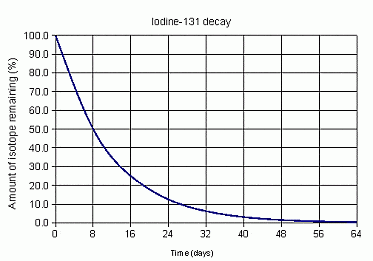
What is the half-life of iodine-131? (read the graph)

The period when huge land plants were dominant and eventually became the coal and oil we use today.
Cambrian
Carboniferous
Jurassic
Miocene

As ____ evolved, they changed Earth’s atmosphere by producing oxygen.
cyanobacteria
reptiles
trilobites
dinosaurs

What type of rock do almost all fossils form in?
Igneous
Sedimentary
Metamorphic
Classic

An insect encased in amber is an example of what type of fossil?
carbonaceous film
permineralized replaced remains
trace
preserved original remains

What type of fossil is evidence such as a footprint, burrow, or teeth marks left behind by an animal?
trace fossil
carbon film
petrified fossil
compression & impression

Which of the following environments would NOT
contain fossils?
a thick deposit of dried mud
sediments deposited in a riverbed
layers of sand that become sandstone
intrusive rock formed from cooled magma

Identify the type of fossil that you see here; these are also known as impressions and copies
trace fossil
mold and cast
petrified fossil
unaltered remains
carbon film

Identify the type of fossil that you see here; it is a dark silhouette outline of the plant
mold and cast
petrified fossil
unaltered remains
carbon film

_______is the amount of time for one-half of a radioactive element to decay into a stable isotope
half-life
radiocarbon dating
radiometric dating
radioactivity

a law of relative dating: a magma intrusion or fault is younger than any rock layer it cuts through
inclusions
original horizontality
cross-cutting relationships
angular unconformity

In which environment would you be LEAST likely to find a fossil?
Amber
Tar
Ice
Volcanic ash
Metamorphic rock

The body of an animal will likely become fossilized if:
There is little oxygen present
It has hard parts like bones and teeth
Is rapidly buried in sediment
All choices are correct

Carbon-14 dating can be used to date 65 myo permineralized dinosaur bones (replaced remains):
True
False

If a section of rocks are missing because of erosion, it is called a/an:
Inclusion
Unconformity
Fault
Intrusion

What are the divisions of geologic time based upon?
Dominant life forms present
Fossil records
Major geologic events
All of these

What evidence supports a meteorite impact 65mya caused the dinosaur extinction?
65myo iridium from the meteorite
65myo crater found
No dinosaur fossils younger than 65my
These are all evidence

What is the fossil fuel found and mined in the Appalachian Plateau Province?
Coal
Oil
Natural Gas
Uranium

Going in order from EAST to WEST what are the five Virginia Provinces?
Piedmont, Coastal Plain, Appalachian Plateau, Valley and Ridge
Valley and Ridge, Blue Ridge, Appalachian Plateau, Piedmont
Appalachian Plateau, Valley and Ridge, Blue Ridge, Piedmont, Coastal Plain
Coastal Plain, Piedmont, Blue Ridge, Valley and Ridge, Appalachian Plateau

Most of the gravel and sand deposits in Virginia are found in which region?
Coastal Plain
Piedmont
Valley & Ridge
Blue Ridge

Contains deep narrow valleys and steep rugged mountain sides through sedimentary rocks.
Contains sandstone as old as 320 million years old
Coal beds can be found here
Blue Ridge
Piedmont
Appalachian plateau
Valley and Ridge

This region is best known for its rolling hills and valuable resources like kyanite and high quality slate:
Piedmont
Appalachian Plateau
Coastal Plain
Blue Ridge

What is the oldest province?
Coastal Plain
Piedmont
Blue Ridge
Appalachian Plateau

Which province is known for its karst topography?
Piedmont
Coastal Plain
Valley & Ridge
Blue Ridge


