Wayground logo

Free Printable Worksheets

Font size

S
M
L
XL
Worksheets

Genetics

Total questions: 72

Worksheet time: 1hrs 12mins

Name
Class
Date
1.
In a heterozygous genotype, the ___________ allele takes over in the phenotype.
a)
recessive
b)
dominant
c)
lower case letter
d)
both 
2.
Aa is
a)
homozygous (purebred)
b)
heterozygous (hybrid)
3.
Which of the following alleles is homozygous (purebred) recessive?
a)
Tt
b)
tt
c)
TT
d)
t
4.
Which of the following is a phenotype?
a)
Aa
b)
red hair
c)
heterozygous genes
d)
mutated DNA
5.
G = green, g = yellow
The genotype for a yellow plant is...
a)
GG
b)
Gg
c)
gg
d)
all of the choices result in yellow
6.
T = tall an t = short
What is the phenotype for Tt?
a)
short
b)
tall
c)
medium sized
d)
neither tall or short
7.
How many alleles (letters) do each person carry for a trait?
a)
1
b)
2
c)
3
d)
4
8.
How many alleles (letters) does a child get from each parent for each trait?
a)
1
b)
2
c)
3
d)
4
9.
Which of the following is homozygous dominant?
a)
Yy
b)
Y
c)
yy
d)
YY
10.
How many chromosomes are in a sex cell?
a)
46
b)
23
c)
26
d)
43
11.
When a capital letter is used, what kind of allele is being represented?
a)
Recessive Allele
b)
Codominance
c)
Punnett Squares
d)
Dominant Allele
12.
When two identical alleles for a trait are in an organism, the organism is said to be ____________?
a)
Heterozygous
b)
Homozygous
c)
allele
d)
resseive
13.
characteristic that is inherited; can be either dominant or recessive
a)
genes
b)
allele
c)
chromosome
d)
trait
14.
The genetic characteristics of recessive genes
a)
tend to mask the characteristics of dominant genes.
b)
are always expressed in the phenotype.
c)
are usually codominant.
d)
tend to be masked by the characteristics of dominant genes.
15.
Genotype refers to the ...
a)
physical expression of the genes
b)
the possible combination of alleles in a gene
c)
whether an allele is dominant or recessive
d)
how an organism will appear
16.
An offspring will receive how many alleles from each parent to determine a specific trait?
a)
one
b)
two
c)
three
d)
five
17.
Which of the following is a phenotype?
a)
BB
b)
Bb
c)
bb
d)
Blue eyes
18.
What is a phenotype
a)
The genetic make up (code)
b)
The physical trait
19.
G = green, g = yellow
The genotype for a yellow plant is...
a)
GG
b)
Gg
c)
gg
d)
all of the choices result in yellow
20.
An allele whose trait only shows up when no dominant allele is present.
a)
hidden allele
b)
dominant allele
c)
recessive allele
d)
present allele
21.
What is the relationship between DNA and chromosomes?
a)
Chromosomes are made of DNA
b)
DNA is made of chromosomes
c)
DNA and chromosomes are the same thing.
d)
All of the above are correct
22.
Put in order smallest to largest:
a)
Chromosome - DNA - Gene
b)
Gene - DNA - Chromosome 
c)
DNA - Gene  Chromosome
d)
Chromosome - Gene  - DNA
23.
when you have two different genes
a)
heterozygous
b)
dominant
c)
homozygous
24.
when you have two of the same genes
a)
heterozygous
b)
recessive
c)
homozygous
25.
DD is an example of
a)
homozygous recessive
b)
dominant
c)
Homozygous dominant
d)
recessive
26.
Dd letters are an example of....
a)
heterozygous genes
b)
homozygous genes
c)
dominant genes
d)
recessive genes
27.
 Dominant alleles are-
a)
capital
b)
lowercase
c)
both
d)
neither
28.
 Recessive alleles are-
a)
capital
b)
lowercase
c)
both
d)
neither
29.
Which of the following terms refers to the different possibilities of a gene?
a)
chromosome
b)
DNA
c)
Punnett Squares
d)
allele
30.
Aa, DD, bB, yy are all examples of
a)
genotypes
b)
phenotypes
31.
Organisms that always produce offspring with the same traits are known as
a)
purebred
b)
hybrid
c)
dominant trait
d)
recessive trait
32.
Organisms that have inherited two different forms of the same trait, one from each parent
a)
purebred
b)
hybrid
c)
dominant trait
d)
recessive trait
33.
A homozygous dominant dog with brown fur is crossed with a heterozygous dog with brown fur. What are the percentages of the possible genotypes?
a)
100% BB
b)
75% BB and 25%Bb
c)
50 % BB and 50% Bb
d)
50% Bb and 50% bb
34.
W=white hair
w= non-white hair
If you cross a horse with WW and a horse with ww what fraction of the offspring would be expected to have white hair?
a)
none
b)
3/4
c)
1/2
d)
all
35.

A mom with the heterozygous gene for Widows peak and a father with the heterozygous gene for Widows peak: odds their baby HAS a widow's peak?

a)

0%

b)

25%

c)

75%

d)

100%

36.

A mom with a dominant HOMOZYGOUS gene of a hitchhiker's thumb and a dad with a homozygous recessive gene for a straight thumb. What is the baby's phenotype?

a)

50% straight thumb

b)

100% Hitchhiker's Thumb

c)

25% Hitchhiker's Thumb

37.
Which of the following alleles is homozygous (purebred) recessive?
a)
Tt
b)
tt
c)
TT
d)
t
38.
T - tall and t = short
In the punnett square below, what belongs in the missing square
a)
tt
b)
Tt
c)
Bb
d)
TT
39.
In a Punnett square each box represents a(n)....
a)
offspring
b)
parent
c)
gene
d)
trait
40.
Is this punnet square true or false?
a)
False, because there should be 3 dominate alleles.
b)
True.
c)
False, because There should be 3 recessive alleles.
d)
I don't know....
41.
A ________________________ is used to predict the possible genotype from certain parents
a)
Mendel Grid
b)
Genetic Tic Tac Toe
c)
Punnett Square
d)
Pedigree Plot
42.
Which is a true statements about this picture?
a)
Brown is recessive
b)
Brown is dominant
c)
Blue is dominant
d)
Blue is codominant
43.
What are the possible phenotypes in this punnett square?
a)
Bb, bb, BB
b)
purple, white
c)
Bb, bb
d)
light purple
44.
R=round seed
r=wrinkled seed.
Cross a homozygous round with a wrinkled. Which statement predicts the results?
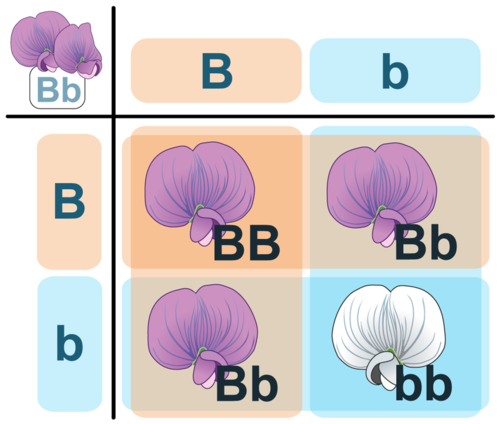
a)
offspring will be Rr
b)
offspring will be RR
c)
round seeds will be recessive to wrinkled
d)
Wrinkled will be observed in half of offspring
45.
In this punnett square, which is the dominant trait?
The B stands for bud.
a)
purple flower bud
b)
white flower bud
c)
dominant
d)
recessive
46.
Which of the following is a phenotype?
a)
Aa
b)
red hair
c)
heterozygous
d)
DNA
47.
If T=Tall & t=short, what is the genotypic ratio?
a)
1:3
b)
3:1
c)
1:2:1
d)
2:2
48.
A dog gives birth to 5 puppies. What percentage of the chromosomes does each puppy share with the mother?
a)
25%
b)
50%
c)
75%
d)
100%
49.
If green is dominant over purple, then what is the genotype for this individual?
a)
Purple
b)
Green
c)
GG
d)
gg
50.
Two brown eyed parents (Bb) have a baby. What is the chance the baby is blue eyed?
a)
0 %
b)
25%
c)
50%
d)
75%
51.
These cause variations.
a)
mutations
b)
adaptations
c)
a desire to change
d)
injuries
52.
A slight difference in an inherited trait between individual members of the same species.
a)
variations
b)
adapatations
c)
homologous structures
d)
analogous structures
53.
An inherited trait that increases an organism's chance of surviving and reproducing.
a)
variation
b)
adaptation
c)
vestigial structure
d)
mutation
54.
The discovery of DNA and genes proved that
a)
Darwin was wrong
b)
mutations create variations and come from genes
c)
we are all the same species
d)
bats and butterflies have a very close common ancestor
55.
When an organism of a species has an adaptation, it will compete for resources better, survive longer and pass that adaptation on to it's offspring. This process is called
a)
evolution by natural selection
b)
artificial selection
c)
inbreeding
d)
outbreeding
56.
Which of the following explains adaptation.
a)
An individual organism changes to meet its needs in the environment. These changes pass down to their offspring.
b)
The species as a whole changes their characteristics.
c)
Beneficial traits allow organism to survive and pass on those traits
d)
New characteristics arise in a species as needed.  If these traits are helpful, they are passed down.
57.

Which of these was not a form of adaptation mentioned in the reading?

a)

Structural

b)

Behavioral

c)

Survival

d)

Physiological

58.
A group of orangutan have become very similar after a series of drastic changes in their environment.  This similarity is likely the result of
a)
selective breeding
b)
random mutaion
c)
inbreeding
d)
natural selection
59.

Adaptations can be:

a)

camouflage

b)

ability to survive cold weather

c)

hunting skills

d)

all of the above

60.

How do you "win" at natural selection?

a)

survive

b)

go extinct

c)

survive & reproduce

61.
When every organism of a species has died.
a)
Evolution
b)
Natural Selection
c)
Extinction
d)
Artificial Selection
62.
Which organisms are most likely to survive?
a)
the best adapted
b)
the fastest
c)
the strongest
d)
the most domesticated (tamed)
63.

What word describes a trait that helps an organism survive in its environment?

a)

natural selection

b)

mutation

c)

camouflage

d)

adaptation

64.
Change over time
a)
Natural Selection
b)
Selective Breeding
c)
Homeostasis
d)
Evolution
65.

Natural Selection is driven by a change in the environment and survival of the

a)

Earth

b)

Fastest

c)

Fittest

d)

Biggest

66.
Survival of the Fittest and Evolution were proposed by what scientist?
a)
Charles Darwin
b)
Albert Einstein
c)
Steven Hawking
d)
Isaac Newton
67.
Why are advantageous traits more likely to be passed onto offspring?
a)
Because they are more likely to survive and reproduce.
b)
Because they come from dominant alleles.
c)
Because they come from recessive alleles.
d)
Because the trait is an acquired phenotype.
68.
Mutations are a change in what?
a)
DNA
b)
tRNA
c)
genotype
d)
phenotype
69.
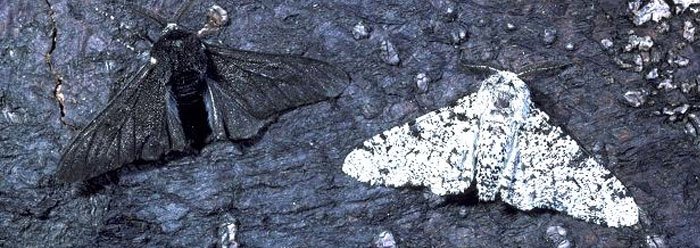
The trees these moths used to live on were white, but have been covered in soot from coal factories. Which moth will be more successful in this environment?
a)
Dark moth
b)
Light moth
c)
Both will be equally successful
d)
Neither will be successful
70.
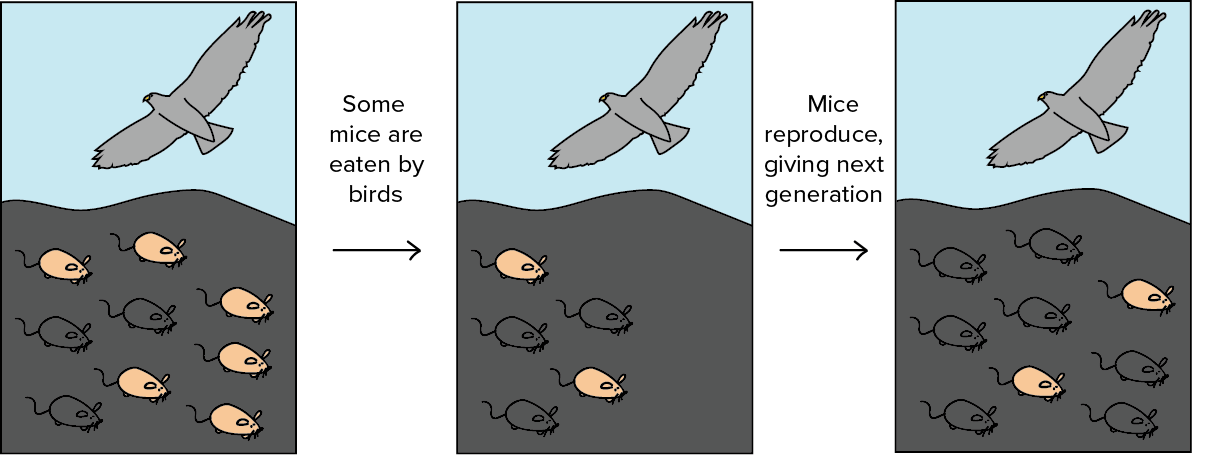
Why is the mouse population changing over time?
a)
The light mice can reproduce more successfully than the dark mice
b)
The hawks eat more dark mice than light mice because the dark mice taste better
c)
The hawks eat more light mice than dark mice because they can see the light mice more easily
d)
The hawks eat more dark mice than light mice because they can see the dark mice more easily
71.
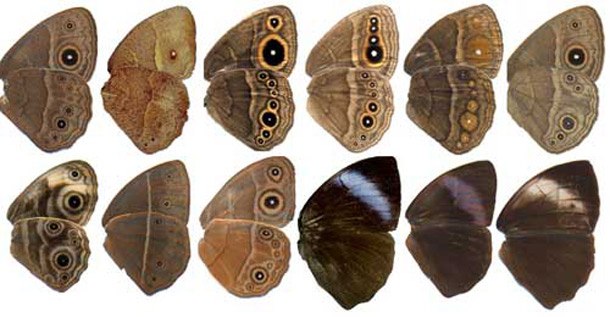
These moths are all the same species. The differences between their wings is an example of ________________
a)
Natural Selection
b)
Variation
c)
Homeostasis
d)
Extinction
72.
An organism's _________ is defined as the environment in which it lives.
a)
habitat
b)
niche
c)
social structure
d)
ecosystem