wayground logo

Free Printable Worksheets

Font size

S
M
L
XL
Worksheets

Comp. Science Advanced CFE Review

Total questions: 148

Worksheet time: 2hrs 57mins

Name
Class
Date
1.
Bobby observed that a metal trash can was covered with rust.  What type of weathering caused the rust on the trash can?
a)
Mechanical weathering 
b)
Wind weathering
c)
Chemical weathering
d)
Erosion weathering
2.
What is likely to cause cracks on the sidewalk?
a)
Repeated freezing and thawing of water
b)
Tree roots or plant roots growing bigger
c)
Both and A and B
d)
Neither A or B 
3.
A student hiking in a rock area on a mountain notices that wide, deep cracks have formed in some of the large rocks. Some of the cracks are so large that the rocks have broken apart. Which process most likely caused these rocks to crack and creak? 
a)
Erosion by wind
b)
Water freezing and thawing
c)
Erosion by fast-moving
d)
Sediments being deposited.
4.

The two main types of weathering are:

a)

mechanical and physical

b)

potential and kinetic

c)

chemical and physical

d)

potential and chemical

5.

Which event breaks rocks down into smaller pieces?

a)

Sedimentation

b)

Deposition

c)

Weathering

d)

Erosion

6.

In what way are weathering and erosion the same?

a)

Both move sediment from one place to another.

b)

Both break down rocks into smaller pieces

c)

Both change the Earth's surface

d)

Both leave sediment in new places

7.

Rain washing soil away from a hillside is an example of

a)

Abrasion

b)

Erosion

c)

Deposition

d)

Weathering

8.

The process of sediment being dropped off in a new place is called

a)

Abrasion

b)

Erosion

c)

Deposition

d)

Weathering

9.
A scientific name consists of 
a)
Genus and Order
b)
Genus and Domain
c)
Genus and species
d)
Kingdon and Phylum
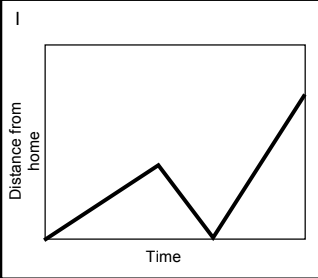
10.
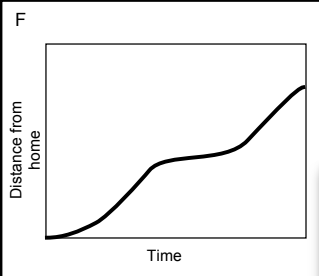
The most general in the order of classification is?
a)
Kingdom 
b)
Phylum 
c)
Class 
d)
Order
11.
The most specific of the classifications is?
a)
class 
b)
order 
c)
genus 
d)
species
12.
The 2 kingdoms that make up Prokaryotes are?
a)
Animals and Plants 
b)
Protists and Fungi
c)
Archea and Bacteria
13.
Kingdom, Phylum, Class, _______
a)
Family 
b)
Order
c)
Genus 
d)
Species
14.
The 8 levels of classification, most broad to most specific.
a)
Domain, Genus, Family, Order, Class, Phylum, Kingdom, Species
b)
Domain, Species, Kingdom, Genus, Phylum, Family, Class, Order
c)
Domain, Kingdom, Phylum, Class, Order, Family, Genus, Species
d)
Order, Kingdom, Species, Domain, Phylum, Family, Class, Genus
15.
Which organisms are most closely related?
a)
Equus caballas (Horse) & Equus burchellii (Zebra)
b)
Cyanea artica (Jellyfish) &
Ctenodiscus crispatus (Mud Starfish)
c)
Naja naja (cobra) & Glycine max (soya bean)
d)
Ophiocomina nigra (black brittle star) & Brassica nigra (black mustard)
16.

Why do scientists use scientific names?

a)

to confuse people

b)

to have a common language

c)

to allow people to say the same thing

d)

because common names are not appropriate

17.

When plants use their roots to get water from the ground, which 2 spheres are interacting? (choose 2)

a)

Geosphere

b)

Hydrosphere

c)

Atmosphere

d)

Biosphere

18.

When a river deposits sediment, which 2 spheres are interacting? (choose 2)

a)

Geosphere

b)

Hydrosphere

c)

Atmosphere

d)

Biosphere

19.

What is the biosphere?

a)

all the air and gases on the planet

b)

made up of living things

c)

the non-living soil, rocks, and minerals of the Earth

d)

the rivers, lakes, and oceans of the Earth

20.

What is the geosphere?

a)

all the air and gases on the planet

b)

all the frozen water on the Earth

c)

the non-living soil, rocks, and minerals of the Earth

d)

the rivers, lakes, and oceans of the Earth

21.

When lake water evaporates, the interaction is between the __________ and the _____________.

a)

atmosphere and hydrosphere

b)

biosphere and geosphere

c)

hydrosphere and geosphere

d)

atmosphere and biosphere

22.

When an animal or human breathes air, the interaction is between the __________ and the _____________.

a)

atmosphere and hydrosphere

b)

biosphere and geosphere

c)

hydrosphere and biosphere

d)

atmosphere and biosphere

23.

what is a cryosphere

a)

parts of earth with animals

b)

hot parts of earth

c)

a portion of earth with solid water

24.

Select the image that best shows the cryosphere and the biosphere interacting.

a)
b)
c)
d)
25.

Which best describes how winds in the jet stream blow?

a)

no pattern

b)

between a boundary of cold air and warm air

c)

between two boundaries of hot air

d)

between two boundaries of cold air

26.

What kind of weather would you expect if the jet stream met the gulf stream?

a)

cirrus clouds

b)

sunny skies

c)

sunny skies

d)

clouds, storms and precipitation

27.

What kind of weather would you expect at the place marked "X" on the weather map?

a)

warm and wet

b)

cold and wet

c)

cold and sunny

d)

cold and clear

28.
What causes wind?
a)
convection currents
b)
conduction currents
c)
radiation currents
d)
tropical currents
29.
Winds are caused by 
a)
equal heating 
b)
unequal heating
30.
What is the instrument called that measures air pressure?
a)
thermometer
b)
ruler
c)
yard stick
d)
barometer
31.
Why does warm air rise?
a)
Warm air is more dense than cooler air.
b)
Warm air has more pressure than cooler air.
c)
Warm air is less dense than cooler air.
d)
Warm air has a higher dew point than cooler air.
32.
Which of these MOST likely causes winds to blow on Earth?
a)
Earth spins quickly, causing air to blow around.
b)
The gravity of Earth and the Moon push and pull the air.
c)
Warm air rises and cool air falls toward Earth's surface.
d)
Ocean waves push air onto the shore and across Earth's surface.
33.
Which describes how wind speed if affected by weather?
a)
rainy weather causes greater wind speeds
b)
warmer weather causes greater wind speeds
c)
differences in air pressure cause greater wind speeds
d)
small temperature changes cause greater wind speeds
34.
I am a fast-moving ribbon of AIR that moves from west to east in the Northern Hemisphere around the Earth.
a)
California Current
b)
Gulf Stream
c)
Jet Stream
d)
Atlantic Ocean
35.
Which is most responsible for guiding the movement of different air masses across the United States?
a)
the oceans
b)
trade winds
c)
the jet stream
d)
easterly winds
36.
Wind is caused mainly by air pressure differences that result from...
a)
a. uneven heating of the Earth's atmosphere.
b)
b. absorption of ultraviolet radiation by Earth's land masses.
c)
c. radiation of heat from Earth's land masses to water bodies.
d)
d. rotation of Earth on its axis.
37.
What kind of breeze is this & what time of day/night would it form?
a)
Land breeze - daytime
b)
Land breeze - nighttime
c)
Sea breeze - daytime
d)
Sea breeze - nighttime
38.
Which statement correctly defines wind?
a)
Wind is the movement of air from areas of low pressure to areas of high pressure
b)
Wind is the movement of air to a colder area in the atmosphere.
c)
Wind is the movement of air from areas of high pressure to areas of low pressure.
d)
Wind is the movement of air pushed around and bouncing off Earth's surface.
39.
Where does the initial source of energy come from that creates winds?
a)
the moon
b)
the sun
c)
the Earth's surface
d)
the rotation of the Earth
40.
Land and water absorb and release the sun’s heat in different ways. One result of this is a sea breeze. Which statement is true of sea breezes?
a)
They originate in the day and blow toward the land.
b)
They originate in the day and blow toward the water.
c)
They originate in the evening and blow toward the land.
d)
They originate in the evening and blow toward the water.
41.
Which term is best described as the movement of air from land to sea?
a)
global winds
b)
sea breeze
c)
land breeze
d)
local winds
42.
What causes global winds and convection in the atmosphere? 
a)
continental deflection
b)
the rotation of the Earth
c)
Moon's gravity
d)
unequal heating of the Earth by the sun
43.
What organs make up the skeletal system?
a)
Muscles
b)
Bones
c)
Heart
d)
Lungs
44.
What is the purpose of the muscular system?
a)
To breathe
b)
To digest food
c)
To move
d)
To release hormones
45.
What is the main organ involved in the nervous system?
a)
Heart
b)
Lungs
c)
Brain
d)
Bones
46.
What is the purpose of the digestive system?
a)
To digest food
b)
To breathe
c)
To move
d)
To create hormones
47.
What is the main function of the nervous system?
a)
To communicate with the rest of the body
b)
To pump blood
c)
To breathe
d)
To clean the body
48.
Where does the digestive system begin?
a)
The brain
b)
The mouth
c)
The lungs
d)
The stomach
49.
What does food provide for the body?
a)
it's like a computer
b)
Energy
c)
Support
d)
Oxygen
50.
What organ decides when you breathe?
a)
The lungs
b)
The brain
c)
The stomach
d)
Nerves
51.
What three parts make up the nervous system?
a)
Brain, lungs and heart
b)
Brain, spine and nerves
c)
Lungs, heart and spine
d)
Spine, nerves and vessels
52.
Which part of the body is like a mixer?
a)
Mouth
b)
Esophagus
c)
Stomach
d)
Lungs
53.
The main purpose of the ____________ system is to break food particles into pieces that can be used.
a)
circulatory
b)
respiratory
c)
digestive
d)
skeletal
54.
What is responsible for delivering oxygen and removing carbon dioxide from the body?
a)
cell nucleus
b)
excretory system
c)
nervous tissue
d)
respiratory system
55.
___________ are the building blocks of life.
a)
cells
b)
legos
c)
blocks
d)
blood
56.
The circulatory system uses _________ to deliver oxygen to the rest of the body.
a)
blood cells
b)
lungs and nose
c)
blood vessels
d)
brain and spinal cord
57.
In multicellular organisms, tissues are comprised of _______.
a)
organs
b)
systems
c)
cells
d)
blood
58.
When tissues come together, they form ___________.
a)
cells
b)
atoms
c)
organs
d)
systems
59.
A(n) _________ is made of small parts connected together to make a whole.
a)
system
b)
problem
c)
evidence
d)
illustration
60.
Which of the following body systems work together for support, protection, and movement?
a)
respiratory and cardiovascular
b)
skeletal and muscular
c)
skeletal and integumentary
d)
digestive and respiratory
61.
What body system removes the waste from your body? 
a)
Circulatory
b)
Excretory
c)
Digestive
d)
Respiratory
62.
This system carries oxygen, nutrients and waste around the body.
a)
Lymphatic
b)
Urinary
c)
Respiratory
d)
Circulatory
63.
The main function of the excretory system is....
a)
To filter waste from the blood stream and carry it outside of the body.
b)
To transport nutrients to the body.
c)
To break down nutrients for absorption.
d)
To provide structure and support for the body.
64.
What body system protects animals against invaders such as bacteria and viruses?
a)
Immune System
b)
Integumentary System
c)
Mammary System
d)
Respiratory System
65.
All foreign materials that cause a response from the immune system are called _____________________.
a)
Antigens
b)
Active Immunity
c)
Antibodies
d)
Antibiotics
66.
What is the first barrier against disease?
a)
White blood cells
b)
Red blood cells
c)
the skin
d)
leucocytes 
67.
If you are feeling ill and the doctor prescribes you some antibiotics to help you feel better, you are infected with a _______
a)
Virus
b)
Bacteria
68.
The purpose of the immune system is to:
a)
Help germs invade your body
b)
Fight off sickness
c)
Make your nose run
d)
Give you diarrhea
69.
What are the 4 types of GERMS?
a)
parasite,ouchy,bug,animal
b)
parasite, fungi, animal,insect
c)
parasite,fungi,virus,bacteria
d)
bug,bird,goat,bear
70.

The _______ is the smallest structural and functional unit of a living thing. (this will be matching on the test)

a)

cell

b)

metabolism

c)

nutrition

d)

defense

71.

______ is keeping conditions in the cell balanced. (This will be a matching question on the test)

a)

Homeostasis

b)

Response

c)

Metabolism

d)

Nutrition

72.

Which choice is NOT part of the cell theory.

a)

All organisms are composed of cells.

b)

Cells are the basic unit of life.

c)

All cells come from previous cells.

d)

Cells are always the same size and shape.

73.

What happened that allowed cells to be studied?

a)

Cells increased in size.

b)

Scientists began to work together.

c)

Scientists became smarter.

d)

The microscope was invented and improved.

74.

What is a benefit of the development of the cell theory?

a)

Cells have made microscopes improve.

b)

There are less biologists today.

c)

There is more diseases on Earth now.

d)

Scientists now know much more about cells and bacteria, which allows them to better treat disease.

75.
All existing cells are produced by other
a)
living cells
b)
dead cells
c)
atom cells
d)
animal cells
76.
The Cell Theory states...
a)
atoms create all matter
b)
living things evolve
c)
the cell is the backbone of all matter
d)
cells are the basic unit of structure and organization of organisms
77.

Cell theory states that...

a)

cells are the basic building block of life

b)

cells are cool

c)

cells are microscopic

d)

cells cannot be destroyed

78.
Which of the following is the correct order of organization in living things from most basic (simple) to most complex?
a)
a.  Organism, cell, tissue, organ, organ system
b)
a.  Organ system, organ, tissue, cell, organism
c)
a.  Cell, tissue, organ, organ system, organism
d)
a.  Cell, organ, tissue, organ, organism, organ system
79.
When a group of organs work together to perform a particular function they create a/an
a)
organ system
b)
organism
c)
tissue
d)
organ
80.
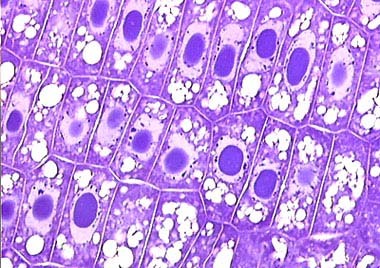
This is a example of ........
a)
cell
b)
tissue
c)
organ 
d)
organ system
81.
A molecule is made up of ____ or more atoms.
a)
1
b)
2
c)
3
d)
4
82.

What is the picture displayed?

a)

Carbon Dioxide

b)

Water

c)

Gasoline

d)

Liquid Nitrogen

83.

A prediction that can only be supported or not supported by scientific experimentation.

a)

hypothesis

b)

theory

c)

law

84.

Explains something we see in the natural world that has been verified through repeated experiments or testing.

a)

hypothesis

b)

law

c)

theory

85.

A ___ is observed and describes in the natural world what appears to always be true.

a)

hypothesis

b)

theory

c)

law

86.

Describes how nature works.

a)

hypothesis

b)

theory

c)

law

87.

Can only be explained mathematically.

a)

hypothesis

b)

theory

c)

law

88.

What is energy?

a)

moving energy

b)

stored energy

c)

renewable energy

d)

The ability to do work.

89.

What is potential energy?

a)

moving energy

b)

stored energy

c)

renewable energy

d)

non renewable energy

90.

What is kinetic energy?

a)

moving energy

b)

potential energy

c)

stored energy

d)

renewable energy

91.
Which of the following is the main source of energy for living things?
a)
Food
b)
Gasoline
c)
Electricity
d)
Batteries
92.
A roller coaster has both kinetic and potential energy.
a)
True
b)
False
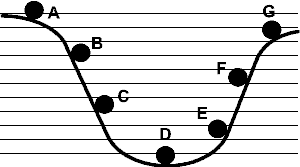
93.

At which point does the ball has the greatest gravitational potential energy (GPE)?

a)

A

b)

G

c)

D

d)

C

e)

G

94.

How could you increase the gravitational potential energy of an object without changing its mass and gravity?

a)

Make the object larger

b)

Lower the object towards the ground

c)

Raise the object farther off the ground

d)

Allow the object to roll on the ground

95.
The faster an object moves, the ________ kinetic energy it has. 
a)
more
b)
less
c)
none of the above
d)
all of the above 
96.
What kind of energy is in a rock at the edge of a cliff?
a)
Potential
b)
Kinetic
97.
As mass increases, KE ...
a)
increases
b)
decreases
c)
stays the same
98.
Matter can not be created nor destroyed: it can only be
a)
Destroyed a little bit
b)
Invisible
c)
Transformed, changed
d)
None of the above
99.
What is the Law of Conservation of mass?
a)
Mass is created in a chemical reaction
b)
Mass is created in a physical change
c)
New chemicals formed from a chemical reaction have a larger overall mass than the original reactants
d)
Mass is never created or destroyed
100.
As energy transformations occur within a system, the total energy of the system __________________.
a)
remains constant
b)
increases
c)
is transferred out of the system
d)
decreases
101.
Which runner stopped for a rest?
a)
Albert
b)
Bob
c)
Charlie
102.
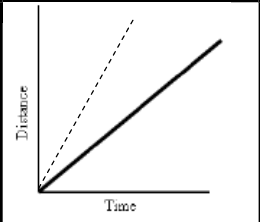
What does this graph represent?
a)
Constant Speed
b)
Acceleration
c)
Not moving
103.
Which runner had a head start?
a)
A
b)
B
c)
C
104.

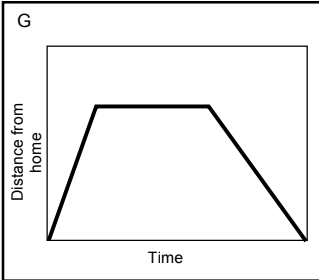
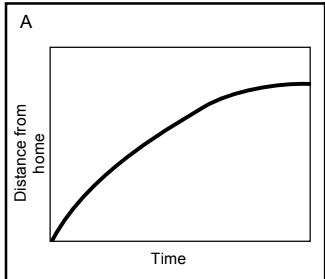
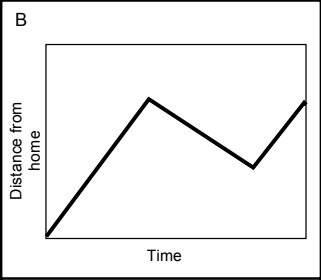
Susie went to the store, when she got there she realized that she forgot her wallet and returned home.


Which graph matches this motion?
a)
b)
c)
d)
105.

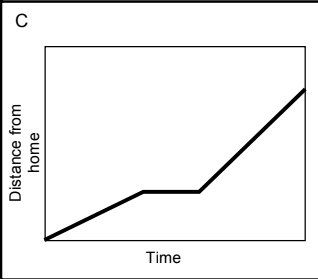
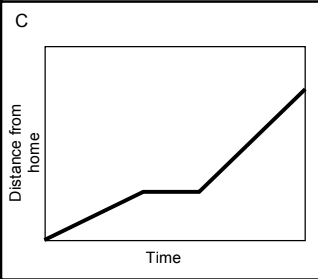
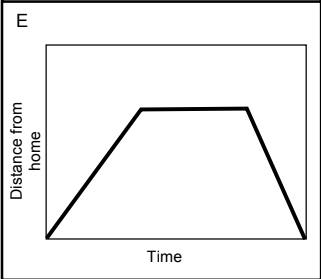
Deb walked to the ice cream shop. Sat and ate her ice cream and then went for a run.


Which graph matches this motion?
a)
b)
c)
d)
106.

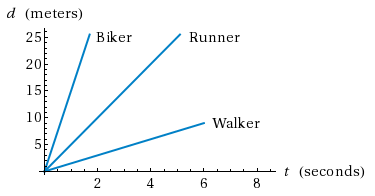
Which person moved the fastest in 3 seconds?

a)

biker

b)

runner

c)

walker

d)

they are all moving equally

107.
What is the net force?
a)
20 N 
b)
0 N 
c)
400 N 
d)
40 N 
108.

What is the unit to MEASURE force?

a)

Kilogram

b)

Meter

c)

Pounds

d)

Newton

109.

A ____________ is a push or a pull on an object.

a)

friction

b)

force

c)

magnet

d)

gravity

110.
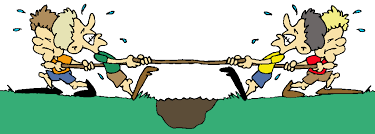
If these teams are pulling with the same amount of force what will happen?
a)
The boy in blue will win.
b)
They will not move at all.
c)
The boy in red will win.
d)
Both will fall down.
111.

Forces that have a net force of zero Newtons

a)

Balanced force

b)

Unbalanced force

112.
The sum of all forces acting on an object.
a)
Contact Force
b)
Balanced Force
c)
Unbalanced Force
d)
Net Force
113.
What will cause an object to move?
a)
Applied forces
b)
Balanced forces
c)
Unbalanced forces
114.

Which example would be a balanced force?

a)

Train moving at a constant speed in the same direction.

b)

A skier going down a hill.

c)

A basketball being passed to a teammate.

d)

An apple falling to the floor.

115.

Magnetism is a...

a)

Contact Force

b)

Non-Contact Force

116.

Air resistance is a...

a)

Contact Force

b)

Non-Contact Force

117.

Static Friction is a...

a)

Contact Force

b)

Non-Contact Force

118.

Gravity is a...

a)

Contact Force

b)

Non-Contact Force

119.

What is the net force acting on the box?

a)

2 N left

b)

2 N right

c)

8 N up

d)

8 N right

120.
When water is heated in the ocean by the sun and turns into water vapor
a)
condensation
b)
evaporation
c)
transpiration
d)
runoff
121.
After condensation, the droplets of water in the clouds fall to the earth in different forms
a)
precipitation 
b)
condensation
c)
evaporation 
d)
ground water
122.
Precipitation occurs because 
a)
the droplets evaporate in the air
b)
the droplets are too light for the air to hold
c)
the droplets are too heavy for the air to hold
123.
The sun's energy 
a)
changes daily
b)
heats the ocean before evaporation
c)
directly causes evaportation
124.
The ________ is the driving force of the earth's surface.
a)
sun
b)
moon 
c)
stars
125.
The water cycle has no start or end
a)
true
b)
false
126.
During which stage do clouds form?
a)
condensation
b)
evaporation
c)
precipitation
127.
Which stages does liquid water from the ocean turn into water vapor?
a)
condesantion
b)
evaporation
c)
precipitation
d)
run off
128.

True or False: All plants produce flowers.

a)

True

b)

False

129.
Which of the following structure can be found in a plant cell but NOT an animal cell?
a)
vacuole
b)
nucleus
c)
chloroplast
d)
mitochondria
130.
Which would be found in the cell of a sunflower plant but not in the cell of a chicken?
a)
cell wall
b)
vacuole
c)
mitochondria
d)
cell membrane
131.

Cell structures that perform specific functions are called

a)

tissues

b)

organs

c)

organelles

d)

organ systems

132.
Plants and animal cells both have a nucleus.
a)
True
b)
False
133.
Which 2 organelles are in plants and animals?
a)
cell wall and cytoplasm
b)
nucleaus and plastids
c)
cell membrane and cytoplasm
d)
cell membrane and chlorophast
134.
The vacuoles in ________ cells are smaller.
a)
Animal
b)
Plant
135.

The cell membrane...

a)

is like a wall that blocks everything from going into the cell

b)

controls what can go into or out of a cell

c)

is hard and rigid, and gives the cell its shape, like an exoskeleton

136.

Which part of the cell CONTROLS everything that happens in the cell?

a)

mitochondria

b)

nucleus

c)

cell membrane

d)

vacuole

137.

Which cell part produces energy?

a)

mitochondria

b)

nucleus

c)

vacuole

d)

cytoplasm

138.

A cell wall...

a)

is very soft and flexible

b)

is very rigid, and supports the plant cell, giving it its shape

c)

is the part that is inside the plant's nucleus

139.

True or False?: Chloroplasts contain chlorophyll, a substance that absorbs the sun's light.

a)

True

b)

False: chloroplasts contain only water and minerals.

c)

False: chloroplasts contain air, like little balloons in the leaf.

140.

What step does every scientific experiment begin with?

a)

hypothesis

b)

question/problem

c)

background research

d)

conclusion

141.

The __________________________________ is the organized way scientists answer questions and solve problems.

a)

scientific method

b)

scientific explanation

c)

scientific notation

d)

scientific guesses

142.
The things that are kept the same to ensure the results are due to the experiment is called..
a)
Control
b)
Constant
c)
Independent Variable
d)
Dependent Variable
143.
The variable the is changed on purpose is..
a)
Constant
b)
Control
c)
Independent Variable
d)
Dependent Variable
144.
The variable that is being tested, counted, or measured and is responding to the independent variable is known as 
a)
Control
b)
Constant
c)
Independent Variable
d)
Dependent Variable
145.
Which brand of paper towel will absorb the most liquid? What is the dependent variable?
a)
brand of paper towel
b)
amount of water absorbed
146.

Justin wants to determine the effect of fertilizer on the growth of grass. What is the independent variable?

a)

amount of fertilizer

b)

height of grass

c)

type of plant

d)

time

147.

What is another term for the independent variable?

a)

responding variable

b)

manipulated variable

c)

constant variable

d)

control

148.
The steps of the scientific method, in order are:
a)
Observation, Research, Hypothesis, Plan, Collect Data, Conclusion
b)
Hypothesis, Plan, Collect Data, Conclusion, Observation, Research
c)
Observation, Research, Collect Data, Plan, Hypothesis, Conclusion
d)
Conclusion, Observation, Research, Collect Data, Plan, Hypothesis