wayground logo

Free Printable Worksheets

Font size

S
M
L
XL
Worksheets

7th Grade Final Review

Total questions: 90

Worksheet time: 2hrs 33mins

Name
Class
Date
1.
At Dominique's Donuts the number of donut holes in a bag can vary. Help Dominique find the mode.
12,10,10,10,13,12,11,13,10
a)
13
b)
12
c)
11
d)
10
2.
Find the mean of these numbers:
2, 57, 38, 42, 6
a)
29
b)
38
c)
50
d)
145
3.
In order to find the median, the data must be sorted from least to greatest first.
a)
True
b)
False
4.
Whats the Range?
a)
TWO
b)
SIX
c)
SEVEN
d)
NINE
5.

If I drink a lot of water then I will have to go to the bathroom.


What is the red part?

a)

Independent Variable

b)

Dependent Variable

6.

What is the 1st step of the scientific method?

a)

Analyze Data

b)

Compare Results

c)

Ask a Question

d)

Make a Hypothesis

7.
A series of steps used by scientists to solve a problem or answer a question. 
a)
scientific method
b)
recipe
c)
data collection
d)
metric system
8.
A testable explanation to a problem that has not yet been tested. 
a)
data
b)
theory
c)
hypothesis
d)
fact
9.
Change from standard form to scientific notation: 12,000,000
a)
12.0  x  107
b)
0.12  x  107
c)
1.2  x  106
d)
1.2  x  107
10.
Try to change the number back to standard form:  6.79  x  104
a)
679,000
b)
6,790
c)
67,900
d)
6,790,000
11.

How many more stamps does John have than Kristin?

a)

2

b)

3

c)

6

d)

9

12.
At 60 seconds, how far had this object traveled? 
a)
0 m
b)
10 m
c)
20 m
d)
40 m
13.
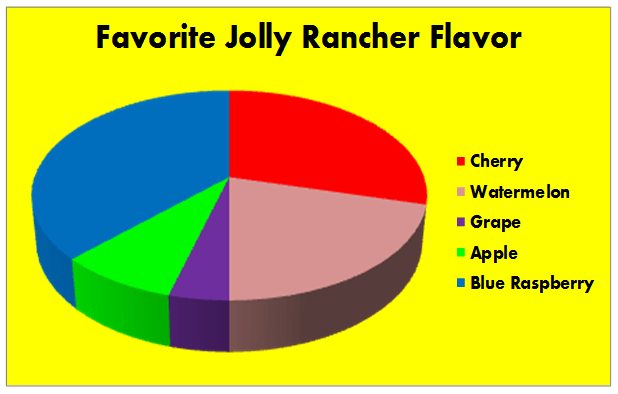
According to this circle graph, what is the least popular flavor of Jolly Rancher?
a)
Blue Rasberry
b)
Watermelon
c)
Grape
d)
Apple
14.
Which of the following is true for ALL living things? 
a)
All living things can move independently.
b)
All living things need insulin to survive.
c)
All living things have brain cells.
d)
All living things grow.
15.

Which of the following is NOT a characteristic of living things.

a)

Movement

b)

Respiration

c)

Interacts with other species

d)

Reproduction

16.

Responding to your environment is a characteristic of life. We call this characteristic of life _____.

a)

Respiration

b)

Response to Stimuli

c)

Excretion

d)

Nutrition.

17.

Put a check next to ALL of the characteristics of life.

a)

Movement

b)

Respiration

c)

Stimuli

d)

Growth

e)

Has a heartbeat

18.

Which biome is also known as the "Temperate Forest"?

a)

Deciduous Forest

b)

Tropical Rain Forest

c)

Tundra Forest

d)

Taiga Forest

19.

Which biome is hot and humid all year round with plenty of rain?

a)

Tundra

b)

Tropical Rain Forest

c)

Taiga

d)

Temperate Forest

20.

Which land biome is the coldest in temperature without any trees?

a)

Taiga

b)

Grassland

c)

Tundra

d)

Deciduous Forest

21.

Organisms in this smallest taxonomic group share many characteristics.

a)

domain

b)

kingdom

c)

species

d)

class

22.

The science of describing, classifying, and naming living things is called:

a)

Geology

b)

Biology

c)

Taxonomy

d)

Chemistry

23.

The scientific name for an organism is made from the:

a)

class and family name

b)

genus and species name

c)

domain and kingdom name

d)

kingdom and phylum name

24.
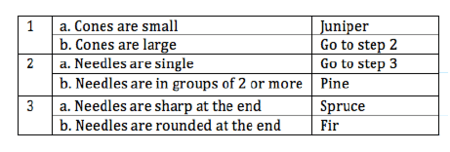
A dichotomous key for trees is provided. Hikers found a tree that has large brown cones and single sharp needles. What species of tree have the hikers found?
a)
Juniper
b)
Pine
c)
Spruce
d)
Fir
25.
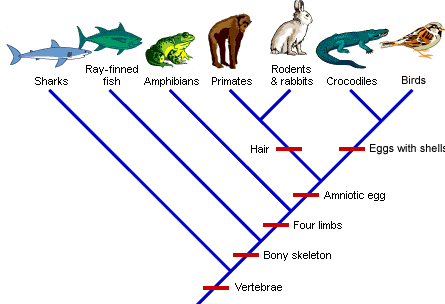
According to this cladogram, birds are LEAST related to: 
a)
Amphibians
b)
Sharks
c)
Ray Finned Fish
d)
Crocodiles
26.
What does a food web represent?
a)
All connections of energy flow throughout all organisms in a habitat.
b)
The specific ways that mutualism is carried out.
c)
A single pathway or energy flow between organisms. 
d)
How carnivores get their food. 
27.
relationship in which two species live closely together
a)
resource
b)
mutualism
c)
succession
d)
symbiosis
28.
The image provided is an example of a(n):
a)
Carnivore
b)
Herbivore
c)
Producer
d)
Autotroph
29.
The nonliving aspects of an ecosystem.
a)
Abiotic factors
b)
Biotic factors
30.
 plants that convert energy from the sun
a)
decomposer
b)
primary consumer
c)
secondary consumer
d)
producer
31.
Which cell structure is found in plant and animals cells and controls what can come into or leave a cell?
a)
cell membrane
b)
cytoplasm
c)
nucleus
d)
vacuole
32.
What is one basic function of the vacuoles?
a)
circulating oxygen
b)
producing food
c)
controlling cell processes
d)
storing water
33.
Chloroplasts in plant cells allow the plant to perform a function that animal cells cannot do.  What is the main function of the chloroplasts found in plant cells?
a)
to absorb light energy and manufacture food
b)
to remove waste materials by active transport
c)
to manufacture chemical energy from food
d)
to control the shape of the cell
34.
All cells need energy to function.  Which cell organelle is responsible for producing energy in the cell?
a)
chloroplasts
b)
mitochondria
c)
nucleus
d)
vacuoles
35.
What is the function of a cell wall?
a)
to protect and support the cell
b)
to perform different functions in each cell
c)
to prevent water from passing through it
d)
to prevent oxygen from entering the cell
36.

What are the "X" shaped things in the drawing.

a)

PMATs

b)

Chromosomes

c)

Ribosomes

d)

Telophase

37.

During what phase of Mitosis do the chromosomes line up in the Middle

a)

Metaphase

b)

Prophase

c)

Telophase

d)

Anaphase

38.

PMAT helps us remember the correct order of the phases of Mitosis. Which of the following has the phases of Mitosis in the correct Order

a)

Interphase, Mitosis, Cytokinesis

b)

Prophase, Metaphase, Anaphase, Prophase

c)

Anaphase, Telophase, Prophase, Telophase

d)

Prophase, Metaphase, Anaphase, Telophase

39.

The process of photosynthesis enables plants to sustain themselves by creating...?

a)

glucose

b)

chlorophyll

c)

water vapor

d)

carbon dioxide

40.

Which of these best classifies the form of energy that is converted to consumable forms in the food chain?

a)

Heat

b)

light

c)

mechanical

d)

gravitational

41.

Which of the following is the correct chemical equation for cell respiration?

a)

6CO₂ + C₆H₁₂O₆ + 6O₂+ ATP --> H₂0

b)

CO₂ + H₂0 + light energy in Chlorophyll ---> C₆H₁₂O₆ + 6O₂

c)

6CO₂ + 6H₂0 + light energy in Chlorophyll ---> C₆H₁₂O₆ + 6O₂

d)

C₆H₁₂O₆ + 6O₂ ---> 6CO₂ + 6H₂0 + ATP

42.

What is the whip-like 'tail' that bacteria use for movement?

a)

Cell wall

b)

Ribosome

c)

Flagella

d)

Cytoplasm

43.
Bacteria come in all of the following shapes EXCEPT which?
a)
spiral
b)
rod-like
c)
rectangular
d)
spherical
44.
Bacteria are prokaryotes which means they
a)
have a nucleus on their capsule
b)
do not contain a nucleus
c)
can live in environments with and without oxygen
45.

A vaccine triggers your body to produce _____________ which help fight infections.

a)

antibiotics

b)

antibodies

c)

antigens

46.

Antibiotics only work against what organisms ?

a)

viruses

b)

bacteria

c)

prions

47.

As a virus changes over time, it can affect different systems within the organism. This change of the virus is called a _______________.

a)

mutation

b)

melanin

c)

metaphysics

48.
Is a virus considered living or non-living?
a)
Living
b)
Non-Living
c)
Neither
49.
Where do viruses reproduce?
a)
Outside of a cell
b)
Inside of a cell
c)
They do not reproduce
50.

A chart that traces the history of traits in a particular family

a)

DNA

b)

pedigree

c)

chromosome

d)

variation

51.
The passing of inherited traits from parents to offspring
a)
acquired traits
b)
inherited traits
c)
heredity
d)
genetics
52.
What is a phenotype
a)
The genetic make up (code)
b)
The physical trait
53.
having two of the same genes for the trait (sometimes called purebred).
a)
homozygous
b)
hetrozygous
c)
protein
d)
chromosome
54.
having two different genes for a trait (sometimes called hybrid).
a)
protein
b)
homozygous
c)
heterozygous
d)
genotype
55.
G = green, g = yellow
The genotype for a yellow plant is...
a)
GG
b)
Gg
c)
gg
d)
all of the choices result in yellow
56.
_____________________ carries information for inherited traits.
a)
DNA
b)
FBI
c)
RNA
d)
CBS
57.

Some protist have tiny hairs called _________ to help them move.

a)

Cilia

b)

flagella

c)

psuedopod

58.

Most protists are

a)

unicellular

b)

multicellular

59.

____________ usually have a plant partner to help them survive.

a)

protists

b)

fungi

60.

An organism that has cell walls, reproduce using spores, and absorb food from the outside of their body are classified as __________

a)

plants

b)

fungi

c)

protists

d)

animals

61.

What are the branching tubes fungi use to absorb food called?

a)

hyphae

b)

amoeba

c)

algae

d)

pseudopod

62.
Plants that do NOT have true roots, stems and leaves and get their water through osmosis are.... 
a)
vascular plants 
b)
nonvascular plants 
63.
Which is NOT a part of the female reproductive structures in a plant? 
a)
Filament 
b)
Pistil 
c)
Ovary 
d)
Style 
64.
A non-flowering plant that produces seeds that are NOT enclosed in a fruit is called... 
a)
petal 
b)
angiosperm 
c)
gymnosperm 
d)
stamen 
65.
Plants whose seeds that are protected by fruits are called.... 
a)
conifer
b)
gymnosperm 
c)
angiosperm 
66.
Cones are the reproductive structures of ......
a)
angiosperms 
b)
gymnosperms
c)
mosses
67.
The waxy covering of a leaf is called ...
a)
stem 
b)
angiosperm 
c)
cuticle 
d)
petal 
68.
What attracts pollinators to a flower? 
a)
bright colored petals 
b)
nectar 
c)
sweet scent 
d)
all of the above
69.
All of the following body systems can be found in a segmented worm EXCEPT the _______.
a)
Circulatory
b)
Digestive
c)
Reproductive
d)
Skeletal
70.
All mollusks have an external shell.
a)
True
b)
False
71.
Which group of cephalopods has ability to flatten body to fit in small spaces and change skin to blend with surroundings?
a)
Cuttlefish
b)
Nautilus
c)
Squid
d)
Octopuses
72.

Name this body type.

a)

Medusa

b)

Polyp

73.

Name this body type.

a)

Medusa

b)

Polyp

74.

All animals in phylum Cnidaria demonstrate _____________.

a)

radial symmetry

b)

asymmetry

c)

bilateral symmetry

d)

pretty symmetry

75.
Sponges get their food by 
a)
going through photosynthesis
b)
decomposing it
c)
sponges do not eat
d)
filter feeding
76.

Which organisms are classified in the class Amphibia?

a)

Birds

b)

Fish

c)

Snakes

d)

Frogs

77.

Which of the following is a characteristic of the class Mammalia?

a)

They have mammary glands to produce milk.

b)

They go through metamorphosis.

c)

They do not have jaws.

d)

They can fly.

78.

Check ALL that apply to all Vertebrates.

a)

have an endoskeleton

b)

have bilateral symmetry

c)

have scales in the skin

d)

have gills

e)

have en exoskeleton

79.
This system transports essentials and removes wastes to and from the cells of the body.
a)
circulatory
b)
respiratory
c)
skeletal
d)
integumentary
80.
This system supplies the body with oxygen and rids it of carbon dioxide.
a)
circulatory
b)
respiratory
c)
muscular
d)
nervous
81.
This system provides a framework for the body.
a)
muscular
b)
integumentary
c)
skeletal
d)
excretory
82.
This system includes the skin, hair, and nails.
a)
integumentary
b)
nervous
c)
skeletal
d)
muscular
83.
This system filters and removes liquid wastes from the body.
a)
endocrine
b)
digestive
c)
circulatory
d)
excretory
84.
This system receives and proccesses information.
a)
respiratory
b)
immune
c)
nervous
d)
endocrine
85.
This system processes food to provide the body with nutrients. 
a)
digestive
b)
excretory
c)
endocrine
d)
circulatory
86.
This system is the body's defense against attack.
a)
endocrine
b)
excretory
c)
muscular
d)
immune
87.
This system allows for movement of the body.
a)
skeletal
b)
nervous
c)
muscular
d)
integumentary
88.
This system secretes chemical messages (hormones) to different parts of the body.
a)
excretory
b)
endocrine
c)
digestive
d)
immune
89.

Arthropods is a group of animals with....

a)

Bent legs

b)

Jointed legs/ foot

c)

Jointed skeletons

d)

Gills

90.

Muscular pouch in a birds digestive system that grinds up food.

a)

gizzard

b)

crop

c)

proventriculus

d)

cloaca