Wayground logo

Free Printable Worksheets

Font size

S
M
L
XL
Worksheets

Biology EOC Review 2

Total questions: 55

Worksheet time: 51mins

Name
Class
Date
1.
Movement of materials down the concentration gradient through a protein channel is an example of 
a)
facilitated diffusion
b)
active transport
c)
respiration
d)
osmosis 
2.
Humans are made up of different cells that preform different functions. From which cells do nerve cells develop? 
a)
Muscle cells
b)
Stem cell
c)
Sperm cells
d)
White blood cells 
3.

Which uses cilia for movement?

a)

Euglena

b)

Amoeaba

c)

Paramecium

4.
What is the function of this molecule in organisms? 
a)
Storage of genetic information
b)
Structure and support
c)
Short term energy storage
d)
Long term energy storage
5.
Which best describes the function of enzymes?
a)
to speed up chemical reactions in a cell
b)
to produce cellular energy
c)
to produce proteins
d)
to speed up cell division
6.
What are the products of photosynthesis? 
a)
glucose and oxygen
b)
glucose and carbon dioxide
c)
glucose and water
d)
water, carbon dioxide, and energy
7.
Which process uses ATP to move materials across the plasma membrane against the concentration gradient?
a)
passive transport
b)
active transport 
c)
facilitated diffusion
d)
osmosis
8.
Which process of the carbon cycle removes carbon dioxide from the atmosphere? 
a)
photosynthesis
b)
cellular respiration
c)
combustion of fossil fuels 
d)
death and decomposing organisms 
9.
Which statement best describes how the use of antibiotics on certain bacteria affects natural selection? 
a)
Natural Selection is altered because bacteria are killed
b)
The rate of selection is decreased because antibiotics kill only young bacteria
c)
Antibiotics alter natural selection by causing bacterial DNA to mutate 
d)
The rate of selection is increased because antibiotics do not kill bacteria that are naturally resistant to them. 
10.
Which statement describes how complementary strands of DNA are linked?
a)
each sugar in one strand is paired with a complementary base in the other strand. 
b)
Each sugar in one strand is pained with a complementary phosphate in the other strand
c)
Each phosphate in one strand is paired with a complementary phosphate in the other
d)
Each base in one strand is paired with a complementary base in the other 
11.
Which process is used to make mRNA from the DNA in the nucleus?
a)
transcription
b)
translation
c)
replication 
12.
Which RNA bases would pair with TACGAA in transcription? 
a)
AUGCUU
b)
ATGCTT
c)
GCATCC
d)
GCAUCC
13.
The white feathers of a snowy owl allow it to blend in with its environment during the winter months (snow). This is an example of ________________
a)
Species
b)
Environmental Change
c)
Adaptation
d)
Variation
14.
What is the advantage of having different shaped beaks?
a)
To look different from other species.
b)
To be able to eat the food readily available in the environment.
c)
To protect itself against predators.
d)
To protect itself against prey.
15.
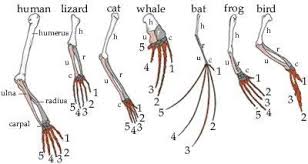
What is this an example of?
a)
vestigial structures
b)
embryology
c)
homologous structures
d)
fossil record
16.

This is a structure that was inherited but has lost most of its original function

a)

homologous

b)

analogous

c)

vestigial

d)

homozygous

17.

These structures share a common function but not structure ex) the wing of a bird and the wing of an insect

a)

homologous

b)

analogous

c)

vestigial

d)

homozygous

18.

This is a result of the organism's genetic variability, ability to reproduce and natural selection.

a)

natural selection

b)

evolution

c)

fertility

d)

genetics

19.
The primary purpose the body uses monosaccharides for is?
a)
Building muscles
b)
Helping the Immune System
c)
Immediate Energy
d)
Generating Heat
20.
The building blocks of nucleic acids are called ...
a)
amino acids
b)
nucleotides
c)
carbohydrates
d)
proteins
21.
ATP is...
a)
a unit of energy in the cell
b)
a type of lipid
c)
a molecule of DNA
22.
The cell membrane is formed mostly by...
a)
carbohydrates
b)
proteins
c)
phospholipids
d)
nucleic acids
23.
Enzymes are _________ that __________ chemical reactions.
a)
proteins, slow down
b)
proteins, speed up
c)
lipids, slow down
d)
lipids, speed up
24.
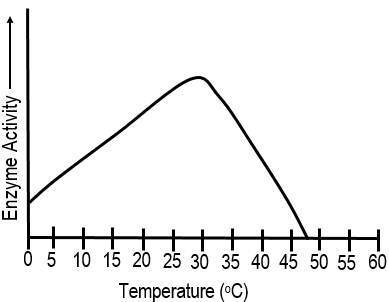
Based on the graph, what temperature does this enzyme work best? 
a)
15 C
b)
40 C
c)
30 C
25.

Having freckles is dominant over not having freckles. If two individuals heterozygous for freckles have a child, what is the probability the child will have freckles?

a)

0%

b)

25%

c)

50%

d)

75%

26.

Some marine worms and mollusks go through similar larval stages during development. Which can be inferred about their relationship?

a)

They share a common ancestor

b)

The mate with each other

c)

They compete for a habitat

d)

The share the same food source

27.

What do both prokaryotic and eukaryotic cells contain?

a)

membrane-bound organelles

b)

linear chromosomes

c)

cytoplasm

d)

a nucleus

28.

What would most likely be produced when a cell with eight chromosomes undergoes mitosis?

a)

two cells with four chromosomes each

b)

two cells with eight chromosomes each

c)

four cells with four chromosomes each

d)

four cells with eight chromosomes each

29.

Which will most likely cause an increase in the frequency of genetic mutations in humans?

a)

increased exposure to mold spores in the air

b)

increased exposure to the rising levels of atmospheric CO2

c)

increased exposure to bacteria in drinking water

d)

increased exposure to X-rays

30.

Plant cells are able to produce their own food. This process happens in which structure?

a)

cell wall

b)

chloroplast

c)

mitochondrion

d)

vacuole

31.

Which statement best explains how sweating during exercise maintains homeostasis?

a)

It regulates mineral concentrations in cells

b)

It regulates body temperature

c)

It maintains water balance

d)

It maintains sugar balance in cells

32.

Which statement best explains why animals are considered heterotrophic?

a)

They are able to produce food through the process of photosynthesis.

b)

They are able to produce food through the process of respiration.

c)

They are able to obtain nutrients by decomposing plant and animal tissue.

d)

They are able to obtain nutrients by consuming other organisms or their products

33.

In some ecosystems, wolves have been eliminated due to their threats to humans. How can the reintroduction of wolves benefit the ecosystem?

a)

It can eliminate weak animals from a prey population, thereby decreasing competition for natural resources

b)

It can eliminate the most fit animals among the prey population, which will cause an increase in birth rates of the prey

c)

It can cause the prey population to migrate to other areas, resulting in more fit prey.

d)

It can cause the prey population to better blend in with their environment.

34.

Which effect could a mutation in mRNA have on the production of proteins?

a)

The protein produced will have a different identity

b)

The protein produced will have a coiled shape.

c)

The protein produced will produce excess nitrogen.

d)

The protein produced will produce excess water

35.

How do some chemicals increase the risk of a person getting cancer?

a)

by causing cell mutations

b)

by causing a deficiency of vitamin D

c)

by causing an increase of toxins in the skin

d)

by causing a decrease in the immune response

36.

What is the difference between the DNA of a dog and the DNA of a fly?

a)

the type of sugar building blocks

b)

the sequence of nucleotides

c)

the strength of hydrogen bonds

d)

the strength of covalent bonds

37.

Which substance do biochemists often search for in fossils to help better understand the evolutionary relationships of the organism that formed the fossil?

a)

ATP

b)

DNA

c)

iron

d)

oxygen

38.

Scientists believe that the polar bear in Alaska and the brown bear in Russia evolved

from a common ancestor. Which would be responsible for this evolutionary change?

a)

artificial selection

b)

asexual reproduction

c)

sexual reproduction

d)

geographic isolation

39.
Which is the correct order?
a)
C,D, B, A, F, E
b)
D,A,F,C,E,B
c)
B,E,C,F,A,D
d)
C,B,D,A E,F
40.
A guinea pig cell has 64 chromosomes.  After mitosis, each daughter contains ___ chromosomes.
a)
128
b)
64
c)
32
d)
16
41.
A male shark has 40 chromosomes in each of its sex cells. How many would be present in its body cells?
a)
20
b)
40
c)
80
d)
160
42.
How many chromosomes do humans have?
a)
46
b)
21
c)
10
43.

------is the combination of two alleles that are different from one another.

a)

homozygous

b)

heterozygous

c)

phenotype

d)

trait

44.

The letters that make-up the genetic code for a trait

a)

genotype

b)

heterozygous

c)

phenotype

d)

trait

45.
---- Is the combination of two alleles that are the same
a)
genotype
b)
homozygous
c)
phenotype
d)
trait
46.
----is the type of gene that always shows itself when present
a)
genotype
b)
homozygous
c)
phenotype
d)
dominant
47.
The physical appearance of the allele combination the offspring receives
a)
genotype
b)
homozygous
c)
phenotype
d)
dominant
48.
Look at the Punnett Square. What's the probability of having the recessive offspring?
a)
100%
b)
75%
c)
50%
d)
25%
49.
What are the parents' genotypes?
a)
Homozygous for brown eyes
b)
Heterozygous for brown eyes
c)
Homozygous for blue eyes
d)
Heterozygous for blue eyes
50.
What is the phenotype for the recessive trait?
a)
brown eyes
b)
green eyes
c)
blue eyes
51.
People often purposely breed cows that produce more milk that are bigger and/or healthier in hopes of producing offspring (calves) with the same traits.  What is this called?
a)
natural selection
b)
genetic engineering
c)
selective breeding
d)
controlled mating
52.

What genotype does a recessive homozygous white female dog have?

a)

WW

b)

Ww

c)

ww

53.

What genotype does a dominant homozygous yellow female snake have?

a)

YY

b)

Yy

c)

yy

54.
What are the possible combinations of a pea plant with the alleles PP and a male pea plant with the alleles pp.
P= purple
p= white
a)
all Pp
b)
all PP
c)
Pp,PP,Pp,PP
d)
all pp
55.
B = brown fur  b = white fur
In the punnett square, what is the probability for white fur? 

a)
0%
b)
25%
c)
50%
d)
75%