
Font size
 Worksheets
Year 9 Science Sem 1 Exam Revision
Total questions: 150
Worksheet time: 3hrs 23mins
Which of the following is not located in the nucleus of an atom
Protons
Neutrons
Electrons
Which scientist discovered the electrons?
Dalton
Thomson
Atristotle
Bohr
Rutherford and his students did experiments that showed
quark
nucleus
proton
electron
What is a particle with one negative charge called?
electron
proton
quark
neutron
What is a particle with one positive charge called?
proton
electron
neutron
quark
What is the neutral particle found in the nucleus called?
proton
neutron
electron
quark
What is the center of an atom called?
nucleus
electron cloud
proton center
photon center
Which one of the following parts of the atom is the smallest?
electron cloud
electron
nucleus
All matter is made of
energy
atoms
electrons
compounds
The majority of an atom's mass exists where?
In the nucleus
In the electron cloud
In the space between the nucleus and the electrons
In the neutrons
What type of charge does a proton have?
negative
postive
no charge/neutral
What two sub-atomic particles belong in the nucleus of an atom?
electrons and protons
protons and neutrons
electrons and neutrons
How do you find the atomic number?
by the number of electrons
by the number of protons
by the number of neutrons
The number of neutrons in an atom =
protons - neutrons
mass number - protons
protons - neutrons
mass number - electrons
The number of electrons in an atom is found by the
protons
atomic number
protons and atomic number
none

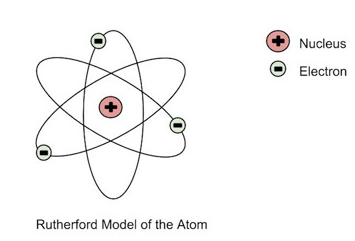
What is the atomic number of this Carbon atom
6
8
14
12

What is the mass number of this Carbon atom?
8
12
6
15

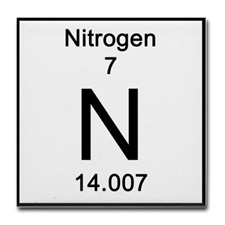
What is the element symbol?
Argon
Ar
18
39.948

What is the element name?
Argon
Neon
18
Ar

The number 18 represents the
Atomic number
Neutrons
Element Name
Element symbol
The mass number of an atom =
protons + neutrons
protons - neutrons
electrons - neutrons
neutrons + electrons


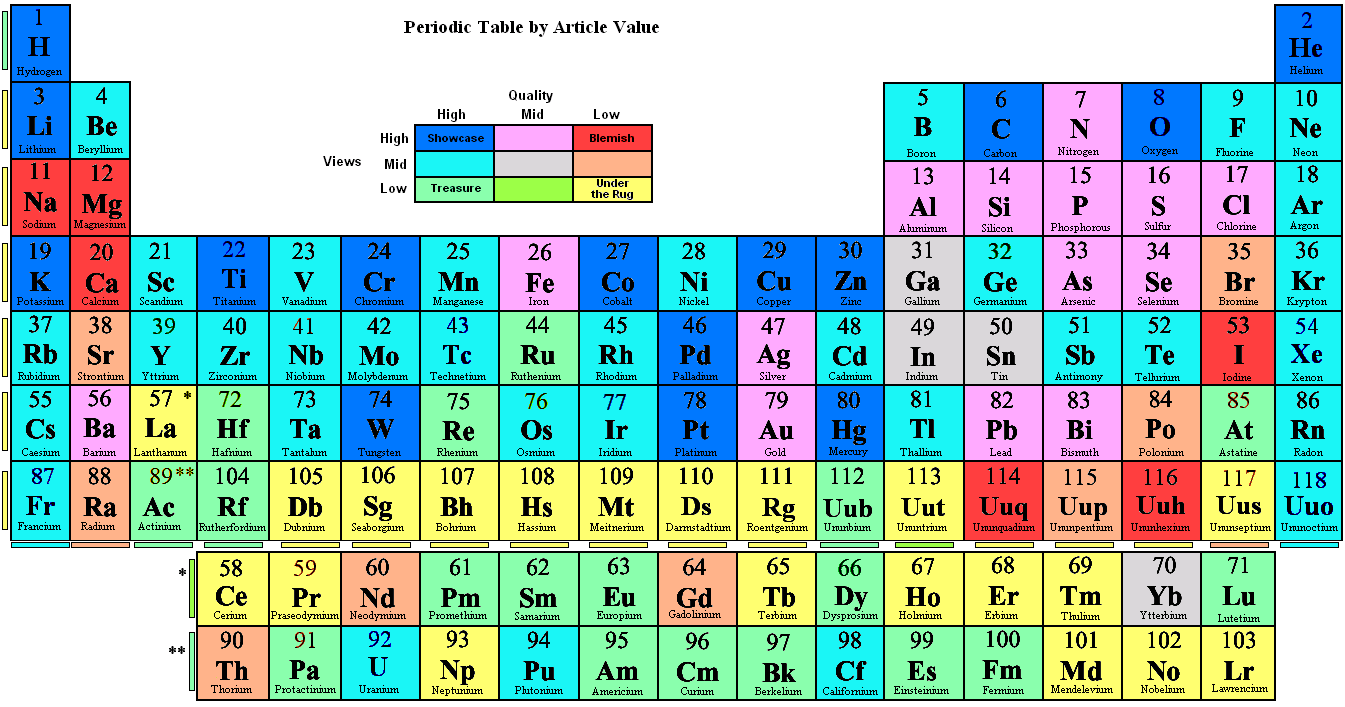

What period is Lead (Pb) in?
6
4
Metals
4A

Which group of the periodic table is composed of inert (not reactive) gases with 8 valence electrons?
alkali metals
alkaline earth metals
halogens
noble gases


The atoms on the right of the staircase are called
metalloids
non-metals
metals
noble gases
Able to be drawn into wire is
malleable
insulator
lustre
ductile
The list which contains only metals is .......
aluminium, copper, nitrogen
iron, oxygen, hydrogen
iron, silver, aluminium
iron, sulphur, copper

Metals create _________ ions, because they give away (lose) electrons.
positive
negative
neutral
The metal which can be cut with knife.
Iron
Silver
Sodium
Magnisium
The chemical symbol for iron
Ir
Fe
I
Fn
All materials show the property of malleability except
iron
graphite
aluminium
silver
All of the following would classify an element as a metal except?
Dull
Luster
Malleable
Ductile
Most metals are solid at room temperature
False
True
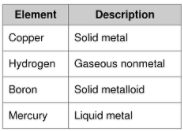
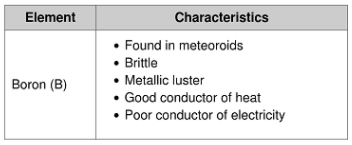
Use the table.
An unknown substance is a semi-conductor and is very brittle. This unknown substance could be which of the following elements form the table?
Copper
Mercury
Boron
Hydrogen
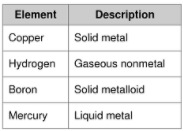
Use the Table.
An unknown substance takes the shape of its container and has a mirror like luster. This unknown substance could be which of the following elements from the table?
Mercury
Hydrogen
Boron
Copper
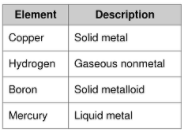
An unknown substance is colorless and has a very low density. This unknown substance could be which of the following elements form the table?
Boron
Mercury
Hydrogen
Copper
An unknown substance is a very good conductor of heat and electricity and can be bent and shaped easily. This unknown substance could be which of the following elements form the table?
Boron
Mercury
Hydrogen
Copper

Metalloids
Plastics
Metals
Nonmetals
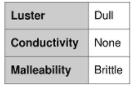
metalloid
nonmetal
metal
alloy
metal
alloy
metalloid
nonmetal
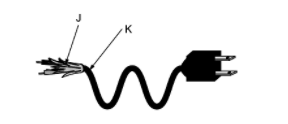
Material labeled K contains elements that do not conduct heat or electricity well. The materials that make up K are most likely
nonmetals
liquids
metals
gases
Which characteristics describe an acid?
tastes sour, litmus indicator turns red
tastes bitter, litmus indicator turns blue
tastes sweet and sour, litmus indicator turns red
tastes sour and bitter, litmus indicator turns blue
Which characteristics describe a base?
tastes sour, litmus indicator turns blue
tastes bitter, litmus indicator turns blue
tastes bitter sour, litmus indicator turns blue green
tastes bitter sour, litmus indicator turns green
Which of the following is an acid?
soap
baking soda
orange juice
water
Which of the following is a base?
carbonated water
lime juice
vinegar
dishwashing detergent

What property do all three of these household items have in common?
sometimes conduct electricity
taste soapy
have a pH equal to or above 7
turn litmus paper blue
When Sally tested an unknown solution, her red litmus paper turned blue, but her blue litmus paper remained blue. What does this indicate?
unknown is acidic
unknown is alkaline
unknown is neutral
unknown can be acidic, alkaline or neutral
Which statement is correct?
Blue litmus paper turns red in alkaline solution.
Red litmus paper turns blue in acidic solution.
Blue litmus paper remains blue in acidic or neutral solution.
Red litmus paper remains red in acidic or neutral solution.
The pH scale is a range from
1 to 7
0 to 14
1 to 14
1 to 20
Which statement is true?
the lower the pH, the stronger the acid
the higher the pH, the stronger the acid
the lower the pH, the more neutral the acid
the higher the pH, the weaker the alkali
A very strong acid would have a pH of
1
7
9
14
A weak alkali would have a pH of
8
7
6
14
A solution with a pH of 3.6 would be
acidic
alkaline
neutral
acidic and alkaline
A solution with a pH of 8.6 would be
acidic
alkaline
neutral
acidic and alkaline
If you have a solution that is very acidic with a pH of 3.5, what can you do to raise the pH of the solution?
add an acid
add more water
increase the temperature
add a base
What is the colour of universal indicator in pure water?
red
blue
violet
green
What would happen to the blue and red litmus papers when they are dipped into a sample of acid rain?
Blue litmus paper remains blue and red litmus paper remains red.
Blue litmus paper turns red and red litmus paper turns blue.
Blue litmus paper remains blue and red litmus paper turns blue.
Blue litmus paper turns red and red litmus paper remains red.
What is the left part of a chemical equation called?
2H2 + O2 ---> 2H2O
Reactants
Yields
Products
Chemical equation
What is the right part of a chemical equation called?
2H2 + O2 ---> 2H2O
Reactants
Yields
Products
Chemical Equation
What is the total number of atoms present in 5Na3PO4?
5
55
40
8
How many Mn atoms are found in the following compound?
2MnO4
1
2
4
8
What is the little number after an element in a chemical equation called?
Example: H2
Coefficient
Atom
Subscript
Equation
Is the following equation balanced?
Al + O2 ---> 2Al2O3
YES
NO
How many elements are in C6H12O6?
1
2
3
4
What is the number before a chemical formula called?
Example: 2H2 + O2 ---> 2H2O
Coefficient
Atom
Subscript
Equation
Is the following equation balanced?
2C2H2 + 5O2 ---> 4CO2 + 2H2O
YES
NO
Is the following equation balanced?
4Fe + 3O2 ---> 2Fe2O3
YES
NO
Is the following equation balanced?
NaHCO3 ---> Na2CO3 + H2O + CO2
YES
NO
Is the following reaction balanced?
2CH3OH + 3O2 ---> 2CO2 + 4H2O
YES
NO
Which of the following equations are correctly balanced?
12CO2 + H2O ---> C6H12O6 + O2
CO2 + H2O ---> 3C6H12O6 + O2
CO2 + 9H2O ---> C6H12O6 + O2
6CO2 + 6H2O ---> C6H12O6 + 6O2
In the equation, 2Mg + O2 ---> 2MgO, which are the reactants?
Mg and O
Mg and MgO
MgO
O and MgO
Balance this equation:
H2 + Cl2 ---> HCl
It is balanced.
H2 + Cl2 ---> 2HCl
3H2 + Cl2 ---> 6HCl
H2 + 3Cl2 ---> 6HCl
Balance this equation:
HgO ---> 2Hg + O2
It is balanced.
2HgO ---> 2Hg + O2
2HgO ---> Hg + O2
HgO ---> Hg + 2O2
Balanced this equation:
Sb2S3 + O2 ---> Sb + SO2
It is balanced.
Sb2S3 + O2 ---> 2Sb + SO2
Sb2S3 + 3O2 ---> 2Sb + 3SO2
3Sb2S3 + 3O2 ---> 2Sb + SO2
How many Oxygen atoms are in 2SO4?
1
2
4
8
Which side of a chemical equation is the reactant side?
Left (before the yields sign)
Right (after the yields sign)
Which side of a chemical equation is the product side?
Left (before the yields sign)
Right (after the yields sign)
What is the Law of Conservation of Mass?
It states that matter cannot be created or destroyed.
It states that energy cannot be created or destroyed.
It states that matter can be created or destroyed.
It states that sound can be created or destroyed.
Mg + __HCl ---> MgCl2 + H2
HCl + Zn --> ZnCl2 + H2
Sulphuric acid + sodium carbonate
-->
Hydrochloric acid + magnesium hydroxide -->

Metal + water ---> metal hydroxide + hydrogen
Metal + water ---> metal hydroxide + hydrogen
Metal + acid ---> metal salt + hydrogen
Metal + acid ---> metal salt + hydrogen

What are the products of combustion?
Hydrogen + oxygen
Carbon dioxide + water
Carbon dioxide + hydrogen
Carbon + water
What does incomplete combustion produce that complete combustion doesn't?
Carbon Monoxide
Water
Heat
Carbon Dioxide
What are the types of combustion?
Complete and incomplete
Incomplete and inexact
Impossible and possible
Computer and incomplete
Which of the following chemical reactions involve combustion?
A forest fire
Human digestion
A car using petrol
All of the above
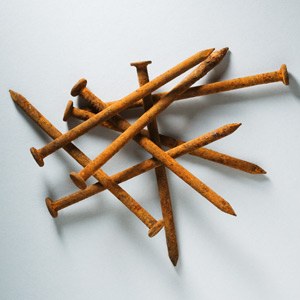

What conditions are required for rusting?
water only
oxygen only
water and oxygen
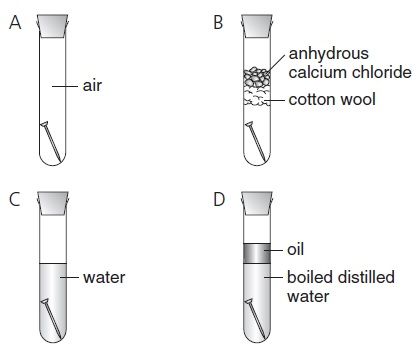
Which diagram shows the most favourable conditions for rust to appear on the nail?
A
B
C
D

Which organelle is responsible making food (Glucose) using sunlight?
Cell Membrane
Nucleus
Chloroplast
Mitochondria
Select all that are raw materials for Photosynthesis.
Water
Carbon Dioxide
Oxygen
Sunlight (Light Energy)
Glucose (Sugar/food)
Select all that are products of Photosynthesis.
Water
Carbon Dioxide
Oxygen
Sunlight (Light Energy)
Glucose (Sugar/food)
Is Glucose (C6H12O6) a Raw Material (Ingredient) or Product of Photosynthesis?
Product
Raw Material
Neither

Exit: Carbon dioxide
Exit: Glucose
Exit: Oxygen
Exit: Water vapor
Which of the following is the correct equation for PHOTOSYNTHESIS?
light + carbon dioxide + water --> glucose + oxygen
carbon dioxide + sugar + water --> oxygen + light
oxygen + light + water --> carbon dioxide + sugar
carbon dioxide + oxygen + water --> Light+ Sugar
Cellular Respiration occurs in what cell organelle?
chloroplast
cytoplasm
mitochondria
animal
Which organism go through cellular respiration?
animals
plants
both animals and plants
none
Which of the following is a reactant of cellular respiration?
Glucose
Carbon Dioxide
Water
ATP
Which of the following is a reactant of cellular respiration
Carbon Dioxide
Water
Oxygen
ATP
Which of the following is a product of cellular respiration?
Glucose
Carbon Dioxide
Oxygen
Radiant Energy
Which statement is true regarding cellular respiration?
The reactants of cellular respiration are identical to the reactants of photosynthesis.
The reactants of cellular respiration are obtained from the products of photosynthesis.
The products of cellular respiration are the same as the products of photosynthesis
Cellular respiration only occurs in autotrophs, photosynthesis occurs only in heterotrophs.

