
 Worksheets
Biological Diversity Review #2
Total questions: 90
Worksheet time: 2hrs 30mins

Where can DNA be found on your body?
(Think of crime scene evidence left behind)
Blood
Hair, Teeth
or fingernails
Saliva, Mucus or Sweat
Semen, Urine or Feces

The yellow part of this picture is DNA. When you add the turquoise part around it, what do we call it now?
allele

Folded DNA so it doesn't tangle and can fit in the nucleus
trait
chromosomes
allele
gene
What is a gene?
A long length of DNA that codes for a chromosome
A short length of DNA that codes for a chromosome
A short length of DNA that codes for a protein.

What is the relationship between genes and DNA?
A gene is one small section of DNA
Genes are bigger than DNA
DNA is in cells but genes are not
DNA is a small section of a gene
Only animals have DNA in their cells
only plants have DNA
DNA is packaged into chromosomes in many living thngs.
The DNA in your nerve cells is different than the DNA in your skin cells.
What is a long coiled strand of DNA and proteins?
gene
RNA
chromosome
genome
Which of the following statements about chromosomes is correct?
Chromosomes are long, thread-like structures
Chromosomes are found in the nucleus of all cells in the human body
Chromosomes contain DNA
All of the above

In this diagram, which letter highlights a gene?
A
B
C

What are these?
Chromosomes
alleles
Phenotypes
genes
This is the an individual recipe in the recipe book for making a protein
DNA molecule
Gene
Genome
chromosome
Which of these pictures shows the correct structure for DNA?


A gene determines a __________ such as eye or hair color.
nucleus
DNA
chromosome
Trait
Which reason explains why nerve cells function differently than muscle cells?
In nerve cells all the genes are expressed.
In muscle cells all the genes are expressed.
In both kinds of cells the same genes are expressed.
In both kinds of cells different genes are expressed.
How much DNA is given to the children from each parent?
10%
25%
50%
75%

How many chromosomes are there in this picture? (please type only number)
(a)
Sex cells have ____________ of the DNA found in body cells.
all
none
half
a little bit
Females produce sex cells called ________
eggs
sperms
ovaries
uterus

What process creates reproductive cells used in sexual production?
meiosis
mitosis
cellular respiration
photosynthesis
Each body cell in an earthworm contains 36 chromosomes. How many chromosomes are in each of its gametes?
54
36
72
18

Which process and type of resulting cell are represented in the diagram?
Mitosis, which produces sex cells
Meiosis, which produces sex cells
Mitosis, which produces body cells
Meiosis, which produces body cells

The genome of a goldfish contains 96 chromosomes. How many chromosomes will each daughter cell have after mitosis of a goldfish cell is complete?
24
48
96
192
If a sex cell has 10 chromosomes, how many chromosomes will there be after fertilization?
5
10
15
20
The genome of a starfish contains 22 pairs of chromosomes. How many chromosomes will each daughter cell have after mitosis of a starfish cell is complete?
22
44
11
4

Asexual reproduction is associated with what type of cell division?
Mitosis
Meiosis


How many chromosomes would be in the a sheep gamete?
If there are 22 chromosomes in the nucleus of a toad skin cell, a toad egg would contain ____ chromosomes.
22
44
11
33
During meiosis the parent cell produces:
2 daughter cells with the same number of chromosomes as the parent cell.
2 daughter cells with the half the number of chromosomes as the parents cell.
4 daughter cells with the same number of chromosomes as the parent cell.
4 daughter cells with half the number of chromosomes as the parent cell.
Which of the following is a heterozygous/hybrid genotype?
FF
tt
Gg
RR
The genetic make-up of an organism
Genotype
The physical traits of an organism
Phenotype
An alternate form of a gene
Allele
A trait that only appears in the absence of a dominant allele
recessive


BB
Bb
bb
Blonde hair
Brown hair
bb
BB
The genotype for a yellow plant is...
R = tongue rolling, r = no tongue rolling. An individual who is Rr can roll their tongue. What type of inheritance pattern does this follow?
Complete Dominance
Incomplete Dominance

A woman with curly hair and a man with straight hair produced a child with wavy hair:
Incomplete dominance
Complete dominance
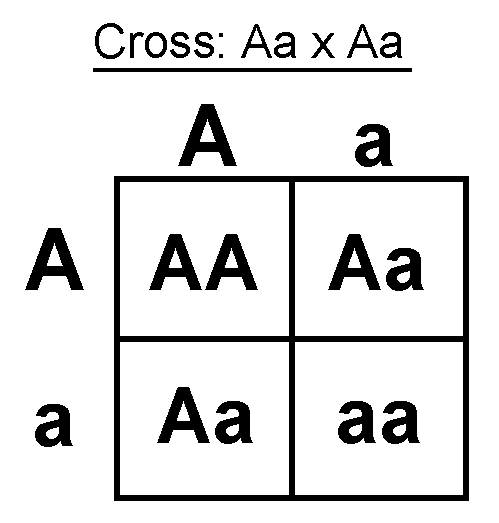
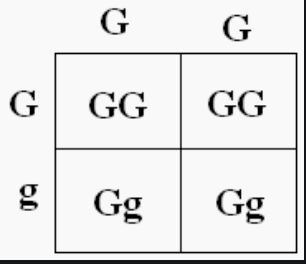
The punnett square is used to tell the color of a frogs skin. "G" means green skin and "g" means brown skin. What is the chance the baby frogs will have brown skin?
0%
25%
50%
100%

If brown eyes are dominant and blue eyes are recessive, what color eyes do the parents in this Punnett Square have?
one has brown eyes and the other has blue eyes
they both have blue eyes
they both have brown eyes
there's no way to tell based on this information

Cody crosses a plant producing wrinkled peas with a plant producing smooth peas. Weeks later, he discovers that all the offspring plants have smooth peas. Cody drew the Punnett square above to show the genotypes of the offspring plants. Which is the dominant phenotype in the pea plants used in Cody’s experiment?
smooth
wrinkled
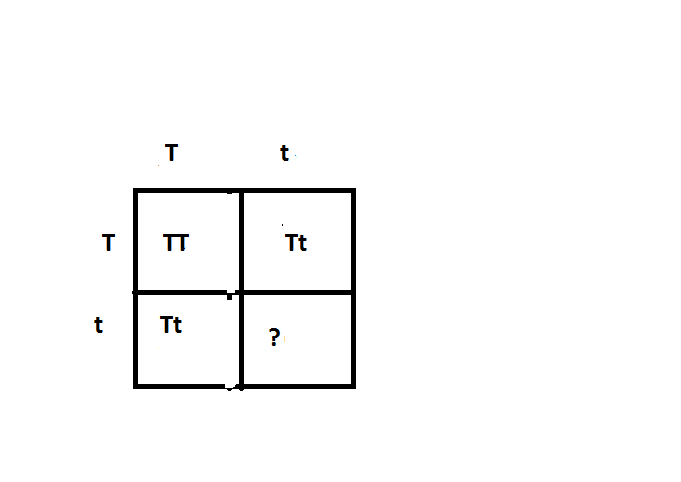
In the punnett square below, what belongs in the missing square
In pea plants, being tall is dominant and being short is recessive. Two tall plants mate. One has the genotype Tt and the other has the genotype TT. What is the chance that they will have a tall offspring?
0%
25%
50%
75%
100%
Albinism is a recessive genetic condition in which pigmentation (generally from melanin) is lacking. An individual with true albinism will have white hair (eyelashes & eyebrows included), very pale skin and red eyes. If each parent is heterozygous, what percentage of their offspring could be affected by albinism?
0%
25%
50%
75%

This type of dominance is ........................... because the heterozygote shows a phenotype that is .............................. .
complete-dominance, dominant
complete dominance, recessive
incomplete dominance, blended
incomplete dominance, equal

The image above shows the incomplete dominant cross where B codes for red flowers and b codes for white flowers. What are the phenotypes of the parents?
a red flower and a white flower
a red flower and a pink flower
a white flower and a pink flower
two red flowers

A red flowered plant (RR) is crossed with a white flowered plant (rr). The gene for petal color in these plants expresses incomplete dominance. What percentage of the offspring will have pink (Rr) flowers?
0%
25%
50%
100%
In giraffes, long neck = GG. Medium neck = Gg. Short neck = gg. What is the probability that two parents with short necks will have offspring with medium necks?
0%
25%
50%
75%
100%
Smooth pea plants and wrinkled pea plants are crossed and produce only wrinkled pea plants. Then two of those wrinkled offspring are crossed together. What percentage of their offspring will be wrinkled?
75%
0%
25%
100%

What is this an example of?
effect of environment on gene expression
incomplete dominance
complete dominance

The Himalayan rabbit’s habitat has cold, snowy winters and mild summers. The body is typically covered in white fur except for the nose, feet, tail, and ears, which are covered in black fur.
A scientist shaved an area of white fur on the back of a Himalayan rabbit and placed an ice pack over the shaved area. The shaved area grew black fur.
Which of these best explains why the hair that grew back where the ice pack was placed was black and not white?
The genes for black hair were activated by specific temperatures.
The white hair mutated to black hair as the rabbit’s body temperature decreased.
The coat color changed from white to black with the age of the rabbit.
White hair only grows during certain times of the year.
Match the following biotechnology
manipulating the genes of a tomato plant so it would grow cube-shaped tomatoes
genetic engineering
making an exact copy using a body cell, usually by injecting the DNA into a surrogate
cloning
joining the sperm and egg in a petri dish and then placing the embryo in a uterus
in-vitro fertilization
Breeding individuals with desirable traits together over many generations
Artificial Selection
Injecting sperm into the uterus of females
Artificial Insemination
A farmer is considering the advantages of cloning a herd of cattle from a single cow. What is one advantage of a cloned herd?
All cattle in the herd would have the most desired traits.
All cattle in the herd would have more genetic variation.
All cattle in the herd would have more resistance to diseases.
All cattle in the herd would have much longer life spans.
Scientists have produced a genetically modified orange tree that is resistant to disease. Which of the following is the best example of a potential benefit to society that could result from this biotechnology?
reduction in orange crops produced
increase in orange crops produced
increase in the cost of orange crop
a change in the distribution of insects that pollinate orange flowers
What effect do biotechnologies like cloning, artificial selection and artificial insemination have on biological diversity?
increase
decrease
no effect
How is extirpation different than extinction?
There is no real distinction between the two.
Extirpation applies to a particular place, while extinction applies to the entire planet.
Extirpation applies to the death of an ecosystem, while extinction applies to the death of a species.
Extirpation applies to a sudden growth of species, while extinction applies to the death of a species.
All of the following are major threats to biodiversity, except:
Habitat Destruction
Conservation
Invasive Species
Pollution
Forest clearing, farming, and road building are all examples of
Biodiversity
Population distribution
Habitat loss
Climate Change
Invasive Species are native to an area.
Invasive species are prey to many animals.
Invasive species have no limiting factors such as predators.
Invasive species keep the ecosystems in equilibrium.
The methods of biodiversity conservation can be classified as in situ conservation and ex situ conservation. Which statement below best describe ex situ conservation?
Preserves the species outside of their natural habitat such as in zoos and botanical parks.
Preserves the species within their natural habitat such as in national parks, permanent forest reserves and marine parks.
The methods of biodiversity conservation can be classified as in situ conservation and ex situ conservation. Which statement below best describe in situ conservation?
Preserves the species outside of their natural habitat such as in zoos and botanical parks.
Preserves the species within their natural habitat such as in national parks, permanent forest reserves and marine parks.
Which of the following is an example of In-situ conservation method?


Cutting down entire forest
Putting animals in a zoo
Polluting mountain streams
Introducing new species to an ecosystem with no known natural predator

What is the manipulated variable in this graph?
Year
% animals extinct
Mammals
Which classification of animals is going extinct at a greater rate?
Mammals
birds
fish, reptiles and amphibians
"The World Bank also estimates that crimes affecting natural resources and the environment inflict damage on developing countries worth more than $70 billion a year." Which perspective is expressed here?
political
economic
technological
health and wellness
"It is estimated that 70 percent of all emerging infectious diseases are zoonotic (those transferred from animals to humans). Several studies have shown a link between natural habitat destruction and increased risk of diseases transferring to humans." Which perspective is expressed here?
political
economic
technological
health and wellness
in 1995 Wolves were reintroduced to Yellowstone National Park. Which answer below most accurately describes a possible trophic cascade the could result from the reintroduction of wolves?
wolves reintroduced-> deer population increased -> tree and vegetation cover decreased
wolves reintroduced-> beaver population decreased -> tree and vegetation cover increased
wolves reintroduced-> deer population decreased -> tree and vegetation cover increased -> beaver population increased
wolves reintroduced-> deer population decreased -> beaver population decreased -> songbird population increased

African elephants eat A LOT of small trees and shrubs that would otherwise become forests. This allows open spaces that grow grassess for antelopes and zebras and provides warm soil for small rodents for burrowing. Elephants also spread seeds via their dung. The extinction of elephants would likely lead to.. (check all that apply)
increase in grasses
decrease in antelopes and zebra populations
increase in tree population
increase in rodent population

How do the predators have a positive impact on the vegetation?
Since the predators eat the herbivores they eat the producers
Since the predators eat the herbivores and keep that population in check so they do not over eat the vegetation
The predators do not eat the vegetation so it is a positive impact
The predators eat the vegetation keeping it in control


prey
resource partitioning

Why does the introduction of the Artic Fox (which preys on seabirds) to seabird nesting islands cause a negative impact on the grass population?
The foxes eat the seabirds which decreases the amount of soil nutrients for the grass
The foxes eat the seabirds which increase the amount of soil nutrients for the grass
The foxes eat the grass
Which is NOT a way to prevent or conserve biodiversity?
Using animal-tested products.
Growing native plants.
Reducing Carbon footprint.
Educate and Spread Awareness

