wayground logo

Free Printable Worksheets

Font size

S
M
L
XL
Worksheets

Science 24 Health Quiz

Total questions: 100

Worksheet time: 1hrs 4mins

Name
Class
Date
1.

What is healthy eating?

a)

Healthy eating is eating a hamburger.

b)

Healthy eating is eating healthy food.

c)

Healthy eating is eating junk food.

d)

Nothing.

2.
________ is a disease that can be passed to a person from another person, animal or object.
a)
Non-communicable disase
b)
Communicable Disease
c)
Pathogens
3.

________ are disease-causing organisms that are so small you need a microscope to see them. Think "fancy word for germs".

a)

Virus

b)

Disease

c)

Communicable

d)

Pathogen

4.
Pathogens like to "attack" humans because they seek which of the following:
a)
shelter
b)
food source
c)
place to multiply
d)
all of the above
5.
Washing your hands is the _________ effective strategy for preventing the spread of disease?
a)
least
b)
most
6.
The ________ is the first line of defense.
a)
eyes
b)
stomach
c)
t-cells
d)
skin
7.
Cancer, Hypertension, and Asthma are examples of what types of disease?
a)
Non-communicable
b)
Communicable
8.
 is the body's defense against infectious organisms and other invaders. 
a)
respiratory system
b)
endocrine system
c)
immune system
d)
circulatory system
9.

Coughing, sneezing, and runny nose are all _______________ of the common cold.

a)

access points

b)

abrasions

c)

organisms

d)

symptoms

10.
What is a non-communicable disease?
a)
An illness that can be passed on by germs from person to person.
b)
A disease that cannot be passed on to another person.
11.

A medicine that can give you immunity to a disease is called a __________.

a)

antibodies

b)

vaccine

c)

pathogen

d)

white blood cell

12.

Viruses can replicate without a host.

a)

True

b)

False

13.

Viruses need to be inside this so they can grow and multiply.

a)

host

b)

parasite

c)

pathogen

d)

acid

14.

Which of the following is a good way to stop the spread of the Covid-19?

a)

cough in your sleeve

b)

wash your hands often

c)

stand at least 2 meters away from people

d)

All of the above

15.

The Covid-19 disease is caused by a _________.

a)

virus

b)

bacteria

c)

fungi

16.

What are some effective ways to stop the spread of disease?

a)

vaccination

b)

proper hygene

c)

healthy diet

d)

all of the above

17.

This is the transmission of infectious disease through air.

a)

Airborne transmission

b)

Droplet spread

c)

Contaminated Objects

d)

Insect bites

18.

This term is used when a disease affects a large proportion of the people over a large area.

a)

Epidemic

b)

Pandemic

c)

Disease

d)

Pathogens

19.

This term is used when many people in a local area get sick at the same time.

a)

Epidemic

b)

Pandemic

c)

Diseases

d)

Pathogens

20.

Disease that occurs over a wide geographic area - an entire country, continent, or whole world. It affects a very high proportion of the population.

a)

Pandemic

b)

symptom

c)

epidemic

d)

quarantine

21.

Able to be passed easily from one person to another

a)

epidemic

b)

vaccine

c)

contagious

d)

asymptomatic

22.

substance prepared from killed or weakened pathogens and introduced into a body to produce immunity

a)

influenza

b)

vaccine

c)

quarantine

d)

pandemic

23.

showing no symptoms of disease

a)

symptomatic

b)

asymptomatic

c)

contagious

d)

symptom

24.
Reasons that viruses are considered to be nonliving is because
a)
They are not cellular
b)
They cannot reproduce on their own
c)
They cannot make proteins
d)
all of the above
25.
What do viruses need to reproduce?
a)
they need genetic material
b)
They need a host cell
c)
They need  bacteria
d)
They need insulin
26.
When a virus invades a living cell, its _______
takes over the cell's functions.
a)
outer coat
b)
genetic material
c)
core
d)
cytoplasm
27.
Which of the following occurs after a virus attaches to a host cell in the viral reproduction process?
a)
The host cell dies
b)
The virus dies
c)
The virus inserts its genetic information into the host cell
d)
copies of the virus are immediately released from the host
28.
What does a virus have on the outside?
a)
a protein coat
b)
a fur coat
c)
crispy skin
d)
membrane
29.
What does a virus have on the inside?
a)
DNA, but never RNA
b)
RNA but never DNA
c)
DNA or RNA
d)
neither DNA or RNA
30.

What are the precautions that need to be taken to protect from Corona virus?

a)

Cover your nose and mouth when sneezing

b)

Add more garlic into your diet

c)

Visit your doctor for antibiotics treatment

d)

Wash your hands after every hour

31.

Antibody structure is commonly

a)

Z shaped

b)

Y shaped

c)

W shaped

d)

T shaped

32.

what will happen with the antibodies after the antigens are gone ?

a)

they will disappear from the body

b)

they will stay in the body

c)

they will destroy the body

d)

non-from above

33.

Antigens are foreign bodies.

a)

Yes

b)

No

34.
The part of foreign materials that cause a response from the immune system are called _____________________.
a)
Antigens
b)
Active Immunity
c)
Antibodies
d)
Antibiotics
35.
Antigens are part of...
a)
Your own immune system.
b)
The pathogen.
36.
Antibodies are made by...
a)
Your own cells.
b)
The pathogen.
37.
What is the role of antibodies?
a)
Kills pathogens
b)
Helps activate other immune cells
c)
Produces antibodies
d)
Binds to antigens and neutralizes pathogen
38.

Select all examples of physical barriers

a)

skin, mucus, tears

b)

skin, mucus, earwax

c)

skin, tears, earwax

d)

stomach acid, music, earwax

39.

What is an example of non-specific immune system response

a)

skin

b)

T lymphocytes

c)

Phagocytosis

d)

Antibodies

40.

Which cell will "eat" pathogens?

a)

helper T cell

b)

B cell

c)

macrophage

d)

cytotoxic T cell

41.

Which is the most important thing used in the first line of defense?

a)

macrophage

b)

fever

c)

skin

d)

antigens

42.
Which is an example of passive immunity?
a)
You have been infected
b)
You have been vaccinated
c)
You made antibodies
d)
You got your mother's antibodies
43.
What type of immunity is vaccination?
a)
natural passive
b)
natural active
c)
artificial passive
d)
artificial active
44.

A chemical agent that kills the microorganisms and is commonly applied to substances used on inanimate objects are _______________

a)

Antiseptics

b)

Sanitizer

c)

Disinfectants

d)

Antibiotics

45.

Which of the following are generally applied on living animal tissues?

a)

Antiseptics

b)

Disinfectants

c)

Preservatives

d)

Sanitizer

46.

What does the word Pandemic mean?

a)

A disease which has spread through a country.

b)

A disease which has spread through many people.

c)

A disease which has spread to many countries around the world

d)

A disease that kills many people

47.

What is an example of something that is contagious?

a)

cancer

b)

headaches

c)

covid

d)

bad grades

48.

Vaccines trick your body into thinking it's been infected by a particular germ or pathogen.

a)

True

b)

False

49.

With a vaccine, the body builds up an immunity to the germ/pathogen even though you've never actually had the germ/pathogen.

a)

True

b)

False

50.

What do pathogens do in your body if your immune system doesn't attack it immediately?

a)

grow larger

b)

shrink

c)

disappear

d)

reproduce and make more of itself

51.

What does an antibody attach to?

a)

antigen on the germ

b)

white blood cells in the blood

c)

nerve cells in the brain

d)

tubes in the lungs

52.

A/an ________ is an injection of a weakened form of a pathogen to help the individual gain immunity from a disease.

a)

Virus

b)

Vacuum

c)

Vaccine

d)

Antibiotic

53.

Which of these would never be included in a vaccine, due to its potential to cause illness/disease?

a)

Fully deactivated virus

b)

Weakened virus

c)

Partial virus

d)

Complete, fully active virus

54.

Inflammation is designed to be a protective mechanism

a)

true

b)

false

55.
which of the following is NOT one of the signs of inflammation?
a)
redness (erythema)
b)
heat 
c)
pain
d)
bleeding
56.
What is the main purpose of the immune system?
a)
support the body through bones and muscles
b)
get rid of waste from the body
c)
protect the body from pathogens
d)
move blood through the body
57.
 Liz notices that shortly after cutting her arm accidentally the area around the cut is turning red and feeling hot.  Which immune system defense is Liz experiencing?  
a)
inflammation
b)
white blood cell clotting
c)
skin
d)
fever
58.
__________ immunity is when the bodies makes its own antibodies.
a)
passive
b)
active
c)
cell mediated
d)
false
59.

Passive immunity is when

a)

You produce your own antibodies to a disease

b)

You are given antibodies to a disease

c)

You are immune to any type of disease

d)

Macrophages invade your lymphatic system and shield you from ever falling sick

60.

Active immunity is when

a)

You produce your own antibodies to a disease

b)

You are given antibodies to a disease

c)

You are immune to any type of disease

d)

Macrophages invade your lymphatic system and shield you from ever falling sick

61.

Doctors sometimes use a vaccine to prepare the body to defend itself against future infections. These vaccines most often contain

a)

antibodies

b)

antibiotics

c)

white blood cells

d)

weakened pathogens

62.

A new vaccine was developed and then tested on a large sample of individuals. This new vaccine will be considered effective if it helps prepare the body to fight future invasion by

a)

inhibiting the response of red blood cells

b)

stimulating the reproduction of microbes

c)

inhibiting the action of immune cells

d)

stimulating the production of antibodies

63.
Which is the best definition of DNA?
a)
a spiral ladder
b)
something in your cells
c)
the recipe for making an organism
64.
DNA is inside your cells. What part of the cell is the DNA inside of?
a)
cell membrane
b)
cytoplasm
c)
nucleus
65.
What is a gene?
a)
A bundle (like a hot dog bun) that the DNA is packed into
b)
something inside the nucleus
c)
a piece of DNA
d)
all of your DNA
66.
Why are your chromosomes arranged in pairs?
a)
Scientists have no idea
b)
Because you get one from your mom and one from your dad
c)
Because pairs can divide easier
d)
Because DNA is awesome
67.
A chromosome is best described as a
a)
gene that has more than one form.
b)
green cell found in many plants.
c)
strand of DNA containing genetic information.
d)
reproductive cell found in certain kinds of bacteria
68.

From smallest to largest how would genetic information be organized?

a)

genes, cell, nucleus, chromosome, DNA

b)

chromosome, cell, gene, DNA, nucleus

c)

DNA, gene, chromosome, nucleus, cell

d)

nucleus, cell, gene, DNA, chromosome

69.
Why is DNA important?
a)
it is very small and very complicated
b)
it's in everything
c)
it serves as the blueprint for traits of all living things
d)
because we eat it every day for energy
70.

What is a long coiled strand of DNA and proteins?

a)

gene

b)

RNA

c)

chromosome

d)

genome

71.

We inherit our genes from ...

a)

our nucleus.

b)

our parents.

c)

from the food we eat.

72.

Our characteristics are controlled by

a)

DNA

b)

genes

c)

chromosomes

d)

parents

73.
The physical appearance of a trait is known as the-
a)
genotype
b)
phenotype
c)
characteristics
d)
intelligence
74.
What you see, or the physical appearance.
a)
Genotype
b)
Phenotype
c)
Homozygous
d)
Heterozygous
75.
This trait will always be expressed if present because it will mask the expression of others
a)
stem cells
b)
heterozygous
c)
dominant
d)
recessive
76.
Having the genes for baldness is an example of
a)
genotype
b)
phenotype
77.
How tall you are is an example of
a)
genotype
b)
phenotype
78.
Having blue eyes is an example of
a)
genotype
b)
phenotype
79.
Having genes that make you more likely to be good at sprinting is an aspect of
a)
genotype
b)
phenotype
80.
T - tall and t = short
In the punnett square below, what belongs in the missing square
a)
tt
b)
Tt
c)
Bb
d)
TT
81.
In the punnett square shown, what must the genotype of the missing parent be?
a)
BB
b)
Bb
c)
bb
d)
Tt
82.
Dominant or recessive?
tt
a)
Dominant 
b)
Recessive
83.
This image shows a...
a)
Punnett Square
b)
Phenotype
c)
Genotype
d)
Dominant allele
84.
What does heterozygous mean?
a)
An organism that has the same genes for a trait (TT or tt)
b)
An organism that has different genes for a trait (Tt)
c)
When neither gene is fully dominant; offspring is a mixture of both
d)
the different forms of a trait (hair color--> brown, blonde, red
85.
Which of the following genotypes is heterozygous?
a)
Bb
b)
BB
c)
bb
d)
B
86.

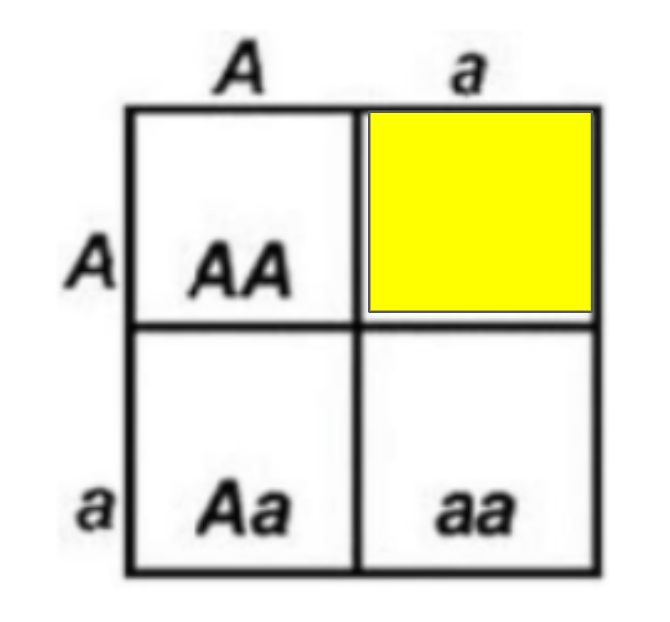
Fill in the Yellow Box

a)

AA

b)

Aa

c)

aa

87.
What allele combination should go in the missing box?
a)
AA
b)
Aa
c)
aa
d)
none of these
88.
Where do mutations occur?
a)
DNA and RNA
b)
DNA 
c)
RNA
d)
mRNA and tRNA
89.
A mutation is?
a)
Any change in DNA
b)
Any change in RNA
c)
Any change in the genetic code
90.

A pedigree chart tracks ________ specific trait(s).

a)

one

b)

two

c)

three

d)

15

91.

If the male or female does not have the trait listed in the pedigree chart, then the circle or square is _________________.

a)

empty

b)

fully shaded

c)

half-shaded

d)

spotted, like a leopard

92.

A vertical line in a pedigree chart represents

a)

parents

b)

offspring

c)

pets

d)

mascots

93.

A heterozygous genotype is represented by a(n) ____________ circle or square.

a)

empty

b)

fully shaded

c)

half-shaded

d)

invisible

94.
Which individual in the first generation is a carrier?
a)
The male
b)
The female
c)
individual 1
d)
None of the above
95.
How many kids did the mother and father from the first generation have?
a)
2
b)
4
c)
5
d)
6
96.
How many boys did the mother and father from the first generation have?
a)
2
b)
4
c)
5
d)
6
97.
How many girls did the mother and father from the first generation have?
a)
2
b)
4
c)
5
d)
6
98.
How many people in this whole pedigree have the trait/disease?
a)
2
b)
3
c)
4
d)
6
99.
How many people in the pedigree are carriers for the disorder? 
a)
b)
8
c)
2
d)
9
100.
What do half colored symbols represent?
a)
The individual is a carrier.
b)
The individual expresses the trait.
c)
The individual has both recessive alleles.
d)
The individual has both dominant alleles.