Worksheets
2020-2021 Final Test Review
Total questions: 105
Worksheet time: 1hrs 9mins
For every action there is...
An equal and opposite reaction
An equal and different reaction
a different force
two more forces

In a tug of war the left team pulls with a force of 200.0 N. The right team pulls with a force of 150.0 N.What is the net force?
50.0 N to the left.
350.0 N to the left.
350.0 N to the right.
50.0 N to the right.
Imagine you travel to another planet that is more massive than Earth. What will change as you walk around the surface of the planet- your mass or your weight?
Mass
Weight
Both
Neither


On the picture the balloon pushes the air right and the balloon goes left. Which of Newton's Laws is this?
Newton's 1st Law
Newton's 2nd Law
Newton's 3rd Law
What property of an object are you calculating when you find the product of the objects mass and velocity (Mass x velocity)?
Momentum
Gravity
Inertia
Weight
How much does a 6.0 kg bag of bolts weigh? (w = m*g) (g = 9.81 m/s2)
6.0N
12.0N
58.8N
600.0 N
Why does a bowling ball and feather hit the ground at different times when dropped from the same height?
They don't; they hit the ground at the same time.
One is more dense than the other.
One is heavier than the other.
Air resistance
You push on a tree with 20.0 N of force, with how much force is the tree pushing back on you?
20.0 N
40.0 N
10.0 N
70.0 N
Which is Newtons second law
Force is equal to an objects mass times its acceleration (f= m x a)
an object in motion stays in motion or an object at rest stays at rest unless acted on by an outside force.
law of inertia
For every action there is an equal and opposite reaction
Ignoring friction, if you dropped a bowling ball and a golf ball from the top of a building, what would happen?
The bowling ball will hit the ground first.
The golf ball will hit the ground first.
They will hit the ground at the same time.
Air resistance will affect the bowling ball more.
45.0 m/s2 is describing...
Mass
Force
Acceleration
weight
What is the scientific unit used to measure weight?
grams
Liters
Pounds
Newtons
Going down a hill a 12.0 kg sled has a force of 36.0 N. What is it's acceleration? ( a= f/m)
2.0 m/s2
3.0 m/s2
I don't know
What?
Which of Newton's Laws explains why a person not wearing a seat belt flies through a car window when someone slams on the breaks.
Newton's 1st Law
Newton's 2nd Law
Newton's 3rd Law
None of them
If an object has 25.3 kg x m/s of momentum before it hits another object, what is the total momentum of the two objects after the collision. This happens in the absence of friction.
12.15 kg x m/s
50.6 kg x m/s
25.3 kg x m/s
There is not enough information to answer this question.


What is defined as a push or pull?
force
motion
vector
speed
If the net force is equal to zero, the forces acting on the object are
balanced
unbalanced

Forces that have a net force of zero.
Balanced force
Unbalanced force

What is the net force?
5000.0 N right
4000.0 N right
40.0 N left
4000.0 N left

What is the net force in this picture?
50.0 Newtons to the right
950.0 Newtons to the right
950.0 Newtons to the left
50.0 Newtons to the left


This type of friction needs to be overcome in order for an object to start moving.
Rolling Friction
Sliding Friction
Static Friction
Fluid Friction
What are the two variables that affect the amount friction created bewtween two surfaces?
The surfaces and the type of friction.
The pressure between the surfaces and the force pushing the objects.
The unbalanced forces.
The surfaces involved and the pressure between them.
Acceleration due to gravity (g) here on Earth is...
3.7 m/s2
1.6 m/s2
9.8 m/s2
24.58 m/s2
Terminal velocity is achieved when...
... the object is in freefall.
...when the force from air resistance equals the force from gravity.
....when the force from air resistance is greater than the force from gravity.
...only the force of gravity is acting on an object.
Conservation of momentum explains that momentum after an incident...
stays the same.
decreases.
increases.
there is not enough information to answer the question.
You walk 10.0 meters to math class in 20.0 seconds. Your average speed is
2.0 m/s
0.5 m/s
200.0 m/s
5.0 m/s

? = D/T with direction
is used to find
The process of changing distance or position from another object
reference point
location
acceleration
motion
Which would NOT make a good reference point?
A house
A tree
A moving car
The distance an object travels per unit of time (how far, how fast) is called:
direction
speed
acceleration
deceleration
I want to find the average speed of a triathlon race. What steps would I take?
add up total distance, add up total time, divide total distance by total time
add up total distance, add up total speed, divide distance by speed
Add up total time and subtract total distance
Grayson walks 5.0 meters in 5.0 seconds. What is his average speed?
25.0 m/sec
1.0 m/sec
5.0 m/sec
.25 m/sec
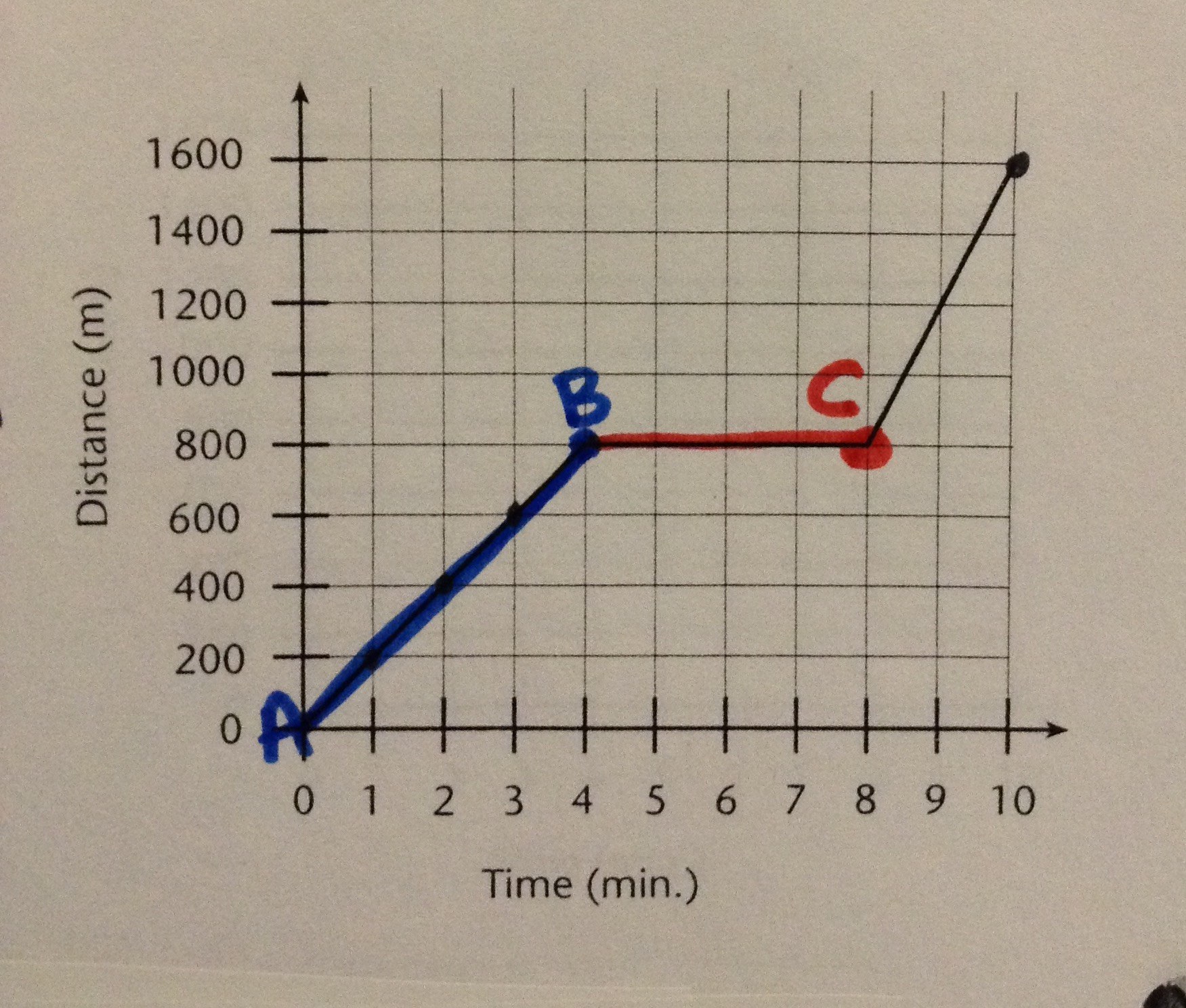
The graph shows Ashley riding her bike to Maria's house.
What is occurring from point A to point B?
they are traveling at a constant speed
they are decreasing in speed
they stopped to take a break
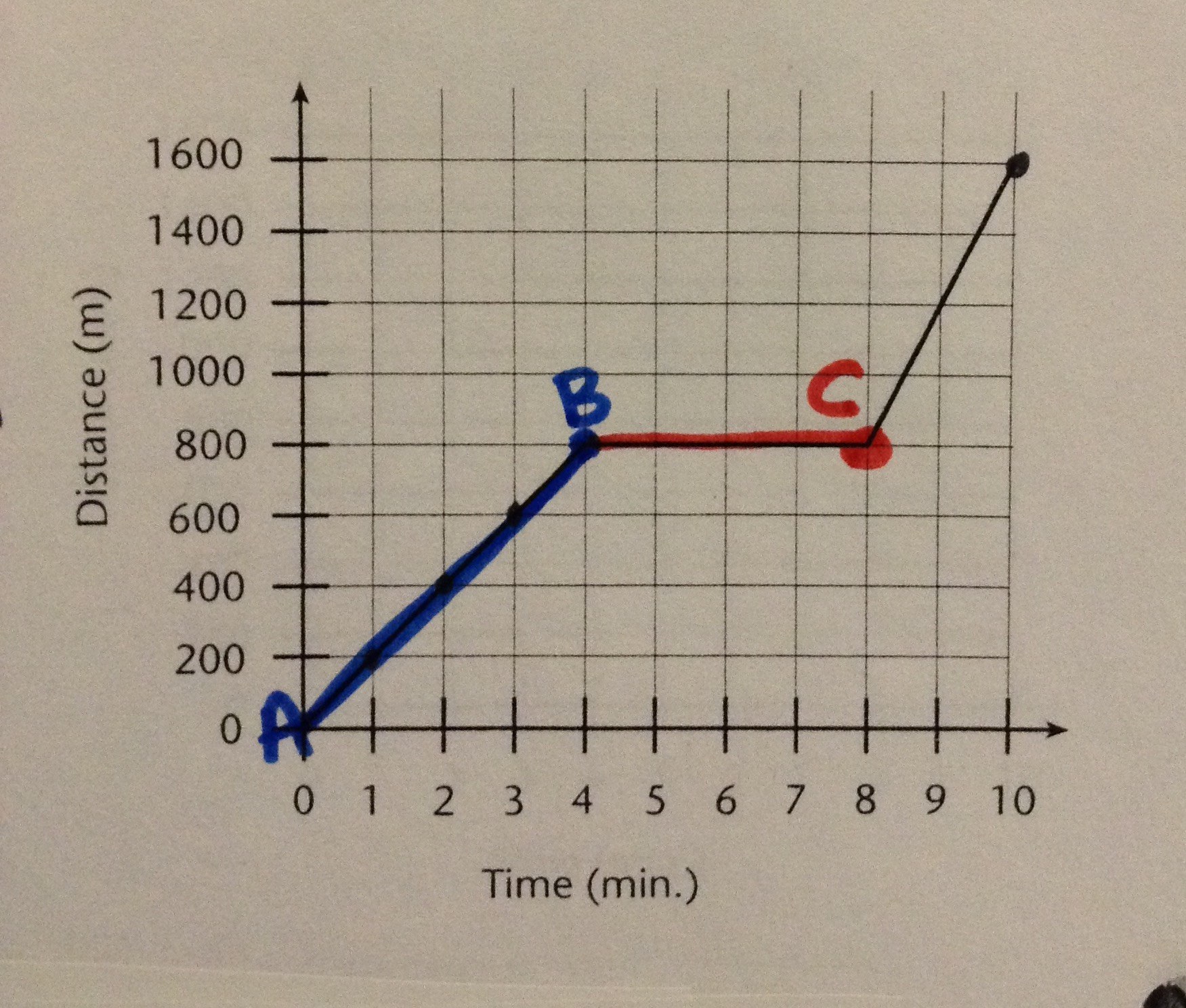
The graph shows Ashley riding her bike to Maria's house.
What was occurring from point B to point C?
She was increasing her speed.
She stopped for 4.0 minutes
She was decreasing in speed
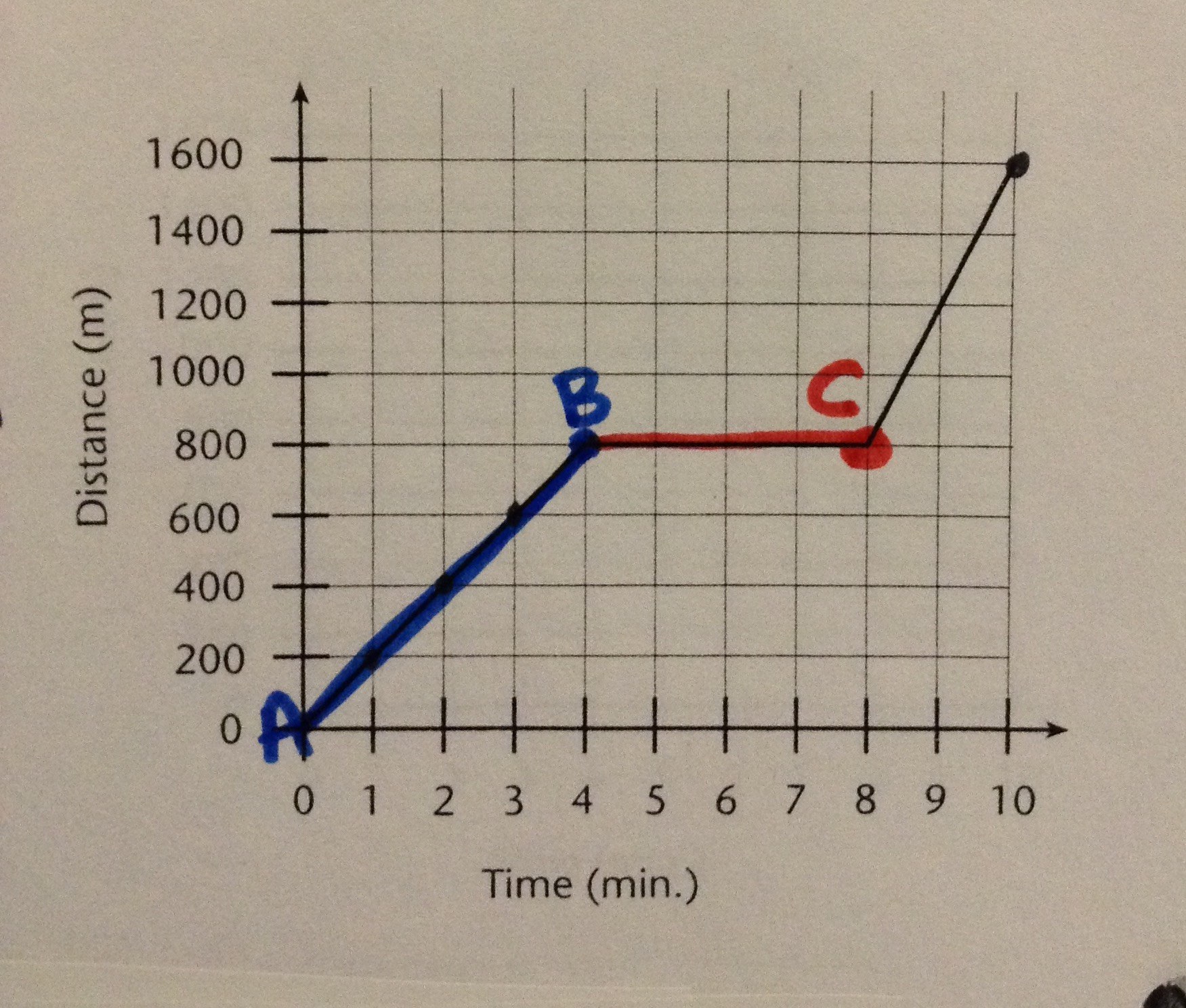
The graph shows Ashley riding her bike to Maria's house.
What was her average speed for the ENTIRE trip?
1600.0 m/min
200.0 m/min
160.0 m/min
What is velocity?
Time + Distance
Speed in a given direction
A fast dinosaur
The direction a storm is moving

Take a good look at this "Velocity vs. Time" graph. How would you describe the motion of this object?
no motion
Constant velocity
Acceleration
negative acceleration

Take a good look at this "Velocity vs. Time" graph. How would you describe the motion of this object?
no motion
constant velocity
acceleration
negative acceleration

Take a good look at this "Velocity vs. Time" graph. How would you describe the motion of this object?
No motion
Constant Velocity
Acceleration
Deceleration
The sun’s energy used by green plants to produce food is an example of light energy being converted to what other form of energy?
kinetic energy
heat energy
mechanical energy
chemical