
 Worksheets
Class 8_Ch.1 and 2
Total questions: 93
Worksheet time: 47mins

Organisms that cannot be seen with unaided eyes are?
Micrones
Microbials
Microorganisms
Microbiology

The type of corona virus that is currently causing pandemic worldwide is
SARS
MERS
COVID-12
COVID-19
Diseases dysentery and malaria are caused by
Bacteria
Protozoa
Fungi
Virus
The bacterium that promotes formation of curd from milk is
Streptococcus
Lactobacillus
Micrococcus
Psuedomonas
The disease causing microbes are known as
Pathology
Pathogenesis
Pathogens
Antibodies
Rhizobium bacteria
Helps in digestion
Helps in Nitrogen fixation
Causes disease
All of the above
Hepatitis A is caused by
Bacteria
Protozoa
Fungi
Virus
Rust of wheat is caused by
Fungi
Bacteria
Virus
Algae
Preservatives used in pickles is
Sodium benzoate
Heat and cold treatment
Sugar
Oil and Vinegar
Influenza is a disease caused due to
Bacteria
virus
Protozoa
None of the above
------------------------------- was the person known to have observed bacteria under a magnifying glass.
(a)
A fungus that grows on stale bread is:
Penicillium
Aspergillus
Rhizopus
None
An example of symbiotic relationship is found in:
Moulds
Bacteriophase
Aspergillus
Lichens
Bacteria is known as__________________ in an ecosystem when feeding on dead organisms.
Decomposers
Herbivore
Pathogens
Infections
The Fermentation process is discovered by
Louis Pasture
Alexander flaming
Edward jenner
John Mendal
Mushroom belongs to
Algae
Virus
Fungi
None of the above
Penicillium is a
Algae
Fungus
Bacteria
Yeast
Malaria is caused bby
Protozoa
Virus
Algae
Bacteria
Amoeba belongs to
Algae
Fungi
Virus
Protozoa

Yeast is used for making bread. Yeast is a
plant.
spice.
fungi.
bacteria.
What type of disease can you get from a virus?
cavities
chicken pox
food poisoning
athlete's foot
Which statement is NOT true?
Microorganisms help dead things decay.
Microorganisms only live in soil.
Microorganisms cause disease.
Microorganisms are used to make cheese.

Microbiology is the study of ______
Environment
Cells
Microbes
Plants
Microorganisms are never found in a
hot water spring.
ice cold water.
marine water.
none of these.
Which is not classified as a major group of the microorganisms?
Bacteria
Plants
Virus
Fungi
Decomposers are those microorganisms that
Synthesize food by photosynthesis.
Break down the dead and decaying organic matter.
Cause weathering of rock.
Convert milk into curd.
_____ are non-cellular infectious particles.
Bacteria
Blue green algae
Viruses
Protozoa
Microorganisms can be seen with the help of a
Kaleidoscope
Telescope
Microscope
Periscope
Viruses show characteristics of:
Both living & non-living
Living
Prokaryotes
Non-living
Microorganisms cannot be seen by naked eye because
they are colonial.
they are tiny in size.
they are ubiquitous in nature.
they are unicellular.
Which one of the following is called pond silk? ( named for beautiful pattern )
Spirogyra
Volvox
Chlamydomonas
Euglena

IDENTIFY THE AGRICULTURAL TOOL
SPADE
KHURPI
PLOUGH
SICKLE
WHICH OF THE FOLLOWING CROP GROWS IN WINTER?
PEA
PADDY
MAIZE
SOYABEAN
WHICH AGRICULTURAL PRACTICE HELPS IN TURNING AND LOOSENING OF SOIL?
SELECTION AND SHOWING OF SEEDS
IRRIGATION
WEEDING AND CROP ROTATION
SOIL PREPARATION
OUT OF FERTILIZER AND MANURE WHICH ONE IS EASILY ABSORBED BY THE ROOTS ?
FERTILIZER
MANURE
BOTH MANURE AND FERTILIZER
NONE OF THESE
WHEN YOU WILL PUT SEEDS IN WATER ,WHAT IS TRUE ABOUT DAMAGED SEEDS?
THEY WILL SINK
THEY WILL FLOAT
THEY ARE HEAVIER
ALL OF THESE
WHICH OF THE FOLLOWING IS NOT A FERTILIZER?
UREA
NPK
POTASH
RHIZOBIUM
The plant roots contain nitrogen fixing bacteria _________________.
Orange
Pea
Mango
Tomato
Which of the following is rich in organic nutrients?
Potash
Ammonium Sulphate
Urea
Compost
VERMICOMPOST IS A
FERTILISER
PESTICIDE
MANURE
NONE OF THESE
WHICH OF THE FOLLOWING IS A CEREAL CROP?
PADDY
MAIZE
BARLEY
ALL OF THESE
Manures are
Organic in nature
Inorganic in nature
Organic as well as inorganic in nature
None of above
Cereals generally provide
Proteins
Sugars
Fats
Vitamins.
_________________ does not include Agricultural practices.
Irrigation
Marketing
Harvesting
Multiple cropping
Which chemical controls pests
Fertiliser
Pesticide
Herbicide
Fungicide
The process of loosening the husk from the grain is called________
Winnowing
Harvesting
Threashing
Weeding
The process of rearing silkworms on a large scale is called______________
Vermiculture
Pisciculture
Sericulture
Apiculture
Rabi Crops are grown in _______ season
Summer
Spring
Winter
rainy
The process of loosening and turning the soil is called
Broadcasting
Irrigation
Ploughing
Levelling
What are the advantages of preparing the soil?
Allows roots to penetrate the soil easily
Makes the top soil nutrient rich
Makes decomposition by microbes easier
All of these
Arrange the following agricultural practices in the order in which they are followed.
A. Storage
B. Harvesting
C. Irrigation
D.Sowing
E. Preparation of soil
A-B-C-D-E
E-D-C-B-A
The organic substance obtained from dead plants and animal wastes is
Manure
Fertilizer
Irrigation
Agriculture
Weeds are the:
unwanted plants growing along the crop
insects and pests
main crop plants
chemical substances
Weeds can be removed by using.
Pesticides
Fungicides
Weedicides
Bactericides
Process of separation of grains from chaff is called:
combining
Winnowing
fallow
harvesting
Which agricultural season in India begins in June/July and ends in October/November?
Kharif
Rabi
None of these
Which is the chief and most popular beverage in India?
Coffee
Tea
Cocoa
WHILE SOWING OF SEEDS PROPER DISTANCE MUST BE MAINTAINED BETWEEN EVERY SEED .WHY?
TO PREVENT FROM OVERCROWDING
TO PREVENT FROM COMPETITION FOR NUTRIENTS,WATER, SHELTER, SUNLIGHT ETC.
TO PROTECT FROM DISEASE
TO PROTECT FROM WEEDS
Which of these is not a cereal?
Maize
Gram
Wheat
Rice
Which of these is not a kharif crop?
Wheat
Rice
Maize
Groundnut
Which of the following is not grown by transplantation:-
Chillies
Tomatoes
Peas
Paddy
Which of the following is not a Rabi crop?
Soyabean
Peas
Wheat
Linseed
The food obtained from animals is rich in :
Fats
Carbohydrates
Minerals
Proteins
In agriculture , broadcasting is used for:-
Ploughing
Crop rotation
Removal of weeds
Sowing of seeds
The rhizobium bacteria presents in root nodules of pea plants can fix one of the following from the Atmosphere. This one is:
Hydrogen
Oxygen
Nitrogen
Halogen
What converts nitrogen gas into a usable form for plants and animals?
bacteria
rain
fungi
car exhaust
The process in which nitrogen circulates and is recycled is called
The nitrogen cycle
The carbon cycle
The water cycle
The phosphorus cycle
How is nitrogen "fixed" into a usable form for plants?
Through action of bacteria only
Through lightning only
Through action of bacteria and lightning
Through photosynthesis
How do animals get the nitrogen they need?
From the air they breathe
From the water they drink
From the food they eat
From the sun
What is the process of combining nitrogen gas with other elements to make nitrogen into usable compounds?
nitrogen composition
nitrogen fixation
ammonia
denitrification
What process occurs when dead plant and animal matter decomposes and nitrogen is released back into the atmosphere?
Assimilation
Fixation
Ammonification
Denitrification
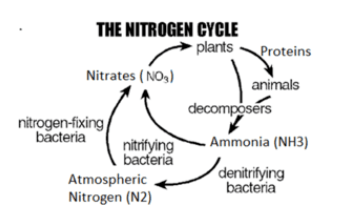
According to this diagram, plants use nitrogen to make _________________________
bacteria
animals
proteins
decomposers
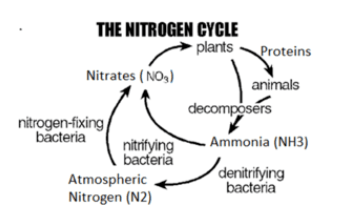
According to this diagram, plants absorb
nitrates
nitrogen fixing bacteria
animals
decomposers
The process that allows organisms to use nitrogen
assimilation
denitrification
fixation
ammonification
Bacteria create a form of nitrogen that animals can use directly.
True
False
What do free living bacteria in the soil do?
Make clouds
Turn atmospheric nitrogen into nitrates
Make carbon dioxide for plants to go through photosynthesis
Help plants take in water
All plants have nitrogen fixing bacteria in their roots.
True
False

