Wayground logo

Free Printable Worksheets

Font size

S
M
L
XL
Worksheets

Evolution

Total questions: 108

Worksheet time: 54mins
Name
Class
Date
1.
Who was the first naturalist to study evolution?
a)
Charles Darwin
b)
Gregor Mendal
c)
Carolus Linneaus
d)
Thomas Edison
2.
This is a process by which organisms inherited advantageous traits that tend to reproduce more successfully than the other organisms do. 
a)
Artificial selection
b)
Natural selection
c)
Populations
d)
Environment
3.
This is a process in which organisms gradually change over time.
a)
Environment
b)
Competition
c)
Evolution
d)
Fossils
4.
These are natural differences within a species.
a)
Evolution
b)
Genetic variation
c)
Biological diversity
d)
Populations
5.
This is an inherited trait that helps an organism survive and reproduce in its environment.
a)
Evolution
b)
Population
c)
Environment
d)
Adaptation
6.
This is the trace or remains of an organism that lived long ago, most commonly preserved in sedimentary rock.
a)
Competiton
b)
Extinction
c)
Evidence
d)
Fossil
7.
Why are advantageous traits more likely to be passed onto offspring?
a)
Because they are more likely to survive and reproduce.
b)
Because they come from dominant alleles.
c)
Because they come from recessive alleles.
d)
Because the trait is an acquired phenotype.
8.
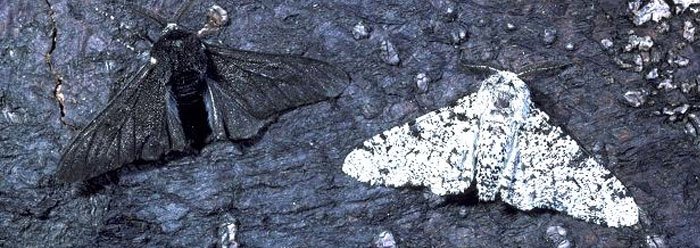
The trees these moths used to live on were white, but have been covered in soot from coal factories. Which moth will be more successful in this environment?
a)
Dark moth
b)
Light moth
c)
Both will be equally successful
d)
Neither will be successful
9.
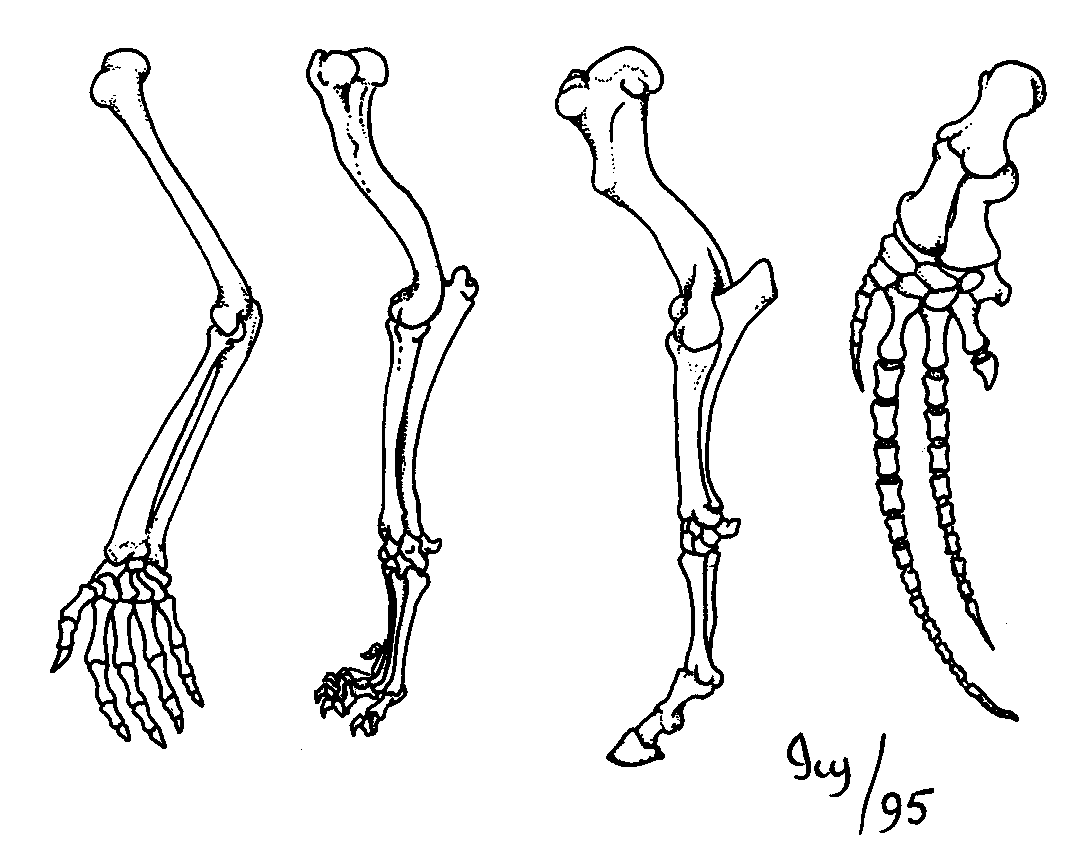
Structures with the same parts have different functions; suggests that organisms share a common ancestry
a)
vestigial structures
b)
homologous structures
c)
adaptive radiation
d)
fossil
10.
Study of embryos of various organisms to show a common ancestor because of similarities in development
a)
natural selection
b)
embryology
c)
speciation
d)
evolution
11.
The diagram shows fossils in different rock layers. Which of these statements about the age of these fossils is most likely correct?
a)
Fossil A and C are the same age
b)
Fossil B is older than fossil C
c)
Fossils A is older than fossil B
d)
Fossil D is older than fossil C
12.
Which of these best represents a time period in which an organism could evolve?
a)
5 days
b)
100 years
c)
10,000 years
d)
2 decades
13.

Whales are aquatic mammals that contain a pelvis (hip) bone. Even though it does not aid in its movement, the function must have been used by a common ancestor of the whale. Thus, the pelvis is referred to as a(n)

a)

vestigial structure

b)

analogous structure

c)

homologous structure

14.
The ability of an organism to survive and reproduce in its specific environment 
a)
diversity.
b)
evolution
c)
adaptation
d)
 fitness
15.
Where humans have bred organisms together based on traits we like.
a)
Evolution
b)
Natural Selection
c)
Extinction 
d)
Artificial Selection
16.
An error in DNA copying that results in a new trait
a)
Homeostasis
b)
Mutation
c)
Natural Selection
d)
Selective Breeding
17.
The long and sharp beak of a woodpecker is an example of:
a)
Natural Selection
b)
Selective Breeding
18.
The environment around Manchester, England, changed during the Industrial Revolution.  How did this change affect peppered moths living in the area?
a)
Natural selection favored moths with dark wings because predators could not see them on the soot-colored trees.
b)
Natural selection favored moths with white wings that were easy for predators to see.
c)
Natural selection favored moths with white wings because predators could not see them on the soot-colored trees.
d)
Natural selection caused moths with white wings to become extinct.
19.
In natural selection, the selective agent is the
a)
humans
b)
mutations
c)
breeders
d)
environment
20.
what did Charles Darwin observe in finch populations of the Galapagos Islands off the coast of South America?
a)
different species on different islands
b)
all species on one of the islands
c)
identical species on all the islands
d)
the same species as North America
21.
Darwin wrote that organisms with traits that are best suited to the environment will ________________
a)
increase in number
b)
become extinct
22.
Some organisms that share a common ancestor have features that have different functions, but similar structures.  These are known as
a)
vestigial structures
b)
analogous structures
c)
homologous structures
d)
fossil structures
23.
What increases genetic variation when animals move from one population to another
a)
genetic drift
b)
sexual selection
c)
bottleneck effect
d)
gene flow
24.
This mechanism of evolution occurs when populations migrate.
a)
Extinction
b)
Gene flow
c)
Genetic drift
d)
Natural Selection
25.
Choose which scientist corresponds best with the statement: 
acquired characteristics are inherited
a)
Darwin 
b)
Lamarck
26.
What is another name for natural selection?
a)
survival of the smartest
b)
survival of the fastest
c)
survival of the biggest
d)
survival of the fittest
27.

Over generations of time apart on different islands with different food sources, the separated populations of Galapagos finches accumulated genetic differences until each group had different beaks. This is an example of _____.

a)

natural selection

b)

genetic drift

c)

adaptation

d)

speciation

28.
Genetic drift is change in the allele frequency of a population due to...
a)
random chance
b)
natural selection
c)
non-random mating (sexual selection)
d)
artificial selection
29.

Many different groups of organisms have wings, even though they do not share a recent common ancestor. This is because they evolved in environments with similar selective pressures. Wings are an example of a(n) ______________ structure.

a)

vestigial

b)

analogous

c)

homologous

30.

A flood drowns a large portion of an insect population, with only a few random individuals surviving. This is an example of ______.

a)

genetic drift

b)

adaptation

c)

natural selection

31.

How do species change over time?

a)

frequency (amount) of certain alleles in a population

b)

towards perfection

c)

through individual evolution

d)

through acquired traits

32.
What characteristic did Darwin observe about the finches on the Galapagos Islands?
a)
Their feathers 
b)
Genotypes 
c)
Their beaks
d)
Their body sizes
33.
The fossil record provides evidence that 
a)
Fossils cannot be dated.
b)
All species were formed during Earth’s formation and have changed little since then.
c)
The fossilized species have no connection to today’s species.
d)
Older species gave rise to more-recent species.
34.
______ _________ explains how two or more organisms could evolve similar traits even though they are not related to each other.
a)
convergent evolution
b)
reproductive isolation
c)
derived characters
d)
hybrid vigor
35.
__________ characters are similar characteristics that have evolved separately in two unrelated organisms.
a)
analogous
b)
homologous
c)
cladistic
d)
phylogenic
36.
Finches on the Galapagos Islands had different beaks in order to help them do what?
a)
Build nests
b)
Fight off predators
c)
Collect food sources
d)
Compete with rivals
37.

Which Hardy-Weinberg factor represents the frequency of heterozygous individuals in a population?

a)

p2

b)

2pq

c)

q2

d)

p2 + 2pq

38.
What do you call all of the genes in a population?
a)
Gene pool
b)
Relative Frequency
c)
Genetic Drift
d)
Allele pool
39.
What does the Hardy-Weinberg equilibrium measure?
a)
changes in allele frequencies
b)
numbers of mutations
c)
goodness of fit
d)
genetic diversity
40.
In the Hardy-Weinberg Equation, q2 is the frequency of what?
a)
The recessive allele 
b)
the dominant allele
c)
the recessive genotype
d)
the dominant genotype
41.
A population of 150 individuals has an allele frequency of 0.3 for the dominant allele (B) and a frequency of 0.7 for the recessive allele (b). Use the Hardy-Weinberg equation to determine the frequency of the genotype (bb).
a)
0.09
b)
0.42
c)
0.49
d)
0.21
42.

The allele frequency of p=.20 What is the percentage of recessive genotype?

a)

.80

b)

.04

c)

.32

d)

.64

43.
Which is a mechanism for change in allele frequency?
a)
gene flow
b)
genetic drift
c)
natural selection
d)
all answers are correct
44.
When a population is in Hardy-Weinberg equilibrium,  what is NOT happening to the species?
a)
Survival
b)
Reproduction
c)
Death
d)
Evolution
45.
Which Hardy-Weinberg equation represents the genotype frequencies in a population?
a)
p + q = 1
b)
p2 + 2pq + q2 = 1
c)
p2 + pq2 + q2 = 1
d)
p + 2pq + q3 = 1
46.
Genetic drift is likely to be seen in a population
a)
That has a low mutation rate
b)
In which natural selection is occurring
c)
That is very small
d)
For which environmental conditions are changing
47.
The Hardy-Weinberg Model is...
a)
available at local hobby stores and retailers throughout the Greater Tazewell area.
b)
a mathematical tool that biologists can use to predict allele frequencies and determine whether or not evolution is occurring within a population.
c)
always occurring within individual organisms in nature.
d)
only useful in the lab and cannot be practically applied to real-world populations of organisms.  
48.

The allele frequency of p=.20 What is the percentage of Heterozygous Dominant genotype?

a)

.80

b)

.04

c)

.32

d)

.64

49.

The allele frequency of p=.20 What is q?

a)

.80

b)

.04

c)

.32

d)

.64

50.

A population's recessive allele frequency 25%. What is the percentage of the Homozygous Dominant genotype?

a)

.5625

b)

.3750

c)

.0625

d)

.25

e)

.5

51.

64% of the population has the recessive phenotype. What is the percentage of the recessive genotype?

a)

.04

b)

.32

c)

.64

d)

.2

e)

.8

52.

A population's recessive allele frequency 25%. What is the percentage of the Heterozygous genotype?

a)

.5625

b)

.3750

c)

.0625

d)

.25

e)

.5

53.

64% of the population has the recessive phenotype. What is the percentage of the heterogeneous genotype?

a)

.04

b)

.32

c)

.64

d)

.2

e)

.8

54.

64% of the population has the recessive phenotype. What is the allele frequency for p?

a)

.04

b)

.32

c)

.64

d)

.2

e)

.8

55.
Which of the following is an example of the bottle neck effect?
a)
Bald Eagles are hunted until near extinction, population recovers.
b)
Small group of iguanas floats to an island, starts a new population.
c)
Red fox pups are more likely to survive in a snowy environment if they are born white.
d)
Farmer chooses seeds from largest apples to plant next year.  This results in larger apples from year to year.
56.
A change in the genetic composition of a population as a result of descending from a small number of colonizing individuals is called:
a)
founder effect
b)
bottleneck
c)
genetic drift
d)
gene flow
57.

Which of these is a condition that must be met for Hardy-Weinberg equilibrium?

a)

extremely small population size

b)

no natural selection

c)

gene flow

d)

nonrandom mating

58.

If there are 400 red flowers, 200 pink flowers, and 100 white flowers. Solve for the frequency of the dominant allele.

a)

0.76

b)

0.86

c)

0.57

d)

0.71

59.

Neo-Darwinism believes that new species develop through

a)

(a) Mutations with natural selection

b)

(b) Continuous variations with natural selection

c)

(c) Hybridisation

d)

(d) Mutations

60.

Select the correct statement –

a)

(a) Darwinian variations are small and directionless

b)

(b) Mutations are random and directional

c)

(c) Fitness is the end result of the ability to adapt and get selected by nature

d)

(d) All mammals except whales and camels have been selected by nature.

61.

Industrial melanism as found in peppered moth proves that

a)

(a) Melanic form has no selective advantage in industrial area

b)

(b) Lighter form has no selective advantage in polluted industrial area and non-polluted area

c)

(c) Melanism is pollution generated feature

d)

(d) True black melanic form develops by recurring random mutation

62.

According to Hardy-Weinberg principle, sum total of all the allelic frequencies is

a)

(a) Zero

b)

(b) One

c)

(c) Infinite

d)

(d) Remain changeable

63.

Hardy-Weinberg principle is applicable to

a)

(a) Small population

b)

(b) Isolated population

c)

(c) Large population

d)

(d) All of these

64.

A tenrec is an animal that has spines all over its body similar to a hedgehog. However, these two animals are not genetically related since tenrecs live in Madagascar and hedgehogs live on the continent of Africa. What is the presence of quills an example of?

a)

Convergent Evolution

b)

Divergent Evolution

c)

Gradualism

d)

Coevolution

65.

Which of the following is NOT a principle of natural selection?

a)

Overproduction of Offspring

b)

Equilibrium

c)

Variation

d)

Adaptation

66.
Which of the following statements is supported by the graph below?
a)
The population is in Hardy-Weinberg equilibrium, as the sum of the frequency of the dominant allele and the recessive allele is always equal to 1
b)
The percentage of individuals homozygous recessive for this particular trait is increasing over time
c)
Selection has caused frequencies to change over time because individuals with a dominant allele survive at higher rates than individuals with recessive alleles
d)
Individuals who are homozygous recessive for this particular trait have migrated into the population, causing the frequency to approach 1
67.

Why has antibiotic resistance evolved in bacteria?

a)

Bacteria reproduce quickly

b)

Bacteria with a resistance to the antibiotic, passed that trait to offspring

c)

Bacteria that are resistant reproduce faster than non resistant strains

d)

Bacteria exposed to antibiotics develop a resistance to them

68.
Which type of evolution shows a common ancestor?  
a)
convergent
b)
divergent
c)
adaptive radiation 
d)
both divergent and adaptive radiation 
69.
In convergent evolution, organisms share physical similarities because they 
a)
have a common ancestor
b)
live in the same enviornment
c)
develop homologous structures
d)
are closely related 
70.
a)
The image shows analogous structures.
b)
The image shows convergent evolution.
c)
The image shows adaptive radiation. 
d)
The image shows organisms that are not closely related.
71.
a)
The image shows convergent evolution. 
b)
The image shows divergent evolution. 
c)
The image shows adaptive radiation.
d)
The image shows analogous structures.
72.
a)
The image shows convergent evolution.
b)
The image shows divergent evolution.
c)
The image shows adaptive radiation.
d)
The image shows homologous structures.
73.
Flying fish, flying birds, and bats are examples of which of the following?
a)
convergent evolution & homologous structures
b)
convergent evolution & analogous structures
c)
divergent evolution & homologous structures
d)
divergent evolution & analogous structures
74.
What happens in divergent evolution? 
a)
organisms become more similar
b)
organisms become less similar
c)
species become more related
d)
adaptive radiation always occurs
75.
a)
A=convergent B=divergent C=adaptive radiation
b)
A=adaptive radiation B=convergent C=divergent
c)
A=divergent B=convergent C=adaptive radiation
d)
A=divergent B=adaptive radiation C=convergent
76.
What was the name of the ship Charles Darwin sailed on?
a)
Boaty McBoaty Face
b)
HMS Beagle
c)
HMS Britannia
d)
HMS Bulldog
77.

The image suggests that whales and hippopotamuses shared a common ancestor. When did these ancestors live?

a)

25-35 million years ago

b)

50-60 million years ago

c)

60-75 million years ago

d)

75 million years ago or more

78.
This experiment was conducted by the scientists:
a)
Stanley Miller and Harold Urey
b)
Harold Urey and Albert Einstine
c)
Harrison Ford and Denzel Washington
d)
James Watson and Francis Crick
79.
The apparatus in the experiment was used to mimic what?
a)
proteins
b)
Earth's present conditions
c)
early Earth's conditions
d)
they didn't mean to mimic anything in particular
80.
The electrical sparks mimicked?
a)
heat waves
b)
lightening
c)
volcano
d)
hurricane
81.
What was the result of the Miller-Urey Experiment?
a)
amino acids
b)
nucleotides
c)
lipids
d)
glucose
82.
Miller/Urey and other scientists have shown that:
a)
 Life on early Earth required material from space
b)
Cells survived in the primitive atmosphere
c)
Amino acids could be produced from inorganic molecules 
d)
Simple cells can be produced in a laboratory
83.
Which of the following was probably not present in the atmosphere of the primitive Earth? 
a)
Methane
b)
Oxygen
c)
Water
d)
Carbon dioxide
84.
Earth formed 4.5 billion years ago, but life did not show until around...
a)
3.5 billion years ago
b)
1 million years ago
c)
200,000 years ago
d)
4.2 billion years ago
85.

Miller/Urey and other scientists studying the origin of life have shown that:

a)

Formation of life on early Earth required material from space

b)

Simple cells can be produced in a laboratory using spontaneous generation

c)

Oxygen and water were present in the atmosphere to support life

d)

Organic molecules like amino acids and nucleotides could be produced from abiotic/inorganic molecules

86.
The idea that Earth's early oceans had organic molecules that became the first life is called the...
a)
Primordial soup hypothesis
b)
Bubble hypothesis
c)
Miller-Urey Experiment
d)
Radioactive dating theory
87.
Which 'building block of life' was NOT made in the Miller Urey experiment?
a)
amino acids
b)
nucleic acids
c)
sugars
d)
lipids
88.
What are 'protobionts'?
a)
A collection of organic molecules surrounded by a lipid membrane
b)
Building blocks of lipids
c)
Complex catalysts that existed on early Earth
d)
Abiotic polymers
89.

Which scientist disproved the idea of spontaneous generation once and for all by using a specifically designed swan-necked flask to heat broth?

a)

Spallanzani

b)

Pasteur

c)

Redi

d)

Needham

90.

Which scientist was one of the first to disprove spontaneous generation by showing that flies were not created by meat?

a)

Spallanzani

b)

Pasteur

c)

Redi

d)

Needham

91.

In 1745, a scientist attempted to prove that microorganisms are created in broth. He heated the broth to kill all microorganisms ,poured the broth into clean flasks, and corked them. After a short time, the clear broth became cloudy, which indicated microorganisms had been created. The cloudy broth "proved" his hypothesis. Which of the following is the BEST alternate explanation for the cloudy broth?

a)

The broth was contaminated by microorganisms found in the air when he transferred the broth to the clean flasks

b)

The scientist secretly introduced the microorganisms into the broth so that it would appear they were generated by the broth

c)

The heat killed the microorganisms but converted some of them into viruses that were then found to multiply in the cooled broth

d)

The cloudiness of the broth was not caused by microorganisms but was instead caused by oxidation

92.

Which of the following is the natural law that states that living organisms come only from other living organisms and are not created from nonliving materials?

a)

evolution

b)

oxidation

c)

biogenesis

d)

abiogenesis

93.

Which scientist(s) came up with the hypothesis that life formed gradually from nonliving materials over a long period of time?

a)

Miller and Urey

b)

Sidney Fox

c)

Pasteur and Redi

d)

Oparin and Haldane

94.

Which of the following refers to the evolution of life from nonliving materials?

a)

physical evolution

b)

organic evolution

c)

chemical evolution

d)

microevolution

95.

Which of the following is the most popularly believed pathway of evolution for bacteria cells?

a)

aerobic bacteria> photosynthetic bacteria> anaerobic, heterotrophic bacteria

b)

anaerobic, heterotrophic bacteria> aerobic bacteria> photosynthetic bacteria

c)

photosynthetic bacteria> aerobic bacteria> anaerobic, heterotrophic bacteria

d)

anaerobic, heterotrophic bacteria> photosynthetic bacteria> aerobic bacteria

96.

__________ is the belief that life can arise from non-living things.

a)

biogenesis

b)

spontaneous generation

c)

cell theory

d)

evolution

97.

__________ is the theory that living things come from other living things.

a)

biogenensis

b)

spontaneous generation

c)

cell theory

d)

evolution

98.

This/These scientist(s) repeated Needham's experiment but boiled the broth longer - covered one and left the other open - only one spoiled.

a)

Redi

b)

Miller and Urey

c)

Oparin

d)

Spallanzani

99.

Pasteur was able to keep the broth her boiled open to air by

a)

using a special S shaped flask

b)

adding a fan to allow better air flow

c)

none of the options listed

d)

both of the options listed

100.

One criticism of Spallanzani's experiment was

a)

he didn't boil the broth long enough

b)

he had a poorly controlled experiment

c)

all of the options listed

d)

air could not get to the broth

101.

The reason the broth eventually became spoiled for Pasteur was _______.

a)

He broke off the flask so germs could enter

b)

Enough time elapsed so the boiling was no longer effective

c)

Someone broke into his lab and contaminated the broth

d)

Spontaneous generation will actually occur if enough time lapses

102.

What name did Oparin and Haldene give the special ingredients that they hypothesized eventually became life

a)

Adam and Eve stew

b)

biogenesis

c)

primodial soup

d)

abiogenesis

103.

While Oparin and Haldane only hypothesized how life may have formed on Earth, who actually came up with a model for this?

a)

Miller and Urey

b)

Watson and Crick

c)

Pasteur and Spallanzani

d)

Needham and Redi

104.

The Coaccervates with nucleoprotein and nutrients characterised as

a)

a Bacteria

b)

b Photozoa

c)

c Fungi

d)

d Free living genes

105.

urey and miller experiment was conducted in the year ----

a)

a 1950

b)

b 1963

c)

c 1953

d)

d 1943

106.

What are the amino acids identified at the end of urey miller experiment

a)

a Glycine

b)

b Alanine

c)

c methionine

d)

d both a and b

107.
What was the first era on earth that was mainly populated by prokaryotes?
a)
Precambian
b)
Crestacious
c)
Cambian
d)
Maleus
108.
The first genetic material was most likely
a)
DNA
b)
RNA
c)
Proteins
d)
Fatty Acids