
 Worksheets
UNIT 7 Natural Selection REVIEW
Total questions: 104
Worksheet time: 2hrs 36mins
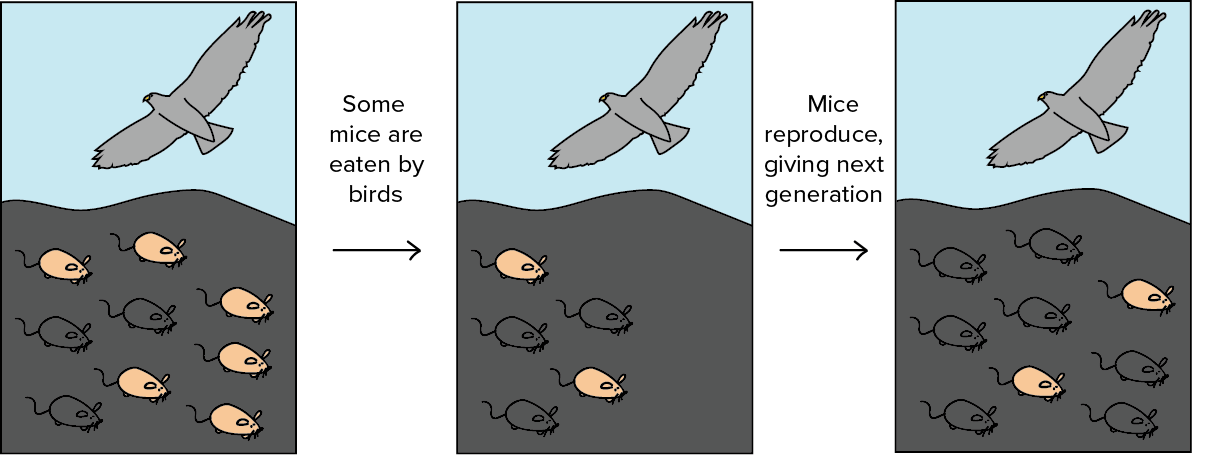
Which of the following is a factor in natural selection?
Individuals of species compete with one another to survive.
All species are genetically diverse.
Individuals better able to adapt to changes leave more offspring.
All of the above.
Individuals that are better able to cope with the challenges of their environment tend to
Increase in population over time.
Decrease in population over time.
Leave fewer offspring than those less suited to the environment.
Both (a) and (c)
Starting in 1954, commercial fishers in the northwest Pacific were paid by weight, rather than by the individual fish, for pink salmon. The fishers increased the use of a type of net that selectively catches larger fish. Which of the following effects did this change in fishing technique most likely have on the salmon population over the next 20 years?
The average body size of the salmon population decreased significantly.
The average body size of the salmon population increased significantly.
The average body size of the males in the salmon population increased, and the females stayed the same.
None of the above.
The Asian shore crab invaded parts of the eastern coast of the United States about 15 years ago. The Asian shore crab preys on blue mussels. In the time since the Asian shore crab arrived, the average shell thickness of the blue mussel population has increased.
Which of the following is the most likely reason that this increase in shell thickness has occurred?
Blue mussels with thick shells attract more crabs that mussels without thick shells.
Blue mussels with thick shells grow in larger colonies than mussels without thick shells.
Blue mussels with thick shells catch more food per day than mussels without thick shells.
Blue mussels with thick shells survive and reproduce more successfully than mussels without thick shells.
The process in which organisms with traits well suited to an environment are more likely to survive and to produce offspring is
Natural selection.
Genetic principles.
Origin of species.
Trait mechanism.
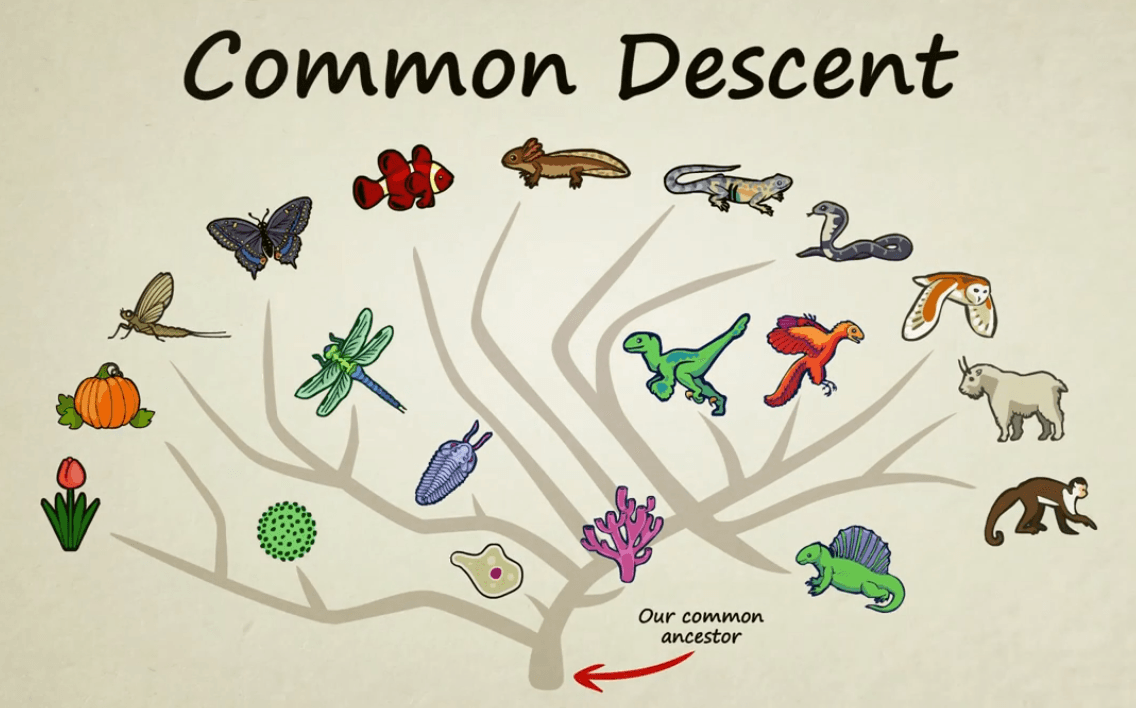
The theory of ‘common descent with modification’ states that all modern organisms
can change in response to environmental change
are descended from a single ancestral species
can be arranged in a linear order from “least evolved” to “most evolved”
Have not changed over time
which of the following is an example of microevolution?
a. the evolution pesticide resistance in pests
b. the increase in size, over time, of the horse species.
c. the change in color of the peppered moth due to pollution
Both A and C

The fossil record provides evidence that
Fossils cannot be dated.
All species were formed during Earth’s formation and have changed little since then.
The fossilized species have no connection to today’s species.
Older species gave rise to more-recent species.
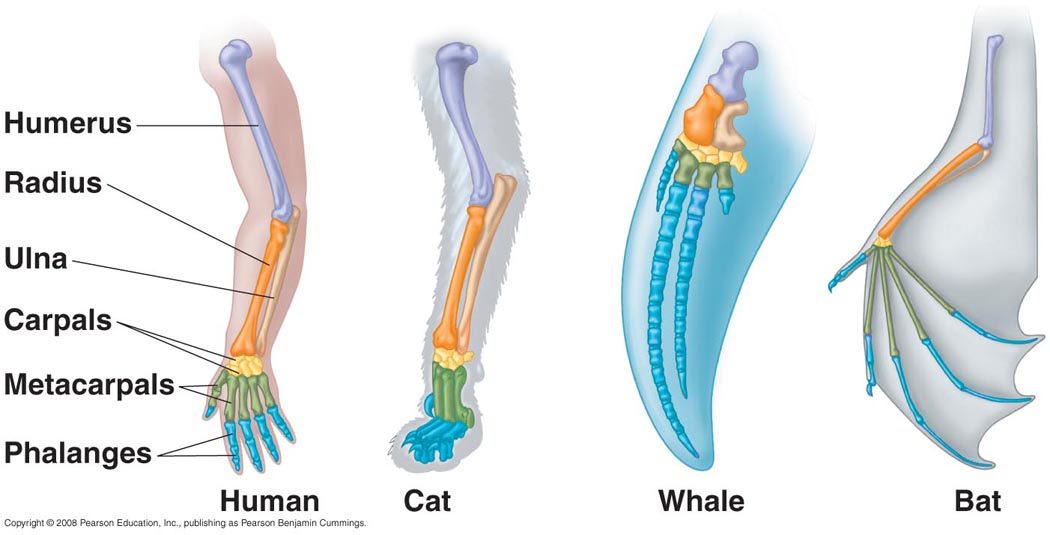
Structures with the same parts but have different functions, suggesting that organisms with a backbone share common ancestry is called…
Not related
Not homologous
Homologous
Young in origin
Structures with no function that are remnants of an organism’s evolutionary past are
Not visible organisms
Young in origin
Vestigial
Useful to the organism
Comparing the human hemoglobin amino acid sequence to the chimpanzees, horses, kangaroos, and chickens, reveal that humans have the fewest amino acid differences with
kangaroos
horses
chickens
chimpanzees
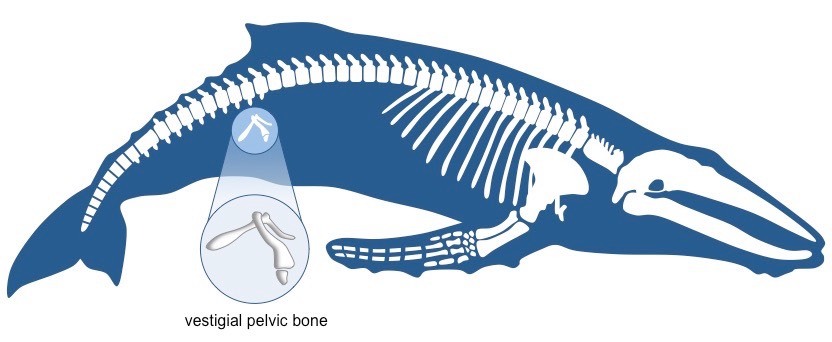
The presence of pelvic bones in the baleen whale is evidence of which of the following?
Whales can travel on land when necessary.
Whales are developing into animals with four functioning limbs.
Whales have functional legs that are hidden by fat and skin.
Whales evolved from four-legged animals.

What is suggested by the similary of early embryos of different species of vertebrates?
No evolutionary relationship between the groups
A recent common ancestry
Similar environments in the past
Evolution from a distant common ancestor
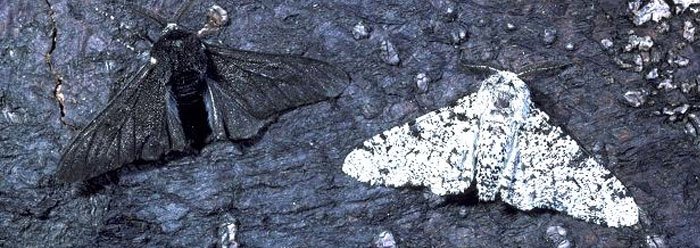


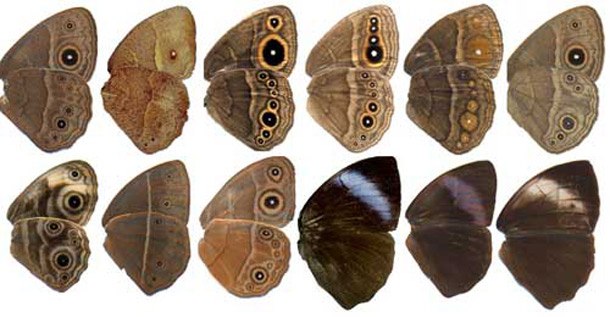
behavioral isolation
temporal isolation
gametic isolation
geographic isolation


When the Grand Canyon in Arizona formed, two populations of one squirrel species were separated by the giant canyon. This is an example of _____________.
Temporal isolation
Behavioral isolation
Geographic isolation
When populations no longer look the same
When populations no longer have the same frequency of alleles
When populations are living in different environments
When populations can no longer interbreed
Genetic diversity is decreased through this process.
Gene Flow
Genetic Drift
In which of the following populations would genetic drift be most likely to cause a rapid evolution of the population?
The human population of India
A large population of Mexican free-tailed bats living in central Texas
A geographically isolated population of 5000 green tree frogs
A small group of 12 cheetahs living in Namibia
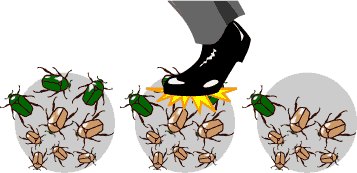
Someone steps on some bugs and randomly removes their alleles from the population. This is an example of
gene flow
genetic drift
speciation
allele frequency
Alleles that improve survival will decrease in frequency in the next generation.
True
False
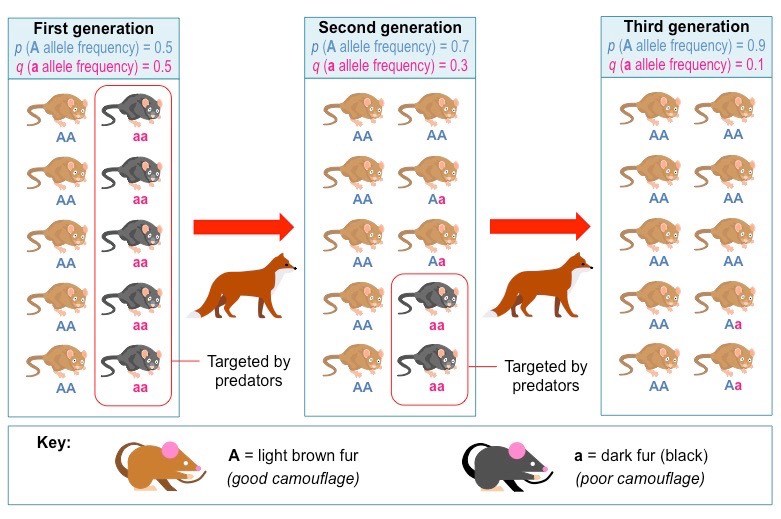
The allele frequencies of the mouse population in the picture are changing over time. Which is true?
The population is evolving.
The population is not evolving.
The population will go extinct.
The population's genetic variation is increasing.
Adaptations are features you are born with that either help you or hurt you in your environment.
True
False
What is binomial nomenclature?
system of 3 names
system of 2 names
the names of the kingdoms
the levels of classification
Who created the 2 name system?
Linnaeus
Edison
Darwin
Einstein
The 3 domains are Eukarya, Archaea, and
Fungi
Plantae
Animalia
Bacteria
What two levels make up a scientific name?
genus and order
genus and species
domain and kingdom
family and genus
What level comes after order?
genus
kingdom
family
species
What level comes before class?
phylum
domain
order
family
The _________ levels that 2 organisms share, the more similar they are to each other.
fewer
more
The 4 eukaryote kingdoms are Animals, Plants, Fungi, and
Bacteria
Archaea
Humans
Protists
Which of these has a backbone?
jellyfish
squid
worm
snake
All living things are made of
cells
prokaryotes
autotrophs
heterotrophs
Scientists place organisms into domains and kingdoms based on cell type, number of cells, and
if they are able to grow.
if they drink water.
if they have the ability to make food.
if they are able to move.
Where are bacteria found
in very few places
only in the air
all over the place
only in cow intestines
Which of these is a fungus?
bacteria
mushroom
algae
seaweed
What is the study of classification?
taxonomy
biology
botany
microbiology
What is a prokaryote?
an organism that has nuclei in its cells
an autotroph
a heterotroph
an organism without a nucleus in its cells
Which of these is a eukaryote?
bacteria living in your digestive system
archaea
bacteria living in food
mold
A heterotroph
cannot make its own food.
is able to make its food.
Which of these is an autotroph?
mushroom
rose
seal
tiger
What is the correct order of classification?family
kingdom, domain, phylum, class, order, family, genus, species
domain, kingdom, phylum, class, order, family, genus, species
domain, phylum, class, order, kingdom, family, genus, species
species, genus, family, phylum, order, class, domain, kingdom
What is the proper way to write a scientific name?
Symbion pandora
Symbion Pandora
symbion Pandora
symbion pandora
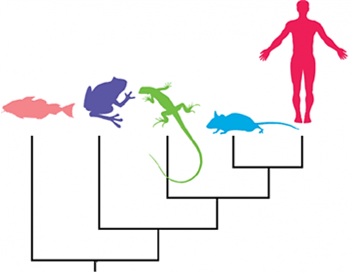
What is the human most closely related to?
Fish
mouse
Salamander
Human

Where is the alligator and T. rex's common ancestor?
Point A
Point B
Point C
Point D
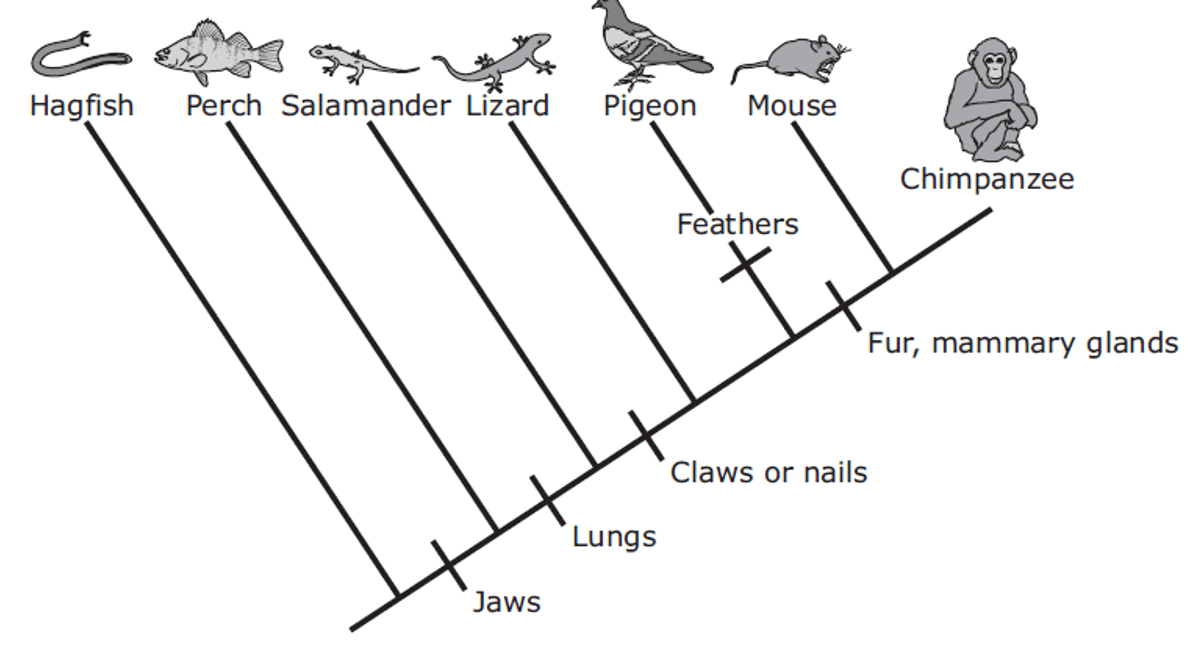
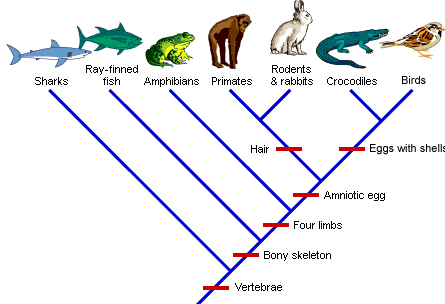
What is the purpose of a cladogram?
To map the ancestral relationships and shared traits of different organisms.
To trace the inherited traits of a single species over time.
To check the likelihood of an offspring having a particular trait.
To monitor mutations that arise among different populations.

What do both the squirrel and lion have in common that the other animals do not?
They are both vertebrates
They both have lungs
They are both mammals
They both lose their canine teeth.

What do amphibians, birds, prosimians and humans all have in common? Check all that apply.
Hair
Endothermic
Eukaryotic
Tetrapod
Vertebrate

Which letter represents the most recent common ancestor of sponges and mushrooms?
A
B
C
D
E

Which trait should go where A is on the cladogram?
eyes
feet
lips
hat

Which organism goes in the B position?


According to the diagram, what is the common ancestor of ALL organisms on the phylogenetic tree?
B
C
D
E

What is the common ancestor of Letters A, B, C, D, E?
1
2
3
4

Using the cladogram, which two organisms are more closely related Lizards and Newts OR Lamreys and Sharks
Newts and Lizards
Lampreys and Sharks

Which trait(s) do conifers have?
vascular tissue only
vascular tissue and seeds
vascular tissue, seeds and flowers
seeds only
How has technology helped us in understanding evolutionary relationships?
We can travel back in time to observe different organisms in their habitats.
We clone different organisms using DNA from fossils so we can bring them back and observe.
We can now compare the DNA of different organisms to help determine the relationships between them.
We can follow different organisms on Twitter to look for similar traits and characteristics.
How can a cladogram be used to show how closely related two organisms are?
The further apart two organisms are on a cladogram the more they have in common.
If two organisms are next to each other on a cladogram then they must be the same species.
All organisms share a common ancestor.
You can use a cladogram to see how many traits two organisms have in common. The more in common, the more closely related they are.
Which of the following pictures is an example of a cladogram?


According to the tree, who is the closest relative to the human?
Yeast
Pine
Giardia
Fern

Based on the cladogram, what trait was last developed?
Opposable thumbs
lungs
claws / nails
fur / mammory glands

Which organisms lack tissues?
Roundworms
Flatworms
Cnidarians
Sponges

What do viruses need to reproduce?
they need genetic material
They need a host cell
They need bacteria
They need insulin

How does a virus cause a person to develop the common cold?
invades the host cell to reproduce
removes energy from the host cell
produces toxins in the host cell
protects the host cell from bacteria

A virus can be classified by its type of
mitochondria
chromosomes
nucleic acid
carbohydrates

takes over the cell's functions.

True or False
The flu (influenza) is caused by a virus.
true
false

What part of a virus is the protein capsule that houses the genetic material (DNA/RNA)?
tail
nucleus
capsid
glycoprotein

Which viral life cycle kills its host cell by lysing (exploding)?
lytic
mitosis
lysogenic
S phase

Which viral life cycle allows viral genetic material to lay dormant while the host cell reproduces?
lytic
mitosis
lysogenic
S phase

What is in the center of the virus?
Nucleic Acids (RNA or DNA)
Nucleus
Capsid
Glycoproteins (surface markers)

Protects the genome of a virus. Made out of protein.
Capsid
Nucleus
Glycoproteins (surface markers)
Nucleic Acids (DNA or RNA)

Helps the virus attach to and enter a host cell.
Nucleus
Nucleic Acids (DNA or RNA)
Capsid
Glycoproteins (surface markers)

Some viruses have this extra layer of protection. Made out of lipids.
Glycoproteins (surface markers)
Nucleic Acids
Capsid
Envelope
How do vaccines work against viruses?
Vaccines are like antibiotics, except they work against viruses.
Vaccines try to prepare the immune system to fight the virus.
Vaccines make it impossible for a virus to enter a host cell.
Vaccines find viral DNA or RNA and cut it to pieces, making the virus unable to replicate.

How does Human Immunodeficiency Virus (HIV) replicate?
Lytic Cycle
Lysogenic Cycle
Mitosis
Binary fission

How does influenza (flu virus) replicate?
Lytic Cycle
Lysogenic Cycle
Mitosis
Binary fission
Should a doctor give a patient antibiotics to treat a disease caused by a virus?
Yes, because antibiotics will stop the cellular processes of the virus, helping the patient get better faster.
Yes, because antibiotics will kill bacteria in the body, giving the immune system an easier time fighting the virus.
No, because diseases caused by viruses are always deadly, meaning that the patient cannot be saved.
No, because viruses are not cells, and antibiotics target cellular processes.
__________ are found in BOTH viruses AND in living single-celled organisms, such as protozoans and bacteria.
ribosomes
a nucleus
nucleic acid (DNA or RNA)
a cell membrane
A virus is referred to as a particle rather than a cell because structurally it is a
RNA core in a carbohydrate envelope.
nucleus surrounded by a protein coat.
plasmid of DNA surrounded by a capsid.
RNA or DNA core surrounded by a protein coat.
Which statement describes ALL living things (NOT viruses)?
They must reproduce sexually.
They are composed of one or more cells.
They are capable of making their own food.
They have organ systems to carry out the processes of life.
The outer protein coat of a virus is called a
membrane envelope
capsid
bacteriophage
head
What materials make up many viruses?
proteins and nucleic acids
capsids, crystals, and nitrogen
bacteriophages, capsids, and membranes
RNA, DNA, and bacteriophages
The instructions for making new copies of a virus are
part of a virus's capsid.
coded in either RNA or DNA.
coded in proteins on the surface membrane.
found only in bacteriophages.

