Wayground logo

Free Printable Worksheets

Font size

S
M
L
XL
Worksheets

APES Chapter 4

Total questions: 108

Worksheet time: 7hrs 30mins

Name
Class
Date
1.

A local area's short-term atmospheric conditions are known as_________, while its long-term conditions are known as ___________

a)

Climate, weather

b)

Weather, current

c)

Storms, weather

d)

Weather, climate

e)

Weather, patterns

2.

An area's climate is determined by what main environmental factors?

1- Average temperature

2- Average humidity

3- Average precipitation

a)

1 only

b)

1 and 2 only

c)

1 and 3 only

d)

2 and 3 only

e)

1, 2, and 3

3.

All of the following influence global air circulation EXECPT

a)

Seasonal changes in temperature and precipitation

b)

Rotation of the Earth on its axis

c)

Properties of air, water, and land

d)

Uneven heating of the Earth's surface

e)

Disruptions in clouds circulation patterns

4.

A connected loop of shallow and deep ocean currents transport warm and cool water to various parts of the earth. This loop results from

a)

Upwelling events that occur along the coast of South America

b)

The location of the continents that ultimate determines the direction and flow of ocean currents.

c)

The rotation of the earth on its axis

d)

Differences in water density due to temperature and salinity

e)

The formation of new oceanic crust at plate boundaries

5.

Terrestrial regions characterized by similar climate, soil, and organisms regardless of where they are found on the Earth are known as:

a)

Biomes

b)

Ecosystems

c)

Continents

d)

Ecological footprints

e)

Communities

6.
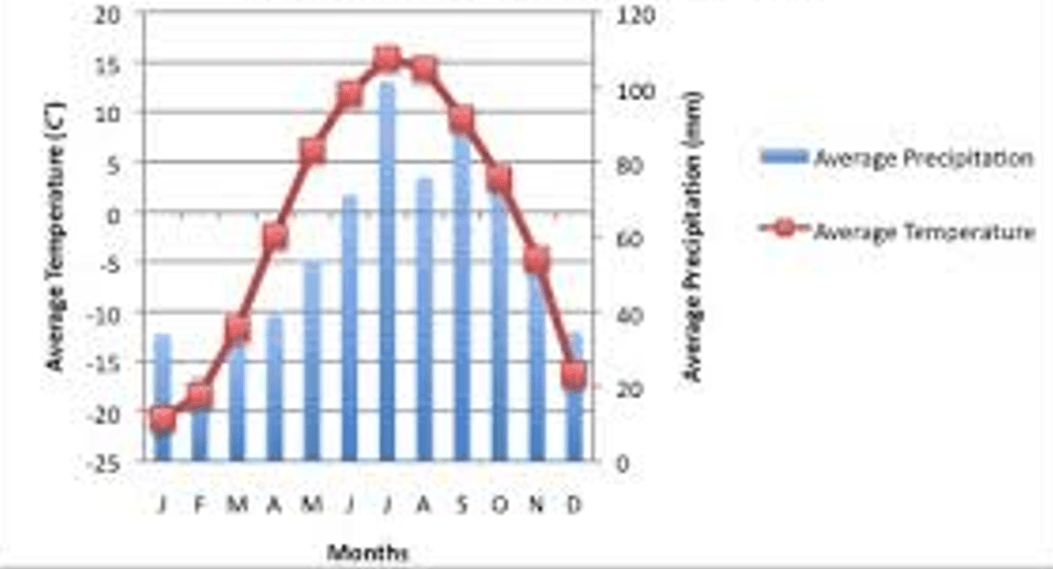
What is the maximum temperature on this graph?
a)
-7 degrees
b)
35 degrees
c)
70 degrees
d)
9 degrees
7.
Which month has the lowest average temperature?
a)
December
b)
November
c)
January
d)
February 
8.
The line graph represents?
a)
Temperature
b)
Precipitation
c)
Wind Direction
9.
The bar graph represents?
a)
Temperature
b)
Precipitation
c)
Wind Direction
10.
What is the average amount of precipitation in the month of June?
a)
less than 50 mm
b)
about 125 mm
c)
about 100 mm
d)
about 200 mm 
11.

All of the following are true of EL Niño-Southern Oscillation (ENSO) EXCEPT:

a)

It occurs regularly, every five years in the Pacific

b)

The prevailing winds in the tropical Pacific weaken and change directions

c)

The warning of the western pacific causes a reduction in upwelling nutrients and an increase in rainfall.

d)

The typical monsoon season in the Eastern Pacific is reduced, and sometimes there are droughts

e)

It changes the distribution patterns of pelagic marine species.
12.
Which biome, because of its climate, has the largest number of species of plants and animals?
a)
tundra
b)
desert
c)
tropical rainforest
d)
pine forest
13.
One characteristic feature of tundra is that only the surface thaws in the summer and refreezes in the winter, leaving a layer of permanently frozen subsoil.  This characteristic is known as
a)
glaciation
b)
permafrost
c)
crystallization
d)
soilfrost
14.
Which type of trees is found in a temperate forest?
a)
deciduous
b)
evergreen
c)
ginko
d)
palm
15.
Which major biome is home to cacti, mesquite, white thorn, pack rats, small reptiles, and coyotes?
a)
desert
b)
taiga
c)
tundra
d)
grassland
16.
Which biome contains large populations of grazing herbivores, few species of birds, and deep, rich soil?
a)
taiga
b)
tundra
c)
deciduous forest
d)
grassland
17.
This biome contains mostly spruce trees and Douglas firs, which are both evergreen.  The winters are long and cold and the summers are short and rainy.  The soil is very rich.  Moose and elk live here.  This biome is classified as a
a)
taiga
b)
tundra
c)
deciduous forest
d)
temperate forest
18.
The biome known for trees with broad leaves that fall off the trees in the winter.
a)
Coniferous Forests
b)
Deciduous Forests
c)
Deserts
d)
Tropical Rain Forests
19.
The most important abiotic factors when studying biomes are...
a)
Food and Water
b)
Water and Sunlight
c)
Temperature and Oxygen
d)
Water and Temperature 
20.

Use the figure. The northern lights are caused by solar radiation hitting charged gas molecules in which layer?

a)

A

b)

B

c)

C

d)

D

e)

E

21.
What animals might be found in a savanna?
a)
moose, caribou, wolves
b)
chameleon, reptiles, burrowing amphibians
c)
snowshoe hares, arctic fox
d)
zebra, gazelle, lion
22.
Aquatic biomes are determined by ________ and ________ of water
a)
depth and temperature
b)
salinity and depth
c)
climate and salinity 
d)
depth and climate
23.
Which of the following is the best definition for estuary?
a)
Narrow band of coastline that exists between high and low tide.
b)
Areas along the coast where fresh water from rivers mixes with salt water from the ocean.
c)
Flowing fresh water containing rapids.
d)
Freshwater aquatic areas that are saturated by water for at least part of the year.
24.
Which of the following is true regarding mangroves?
a)
There must be a freshwater input into a mangrove in order for plant life to survive.
b)
Mangroves contain rapids that allow for the mixing of water and air making it a highly productive ecosystem
c)
Mangrove plants are salt tolerant and protect the shoreline from erosion.
d)
Mangroves have an aphotic zone that has little photosynthetic activity occurring.
25.
In what zone of the ocean does photosyntesis occur?
a)
Photic zone
b)
Aphotic zone
c)
Benthic Zone
26.
Which is not a factor that affects climate?
a)
altitude
b)
latitude
c)
lakes and oceans
d)
living organisms
27.
 The rain shadow is shown at ____
a)
A
b)
B
c)
C
d)
D
28.
Does the following statement refer to climate or weather?
Today's air temperature was the lowest this week.
a)
Climate
b)
Weather
29.
What is the Coriolis Effect and how does it effect global winds?
a)
Curving of winds due to rotation of earth curves wind counterclockwise in Northern Hemisphere and clockwise in the Southern Hemisphere
b)
Movement of ocean currents caused by earth rotation' counterclockwise in Northern Hemisphere and clockwise in Southern Hemisphere
c)
curve of global winds caused by global rotation clockwise in Northern Hemisphere and counterclockwise in Southern Hemisphere
30.
What has the highest albedo?
a)
the oceans
b)
 glacial ice
c)
the ground
d)
roads
31.
What are the reasons for the seasons?
a)
Earth's tilt and rotation.
b)
Earth's rotation and revolution.
c)
Earth's tilt and revolution.
d)
Earth's tilt and resolution
32.
The main human activity that releases greenhouse gases is
a)
using bottled water
b)
burning fossil fuels
c)
texting on cellphones
d)
eating meat
33.
Which list is in the correct order of atmospheric layers starting from Earth's surface?
a)
troposphere, stratosphere, mesosphere, thermosphere, exosphere
b)
Thermosphere, stratosphere, troposphere, mesosphere, exosphere
c)
Exosphere, troposphere, mesosphere, stratosphere, thermosphere
d)
mesosphere, stratosphere, thermosphere, exosphere, troposphere
34.
Which of the following contributes to the unequal warming of earth?
I. variation in the angle of sunlight that reaches Earth
II. variation in the amount of surface area over which the Sun's rays are distributed
III. variation in the amount of sunlight reflected from clouds
a)
I only
b)
I and II only
c)
II and III only
d)
III only
35.
Latent heat release
a)
increases air temperature
b)
decreases air temperture
c)
increases the amount of water vapor
d)
increases air pressure
36.
Which of the following does NOT contribute to atmospheric convection currents?
a)
Hadley cells
b)
westerlies
c)
gyres
d)
polar cells
37.
The maximum amount of water vapor air can hold at a given temperature is called the
a)
saturation point
b)
latent heat capacity
c)
absolute humidity
d)
dew point
38.
The Coriolis effect is responsible for
a)
the convergence of two ascending Hadley cells
b)
the location of atmospheric currents caused by the unequal heating of Earth
c)
the cooling effect of air as it rises and expands
d)
the deflection of atmospheric currents
39.
Which of the following does NOT play a role in causing a rain shadow?
a)
cold polar air
b)
prevailing trade winds
c)
mountain ranges
d)
adiabatic cooling
40.
Which is the correct order of the convection cells starting from the equator?
a)
polar, ferrell, hadley
b)
ferrell, hadley, polar
c)
polar, hadley, ferrell
d)
hadley, ferrell, polar
41.
Which of the following does NOT drive ocean currents?
a)
Precipitation
b)
salinity
c)
prevailing winds
d)
gravity
42.
High productivity and nutrient availability in the ocean occurs in the areas with
a)
gyres
b)
upwelling
c)
warm waters
d)
prevailing wersterlies
43.

Warm ocean currents generally come from

a)

The North Pole

b)

The South Pole

c)

The Equator

d)

Both North and South Poles

44.
Cold ocean currents generally come from
a)
The North Pole 
b)
The South Pole
c)
The Equator
d)
Either Pole
45.
Upwelling is associated with
a)
a decrease in access to nutrients for phytoplankton
b)
cooler, nutrient-rich waters being pushed up from deeper ocean waters
c)
temperature gradients moving water from the equator to the poles
d)
an increase in human fatalities
46.
On average El Nino occurs how often?
a)
1-2 years
b)
2-7 years
c)
7-10 years
d)
15-25 years
47.
What is a cause of El Nino?
a)
Warm water pushing westward
b)
Cold Water upwells along South America
c)
Weakening of Trade Winds
d)
Strengthening of Trade Winds
48.

Describes a lake with a low level of nutrients and low productivity

a)

oligotrophic

b)

mesotrophic

c)

eutrophic

d)

benthic zone

49.

Describes a lake with high nutrients and high productivity

a)

oligotrophic

b)

mesotrophic

c)

eutrophic

d)

benthic zone

50.

Which biome contains the aphotic zone

a)

coral reef

b)

mangrove swamps

c)

open ocean

d)

streams and rivers

51.

an aquatic region characterized by a particular combination of salinity, depth, and water flow.

a)

Temperate Rainforest

b)

Woodland/shrubland

c)

Tundra

d)

Aquatic Biome

52.
a swamp that occurs along tropical and subtropical coasts and contains salt-tolerant trees with roots submerged in water.
a)
Mangrove Swamp
b)
Temperate Grassland/Cold Desert
c)
Photic Zone
d)
Eutrophic
53.

an aquatic biome that is submerged or saturated by water for at least part of each year, but shallow enough to support emergent vegetation.

a)

Eutrophic

b)

Tundra

c)

Freshwater Wetland

d)

Phytoplankton

54.

an impermeable, permanently frozen layer of soil.

a)

Terrestrial Biome

b)

Permafrost

c)

Temperate Grassland/Cold Desert

d)

Tundra

55.
a coastal biome typified by moderate temperatures and high precipitation.
a)
Temperate Rainforest
b)
Tropical Seasonal Forest/Savanna
c)
Hadley Cell
d)
Photic Zone
56.

the most diverse marine biome on Earth, found in warm, shallow waters beyond the shoreline.

a)

Terrestrial Biome

b)

Mesotrophic

c)

Coral Reef

d)

Woodland/shrubland

57.

the deeper layer of ocean water that lacks sufficient sunlight for photosynthesis.

a)

Temperate Grassland/Cold Desert

b)

Freshwater Wetland

c)

Tropical Seasonal Forest/Savanna

d)

Aphotic Zone

58.

a cold and treeless biome with low-growing vegetation.

a)

Nitrification

b)

Tundra

c)

Cellular Respiration

d)

Hadley Cell

59.
the upper layer of ocean water in the ocean that receives enough sunlight for photosynthesis.
a)
Photic Zone
b)
Chemosynthesis
c)
Mesotrophic
d)
Subtropical Desert
60.

the deflection of an object’s path due to the rotation of Earth.

a)

Terrestrial Biome

b)

Aquatic Biome

c)

Freshwater Wetland

d)

Coriolis Effect

61.
a biome characterized by cold, harsh winters, and hot, dry summers.
a)
Temperate Grassland/Cold Desert
b)
Phytoplankton
c)
Chemosynthesis
d)
Cellular Respiration
62.

a convection current in the atmosphere that cycles between the equator and 30° N and 30° S.

a)

Aquatic Biome

b)

Coral Bleaching

c)

Hadley Cell

d)

Mesotrophic

63.

a biome prevailing at approximately 30° N and 30° S, with hot temperatures, extremely dry conditions, and sparse vegetation.

a)

Mangrove Swamp

b)

Permafrost

c)

Subtropical Desert

d)

Freshwater Wetland

64.
a geographic region characterized by a particular combination of average annual temperature, annual precipitation, and distinctive plant growth forms on land.
a)
Terrestrial Biome
b)
Temperate Rainforest
c)
Phytoplankton
d)
Nitrification
65.

a biome marked by warm temperatures and distinct wet and dry seasons.

a)

Coral Bleaching

b)

Eutrophic

c)

Tropical Seasonal Forest/Savanna

d)

Chemosynthesis

66.

the process by which cells unlock the energy of chemical compounds.

a)

Coral Reef

b)

Cellular Respiration

c)

Permafrost

d)

Aquatic Biome

67.

In which layer of the atmosphere does most weather occur?

a)

Troposphere

b)

Stratosphere

c)

Mesosphere

d)

Atmosphere

68.

A local area's short-term atmospheric conditions are known as_________, while its long-term conditions are known as ___________

a)

Climate, weather

b)

Weather, current

c)

Storms, weather

d)

Weather, climate

e)

Weather, patterns

69.
Which of the following has the highest albedo?
a)
soil
b)
snow
c)
water
d)
pavement
70.
Temperature changes in adiabatic heating occurs due to 
a)
water vapor condensing
b)
a pressure increase
c)
absorption of sunlight
d)
a pressure decrease
71.

Latent heat release

a)

increases air temperature

b)

decreases air temperture

c)

increases the amount of water vapor

d)

increases air pressure

72.
The Coriolis effect is responsible for
a)
the convergence of two ascending Hadley cells
b)
the location of atmospheric currents caused by the unequal heating of Earth
c)
the cooling effect of air as it rises and expands
d)
the deflection of atmospheric currents
73.
Which of the following does NOT drive ocean currents?
a)
Precipitation
b)
salinity
c)
prevailing winds
d)
gravity
74.
climate change could potentially disrupt which one of the following phenomena?
a)
El Nino - southern oscillation (ENSO)
b)
thermohaline circulation
c)
rotation of southern hemisphere gyres
d)
upwelling off the coasts of Australia and New Zealand
75.
Gyres do all of the following EXCEPT
a)
redistribute heat in the ocean
b)
result from the Coriolis effect
c)
rotate clockwise in the Northern Hemisphere
d)
redistribute nutrients from the deep ocean
76.
In addition to temperature a terrestrial biome is defined by
I. annual precipitation
II. distinctive animal species
III. distinctive plant species
a)
I only
b)
I and II only
c)
I and III only
d)
I, II, and III
77.
Which of the following biomes has the highest soil nutrient levels?
a)
Temperate seasonal forest
b)
tropical rainforest
c)
temperate rainforest
d)
boreal forest
78.
Most of the photosynthesis in lakes and ponds occurs in the
a)
benthic zone
b)
littoral zone
c)
limnetic zone
d)
profundal zone
79.
aquatic biomes are categorized by which of the following
I. dominant plant growth forms
II. depth
III. salinity
a)
I and II only
b)
I and III only
c)
II and III only
d)
III only
80.
Which gas makes up the largest component of Earth's atmosphere?
a)
oxygen
b)
nitrogen
c)
argon
d)
carbon dioxide
81.
This layer of the atmosphere contains most of the ozone.
a)
troposphere
b)
thermosphere
c)
mesosphere
d)
stratosphere
82.
The higher you go, the air becomes.......
a)
More dense
b)
Less dense 
83.
Warm air rising and cool air sinking are examples of parts of this method of heat transfer.
a)
Conduction
b)
Convection
c)
Radiation
84.
The angle of insolation is responsible for local temperature variations. Which temperature variation is NOT a product of the angle of insolation?
a)
Cloud Cover
b)
Latitude
c)
Time of Day
d)
Time of Year
85.
This is the side of the mountain that is often drier and warmer.
a)
Leeward Side
b)
Wet Lapse Rate
c)
Windward Side
d)
Wild Side
86.
At the Equator, air is hit by more solar energy.  As it warms and rises, a _____ is formed, which nearby air flows toward.
a)
Low pressure zone
b)
High pressure zone
87.
If the Earth did not rotate on its axis, there would be no
a)
Greenhouse effect
b)
Coriolis effect
c)
Global warming
d)
Convection
88.
Where is ocean water the densest.
a)
The surface
b)
The middle
c)
The bottom
d)
Lake Michigan
89.
The land area that supplies water to a river system is called a
a)
water table
b)
trailer
c)
house
d)
watershed
90.
What does it mean to "moderate" the climate in an area?
a)
to make it rain more
b)
to make it colder
c)
to make it milder and less severe
d)
to make it more extreme
91.
What is salinity?
a)
how warm the water is
b)
how cold the water is
c)
how deep the water is
d)
how salty the water is
92.
Which is more dense, warmer water or colder water?
a)
warmer water
b)
colder water
93.
Which is more dense, water with low salinity or high salinity?
a)
low salinity
b)
high salinity
94.
What is "upwelling"?
a)
when wind near a shore pushes surface water away, nutrient rich cold water rises from the depths
b)
water rises from springs at the bottom of lakes
c)
it is when cold water sinks in the Norwegian Sea
d)
It is when the Coriolis effect makes currents go around in a circle
95.
During __________ the Southeast Trade Winds weaken.
a)
Normal Conditions
b)
El Nino
c)
La Nina
96.
During __________ upwelling occurs off the coast of Peru.
a)
Normal Conditions
b)
El Nino
97.
What two factors are primarily used to describe climate?
a)
temperature and density
b)
temperature and precipitation
c)
precipitation and density
d)
winds and humidity
98.
An estuary is where 
a)
fresh water meets ponds
b)
fresh water meets lakes
c)
fresh water meets streams
d)
fresh water meets salt water
99.
Which biome is MOST LIKE the "desert" in terms of precipitation?
a)
tropical rainforest
b)
temperate deciduous forest
c)
tundra
d)
coniferous forest
100.
The tundra
a)
has a layer of soil that is permanently frozen beneath the top soil.
b)
is too cold to support insect life.
c)
is resistant to environmental damage because it is usually frozen.
d)
All choices are correct.
101.
The land that is sometimes underwater and contains water soaked soil are called _______________________
a)
wetlands
b)
drylands
c)
evaporation
d)
creeks
102.
Why is primarily low growing vegetation found in arctic biomes?
a)
frequent flooding prevents plant growth
b)
carbon dioxide is trapped in permafrost
c)
less solar energy is received during the fall and winter
d)
human activity prevents plants from growing
103.
Which hemisphere would be experiencing winter?
a)
Northern
b)
Southern
c)
Western
d)
Eastern
104.
What factor in the Earth/Sun relationship causes uneven heating of Earth resulting in seasons?
a)
The pull of the moon
b)
Diffusion
c)
Rotation
d)
Tilt
105.
Which of the following is a threat to coral reefs?
a)
Salinity 
b)
Runoffs
c)
Temperature
d)
Dams
106.
Increase in nutrients
a)
Salinity
b)
runoffs
c)
eutrophication
107.
What happens as depth increases in an ocean?
a)
Light decreases and it gets colder
b)
Light increases and it gets warmer
c)
Nothing
108.
Estuary water should have 
a)
less salt than the ocean
b)
more salt than the ocean
c)
no salt