
 Worksheets
Unit 3 Test Review - Biochemistry
Total questions: 60
Worksheet time: 58mins

Which macromolecule does this structure represent?
carbohydrate
nucleic acid
protein
lipid
If something has a pH of 13, its would be considered a...
Weak base
Strong base
Weak acid
Strong acid
If something has a pH of 3, it would be considered a...
Weak Base
Strong base
Weak acid
Strong acid
When a human fever raises above 105 degrees Fahrenheit, what happens to the enzymes (proteins) in our bodies?
overloads the enzymes
denatures the enzymes
increase the activation energy
causes molecules to vibrate quickly and not allowing enzymes to attach to substrates

Which macromolecule is pictured?
lipid
carbohydrate
nucleic acid
protein

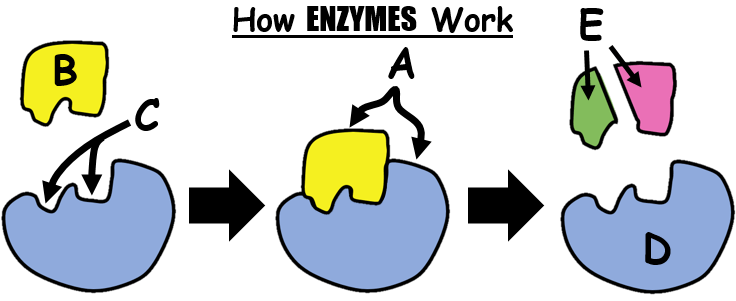
Which letter represents the active site?
A
B
C
D
What type of bond holds water molecules together?
ionic
covalent
dipole
hydrogen
What does 1 hydrogen (H+) ion and 1 hydroxide (OH-) ion make?
water
table salt
starch
sugar
Why do our bodies need enzymes?
to store excess fat
to turn energy into sugar
to break down the food we eat
to make DNA into nucleic acids


In the graph, the energy level needs to increase before it goes back down. The increase is called the:
enzyme energy
substrate
activation energy
active site

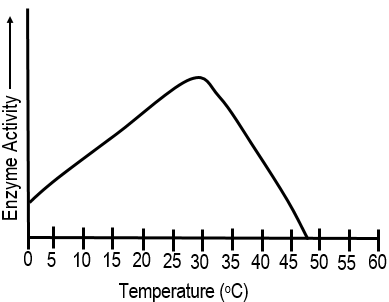
In the figure, why doesn't the reaction rate continue to increase as the temperature increases?
It does.
It reaches the saturation point where no active site is bonded to the activation energy.
At too high of a temperature, the protein changes shape and can no longer function.
A substrate in an enzyme catalyzed reaction is also called
an active site.
activation energy.
the reactant.
the product.
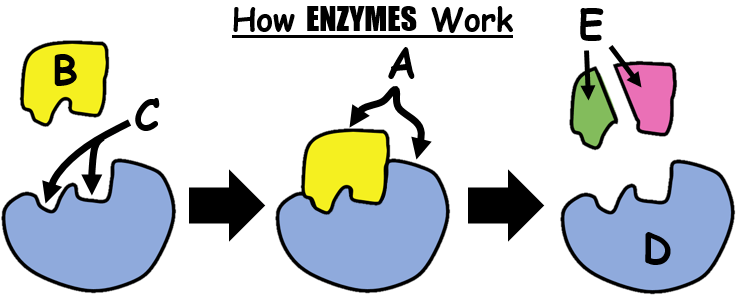
Letter D...
active site
enzyme
substrate
products

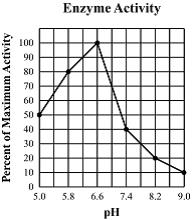

The diagram shown is a:
protein
lipid
carbohydrate
nucleic acid

Glucose, a simple sugar and sucrose a complex sugar are examples of:
proteins
carbohydrates
lipids
nucleic acids

A substance formed by a chemical reaction:
substrate
product
enzyme
activation energy

Why is water's property of polarity so important?
The positive and negative poles allow it to attract itself and other stuff
The negative poles of the water molecule allows water to attract itself
The positive and negative poles allow it to repel itself and other stuff
The positive poles of the water molecule allows water to repel itself

A universal solvent:
is slow to heat up and cool down
causes water to stick to other molecules
makes water less dense
can dissolve almost anything

A substance with a pH above 7 is an:
acid
base
neutral
plasma

The diagram shows the monomer for which macromolecule?
Protein
Lipid
Carbohydrate
Nucleic Acid

An organic compound contains:
Hydrogen
Oxygen
Carbon
Sodium
Isotopes of an element have a different number of...
Protons
Neutrons
Electrons
Mass

An atom's atomic number is equal to
The number of protons in the atom's nucleus
The number of neutrons in the atom's nucleus
The number of electrons in the atom
The total of protons + neutrons

What are valence electrons?
The innermost electrons
The outermost electrons
What is the octet rule?
Elements can only have 8 electrons in its outermost shell
The elements must form an octopus like structure
How many valence electrons does Argon have
8
11

Which of the elements in the picture has correct electron dot notation?
1
2
3
4

How many covalent bonds does carbon need to form in order to have a full octet?
2
3
4
5

TRUE or False
A neutralization reaction occurs when you mix an acid with a base.
TRUE
FALSE
Fill in the blank - A _____________ is a chemical that prevents sharp changes in pH.
acid
enzyme
buffer
base
What happens when enzymes are heated to a high temperature?
The enzymes die.
The shapes of the enzyme are altered.
The enzymes' amino acid sequence changes.
The enzymes remain the same

Humans need to produce the enzyme lactase because:
the disaccharide lactose needs to be broken down to be used for energy.
the disaccharide glucose needs to be broken down to be used for energy.
the polysaccharide galactose needs to be added to fructose to release energy.
the monosaccharide glucose will never be absorbed for energy.
N2+O2--> _NO
Which equation is balanced?
PbO2 + 2H2
SO2 + H20 --> H2SO4
2Na + 2H2O --> 2NaOH + H2
Determine the coefficients to balance the equation.
__Al +__HCl --> __H2 +__AlCl3
2,6,3,2
it's already balanced
4,12,3,4
2,1,4,5

