
 Worksheets
Earthquake Study Assignment
Total questions: 72
Worksheet time: 15hrs 37mins
Which way do the waves generated by an earthquake travel?
out in space
outward in all directions
towards the center of earth
along the surface of earth
What happens to the lag time (distance between a P-wave and an S-wave) as they move away from the epicenter?
stays the same
gets larger
gets smaller
there is no distance
Seismologists use a __________________ to detect and record earthquake waves. Scientists will analyze the data collected on the _____________________.
seismogram, seismograph
Seismologist, seismic
Seismograph, seismogram
The_________________of an earthquake is on the surface directly above the _______________.
center, fault
epicenter, focus
focus, epicenter
Scientists that study earthquakes are called a _________________________.
seismoman
seismologist
earthquakeologist
Earthquakes are caused by the sudden release of ________________________ which moves as ________________________ through the earth.
energy, waves
heat, zombies
waves, energy
Scientists use the data from three seismograph _____________________ to find an earthquakes epicenter, this process is called _______________________.
spots, three times
Stations,triangulation
tools,triangle
What's the main cause of most earthquakes?
Pressure from within Earth's crust
Hurricanes
Human activity
Changes in temperature within the earth's mantle
Which of the following is a true statement about tectonic plates?
All tectonic plates are located at Earth's core
They're located approximately 10 meters below the surface of the ocean
They're located in the molten layer beneath Earth's crust
All of Earth's landmass rests on tectonic plates
Most earthquakes happen along _________________.
the coast
faults
the desert
mountain ranges
Second waves to arrive in an earthquake
P waves
S waves
Surface waves
First waves to arrive in an earthquake
P waves
S waves
surface waves

The place where an earthquake originates inside the Earth's surface is called...
Epicenter
Focus
Underground
Crust

The place on the Earth's surface, above the origin of the earthquake.
Epicenter
Focus
Surface
Crust

Which city is closest to the epicenter?
A
B
C
What is the minimum number of seismograph stations needed to locate an earthquake epicenter?
1
2
3
5
Match the stress that corresponds to divergent boundaries
compression
tension
shear
magnetic
Shear stress is associated with what type of plate boundary?
convergent
divergent
transform
strike-slip
What type of fault is most associated with a transform boundary?
strike-slip
reverse
normal
convergent
S waves cannot travel through liquid (although p waves can). Which layer of the earth would block S waves from traveling through the Earth?
Inner core
Outer core
Mantle
Crust


What type of fault is this?
normal fault
reverse fault
strike-slip fault
Forces that changes rock shape or volume is called
tension
compression
stress
Reverse faults have __________________ and folding that formed the Alps and Himalayas.
tension
compression
stress
________________ pulls on crust which results in a normal fault.
tension
compressions
stress
Strike-slip fault has a ______________________ boundary.
divergent
convergent
transform
Reverse faults ______________________ at an angle.
pull apart
push together
slip past each other
Normal faults ______________________ at an angle.
pull apart
push together
slip past each other
Strike slip faults move by ____________________.
pulling apart
pushing together
slipping past each other

Identify Item #1
Seismic waves
Fault
Focus
Epicenter
Identify Item #2
Seismic waves
Fault
Focus
Epicenter
Identify Item #3
Seismic waves
Fault
Focus
Epicenter
Identify Item #4
Seismic waves
Fault
Focus
Epicenter
Identify the type of boundary associated with this fault:
Convergent
Divergent
Transform


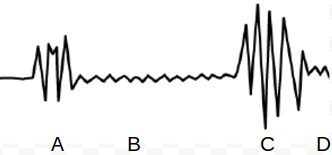
Around what time did the first P wave get detected?
100 sec
120 sec
150 sec
160 sec

Which station was closest to the earthquake's epicenter?
Station A
Station B
Station C
What is the range for the Mercalli intensity scale?
l to Xll
l-X
1-10
infinity
How many seismic stations are required to locate the epicenter of an earthquake?
(a)

What's at the red 'X"?
Fault
Hypocenter...or focus
Triangulation
Epicenter
What is needed to determine the epicenter of an earthquake?
The arrival time of P-wave and S-wave
The distance of the epicenter from a seismic station
The difference in the arrival time of P-wave and S-wave
The distance of the epicenter from three different seismic stations
To determine the lag time, simply get the _____________________ of S-wave and P-wave.
difference
sum
product
dividend
Where is the Ring of Fire located?
Atlantic Plate
Pacific Plate
Japanese Plate
North American Plate
What s driving the movement of the tectonic plates?
Gravity
Tides caused by lunar activity
Convection currents deep in the mantle
A giant turtle

Which earthquake scale is shown in the picture:
Richter
Moment magnitude
Modified Mercalli
Fujita
Which earthquake intensity scale rates the total amount of energy released from the earthquake?
Mercalli Scale
Richter Scale
Moment Magnitude Scale
de Fuca scale
When looking at a worldwide map where do the most frequent earthquakes occur?
areas near mountain ranges
areas near plate boundaries
ice covered regions
all of the above
California has a high risk of damaging earthquakes in the United States. What reason explains this?
California is along a divergent boundary
California has a large transform boundary
California is part of a subduction zone
California is cursed.
Choose all the answers the apply:
What is common around the Ring of Fire?
subduction
earthquakes
volcanoes
rift valleys
deep ocean trenches

What is this instrument called?
Richter scale
Barometer
Electrograph
Seismograph
Why are faults sometimes referred to as "active boundaries?" Choose the best answer.
Because they are all volcanically active
Because they serve as boundaries between nations
Because Earth's crust shifts on either side of them
Because people must actively avoid faults to escape injury
Which city is most likely to experience a strong earthquake?
Los Angeles
Chicago
New York
Miami

In a normal fault, the part of the fault that slips due to tension is the
hanging wall
footwall
reverse fault
anticline

Which type of seismic wave cannot travel through liquids?
P wave
an L wave
an S wave
a surface wave

