wayground logo

Free Printable Worksheets

NEW

Font size

S
M
L
XL
Worksheets

Atomic Theory - History

Total questions: 63

Worksheet time: 1hrs 28mins

Name
Class
Date
1.
Who believed that electrons were scattered amongst positively charged material.
a)
JJ Thomson
b)
Ernest Rutherford
c)
John Dalton
d)
Niels Bohr
2.
Believed that atoms are small, hard particles that were "indivisible"
a)
Democritus
b)
Aristotle
c)
Schrodinger
d)
Greek Philosophers
3.
Did experiments to show that atoms form compound in set ratios.
a)
John Dalton
b)
Schrodinger
c)
Niels Bohr
d)
JJ Thomson
4.
Discovered that the atom has a small, dense, positively charged nucleus.
a)
Ernest Rutherford
b)
Heisenberg
c)
Democritus
d)
JJ Thomson
5.
Believed that all atoms of the same element would be the same.
a)
John Dalton
b)
JJ Thomson
c)
Niels Bohr
d)
Modern Atomic Theory
6.
The following picture represents which atomic model?
a)
Ernest Rutherford
b)
John Dalton
c)
Democritus
d)
Aristotle
7.
The following picture represents which atomic model?
a)
JJ Thomson
b)
John Dalton
c)
Ernest Rutherford
d)
Schrodinger & Heisenberg
8.
Discovered the electron within the atom
a)
Thomson
b)
Chadwick 
c)
Schrodinger & Heisenberg
d)
Dalton
9.
Discovered the nucleus of the atom through the Gold Foil Experiment
a)
Rutherford
b)
Chadwick
c)
Thomson
d)
Dalton
10.

Which Greek philosopher gave the concept of 'Atomos'?

a)

Plato

b)

Aristotle

c)

Democritus

d)

Pythagoras

11.

Who discovered electrons?

a)

Dalton

b)

J.J.Thomson

c)

Rutherford

d)

Becquerel

12.

Which of the following is a postulate from Dalton's Atomic Theory?

a)

All elements are made up of atoms

b)

Atoms of an element are identical

c)

Atoms combine in whole number ratio to form compounds

d)

A chemical reaction is the rearrangement of atoms

e)

All options are correct

13.

Who changed the term 'Atomos' to 'Atom'?

a)

Democritus

b)

John Dalton

c)

J.J.Thomon

d)

James Chadwick

14.
Believed that atoms of the same element are identical to each other
a)
Bohr
b)
Rutherford
c)
Dalton
d)
Thomson
15.
Who believed that electrons were scattered amongst positively charged material.
a)
JJ Thomson
b)
Ernest Rutherford
c)
John Dalton
d)
Niels Bohr
16.
Anything that takes up space and has mass.
a)
Mass
b)
Proton
c)
Weight
d)
Matter
17.
Subatomic particle that determines the name of an atom. It has a positive charge and is located in the nucleus of an atom.
a)
Electron
b)
Neutron
c)
Proton
d)
Voltron
18.
The experiment used by Ernest Rutherford to discover the nucleus of an atom. 
a)
Cathode Ray Experiment
b)
Gold Foil Experiment
c)
Reflector Experiment
d)
Plum Pudding Experiment
19.
What two subatomic particles effect the mass of an atom?
a)
Electrons & Protons
b)
Protons & Neutrons
c)
Neutrons & Electrons
20.
Who discovered the nucleus of an atom?
a)
John Dalton
b)
Ernest Rutherford
c)
James Chadwick
d)
Neils Bohr
21.
Subatomic particle that has a negative charge and is located outside of the nucleus.
a)
Electron
b)
Proton
c)
Neutron
d)
Voltron
22.
What was INCORRECT about John Dalton's theory about atoms?
a)
All matter is made of atoms
b)
Atoms are indivisible
c)
Atoms are too small to see
d)
Atoms of a given element are identical
23.
True or False: All matter is made up of atoms.
a)
True
b)
False
24.
What subatomic particle changes the name of the atom?
a)
Neutron
b)
Proton
c)
Voltron
d)
Electron
25.

What two particles affect the charge of an atom?

a)
Electrons & Neutrons
b)
Protons & Electrons
c)
Neutrons & Protons
26.
The sum of the protons and neutrons in an atom.
a)
Atomic Number
b)
Mass Number
c)
Sum Number
d)
Nuclear Number
27.
True or False: The majority of an atom is made up of empty space
a)
True
b)
False
28.

What is the smallest unit of matter? It is composed of protons and neutrons, held together in the nucleus, and electrons around the nucleus in different electron orbitals, which form an electron cloud.

a)

cell

b)

nucleus

c)

atom

d)

electron

29.

What are any of the various self-contained units of matter or energy that are fundamental parts of all matter. These particles include electrons, protons, and neutrons.

a)

subatomic particles

b)

elements

c)

nucleus

d)

electron cloud

30.

What is a subatomic particle with a positive charge that is in the nucleus of an atom?

a)

neutron

b)

proton

c)

electron

d)

valence electron

31.

What is a subatomic particle without an electric charge, located in the nucleus of an atom?

a)

neutron

b)

proton

c)

electron

d)

valence electron

32.

What is a subatomic particle with a negative charge? It is found outside of the nucleus.

a)

neutron

b)

proton

c)

electron

d)

electron cloud

33.

What is the center of an atom containing protons and neutrons?

a)

nucleus

b)

neutron

c)

proton

d)

electron cloud

34.
What electrical charge does a proton have?
a)
+1
b)
0
c)
-1
d)
+2
35.

What mass does a neutron have?

a)

1 amu

b)

0 amu

c)

-1 amu

d)

+2 amu

36.
Complete the missing label on the diagram.
a)
Neutron
b)
Centre
c)
Nucleus
d)
Sub atomic particle
37.
Which particle is negatively charged?
a)
proton
b)
atom
c)
neutron
d)
electron
38.
In order for an atom to be neutral what has to be true?
a)
The atom has more protons than neutrons
b)
The atom has more neutrons than protons
c)
The atom has the same number of protons and neutrons
d)
The atom has the same number of protons and electrons
39.

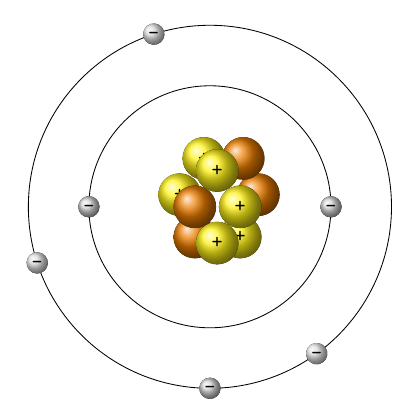
How many electrons does this atom have?

a)

2

b)

4

c)

6

d)

10

40.
What scientist is best known for his "Plum Pudding" model of the atom?
a)
J.J. Thomson
b)
Ernest Rutherford
c)
John Dalton
d)
Democritus
41.

In the atomic model nicknamed the "plum pudding" model, what do the plums represent?

a)

the nucleus

b)

the atom

c)

the electrons

d)

the positive material

42.
What is the atomic number?
a)
the number of protons
b)
the number of protons and neutrons
c)
the number of neutrons
d)
the number of protons and electrons
43.
What is the mass number defined as?
a)
the number of protons
b)
the number of protons and neutrons
c)
the number of neutrons
d)
the number of protons and electrons
44.
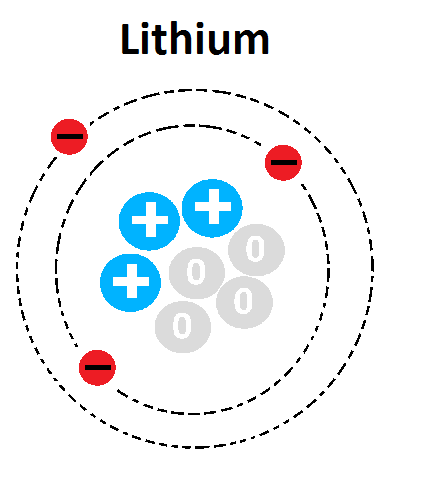
What is the atomic number of this atom?
a)
1
b)
3
c)
4
d)
7
45.

Found in the nucleus of an atom. This particle has a positive charge.

a)

Neutron

b)

Proton

c)

Electron

d)

Decepticon

46.

Found orbiting outside the nucleus, this subatomic particle has a negative charge.

a)

Neutron

b)

Proton

c)

Electron

d)

Idontknowatron

47.

Found in the nucleus of an atom, this subatomic particle has a neutral (or no ) charge

a)

Neutron

b)

Proton

c)

Electron

d)

Whattheheckatron

48.

The atomic number will always be the same as the _______________ in a neutral atom.

a)

Mass number and number of protons

b)

Number of neutrons and protons

c)

number of electrons and protons

d)

Number of electrons and neutrons

49.

The periodic table is in order by the

a)

Mass number

b)

Neutron number

c)

Atomic number

d)

APE MAN Number

50.

The smallest subatomic particle is the

a)

proton

b)

neutron

c)

electron

d)

decepticon

51.

Identify #1

a)

proton

b)

neutron

c)

electron

d)

nucleus

52.

Identify #2

a)

proton

b)

neutron

c)

electron

d)

nucleus

53.

Identify #3

a)

proton

b)

neutron

c)

electron

d)

nucleus

54.

Identify #4

a)

proton

b)

neutron

c)

electron

d)

nucleus

55.

What is the mass number of this atom?

a)

1

b)

3

c)

4

d)

7

56.

Atoms of the same element which have a different number of neutrons are called _________________.

a)

ions

b)

isotopes

c)

quarks

d)

molecules

57.
The number in the upper corner of an element tile (7 for nitrogen) is called _____
a)
the proton number
b)
the atomic number
c)
the electron number
d)
the mass number
58.
For a given element, the atomic number indicates the number of _____
a)
protons in the nucleus
b)
neutron in the nucleus
c)
electrons in the atom
d)
nucleons in the atom
59.
If an atom contains exactly three protons, then it's an atom of _____
a)
lithium
b)
gold
c)
nitrogen
d)
carbon
60.
For an atom to be electrically neutral, it must contain the same number of _____
a)
protons and neutrons
b)
neutrons and electrons
c)
protons and electrons
d)
nucleons and electrons
61.
The sum of the number of protons and the number of neutrons is called the _____
a)
atomic number
b)
mass number
c)
isotope number
d)
average weight
62.

How many protons are in one atom of Lithium?

a)
3
b)
6
c)
7
d)
6.941
63.

How many electrons are in one atom of Lithium?

a)
3
b)
6
c)
7
d)
6.941