
 Worksheets
Final Exam Review
Total questions: 138
Worksheet time: 3hrs 30mins
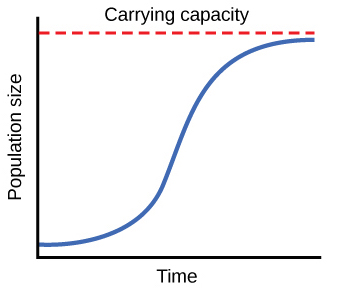


What is happening at the 'A' on the graph?
the population overshoots above the carrying capacity
the population stops growing
growth begins to slow down due to limited resources
growth is speeding up due to an abundance of resources

What point on the graph represents the carrying capacity?
A
B
C
D
Two male Giraffes are fighting over the last green leaf of a tree that is dying.
Intraspecific Competition
Mutualsim
Predation
Commensalism
Interspecific Competition
A population is...
All members of one species in one area
All members of all species that live in one area
All of the living and nonliving things in an area
None of these
What factor describes when populations decrease because animals are moving out of a population?
Emigration
Limiting Factors
Immigration
Exponential Growth
Population increases at a constant rate over time.
Exponential Growth
Logistic Growth
Stable Growth
Strategic Growth
An island is any ____ habitat surrounded by ________
suitable - unsuitable habitat
land - water
small lfragment land - water
unsuitable - suitable habitat
Generally, ______ islands have _______ number of species
far - fewer
far - more
close - fewer


You are on a town committee formed to determine the borders for a new local nature park. You explain that according to the theory of island biogeography, if the committee wishes to promote species richness it should
II only
III only
I and II
I, II, and III
The aesthetic value of an ecosystem provides
a supporting service.
a regulating service.
an intrinsic value.
a cultural service.
A(n) ______ in species diversity is associated with a(n) ________ in the functions an ecosystem provides.
increase; decrease
decrease; increase
decrease; unobserved change
decline; decline
Which is NOT one of the five ecosystem services that are used to calculate instrumental value?
species biodiversity
resilience
support systems
regulating services
Human waste is often dumped in the ocean. Microbial organisms in marine ecosystems can break down organic waste into less harmful components. This is an example of
a cultural service.
an ecosystem provision.
a regulating service.
an intrinsic value.
Products obtained from nature that humans can use such as lumber, medicines and food crops are
ecological benefits.
provisions.
supplies.
services.
What prediction is correct about island biogeography?
Smaller islands have more resources, and will have more biodiversity
Larger islands have more space for resources, but will have less biodiversity due to competition
Islands closer to mainland will be more diverse due to more successful dispersal.
There is more diversity far away from the mainland because some species fly.
Which of the following is true about island biodiversity?
Small islands are more likely to have more immigrated species
Small islands have higher biodiversity than large islands
Small islands have more resources and as a result may have more species
Small islands have fewer resources and as a result may have fewer species
The theory of island biogeography suggests that species richness is affected by which of the following factors?
I. island distance from mainland
II. how the island is formed
III. island size
II only
III only
I and III
II and III
Various sources of pollution and energy have entered the biosphere as a result of human activities. Collectively, we call these _______________ sources.
Anthropogenic
Natural
Industrial
Gas-based
The portion of a fundamental niche that is fully utilized by a species is a _______________.
Vertical niche
Realized niche
Consumer niche
Regulated niche
Which of the following is true about island biodiversity?
Small islands are more likely to have more immigrated species
Small islands have more biodiversity
Small islands have more species
Small islands have less resources
An optimum range is
A threat to an organism
An organism's niche
An organism's comfort zone
An organism's species richness
Jay has 3 green marbles, 4 red skittles, and 5 twix. What is the species richness?
3
12
1.5
0.50
What is genetic diversity?
Diversity within a species
# of species and abundance in the community
How many different habitats are in a region
What is habitat diversity?
Diversity within a species
# of species and abundance in the community
How many different habitats are in a region
What is species diversity?
Diversity within a species
# of species and abundance in the community
How many different habitats are in a region
Factors that limit a species from growing out of control.
Environmental resistance
Biotic potential
Host Parasites
Relationships
What is a change brought about by a physical, chemical, or biological agent that impacts population size or community structure?
resistance
stability
disturbance
resilience
What is the ability of an ecosystem to recover after it has undergone a disturbance?
resistance
stability
disturbance
resilience
Which of the following are examples of natural disturbances? (Select ALL that apply!)
tornado
tsunami
volcano
earthquake
urbanization
what is a water shed
an aquifer.
water stored under ground used for drinking
an area or ridge of land that separates waters flowing to different rivers, basins, or seas.


The intermediate disturbance hypothesis theory states that intermediate levels of disturbance will
increase runoff
increase ecosystem nutrient cycling
decrease primary productivity
increase species diversity

Phylogenetic trees show...
Evolutionary relationships between different species
How one species has evolved through time
Which species has evolved the most
Which species have evolved from other species
Human activities such as the ____ release large amounts of Carbon into our atmosphere.
Burning of fossil fuels
burning of wood
use of synthetic fertilizers
use of detergents
Which of the following biogeochemical cycles does not have an atmospheric phase?
Hydrolic Cycle
Nitrogen Cycle
Sulfur Cycle
Carbon Cycle
Phosphorous Cycle
Energy enters a system as sunlight and a producer is able to produce 10 kilograms of tissue. If eaten, the producer would produce about ___ kilograms of a consumer tissue that would provide about ____ kilograms of tissue for a secondary consumer
100; 10
10; 1
100; 1
1; 0.1
Productivity in an ecosystem has to do with
Efficiency of its primary producers
The number of different species living in the ecosystem
Its longevity
Its rate of producing biomass
An ecosystem consists of
A physical environment within which a biological community lives
The species with which a biological community interacts
A biological community and its physical environment
the primary producers within a biological community
The length and complexity of a food web in the Arctic would be ____ when compared to one in the tropical rainforest.
Short and less complex
short and more complex
long and less complex
long and more complex
Producers rely on _____ to release chemical energy and consumers rely on ____ to release chemical energy.
Cellular Respiration; photosynthesis
Cellular Respiration; cellular respiration
photosynthesis; cellular respiration
photosynthesis; photosynthesis
Ecologists study....
Living things and their genetic makeup
Genetic Patterns and the chemistry in them
The physical world and its processes
Relationships between organisms and their environment
In the Nitrogen cycle, what is one Natural way that Nitrogen gets into our soil?
Fertilizers
Human Waste through septic tanks
Decomposing animals
Industrial waste
In the _____, there is no wet/dry season. But we do see more lower plants with a thicker epidermis..
Tundra
Boreal
Savanna
Desert
Taiga
There are less nutrient rich soils in the Rain Forest due to the dense tree canopy and water runoff.
True
False
We see saltier soils due to the evaporation rate in which biome?
Forest
Grasslands
Tundras
Deserts
Which biome has the lowest average Temperature, and the lowest Precipitation?
Tundra
Savanna
Rainforest
Taiga
Select the two characteristics that determine which type of biome an ecosystem is.
Climate
Temperature
Elevation
Precipitation
Which of the following is NOT an example of a state factor for a biome?
Human Interaction
Forest Fires
Topography
Biomass
Which is the only biogeochemical cycle that doesn't occur in our atmosphere?
Nitrogen
Phosphorus
Hydrogen
Carbon
Which of the following is an example of a biotic factor?
Temperature
Light
Atmosphere
Population
Water
Intraspecific Competition is between the same species. true or false?
True
False
Diurnal and Nocturnal creatures share their resources through the use of which of the following processes?
Competition
Resource Partitioning
Different trophic levels
Coevolution
In a food pyramid, which organism can be found on the bottom?
Primary Consumers
producers
Secondary Consumers
Herbivores
One species benefits and the other is not affected is an example of which symbiotic relationship?
Parasitism
Commensalism
Mutualism
Predation
Human activities such as the ____ release large amounts of Carbon into our atmosphere.
Burning of fossil fuels
burning of wood
use of synthetic fertilizers
use of detergents
Which of the following biogeochemical cycles does not have an atmospheric phase?
Hydrolic Cycle
Nitrogen Cycle
Sulfur Cycle
Carbon Cycle
Phosphorous Cycle
Exemplified by bees consuming nectar and carrying pollen from one flower to another
Commensalism
Parasitism
Mutualism
Predation
Competition
Exemplified by starlings displacing bluebirds from nesting sites
Commensalism
Parasitism
Mutualism
Predation
Competition
Exemplified by ticks feeding on a deer
Commensalism
Parasitism
Mutualism
Predation
Competition
Exemplified by tree frogs using plants as protection with no benefit or harm coming to that plant.
Commensalism
Parasitism
Mutualism
Predation
Competition
Which of the following best describes a symbiotic relationship?
Striped bass and bluefish eat the same variety of mackerel.
Intestinal bacteria inhabit the gut of humans.
Mountain lions feed on white-tailed deer.
Marsupial animals carry their young in a pouch
The underlying subsoil of this biome is permafrost, which prevents both water draining through and deep-rooted plants from growing. Additionally, there is very little precipitation per year.
Temperate grassland
Taiga/Boreal Forest
Tundra
Tropical Rainforest
Which of the following is a characteristic of tropical rain forests?
They rarely receive more than 100 centimeters of rain per year.
Their soils typically have a high pH
They do not exhibit a great deal of species diversity
Their soils are relatively poor in nutrients

Which environment is characterized by the highest diversity of tree species?
A
B
C
D
E
Which environment is characterized by relatively even temperatures throughout the year and little rainfall?
A
B
C
D
E
Which environment is has permafrost as an underlying subsoil?
A
B
C
D
E
Looking at the graphs, how can you tell that C is in the southern hemisphere?
It has a relatively even temperature throughout the year.
It has a larger amount of precipitation that occurs in June and July
The ratio of the temperature to precipitation indicated a southern climate.
A larger amount of precipitation that occurs in January and December
This biome is characterized by long dry seasons and is dominated by grasses, shrubs, and grazing animals.
Savanna
Boreal
Tropical Rainforest
Grassland

The location of the greatest remaining natural biodiversity
A
B
C
D
E
This freshwater biome is characterized by fast-flowing water that can originate from underground springs or runoff, which carries sediment and organic material.
Coral Reefs
Rivers
Freshwater Wetlands
Open ocean
This biome is considered to have the lowest primary productivity.
Open ocean
Wetlands
Coral Reefs
Rivers
The two major processes involved in the nitrogen cycle are
weathering and erosion
erosion and deposition
evaporation and transpiration
photosynthesis and respiration
fixation and denitrification
Select the choice that best fits each statement.
Plant roots absorb ammonium ions and nitrate ions for use in making molecules such as DNA, amino acids, and proteins.
Denitrification
Assimilation
Ammonification
Nitrogen fixation
What is the main difference between phosphorus and the other major cycles?
Phosphorus exists in elemental form
Phosphorus does not have an atmospheric component
The phosphorus cycle occurs very rapidly
Phosphorus is not needed for life

Which letter correctly identifies a process of the hydrologic cycle in which the phase of water is changed from a liquid to a gas?
A
B
C
D
The process in the hydrologic cycle in which water vapor is released from leaves into the atmosphere is called
Transpiration
Precipitation
Photosynthesis
Condensation
Of the following organisms, which occupies the lowest trophic level?
Deer
Spider
Lion
Snake
In a given ecosystem, producers convert solar energy into 15,000kcal of chemical energy stored in organic compounds. Which of the following is the most likely amount of energy available to primary consumers?
1.5 Kcal
150 kcal
1,500 kcal
13,500 kcal
Select the choice that best fits each statement.
An energy transformation occurs and results in increased disorder.
Potential energy
Kinetic energy
First Law of Thermodynamics
Second Law of Thermodynamics
Which of the following best describes the net primary productivity of an ecosystem?
Net primary productivity is the amount of energy captured by producers through photosynthesis over time.
Net primary productivity is the amount of energy lost by producers through respiration over time.
Net primary productivity is the amount of energy lost through respiration by producers subtracted from the gross primary productivity of an ecosystem.
The two major processes involved in the carbon cycle are
weathering and erosion
erosion and deposition
evaporation and transpiration
photosynthesis and respiration
fixation and denitrification

Exponential population growth can be described as
growth when resources are limited
a j-shaped curve
a s-shaped curve
growth that reaches carrying capacity
Logistic population growth can be described as
growth when resources are limited
a s-shaped curve
reaching carrying capacity
all of the above

Which country will have the most rapid population growth?
Sweeden
United States
Mexico
None

Density-independent limiting factors to population growth includes
stress from overcrowding
parasitism
competition
natural disasters

Exponential Growth occurs when-
populations have plenty of food/space
home to keystone species
have few evasive species in a habitat
have little to no competition or predators

At what population was carrying capacity met?
250
1000
400
720
What limits Population Growth?
birth rates increasing
resources being used up
natural selection taking place
none of the above
As resources become less available the growth of a population
slows or stops
decreases or increases
up or down
in or out

What is a condition that halts population growth?
limiting factors
renewable resources
climate
conservation

What could cause exponential growth in population in a community?
people lifting heavy stuff
a community leaving
someone spreading a plague
people moving to the community/unlimited resources

What is a population ?
Disturbance has removed vegetation but left soil intact.
The natural birth, growth and development of ecosystem.
All organisms of a species that live in the same area.
A community of interacting organisms and their environment.
occurs when population slows or stops following a period of exponential growth.
no growth
population growth
logistic growth
exponential growth
Causes of death in a population may be-
density dependent & density independent
dispersion independent
density independent
independent density
Three factors can affect population size
births, deaths,leaves or enters population
deaths, birth, buildings
photosynthesis, weather, deaths
houses, weather, heath
Factor that causes population growth to decrease.
growth factor
limiting factor
density factor
environmental factor
What is happening at the 'A' on the graph?
the population overshoots above the carrying capacity
the population stops growing
growth begins to slow down due to limited resources
growth is speeding up due to an abundance of resources
What point on the graph represents the carrying capacity?
A
B
C
D
Two male Giraffes are fighting over the last green leaf of a tree that is dying.
Intraspecific Competition
Mutualsim
Predation
Commensalism
Interspecific Competition
A population is...
All members of one species in one area
All members of all species that live in one area
All of the living and nonliving things in an area
None of these
What factor describes when populations decrease because animals are moving out of a population?
Emigration
Limiting Factors
Immigration
Exponential Growth
Population increases at a constant rate over time.
Exponential Growth
Logistic Growth
Stable Growth
Strategic Growth

