wayground logo

Free Printable Worksheets

NEW

Font size

S
M
L
XL
Worksheets

8th Grade Science Midterm Review

Total questions: 65

Worksheet time: 59mins

Name
Class
Date
1.
The living organisms in an ecosystem such as plants and animals
a)
adaptation
b)
biotic
c)
decomposer
d)
abiotic
2.
The non-living factors in an ecosystem such as rocks, water and temperature.
a)
natural selection
b)
biotic
c)
biodiversity
d)
abiotic
3.
Organisms that make their own food. Also called autotrophs.
a)
Producer
b)
Parasite
c)
Scavenger
d)
Decomposer
4.
Organisms that eat other organisms (heterotroph).
a)
Producer
b)
Parasite
c)
Consumer
d)
Scavenger
5.
The arctic hare in the picture is shown camouflaged in the snow from possible predators. However, when summer arrives, what trait(s) will allow this hare to avoid predators? 
a)
its long ears for keen hearing and fast hind legs
b)
the ability to eat lots of grass
c)
its relatively small size in comparison with predators 
d)
the thickness of its fur 
6.
In question #1, what would happen if the arctic hare did not have these specific traits? 
a)
The species would become overpopulated. 
b)
The chance of young hares surviving to adulthood and reproducing would be greatly diminished. 
c)
The hare would be a popular target for game hunters. 
d)
All of the above. 
7.
In the graph below, what is a possible reason why the population of “gray” peppered moths in England changed? 
a)
Human pollution during the industrial revolution changed the moths’ natural habitat. 
b)
The number of predators increased. 
c)
The moths’ food source vanished. 
d)
The moths were unable to reproduce. 
8.
The polar bear depends on sea ice in order to hunt for seals. If arctic temperatures increase, what is the long- term outlook for polar bears? 
a)
polar bear population will gradually increase
b)
polar bear population will gradually decrease 
c)
polar bear population will remain unchanged 
d)
polar bears will adapt quickly to new food sources 
9.

A characteristic of an organism that increases the chances of survival in its environment.

a)

Abiotic

b)

Adaptation

c)

Allele

d)

Biodiversity

10.

The image shows an aquatic food chain. Which organism(s) will be unaffected if the krill are removed from the aquatic food web?

a)

A. fish

b)

B. penguin

c)

C. phytoplankton

d)

D. squid

11.

Examine the diagram of a food web.


A small population of eagles is introduced in the food web. The eagles feed on mice and reproduce at high rates. What is the most likely consequence of the introduction of eagles in the food web?

a)

A. The eagles will coexist with the hawks.

b)

B. The hawks will prey on grasshoppers.

c)

C. The eagles will compete with the hawks.

d)

D. The hawks will establish a mutualistic relationship with mice.

12.
Which of the following would be the most likely effect, if there were a sudden increase in the cricket population?
a)
There would be a decrease in the small bird population.
b)
There would be a decrease in the grass/flowers population.
c)
There would be a decrease in the mice population.
d)
There would be an increase in the grass/flowers population.
13.
What does biodiversity mean?
a)
Only one species in an area.
b)
The different amount of species in an area
c)
All abiotic life
d)
Nitrogen fixation
14.
Who causes the most damage to coral reefs?
a)
Whales
b)
Fish
c)
Boats
d)
Humans
15.
The picture below shows how runoff from an urban location is routed to the ocean. Pollution in the runoff can damage ocean ecosystems. A likely cause of the runoff is: 
a)
larger amounts of farmland to support more people 
b)
pavement and concrete prevents water from entering the groundwater 
c)
increased rainfall in urban areas 
d)
sediments being deposited in the streams and rivers around urban areas 
16.
What does this symbol on a weather map indicate? 
a)
High pressure system
b)
Low pressure system
c)
Cold front
d)
Warm front
17.
This is the symbol for a... 
a)
Stationary Front
b)
Occluded Front
c)
Cold Front
d)
Warm Front
18.
This is the symbol for a... 
a)
Cold Front
b)
Warm Front
c)
Stationary Front
d)
Occluded Front 
19.
This is the symbol for a... 
a)
Occluded Front
b)
Stationary Front
c)
Warm Front
d)
Cold Front 
20.
What type of weather usually goes with this symbol?
a)
Clear, sunny skies
b)
Cloudy skies
c)
Hot temperature
d)
Thunderstorms
21.
Which type of front often produces thunderstorms?
a)
cold
b)
stationary
c)
 warm
d)
occluded
22.

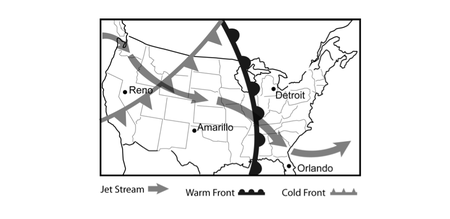
Based on the information provided in the weather map, which city shown most recently experienced a temperature rise?

a)

Amarillo

b)

Detroit

c)

Orlando

d)

Reno

23.
Low pressure will usually bring what kind of weather?
a)
Sunny
b)
Calm
c)
Stormy
24.
What type of weather is Watauga, Texas likely experiencing in this image?
a)
Clear, sunny skies and cool weather
b)
High winds and thunderstorms
c)
Hot weather with a warm front
d)
Cloudy skies with high winds
25.

What is the source of the thermal energy that heats our planet’s atmosphere?

a)

Earth's core

b)

Green plants

c)

The Sun

d)

Fossil Fuels

26.
If you looked at a map of the Earth from 100 million years ago, it would look much different than today. This is because: 
a)
The continual circulation of magma underneath the Earth’s crust has caused the crustal regions to move. 
b)
Life forms and organisms living on the Earth in the last 100 million years have caused the landscape to radically change. 
c)
Erosion and weathering has changed the shape and location of the continents. 
d)
Gravity forces from the Moon and Sun cause the continents to move. 
27.
Determine the contour interval:
a)
5 m
b)
10 m
c)
15 m
d)
20 m
28.
What do close contour lines represent on a map?
a)
waterfall
b)
steep area
c)
gradual area
d)
river
29.
Where are earthquakes most likely to occur?
a)
In the middle of plates
b)
In the oceans
c)
Along plate boundaries
d)
Anywhere on the Earth
30.

How do folded mountains form?

a)

They form when plate boundaries diverge.

b)

They form on the continent side of convergent boundaries.

c)

They form when plates collide or push against each other.

d)

They can form several different ways.

31.
What are the puzzle pieces of the Earth's surface called?
a)
Tectonic plates
b)
Puzzles
c)
Earthquakes
32.

What type of boundary is shown in the diagram?

a)

Divergent

b)

Convergent

c)

Transform

33.

What type of boundary is shown in the diagram?

a)

Divergent

b)

Convergent

c)

Slide/Transform

34.

What type of boundary is shown in the diagram?

a)

Divergent

b)

Convergent

c)

Slide/Transform

35.
What forms at the divergent boundary? 
a)
deep-ocean trench
b)
mid-ocean Ridge
c)
land ridge
d)
the Pacific Ocean
36.
What is the term for the process by which a heavier, denser plate slides under a less dense plate?
a)
plate boundary
b)
submersion
c)
accretion
d)
subduction
37.
All of the continents were once part of one large continent called...
a)
Panacea
b)
Pangea
c)
North America
d)
Gondwana
38.

Wegner used the following as pieces of evidence...

a)

fit/shape of continents

b)

geologic and fossil

c)

climate

d)

all of the above

39.

A topographic map is provided. In which direction is the river flowing?

a)

From north to south

b)

From south to north

c)

From east to west

d)

From west to east

40.
What is the elevation of point B?
a)
800 ft
b)
850 ft
c)
900 ft
d)
1000 ft
41.
What do contour lines that are farther apart represent?
a)
waterfall
b)
steep area
c)
gentle slope
d)
river
42.
It is steep on a topographic map where __________.
a)
lines are closest together
b)
a river flows into a lake
c)
contours bend
d)
contours are far apart
43.
A cliff formed near the ocean.  Which statement best describes how this cliff formed?
a)
Warm air melted the rock.
b)
Sun rays evaporated the rock.
c)
Ocean waves washed away rock.
d)
Plant roots pushed away the rock.
44.
This landform was probably caused by - 
a)
high tides.
b)
wind.
c)
human activity.
d)
running water.
45.

This is a satellite image of the Houston Ship Channel. Which point on this image will experience the most erosion?

a)

A

b)

B

c)

C

d)

D

46.
The cycle that powers the ocean currents, weather, and tectonic plates it called
a)
conduction current
b)
radiation
c)
condition current
d)
convection current
47.
Warm air _________ and cool air ___________.
a)
rises/sinks
b)
sinks/rises
48.

What is one effect of the uneven heating of Earth caused by the Sun?

a)

Rotation of Earth

b)

Generation of wind

c)

Oceans losing salt

d)

Plants failing to grow

49.
A hurricane forms over the Atlantic Ocean. When it hits land and comes ashore, its wind speed decrease significantly.  This happens because the hurricane:
a)
gains more water from the flooded land than the ocean
b)
meets a land breeze
c)
meets a stronger hurricane moving from land
d)
no longer gains energy from warm ocean water
50.
Which of the following is most likely a cause of hurricanes?
a)
Cooler ocean temperatures
b)
Warmer ocean temperatures
c)
Large ocean waves
d)
Strong ocean currents
51.

Which of the following is a major way in which oceans contribute to weather systems?

a)

Ocean water has high salinity.

b)

Oceans transfer energy from the Sun.

c)

Most volcanic activity occurs in the ocean.

d)

Oceans have high levels of biodiversity.

52.
The tilting of the Earth on its axis contributes to: 
a)
the different phases of the moon we see 
b)
the changing of seasons as Earth moves around the Sun 
c)
high and low ocean tides
d)
an increase in the gravitational force from the Sun 
53.
What phase of the moon will you see in this situation? 
a)
A
b)
B
c)
C
d)
D
54.
Which of the following is the best model of earth’s revolution? 
a)
A spinning top
b)
a marble traveling around a beach ball at an angle
c)
a basketball spinning on an 8th grader's finger
d)
a cat chasing a squirrel
55.
Which of the following is the best model of earth’s revolution? 
a)
A spinning top
b)
a marble traveling around a beach ball at an angle
c)
a basketball spinning on an 8th grader's finger
d)
a cat chasing a squirrel
56.
What lunar phase would occur a week after a new moon?
a)
Last Quarter
b)
Full Moon
c)
New Moon
d)
First Quarter
57.
This picture shows the moon and the earth during a _______ Moon and a ______ Tide.
a)
Full....Neap
b)
New...Spring
c)
Full...Spring
d)
New...Neap
58.
If the new moon must always be between the sun and Earth where should a student put the "sun"
a)
Position 1
b)
Position 2
c)
Position 3
d)
Position 4
59.
Which answer correctly labels each letter as day and night? 
a)
X = night
Y = day
b)
X = day
Y = night
60.
Which season is taking place in the Northern Hemisphere in Position 3?
a)
Winter
b)
Spring
c)
Summer
d)
Fall
61.
What are the reasons for the season?
a)
Earth's tilt & rotation
b)
Earth's tilt & revolution
c)
Earth's rotation & rovolution
d)
Earth's tilt & resolution
62.

At which position would the people on Earth see a full moon?

a)

1

b)

3

c)

5

d)

7

63.

Visible part of the moon is shrinking.

a)

waxing

b)

waning

64.

Visible part of the moon is growing larger:

a)

waxing

b)

waning

65.

The model shows Earth in several positions relative to the Sun. In which position is it winter in North America?

a)

Position 1, because North America receives the most direct sun.

b)

Position 2, because North America is tilted toward the Sun.

c)

Position 3, because North America is parallel to the Sun.

d)

Position 4, because North America is tilted away from the Sun.