Wayground logo

Free Printable Worksheets

Font size

S
M
L
XL
Worksheets

Fall Final 21

Total questions: 140

Worksheet time: 2hrs 15mins

Name
Class
Date
1.

Photosynthesis occurs in:

a)

Mitochondria

b)

Chloroplasts

c)

Humans

d)

Animals

2.

What are the reactants in Photosynthesis?

a)

Sun, CO2, glucose

b)

glucose and oxygen

c)

sun, carbon dioxide, water

d)

water, glucose

3.

The process in which plant cells make energy

a)

Exothermic

b)

Endothermic

c)

Cellular Respiration

d)

Photosynthesis

4.

For photosynthesis, a plant needs water, sun, and...

a)

oxygen

b)

carbon dioxide

c)

glucose

d)

mitochondria

5.

Which part of a plant anchors the plant to the ground and soaks up water and minerals?

a)

stem

b)

leaves

c)

roots

d)

petals

6.

Where is the main site of photosynthesis on a plant?

a)

Stem

b)

Leaves

c)

Petals

d)

Pollen

7.

Plants take in radiant energy and turn it into what form of energy?

a)

Chemical

b)

Thermal

c)

Potential

d)

Kinetic

8.

What are the end products of photosynthesis?

a)

Carbon Dioxide and Water

b)

Glucose and Carbon Dioxide

c)

Oxygen and Glucose

d)

Water and Glucose
9.
Which of the following is the correct equation for PHOTOSYNTHESIS?
a)
CO2 + light + H2O --> O2 + Sugar
b)
CO2 + sugar + H2O --> O2 + light
c)
O2 + light + H2O --> CO2 + Sugar
d)
CO2 + O2 + H2O --> Light+ Sugar
10.
What is the ultimate ORIGINAL source of energy for living things
a)
Sugar
b)
Sun
c)
Moon
d)
Carbon Dioxide
11.
Which organisms perform Photosynthesis?
a)
Only Autotrophs
b)
Only Heterotrophs
c)
Autotrophs and Heterotrophs
12.
Which of the following is an example of a HETEROTROPH?
a)
Grass
b)
Algae
c)
Lemon Tree
d)
Bear
13.
a)
Producer
b)
Primary Consumer
c)
Autotroph
d)
Decomposer
14.
What percentage of energy is passed on to each trophic level?
a)
10%
b)
50%
c)
90%
d)
100%
15.
The arrows in a food chain or web represent ...
a)
They point to the organism that is being eaten.
b)
It shows how sunlight flows within an ecosystem.
c)
They show the direction the energy is flowing between organisms. 
d)
They represent how water is transferred within a habitat.
16.
The owl and weasel compete for which organism?
a)
Hawk
b)
Spider
c)
Grasshopper
d)
Shrew
17.
An animal that is hunted and eaten for food is the  __________.
a)
predator
b)
prey
c)
population
18.
An organism that gets energy from eating other organisms is a ______________.
a)
producer
b)
consumer
c)
decomposer
d)
prey
19.
Which of the following would be the most likely effect, if there were a sudden increase in the cricket population?
a)
There would be a decrease in the small bird population.
b)
There would be a decrease in the grass/flowers population.
c)
There would be a decrease in the mice population.
d)
There would be an increase in the grass/flowers population.
20.
Which of the following best describes the small bird in the food web above?
a)
primary and secondary consumer
b)
secondary and tertiary consumer
c)
primary consumer only
d)
secondary consumer only
21.
The diagram represents a pyramid of energy in an ecosystem.  Which level would most likely contain organisms that can photosynthesize?
a)
A
b)
B
c)
C
d)
D
22.
If there are 100 kcal of energy available in the producers, how much energy would be available to the herbivores?
a)
10 Kcal
b)
1 Kcal
c)
100 Kcal
d)
1000 Kcal
23.
Which organisms have the most energy? 
a)
ladybugs
b)
plants
c)
owl
d)
mosquitoes
24.
If these organisms were arranged in an ecological biomass pyramid, which organism would have the least amount of biomass?
a)
coyote
b)
insect
c)
lizard
d)
shrub
25.
If the small bird on trophic level 3 in the pyramid has 50 kcal of energy available, how many kcal of energy were present in the trees?
a)
5
b)
500
c)
5000
d)
0.5
26.
During ____________, _____________ convert light energy into the chemical energy in sugar molecules. 
a)
chemosynthesis, consumers
b)
chemosynthesis, producers
c)
photosynthesis, producers
27.
What is an example of a decomposer?
a)
Plum
b)
Mushroom
c)
Deer
d)
Bird
28.
Which of the following types of organisms would benefit most directly from the products of decomposer organisms?
a)
Decomposers
b)
Primary consumers
c)
Secondary consumers
d)
Producers
29.
Oxygen is released into the air by
a)
The sun
b)
Animals
c)
Volcanoes
d)
Plants
30.
Which organism is likely to be at the beginning of a food chain for a pond?
a)
Sunfish
b)
Freshwater shrimp
c)
Paramecium
d)
Green Algae
31.
What is indicated by the diagram?
a)
Food web
b)
Food chain
c)
Food map
d)
Food menu
32.
What do the arrows indicate in a food web?
a)
What eats what
b)
Where the energy is being transferred
c)
How the animals are related
33.
An organism that eats both plants and animals are know as a 
a)
Carnivore
b)
Omnivore
c)
Herbivore
d)
Decomposer
34.
What is the first source of energy for all food webs?
a)
Plants
b)
Sunlight
c)
Mineral in the soil
d)
Decomposers
35.
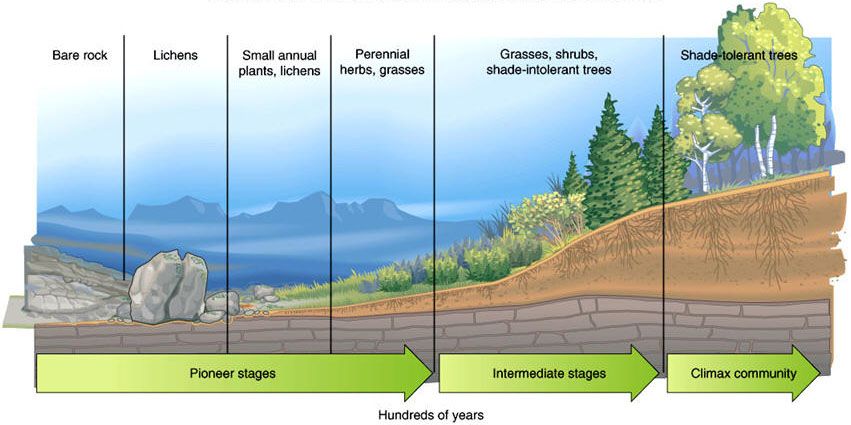
What is ecological succession?
a)
A slow change in an environment
b)
A change that takes days in an environment
c)
No change
d)
Abiotic change
36.
What are examples of pioneer species in a primary succession?
a)
Bushes and Shrubs
b)
Oak trees
c)
Mossess and Lichens 
d)
A rose Bush
37.
A pioneer species is...
a)
a large organism
b)
the first organisms to adapt to a new environment 
c)
The best organism 
d)
Abiotic organisms 
38.
What is the most important function of pioneer species?
a)
To create rocks
b)
To create soil and add nutrients to the environment 
c)
To look nice
d)
Food for animals 
39.
A climax community is ….
a)
the beginning of a new ecological succession.
b)
the rocks in a new environment.
c)
the fire that will cause destruction.
d)
an area that reaches its greatest growing potential.
40.
What is the difference between primary and secondary succession?
a)
Primary succession already has soil.
b)
Primary has soil and secondary does not
c)
soil is present in both
d)
primary has no soil and secondary has soil
41.
A large tree forest is an example of ...
a)
a small community
b)
a abiotic community
c)
a climax community
d)
a pioneer species 
42.
Why does primary succession take longer to reach climax community?
a)
Because trees do not perform photosyntheses.
b)
Because climax community is in a forrest.
c)
Because primary succession already has soil
d)
Because primary succession does not have soil
43.
Which is the correct order in primary succession?
a)
Rocks, Lichens & Mosses, Bushes & Shrubs, Trees
b)
Lichens & Mosses, Rocks, Trees, Bushes & Shrubs 
c)
Trees, Bushes and Shrubs, Lichens & Mosses, Lichens & Mosses
d)
Rocks, Grass, Trees, Bushes & Shrubs
44.
First species occuring in areas of primary succession are mosses and
a)
grasses
b)
wildflowers
c)
trees
d)
lichens
45.
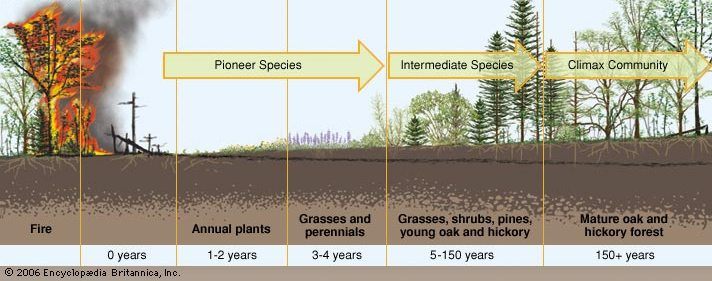
The picture shows what type of succession?
a)
primary
b)
secondary
c)
tertiary
d)
quadanary
46.
The picture shows what type of succession?
a)
primary
b)
secondary
c)
tertiary
d)
quadanary
47.
After a volcanic eruption, lava covers the land. What is the order that plants grow to repopulate the area?
a)
Lichens → Shrubs → Grasses → Trees
b)
Lichens → tree → shrubs→Grasses
c)
Grasses → Lichens → Shrubs → Trees
d)
Lichens → Grasses → Shrubs → Trees
48.
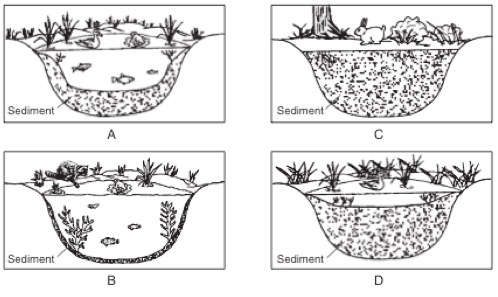
What is the correct order from oldest (happened first) to youngest (happened last) in this pond succession?
a)
A, B, C, D
b)
D, C, B, A
c)
B, A, D, C
d)
C, D, A, B
49.
Succession that occurs in an area with NO SOIL
a)
ecological succession 
b)
primary succession 
c)
secondary succession
d)
pioneer speciles
50.
RUST is chemical weathering by
a)
water dissolving minerals
b)
carbonic acid in groundwater
c)
acid rain
d)
oxidation
51.
Mounds of wind-deposited sand in deserts and on shorelines are
a)
sea arches
b)
sea stacks
c)
dunes
d)
cliffs
52.
What part of trees, grass, or other plant holds soil in place to prevent erosion?
a)
flowers
b)
trunk or stem
c)
roots
d)
leaves
53.

What is the breakdown of the Earth’s crust into sediment called?

a)

erosion

b)

deposition

c)

weathering

d)

whooshing

54.

What is it called when weathered rock is carried away?

a)

weathering

b)

erosion

c)

deposition

d)

breaking

55.

Which one of the examples below is physical weathering?

a)

lichens growing on rock

b)

acid rain wearing away limestone

c)

oxidation (rusting) of a flag pole

d)

frost wedging splitting a rock apart

56.

Which of these terms describes the process of acid rain wearing out limestone?

a)

deposition

b)

chemical weathering

c)

physical weathering

d)

erosion

57.

Which of these is an example of erosion?

a)

light shining onto a mountain

b)

wind blowing away sediment

c)

rain breaking down rock

d)

all options are correct

58.

What is the process called when a glacier deposits rocks in oceans and lakes?

a)

deposition

b)

chemical weathering

c)

physical weathering

d)

erosion

59.

What is the movement of weathered material (sediment) from one place to another by wind, water, gravity, or ice?

a)

erosion

b)

deposition

c)

chemical weathering

d)

physical weathering

60.

This is an example of _____________________________.

a)

physical weathering

b)

chemical weathering

61.

The process in which sediment settles out (drops to the bottom) of the water or wind that is carrying it

a)

Weathering

b)

Erosion

c)

Sedimentation

d)

Deposition

62.

Fragments of weathered rocks are known as ____.

a)

sediments

b)

deposits

c)

limestones

d)

sandstones

63.

The breakdown and decomposition of rocks as a result of chemical reactions and processes

a)

Physical weathering

b)

Chemical weathering

64.

When iron in rocks reacts with oxygen, it forms iron oxide (rust), which weakens rocks and causes them to break apart. This is an example of...

a)

physical weathering

b)

chemical weathering

c)

erosion

d)

deposition

65.

Muddy water being carried away by a fast-moving river is an example of...

a)

physical weathering

b)

chemical weathering

c)

erosion

d)

deposition

66.

How do plants weather rocks?

a)

During photosynthesis

b)

When the plant moves water from the roots to the leaves, the rock breaks

c)

When roots grow into cracks of rocks and expand, the rock breaks

d)

Plants don't weather rocks

67.
Abiotic means: 
a)
Living
b)
Dead
c)
Non-living
d)
Water
68.
Biotic means:
a)
Living
b)
Non-living
c)
Man made
d)
Found in nature
69.
What is an area of higher elevation that separates watersheds?
a)
Estuary
b)
Divide
c)
Wetland
d)
Transition zones
70.
What is a watershed?
a)
Water in an area
b)
Water that flows into a river or stream
c)
Land that water flows over and through
d)
Water that is salty
71.
Pollutants from a highway enter a stream or creek and travel to a river. River water tested with the pollutant found is called  
a)
point source pollution
Available space for crops
b)
nonpoint source pollution.
c)
eutrophic pollution
d)
riparian pollution
72.
What is all the water that runs off the surface of the land and washes into rivers, streams, and other waterways called?
a)
Runoff
b)
Storm Drain
c)
Surface Water
d)
Tributary
73.
What is Point Source Pollution (PSP) ?
a)
When you cannot trace the direct source of pollution
b)
When you can trace the point of the source - "pipe to source"
74.

Look closely at the map of the watershed below. If water enters the watershed at the top of the mountain where the arrow is pointing, at which point will it stop draining?

a)

Point A

b)

Point B

c)

Point C

d)

Point D

75.

Where are you most likely to find a watershed?

a)

In a lake

b)

On a mountain top

c)

At the bottom of a valley

d)

Everywhere

76.

What definition BEST describes a watershed?

a)

An area where water infiltrates the soil

b)

An area where aquatic plants and animals thrive

c)

An area where snow melts and changes into liquid water

d)

An area that collects precipitation and drains it to the lowest point

77.

The boundaries of a watershed are determined by ___________

a)

Elevation

b)

Soil type

c)

The amount of water that flows

d)

The kinds of organisms found in the area

78.

Which statement about water pollution is TRUE?

a)

Pollution only affects surface water.

b)

Pollution cannot be dissolved in water.

c)

Pollution affects both surface and groundwater.

d)

Pollution cannot travel through soil to groundwater.

79.

A neighborhood in a small Texas town had to be evacuated because the houses were sinking due to a problem in the aquifer. What is the most likely cause of this problem?

a)

Heavy rains caused oversaturation of soil foundations.

b)

Overbuilding in the area polluted the ground water.

c)

Runoff from fertilized land created a dead zone.

d)

Excessive removal of water weakened the ground.

80.

Pollutants from a factory that enter the water in a watershed will have a negative effect on which of the following?

a)

Local pond life

b)

Rainfall rates

c)

Direction of river flow

d)

Available space for crops

81.

The use of pesticides and fertilizers is carefully monitored because of the effect they can have on the environment. Which of the following is a possible negative effect of the use of these chemical on the environment?

a)

These chemicals are expensive to produce.

b)

Runoff carries these chemicals into lakes and streams.

c)

Storage space for these chemicals is limited.

d)

Theses chemicals cannot be purchased in large bulk.

82.

All water below the surface of land is called__________.

a)

water table

b)

watershed

c)

groundwater

d)

runoff

83.

Examine the picture provided. Which of the following is true about saturation zone?

a)

It is above the surface water.

b)

It is above the water table

c)

It is a form of precipitation.

d)

It is below the water table.

84.

Which of the following best describes water table?

a)

It is in unsaturated zone.

b)

It is a surface water

c)

it is the top of saturation zone.

d)

It is an aquifer.

85.

The picture shown is an example of______

a)

runoff

b)

point source water pollution

c)

nonpoint source water pollution

d)

ground water

86.

Rapid growth of algae in a pond is often the result of -

a)

loss of habitat due to commercial building.

b)

flooding that causes water levels to rise.

c)

excess nutrients from fertilizer runoff.

d)

clogged river tributaries entering a lake.

87.

Groundwater is recharged when rainwater infiltrates into the ground.

a)

True

b)

False

88.

Which biome is more biodiverse?

a)

Desert

b)

Grassland

c)

Tundra

d)

Rainforest

89.
 Which biome is more likely to survive a change in the environment?
a)
High (rich) biodiversity
b)
Low (poor) biodiversity
90.
What does biodiversity mean?
a)
Only one species in an area.
b)
The different amount of species in an area
c)
All abiotic life
d)
Nitrogen fixation
91.

Image "B" shows more biodiversity than image "A". Why?

a)

Because "B" shows more different species than image "A"

b)

Because image "B" has less different species than "A"

c)

"A" has a greater number of same species plants so this statement is wrong.

d)

Both images show the same biodiversity

92.

Food Web B is an example of...

a)

Low biodiversity and low sustainability. If the producer dies then all the food web will suffer.

b)

High biodiversity and high sustainability. If an organism is removed the food web will continue with no effect.

93.
Currently sharks are on a rapid decline due to overfishing. If sharks go extinct will this affect the biodiversity of the ocean?
a)
No, sharks are not important.
b)
No, sharks will only affect the seal populations.
c)
Yes, it will disrupt the entire food chain in the ocean.
d)
Yes, but only a little.
94.
Why is biodiversity so important?
a)
Because all species depend on each other to survive, so if one becomes extinct another species that relies on it could go extinct as well
b)
Because it’s better to have only one variation of each species.
c)
Because it better to only have a few species on Earth.
d)
Honestly, I have no idea what biodiversity is!
95.

High biodiversity makes the food web more complex and better able to support the most species, even if some populations decrease.

a)

True

b)

False

96.

High biodiversity is a sign of a healthy ecosystem.

a)

True

b)

False

97.
What is this biome?
a)
Arctic Tundra
b)
Desert
98.
What is this biome?
a)
Grassland
b)
Desert
99.
What is this biome?
a)
Desert
b)
Arctic Tundra
c)
Tropical Rainforest
100.
What is this biome?
a)
Desert
b)
Arctic Tundra
101.
What is this biome?
a)
Deciduous Forest
b)
Tropical Rainforest
102.
What is this biome?
a)
Coniferous Forest
b)
Desert
103.
A large area where different plants and animals live is called a _______?
a)
school
b)
biome
104.
The Arctic Tundra is very _____ in the winter.
a)
hot
b)
cold
105.

Plants and animals in the tundra must be able to adapt to the extremely ___________ weather

a)

small

b)

cold

c)

perennials

d)

shallow

106.
Very little sun reaches this part of the rainforest.
a)
equal
b)
earth
c)
floor
d)
carnivorous 
107.

The two main abiotic factors that determine where organisms live are

a)

temperature and latitude

b)

altitude and precipitation

c)

temperature and precipitation

d)

soil type and precipitation

108.
This biome is found around the equator and is home to a large amount of biodiversity.
a)
Deserts
b)
Tropical Rain Forests
c)
Savannas
d)
Chaparral 
109.
This catastrophic event starts by lightening or a camper...
a)
Volcano
b)
Tornado
c)
Wildfire
d)
Drought
110.
A large storm associated with low pressure, forms over water is called...
a)
Flood
b)
Hurricane
c)
Tsunami 
d)
Blizzard
111.
What catastrophic event is caused by an unusually large amount of water for an area?
a)
Hurricane
b)
Flood
c)
Blizzard
d)
Tsunami 
112.
What catastrophic event results in destruction along a narrow path?
a)
a volcanic eruption
b)
a tsunami
c)
a hurricane
d)
a tornado
113.
What catastrophic event would be of greatest risk to a grassland?
a)
hurricane
b)
flood
c)
tsunami
d)
wildfire
114.

What adaptation makes the most sense for living in a cold snowy area?

a)

gills

b)

colorful wings

c)

white fur

d)

striped skin

115.

Chameleons are reptiles that have the ability to hide from predators and prey by blending in with their environment. They can change the pattern and/or color of their skin. This ability is known as --

a)

natural selection

b)

imitations

c)

mimicry

d)

camouflage

116.
An example of a behavioral adaptation is
a)
The long neck of a giraffe
b)
Penguins huddling together for warmth
c)
A camel's hump used to store water
d)
A polar bear's white fur used for camouflage
117.
A lion has pointed teeth to help it tear meat off of the bone.
a)
Behavioral Adaptation
b)
Structural Adaptation
118.
An owl is mostly nocturnal meaning it hunts and is active at night.
a)
Behavioral Adaptation
b)
Structural Adaptation
119.
Parrots have special feet, with two toes on the front and back to help them cling to branches.
a)
Behavioral Adaptation
b)
Structural Adaptation
120.
Anything that helps an animal survive in its environment.
a)
counter-shading
b)
mimicry
c)
adaptation
d)
camouflage
121.
How do adaptations help animals?
a)
To escape animals
b)
to hunt for food
c)
to survive in their habitats
d)
All of these are correct
122.

Which organism would be least likely to survive a migration?

a)

A deer with an extra horn

b)

A bird flying with a flock

c)

A monarch butterfly with a damaged wing

d)

A bison that joins a herd

123.

A desert is biome that can have extremely harsh living conditions. Which adaptations do animals need to survive in this type of environments.

a)

I, III, and IV

b)

I, II, and IV

c)

II, III, and IV

d)

I, II, III, and IV

124.
All are an example of Natural Selection Except...
a)
the dark colored frogs out last the light colored frogs
b)
selecting two chickens to make more big chickens
c)
the brown moths were able to create more offspring because they were able to hide
d)
The colorful fish are able to pass off their variation to their offspring to survive
125.
Which is an example of an internal adaptation?
a)
migration
b)
hibernation
c)
behavioral
d)
gills
126.
What is a reason why people want to engage in selective breeding?
a)
To generate desired traits in the organism's offspring
b)
To generate wealth and freedom
c)
To generate freedom only
d)
To generate more offspring for themselves
127.

The sharp teeth of lions are what type of adaptation?

a)

Structural

b)

Physilogical

c)

Behavioral

128.

When food is scarce ( not much available), bears hibernate.What type of adaptation is this?

a)

Structural and Behavioral

b)

Physiological and Behavioral

c)

Physiological and Structural

129.

A bird uses its beak to take food

a)

Structural

b)

Physilogical

c)

Behavioral

130.

Some animals pretend to be dead to protect themselves from predators

a)

Structural

b)

Behavioral

c)

Physiological

131.

Frogs use webbed feet to swim in water

a)

Structural

b)

Physilogical

c)

Behavioral

132.

Snake produces venom

a)

Structural Adaptation

b)

Behavioral Adaptation

c)

Physiological Adaptation

d)

Mimicry

133.
The scientific name for an organism is made from the:
a)
class and family name
b)
genus and species name
c)
domain and kingdom name
d)
kingdom and phylum name
134.
Tool used by a taxonomist to identify an unknown organism is a:
a)
dichotomous key
b)
binomial nmenclature
c)
scientific name
d)
binomial key
135.
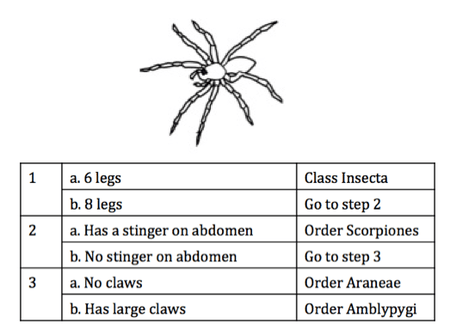
An illustration and a dichotomous key are given. What is the correct classification for this organism?
a)
Class Insecta
b)
Order Amblygygi
c)
Order Araneae
d)
Order Scorpiones
136.
A table of arachnid and insect characteristics is shown. Which characteristic could be used to distinguish between
arachnids and insects?
a)
Jointed legs
b)
Body segments
c)
Presence of eyes
d)
Presence of antennae
137.
When using a dichotomous key to identify organisms, what do we look at?
a)
physical features
b)
weather patterns
c)
environment
d)
diet
138.
What step do we always start with when using dichotomous keys?
a)
1
b)
2
c)
3
d)
4
139.
What is a dichotomous key used for in science?
a)
To organize biomes
b)
Classify organisms
c)
Identify bacteria only
d)
None of these
140.
The method of naming organisms by using two names is known as
a)
binomial nomenclature
b)
dinomial menoclature
c)
dichotomous naming
d)
the scientific method