
 Worksheets
Evidence for Evolution Review
Total questions: 69
Worksheet time: 45mins

As these embryos continue to develop, what will most likely happen?
Develop new organs according to the nutritional requirements of each organism
Share similar habitats
Develop the distinctive characteristics of their own species
Continue to closely resemble each other as adults.

Based off of the bone structure of humans and snakes, which of the following can we conclude?
Humans are an ancestor of snakes
One of the ancestors of snakes had legs, which they no longer use
Humans will eventually become snakes
Snakes have legs that they still use

Based on these DNA sequences, which animal is most closely related to humans?
Rhesus Monkey
Mouse
Dog

Using this fossil record, which statement below is true?
The T-rex lived before the Devonian fish
Trilobites lived in multiple time periods
The mammoth and the T-rex lived close together in time.
The Devonian fish is the oldest fossil ever found.

Why is the fossil record considered evidence for evolution?
They provide physical examples of living things changing over time
Fossils are very easy to find, making this type of evidence very common
They show organisms developing from early stages of life until they die.



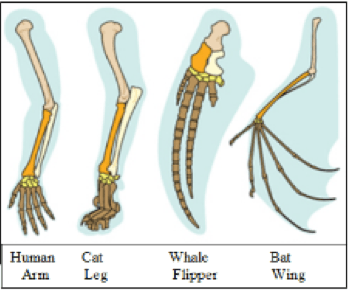
The bones in the figure above are-
Evidence of a common ancestor
Evidence that animals can walk
Evidence that fossils are old
Evidence of nothing

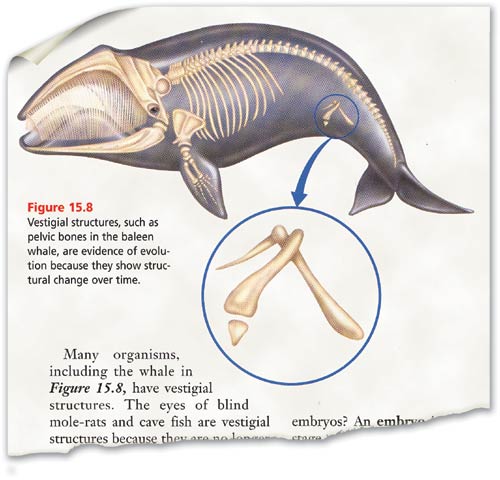
The picture shows a/an ___________
homologous structure
vestigial structure

Whales have pelvic bones. What type of structure does this best represent?
Homologous structure
Analogous structure
Vestigial structure
None of the above
Which of the following are vestigial structures humans have? Select all that apply.
Appendix
Tailbone
Forearm bones
Goosebumps

When scientists see similarities between a hippopotamus embryo and a rabbit embryo, this suggests:
Rabbits evolved from hippopotamus.
Hippopotamus share a common ancestor with rabbits.
Hippopotamus evolved from rabbits.
Hippopotamus and rabbits share the same traits.
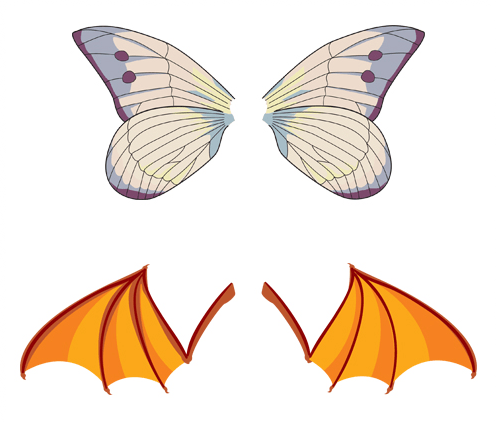
body parts that perform a similar function but differ in structure
homologous structures
analogous structures
vestigial structures
comparative anatomy

Penguin flipper and fish fin
Homologous
Vestigial
Analogous
None of the above
The analysis of embryos can prove...
fossils
extinction
common ancestry
Similar structures with different purposes found in different species are known as _____
vestigial structures
DNA
homologous structures
the fossil record


According to this image, which organism is LEAST closely related to the baboon? (HINT: differences are circled in red)
Chimp
Lemur
Gorilla
Human

According to this image of the DNA of 4 organisms, which organism is LEAST closely related to Sample 1?
Sample 2
Sample 3
Sample 4
A grasshopper and a honeybee have similarly structured mouth parts, although they use their mouth parts for different things. The mouth parts ARE INHERITED from a common ancestor. Are these mouthparts examples of homologous or analogous structures?
Homologous
Analogous

Look at the picture of the two structures. These bones were NOT INHERITED from a common ancestor. Are the fish fin and penguin fin homologous or analogous structures?
Homologous
Analogous
Many snakes have leg nubs, but do not use them to slither around the ground. This is an example of what type of structure?
Homologous
Analogous
Vestigial

Based on the fossil pictured, what currently living species is most closely related to this extinct species?
Zebra
Snake
Monkey
Human

Which layer has fossils with the most RECENTLY evolved organisms?
Layer A
Layer B
Layer C
Layer D
How do fossils provide evidence for evolution? Select all that apply
Rock layers that fossils are found in show different time periods and we can see a change over time
Fossils show how populations will change in the future because they show which traits have been successful before
We can compare body structures in fossils to modern day organisms and see that they are the exact same
It shows that ancient populations changed really quickly, and that evolution is a fast process
Which of these answer BEST describes a fossil?
fossils are remains or traces of once-living organisms found in layers of rock or ice, or in amber.
organism from which other organisms are descended.
body of an organism that died recently but has not decomposed
Which of these statements is TRUE of the fossil record?
The fossil record contains a complete record of every extinct organism.
The fossil record contains mostly soft organisms that had no hard bones of outer shell
Newer layers contain organisms more similar to modern-day organisms than do older layers.

The diagram below shows a portion of the fossil record in sedimentary rock. Different rock layers and fossils are clearly visible.
Layer B contains the second-oldest fossils.
Layer A contains the most recently formed fossils.
The fossils in layer B are older than those in layer D.
A scientist described two modern-day species as sharing a common ancestor. What does it mean when two species share a common ancestor/
It means that the two species are actually the same species
It means that one of the species evolved from other species
It means that both species evolved from one species that lived in the past.
William discovered that two modern-day species have very similar DNA. He concludes that the two species are closely related. What type of evidence did William MOST LIKELY use to reach his conclusion?
fossil evidence
DNA evidence
structural evidence


The similarities of the bones in the diagram provide evidence that---
The organisms shown lived in the same natural environment
The organisms shown may have developed from a common ancestor
The organisms shown have the same genetic diseases
All vertebrate species have identical forelimbs

The opossum, which is native to North America, and the kangaroo, which is native to Australia, are marsupials.
The fact that both these mammals incubate their immature offspring in a pouch provides evidence that they —
belong to the same species
must travel great distances to eat
have very similar skeletal structures
are descended from a common ancestor
Genome maps provide the DNA sequences of chromosomes. Some scientists have compared the genome maps of a hedgehog and a sloth. What do these genome maps allow the scientists to determine (find out)?
The color patterns of the offspring of each species
How much the size ranges of the two species differ
The methods of protein synthesis that each species uses
How closely related the two species are to each other

Three species of lizards of the genus Gallotia are found on the Canary Islands, a chain of seven volcanic islands off the west coast of Africa.
The easternmost island, Lanzarote, is the oldest, while the westernmost island, El Hierro, is the youngest. The distribution of lizard species is shown on the map below.
Which statement about the ancestry of the lizards from the genus Gallotia is best supported by this information?
The common ancestor of the lizards first colonized the island of El Hierro
The ancestors of each species came from different continents at different times
The common ancestor of the lizards probably came from Africa
The ancestors of each species evolved in Spain and were brought to the islands at the same time
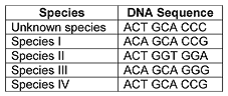
According to this data, the unknown bacterial species is most closely related to:
Species I
Species II
Species III
Species IV
How does Pangaea support the Theory of Evolution? Select all that apply
It provides an explanation for why similar fossils are found on different continents
The movement of continents provides an example of a big change in environment that would cause evolutionary pressures that would drive species to evolve
It explains how the planet became warmer over the years
It provides evidence that continents are growing in size slowly
What is is the study of how and why plants and animals live where they do?
Evolution
Adaptive Radiation
Biogeography
Biogeology


Two organisms that are closely related would have...
very similar DNA sequences
no proteins in common
exactly the same DNA sequences
completely different DNA sequences
When a species completely dies out, it is considered...
adapted
fossilized
extinct
mutated
Remains of organisms are called...
extinctions
mutations
fossils
variation
The geographical distribution of plants and animals
Biogeography
Animal Geography
Human Geography
Plantogeography

