Wayground logo

Free Printable Worksheets

Font size

S
M
L
XL
Worksheets

Physics First Semester 1 Review

Total questions: 114

Worksheet time: 2hrs 52mins
Name
Class
Date
1.
An object following a straight-line path at a constant speed 
a)
has zero acceleration
b)
has no forces acting on it
c)
has a net force acting in the direction of motion
d)
none of these
2.
What kind(s) of objects have inertia?
a)
all objects with mass
b)
only objects at rest
c)
only objects in motion
d)
only objects whose motion is being changed
3.
An object in motion will stay in what kind of motion as long as the net forces acting on it are zero?
a)
slowing motion in a straight line
b)
accelerating motion in a straight line
c)
constant motion in a straight line
d)
constant motion in an unpredictable direction
4.
friction is a force that acts 
a)
in the same direction as the motion
b)
opposite to the direction of the motion
c)
opposite to the applied forces
d)
the same direction as the applied force
5.
What is Newton's First Law
a)
F=ma
b)
Every action has an equal and opposite reaction
c)
An object at rest stays at rest, an object in motion stays in motion. 
d)
Friction 
6.
The ______of an object tends to make the object resist being set into motion.
a)
mass
b)
force
c)
motion
d)
unbalanced forces 
7.
The tendency of an object to resist a change in its state of motion is called the object's ______.
a)
incline
b)
straight line
c)
friction 
d)
inertia 
8.
Without a force to stop or slow a coasting object, the object will coast forever in a ______ line. 
a)
blue
b)
red
c)
straight
d)
vertical 
9.
Without a force to stop or slow a coasting object, the object will coast forever in a ______ line. 
a)
blue
b)
red
c)
straight
d)
vertical 
10.
_________ opposes the motion of one object moving past another. 
a)
friction 
b)
velocity
c)
unbalanced forces
d)
simple machines 
11.
Objects at rest remain at rest and objects traveling at a steady rate in a straight line continue that way until a _________acts on them.  
a)
force
b)
velocity
c)
inertia
d)
acceleration 
12.
What happens when unbalanced forces act on an object at rest?
a)
the object remains at rest
b)
the object begins moving in an unpredictable direction
c)
the object begins moving in the direction of the net force
d)
the object begins moving opposite to the direction of net force
13.
An object with a mass of 6.0 kg accelerates 4.0 m/s2 when an unknown force is applied to it. What is the amount of the force?
a)
240 N
b)
24 N
c)
2.4 N
d)
0.24 N
14.

According to Newton's second Law, which would take more force to slow down?

a)

The silver car

b)

The green car

c)

They would both take the same force

15.

Jenny applies a 60 N force to a 20 Kg cart, what is the acceleration of the cart if friction can be neglected?

a)

1200 m/s2

b)

0.33 m/s2

c)

20 m/s2

d)

3 m/s2

16.

When force is 20 N, mass is 5 kg, what is acceleration?

a)

25 m/s/s

b)

5 m/s/s

c)

100 m/s/s

d)

4 m/s/s

17.

Football A has a greater mass than football B. Which football will have greater acceleration when both are thrown with the same force in the same direction?

a)

Football A

b)

Football B

c)

They will have the same acceleration

d)

Mass has no effect on acceleration

18.
Newton's Third Law States...
a)
Objects in motion stay in motion and objects at rest stay at rest
b)
Force is equal to mass times acceleration
c)
For each action there is an equal and opposite reaction
19.
An archer shoots an arrow. The action force is the bowstring against the arrow, the reaction force is...
a)
Air resistance against the bow
b)
the arrow's push against the bowstring
c)
the grip of the archer's hand on the bow
20.
A baseball player bats a ball with a force of 1,000 N. The ball exerts a reaction force (without any additional forces action on it) against the bat of...
a)
Less than 1, 000 N
b)
1,000 N
c)
More than 1,000 N
21.
A rocket pushes exhaust 10, 000 N. Without any other forces acting on the rocket, how much force does the rocket go forward?
a)
15,000 N
b)
1,000 N
c)
10, 000 N
22.
What is the reaction force to a foot pushing down on the floor?
a)
The foot going through the floor
b)
The floor pushing back against the foot
c)
The floor breaking to the foot
23.
According to Newton's Third law the strength or magnitude of forces will be...
a)
smaller
b)
equal
c)
larger
24.
A rocket is sent into space.  When the power dies out, the rocket will just keep floating and moving in space forever (unless an unbalanced force, such as a meteor, runs into it).
a)
Newton's 1st Law
b)
Newton's 2nd Law
c)
Newton's 3rd Law
d)
None of them
25.

Unbalanced forces have what type of motion?

a)

accelerated

b)

constant

c)

none

d)

slow

26.

Acceleration is the rate of change of an object's:

a)

Force

b)

Velocity

c)

Momentum

d)

Mass

27.

If the velocity of an object is positive, what does it mean when the object's acceleration is negative?

a)

The object is speeding up.

b)

The object is slowing down.

c)

The object is changing direction.

d)

The object is falling down.

28.
In each of the following cases, determine where the car has no acceleration ?
a)
A car shortly after a stoplight turns green.
b)
A car approaching a red light
c)
A car with the cruise control set at 80 km/h
d)
A car turning a curve at a constant speed
29.

Acceleration is a vector measurement because it has both a magnitude and a ________.

a)

Time

b)

Distance

c)

Speed

d)

Direction

30.

Which of the following scenarios exhibits an object in accelerated motion?

*More than one answer is correct.*

a)

a rock at rest

b)

a cross country runner moving at a constant speed

c)

a bicyclist slowing down as she goes up a hill

d)

a bicyclist getting faster as she goes down a hill

31.

How does the motion of an Object A, travelling with a constant acceleration of 4 m/s/s, differ from that of an Object B, travelling with a constant acceleration of 2 m/s/s?

a)

Object A increases its velocity 2 m/s more each second than Object B

b)

Object A is speeding up while Object B is slowing down.

c)

Object A has a faster starting velocity than Object B.

d)

Object A is travelling in the positive direction, while Object B is travelling in the negative direction.

32.

A positive acceleration means that your object is _____.

a)

not accelerating

b)

not moving

c)

speeding up

d)

slowing down

33.

The equation for acceleration is...

a)
b)
c)
d)
34.

If you are test-driving a Bugatti Veyron and you go from 0 m/s to 124 m/s in 3.7 seconds, what was your acceleration?

a)
33.5 m/s2
b)
0.03 m/s2
c)
-33.5 m/s2
d)
-0.03 m/s2
35.

What is the final velocity of a rocket that travels for 4 seconds, has an initial velocity of 12 m/s and an acceleration of 2 m/s2?

a)

-4 m/s

b)

10 m/s

c)

20 m/s

d)

-10 m/s

36.

A golf ball accelerates off a tee at 100m/s2, changing its velocity from 0m/s to 50 m/s towards the fairway. How long did it take the golf ball to accelerate?

a)
750 seconds
b)
35 seconds
c)
0.3 seconds
d)

0.5 seconds

37.
Which graph represents the greatest acceleration?
a)
A
b)
B
c)
C
d)
D
38.

The graph shows

a)

positive velocity that's getting faster

b)

negative velocity that's getting faster

c)

negative velocity that's getting slower

d)

positive velocity that's getting slower

39.

The graph shows

a)

positive velocity that's getting faster

b)

negative velocity that's getting faster

c)

negative velocity that's getting slower

d)

positive velocity that's getting slower

40.

The graph shows

a)

positive velocity that's getting faster

b)

negative velocity that's getting faster

c)

negative velocity that's getting slower

d)

positive velocity that's getting slower

41.

The graph shows

a)

positive velocity that's getting faster

b)

negative velocity that's getting faster

c)

negative velocity that's getting slower

d)

positive velocity that's getting slower

42.

What are the three ways an object can accelerate?

a)

Speed up, slow down or change direction

b)

Go forward, go backward or stop

c)

Turn left, turn right or go straight

d)

distance, displacement or speed

43.
A car is speeding up in the same direction of motion so the acceleration is ---------
a)
negative
b)
positive
44.
Why does a car accelerate as it round a corner at a constant speed?
a)
Its direction changes
b)
It doesn't
c)
It slows down
d)
Its speeds up  
45.
During which interval is the object speeding up?
a)
A to B
b)
B to C
c)
D to E
d)
E to F
46.
Which graph represents zero acceleration (constant velocity)?
a)
A
b)
B
c)
C
d)
D
47.

A negative acceleration typically means that your object is _____. 

a)
not accelerating
b)
not moving
c)
speeding up 
d)
slowing down 
48.
In each of the following cases, determine where the car has no acceleration ?
a)
A car shortly after a stoplight turns green.
b)
A car approaching a red light
c)
A car with the cruise control set at 80 km/h
d)
A car turning a curve at a constant speed
49.

What type of force is this man using to push his grocery cart?

a)

Normal Force

b)

Gravity

c)

Air Resistance

d)

Applied Force

50.

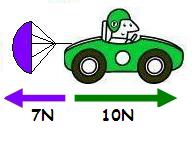
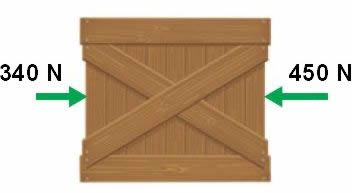
What is the net force?

a)

3 N

b)

3 N, right

c)

17 N, right

d)

3 N, left

51.

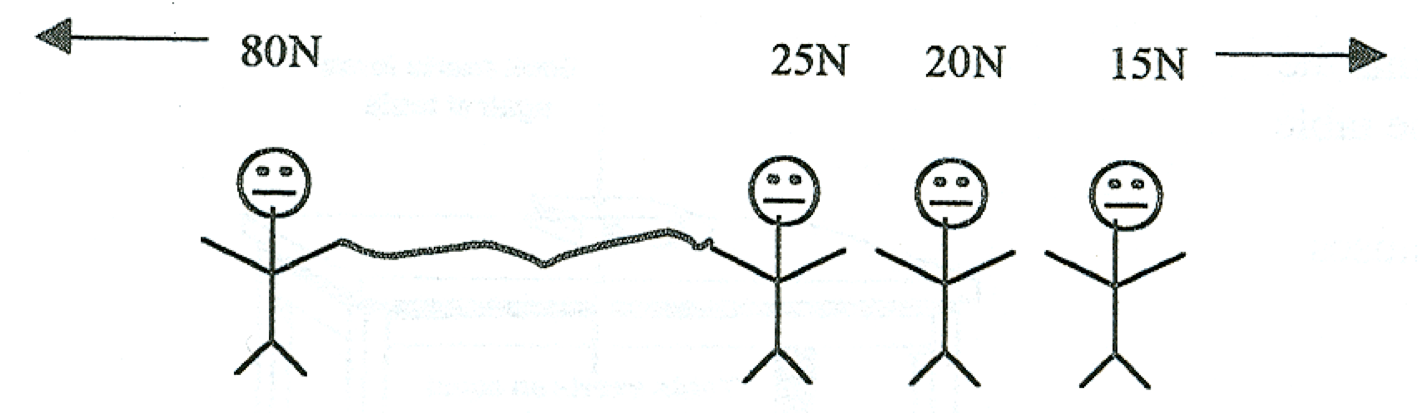
Who wins the tug of war with what net force?

a)

The person on the left with 20 N

b)

The person on the left with 80 N

c)

The people on the right with 20 N

d)

The people on the right with 100 N

52.
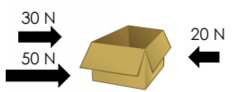
What is the net force?
a)
20 N 
b)
0 N 
c)
400 N 
d)
40 N 
53.

What is the unit to MEASURE force?

a)

Kilogram

b)

Meter

c)

Pounds

d)

Newton

54.

A ____________ is a push or a pull on an object.

a)

friction

b)

force

c)

magnet

d)

gravity

55.
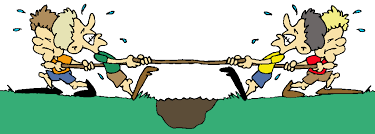
If these teams are pulling with the same amount of force what will happen?
a)
The boy in blue will win.
b)
They will not move at all.
c)
The boy in red will win.
d)
Both will fall down.
56.
Balanced or unbalanced?
a)
balanced
b)
unbalanced
57.

Forces that have a net force of zero Newtons

a)

Balanced force

b)

Unbalanced force

58.
The sum of all forces acting on an object.
a)
Contact Force
b)
Balanced Force
c)
Unbalanced Force
d)
Net Force
59.
Calculate the Net Force. 
a)
60N, Left 
b)
40N, Right 
c)
0N
d)
60N, Right
60.
What is a Force?
a)
The distance
b)
Mass
c)
A push or pull
d)
Give me a  failing grade 
61.
What force holds the planets in motion around the sun?
a)
Magnetic
b)
Electrical
c)
Gravitational
d)
Air Resistance
62.
All objects in the universe have a gravitational attraction to each other. 
a)
True
b)
False
63.
This type of force resist motion between two surfaces that are pressed together
a)
contact
b)
gravity
c)
friction
64.

If both forces are going in the same direction you should______ those forces

a)

Add

b)

Subtract

c)

Divide

d)

Multiply

65.

When forces are going in the opposite direction of each other you should do what do find the net force

a)

Subtract

b)

Add

c)

Divide

d)

Multiply

66.
The force that pulls things toward earth.
a)
Speed
b)
Gravity
67.
What is force?
a)
A push exerted on an object
b)
A push or pull exerted on an object
c)
A pull exerted on an object
d)
Nothing
68.

__________ is the amount of matter in an object. It does not change regardless of location

a)

Weight

b)

Mass

69.

______________ is how heavy an object is. It is determined by the pull of gravity

a)

Weight

b)

Mass

70.
What best describes the mass and weight of a person as they move around the universe?
a)
mass and weight changes
b)
Mass and weight stays constant
c)
weight remains constant, mass changes
d)
Mass stays constant, weight changes
71.

The force of gravity on one of Jupiter's moons is a little more than 2 times the gravitational force on Earth. If an object has a mass of 50 kg and a weight of 490 N on Earth, what would be the object's approximate mass and weight on that moon?

a)
50 kg and 490 N
b)
100 kg and 490 N
c)
50 kg and 980 N
d)
100 kg and 980 N
72.

What would be the weight of a 10 kg object on earth?

a)

1 N

b)

10 N

c)

0.1 N

d)

98 N

73.

Which variable goes on the y-axis

a)

independent variable

b)

dependent variable

c)

constant

d)

control

74.

Which variable goes on the x-axis

a)

independent variable

b)

dependent variable

c)

constant

d)

control

75.

Which variable always goes on the x-axis?

a)

time

b)

position

c)

velocity

d)

acceleration

76.

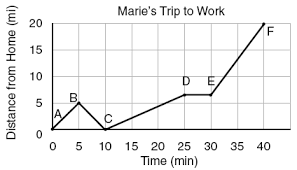
How far did Marie go before she turned around?

a)

20 mi

b)

5 mi

c)

10 mi

d)

25 mi

77.

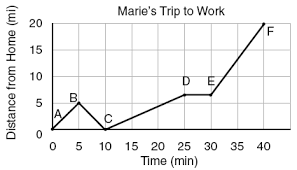
During what period of time was Marie stopped?

a)

0-5 minutes

b)

5-10 minutes

c)

10-25 minutes

d)

25-30 minutes

78.

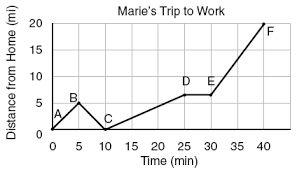
When was Marie driving the fastest?

a)

C to D

b)

D to E

c)

E to F

79.

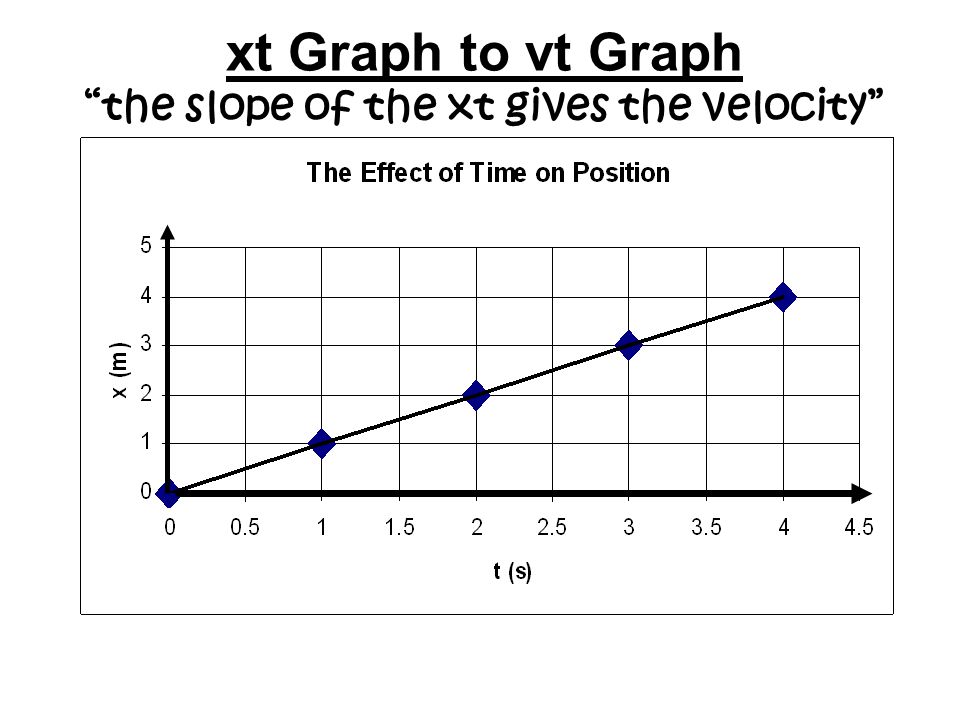
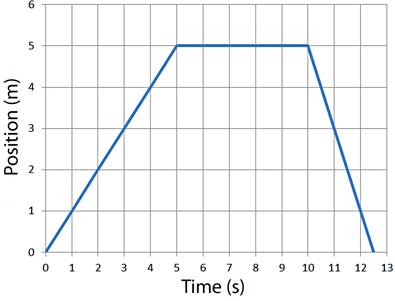
How fast is this object moving?

a)

1 meter

b)

1 meter /second

c)

2 meters/second

d)

4 seconds

80.

Which is true about plot c?

a)

position is negative

b)

velocity is positive

c)

position is changing

81.

At what time does this object have a negative velocity?

a)

3 seconds

b)

7 seconds

c)

11 seconds

d)

never

82.
_____ are measured in units of m/s in Physics.
a)
Speed and velocity
b)
Distance and displacement
c)
Scalars
d)
Vectors
83.

Consider the position vs. time graph below for cyclists A and B.

Do the cyclists start at the same point?

a)

Yes

b)

No

84.

At t= 7s, which cyclist is ahead?

a)

A

b)

B

85.

Which cyclist is travelling faster at t = 3s? (You need to know that both cyclists are traveling at constant speed, meaning that both x(t) lines are straight)

a)

A

b)

B

86.

Are their velocities equal at any time?

a)

Yes

b)

No

87.

What is happening at the intersection of lines A and B?

a)

The cyclists stop

b)

The cyclists speeds are equal

c)

The cyclists are at the same position at the same time.

88.

What is speed?

a)

how far you go

b)

how much distance is covered over a period of time

c)

how fast you accelerate

d)

the change in the location of a object

89.

Total distance divided by total time is

a)

average speed

b)

constant speed

c)

instantaneous speed

d)

acceleration

90.
When you look at the speedometer of your car, it tells you your....
a)
Average speed
b)
Instantaneous speed
91.
You walk 10 meters to math class in 20 seconds. Your average speed is
a)
2 m/s
b)
0.5 m/s
c)
200 m/s
d)
5 m/s
92.
What two measurements are necessary for calculating speed?
a)
Mass and time
b)
Temperature and mass
c)
Mass and distance
d)
Distance and time
93.

At 7 seconds, this object's velocity is:

a)

positive

b)

zero

c)

negative

d)

can't tell from the plot

94.

Velocity includes speed and __________________.

a)

Magnitude

b)

Direction

c)

Units

d)

Displacement

95.

Which of the following is a unit for acceleration?

a)

mi/hr

b)

km/s

c)

m/s/s

d)

Ft

96.

What are the three ways an object can accelerate?

a)

It speeds up

b)

It slows down

c)

It only speeds up

d)

It changes direction

97.

What force affects an object in free fall?

a)

Gravity

b)

Friction

c)

No force

d)

Tension

98.

Objects that fall to the earth fall at an acceleration of...

a)

2 m/s2

b)

5 m/s2

c)

9.8 m/s2

d)

6 m/s2

99.

Displacement is distance combined with...

a)

Velocity

b)

Speed

c)

Direction

d)

Acceleration

100.

I biked 5km to school. Is this an example of distance or displacement?

a)

Distance

b)

Displacemeent

101.

I drove 25km South to the my friends house. Is this an example of distance or displacement?

a)

Distance

b)

Displacement

102.

Motion is described with respect to a

a)

Graph

b)

Slope

c)

Displacement

d)

Frame of reference

103.

What does this graph represent?

a)

Moving at constant speed

b)

Speeding up

c)

Not moving (at rest0

d)

Slowing down

104.

The slope of a distance-time graph is the

a)

Distance

b)

Motion

c)

Acceleration

d)

Speed

105.

What does this graph represent?

a)

Moving at constant speed

b)

Speeding up

c)

Not moving (at rest0

d)

Slowing down

106.

Which runner has the fastest speed?

a)

Runner A

b)

Runner B

c)

Runner C

107.

Newton’s 1st Law of motion is also the law of _________.

a)

Inertia

b)

Momentum

c)

Balanced forces

d)

Net forces

108.

Inertia is the tendency of an object to ________ changes in motion

a)

Include

b)

Increase

c)

Multiply

d)

Resist

109.

When forces are balanced, the net force is ________.

a)

Negative

b)

0

c)

Positive

110.

Newton’s 1st law states that an object won’t change its motion unless acted on by a(n) ___________ force.

a)

Balanced

b)

Positive

c)

Unbalanced

d)

Negative

111.

Newton’s 2nd law of motion says that the force of an object is equal to its mass times its ____________.

a)

Displacement

b)

Velocity

c)

Position

d)

Acceleration

112.

What's the net force acting on the object?

a)

9N left

b)

1N left

c)

9N right

d)

1N right

113.

A box sliding down an incline increases its speed 14 m/s in 2s. What’s the acceleration of the box?

a)

0.143 m/s/s

b)

3 m/s/s

c)

7 m/s/s

d)

28 m/s/s

114.

A car travels 50m in 2s, what is the speed of the car?

a)

10 m/s

b)

25 m/s

c)

20 m/s

d)

5 m/s