
 Worksheets
AP Mitosis and Meiosis
Total questions: 88
Worksheet time: 3hrs 34mins


The amount of DNA in a cell is measured right after mitosis and found to be 8 picograms. How many picograms of DNA would be found in a nucleus in the G2 phase?
4
8
16
24


A kinetochore is a special protein located at the ___________ of a chromosome.
membrane
centrioles
centrosome
cell wall


Which molecules act as gatekeepers for each checkpoint of the cell cycle?
p53 gene
cyclins and cycline-dependent kinases
thyroid hormones


Apoptosis is
programmed cell death
mysterious cell death
programmed cellular mutation
mysterious cellular mutation

Crossing over involves:
synapsis
formation of a tetrad
alignment of homologous chromosomes
all of the above
Why do cells such as neurons divide very rarely?
They no longer have active nuclei
They have entered G0
they can no longer break down cyclins
They no longer produce MPF

If a stem cell (body cell) has 24 chromosomes, how many will it have at the end of meiosis?
24
12
6
the number varies per species
Meiosis results in ______.
4 genetically unique haploid gametes
4 genetically unique diploid cells
2 genetically identical cells
4 genetically identical cells

Two processes that increase genetic variation during meiosis are crossing over and _____
Synapsis
Tetrad
Independent assortment
Gameiosis
A haploid cell has
three sets of chromosomes
one set of chromosomes
two sets of chromosomes
four sets of chromosomes

What is one of the advantages of reproducing sexually versus asexually?
underproduction of offspring
overproduction of offspring
genetic variation
artificial selection


Haploid cells are represented by
2n
n
1/2 n
4n
A cell that has a full set of chromosomes is called a______ cell.
haploid
diploid
triploid
hetrolpoid
Which of the following carry the same genetic information?
sister chromatids
X and Y chromosomes
all autosomes
all haploid cells
In humans, the 22 pairs of chromosomes that don't include the sex chromosomes are called
loci
polysomes
autosomes
somatic chromosomes
This law describes how each homologous pair separates independently of any other pairs during Anaphase I of meiosis
Law of Segregation
Law of Independent Assortment
Law of Gravity
Law of Mathematical Order

In human beings, mitosis is necessary for:
growth and repair of tissues
formation of the gametes, or sex cells
reproduction of another individual
reducing the number of chromosomes

What is occurring in this phase of mitosis?
chromosomes are condensing
chromosomes are aligned in the middle of the cell
chromosomes are pulled apart
two new nuclei are being formed
If a cell undergoes mitosis repeatedly, but does not undergo cytokinesis, predict what the cells would look like:
Many individual cells each with their own nucleus.
One large cell with many nuclei.
Two large cells with many nuclei in each cell.
Many individual cells, each lacking a nucleus.

During which process does the cell divide two times?
Mitosis
Meiosis
Which process produces cells that are identical?
Mitosis
Meiosis
Which process produces cells that are unique / different from each other?
Mitosis
Meiosis
Chromosomes condense
Mitosis
Meiosis
Both
During anaphase I
sister chromatids separate
homologous pairs meet in the middle
homologous pairs separate
sister chromatids meet in the middle
During anaphase II
sister chromatids separate
homologous pairs meet in the middle
homologous pairs separate
sister chromatids meet in the middle
If an organism's 2n = 18 How many total chromosomes are in its nucleus?
18
9
36
3
It is difficult to observe individual chromosomes during interphase because
the DNA hasn't replicated yet.
they are in the form of long, thin strands (euchromatin & heterochromatin)
they leave the nucleus and are dispersed to other parts of the cell
the spindle must move them to the middle before they are visible

Item 5 in the diagram represents _____
S phase
Meiosis
Fertilization
Mitosis
Item 3 in the diagram represents _____
S phase
Meiosis
Fertilization
Mitosis
Item 2a in the diagram represents _____
Ovaries
Testes
Fertilization
Mitosis

This cell is in which stage of meiosis?
Prophase I
Anaphase II
Metaphase I
Anaphase I
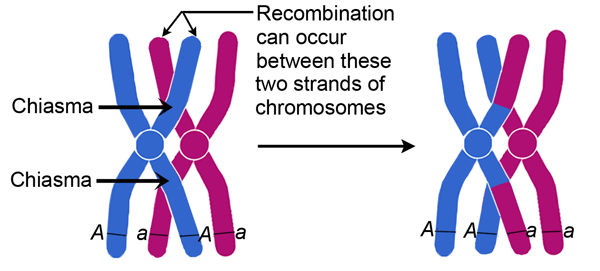
During what phase does the process shown occur?
Prophase of mitosis
Prophase I of meiosis
Prophase II of meiosis
This is a form of non-disjunction and not a normal process in cell division
What does this process accomplish?
This process reduces the number of chromatids per chromosome
This creates new combinations of genes on a single chromosome; resulting in genetic variation
This process reduces the chromosome number (diploid to haploid)
This is a form of non-disjunction and not a normal process in cell division

The process on the right is:
Right: meiosis
Right: cloning
Right: meiosis
Right: mitosis

Is the following cell diploid or haploid?
Diploid
Haploid

