wayground logo

Free Printable Worksheets

Font size

S
M
L
XL
Worksheets

Big Spiral Review

Total questions: 74

Worksheet time: 1hrs 3mins

Name
Class
Date
1.

This variable in an experiment is the one being deliberately changed by the scientist.  It is the only variable that is different between groups.

a)
dependent variable
b)
independent variable
c)
data
d)
control group
2.

What is the variable that we are measuring and collecting data about in an experiment?

a)
Independent
b)
Dependent
c)
Control
d)
Experimental
3.

What is the dependent variable for this hypothesis:  "If I add salt to the plant, then it will grow taller."

a)
grow taller
b)

plant growth

c)
amount of salt
d)
add salt
4.
A student is planning an experiment to find out how the height from which he drops a ball affects how high the ball bounces. The dependent variable is the _____.
a)
Diameter of the ball
b)
Force acting on the ball
c)
Height that the ball bounces
d)
Height from which the ball is dropped
5.
When experimenting with the growth of a plant, a scientist uses three (of the same type of) plants, two different fertilizers, equal light, and equal water. The fact that we kept the light, plant, and water the same in each experiment are examples of ____________.
a)
an dependent variable
b)
an independent variable
c)
a control
d)
constants
6.

Question: Does the flavor of ice cream effect how fast the ice cream melts?

The flavor of the ice cream is the ____________?

a)
independent
b)
dependent
7.

Consider the following question: Does the type of shoe worn during a 30 meter dash affect the speed of the runner? The speed of the runner is the _______.

a)
independent
b)
dependent
8.

Consider the following questions: Does changing the scent of a brand of dog food affect how much the dog eats? How much the dog eats is the ___________.

a)
independent
b)
dependent
9.

Consider the following question: Do roses grow more in height in partial or direct sunlight? Grow more in height is the ___________.

a)
independent
b)
dependent
10.

Consider the following questions: How does increasing the slope of a ramp affect how far a marble travels? Increasing the slope is the _______.

a)
independent
b)
dependent
11.

The Metric System is based on powers of:

a)

5's

b)

10's

c)

20's

d)

50's

12.

Which units are the BASE units in the metric system? Check all that apply.

a)

Meters

b)

Liters

c)

Grams

d)

Inches

e)

Miles

13.

What scientific tool is used to measure volume of liquids, such as water and chemicals?

a)

Meter Stick

b)

Ruler

c)

Graduated Cylinder

d)

Triple Beam Balance

14.

What scientific tool is best to measure the length of a classroom?

a)

Meter Stick

b)

Ruler

c)

Graduated Cylinder

d)

Triple Beam Balance

15.

What scientific tool is used to measure the mass of an object like a beaker?

a)

Meter Stick

b)

Ruler

c)

Graduated Cylinder

d)

Triple Beam Balance

16.

Which units below are NOT part of the metric system? Check all that apply.

a)

Inches

b)

Feet

c)

Meters

d)

Grams

17.

What unit is used for measuring MASS in the metric system?

a)

Grams

b)

Liters

c)

Meters

d)

Miles

18.

Which unit of the metric system is used for measuring VOLUME?

a)

Meters

b)

Liters

c)

Grams

d)

Ounces

19.

What base unit is used in the metric system to measure LENGTH?

a)

Meters

b)

Liters

c)

Grams

d)

Miles

20.

Which unit is smaller?

a)

Centimeters

b)

Millimeters

21.
Which of the following scientists concluded that all animals are made of cells?
a)
Rudolf Virchow
b)
Matthais Schleiden
c)
Robert Hooke
d)
Theodor Schwann
22.
Which of the following scientists was the first to observe bacteria?
a)
Anton van Leuwenhoek
b)
Matthais Schleiden
c)
Robert Hooke
d)
Theodor Schwann
23.
Which of the following statements is not part of the cell theory?
a)
Cells are the basic unit of structure and function in all living things.
b)
All cells are produced from other cells.
c)
Only animal cells are composed of cells.
d)
All living things are composed of cells.
24.
The invention of the microscope made it possible for people to discover and learn about
a)
Plants
b)
Skin 
c)
Animals 
d)
Cells
25.
What is one way in which all living things on Earth are alike?
a)
All living things have hair.
b)
All living things are made of cells and come from other cells.
c)
The cells of all living things have chloroplast.
d)
All living things can move. 
26.
What structures distinguish a plant cell from an animal cell?
a)
Plant cells have cell walls and ribosomes.
b)
Plant cells have cell walls and chloroplasts.
c)
Plant cells have chloroplasts and ribosomes.
d)
Plant cells have chloroplasts and mitochondria.
27.
When cells are damaged, new cells are created by cell division. How does the cell theory support this fact?
a)
It states that all cells have a nucleus which divides.
b)
It states that all living things are made up of one or more cells.
c)
It states that cells come from previously existing cells.
d)
 It states that the basic units of structure and function are cells.
28.
Which organism is made up of cells that have both a cell membrane and a cell wall?
a)
desert mouse
b)
human 
c)
maple tree
d)
zebra
29.

In what organelle is the genetic material found inside?

a)

cell membrane

b)

chloroplast

c)

nucleus

d)

ribosome

30.

What organelle is called the "powerhouse" of a cell?

a)

mitochondria

b)

nucleus

c)

cell wall

d)

cell membrane

31.

A large central vacuole is found in a _____ cell.

a)

animal

b)

plant

32.

What is the function of a chloroplast?

a)

makes proteins for animal cells

b)

allows materials in and out of the cell

c)

provides structure and support

d)

absorbs sunlight for photosynthesis

33.

What is the structure that contains DNA and directs the cell?

a)

endoplasmic reticulum

b)

central vacuole

c)

cell wall

d)

nucleus

34.

Looking in a microscope, you see cells that have rectangular shapes and a green color. What type of cells are you probably viewing?

a)

plant cells

b)

animals cells

c)

muscle cells

d)

blood cells

35.

Identify the structure that is indicated by the arrow in the image.

a)

cell wall

b)

central vacuole

c)

chloroplast

d)

nucleus

36.

Identify the structure that is indicated by the arrow in the image.

a)

cell wall

b)

central vacuole

c)

chloroplast

d)

cell membrane

37.

The arrow is showing the fluid inside the cell that surrounds the cell organelles. What is the arrow pointing to in the cell?

a)

cytoplasm

b)

mitochondria

c)

ribosomes

d)

nucleus

38.

What type of cell is being shown in the image?

a)

plant

b)

animal

39.

Identify the structure that is labeled "C" in the image.

a)

central vacuole

b)

nucleus

c)

chloroplast

d)

mitochondria

e)

cell membrane

40.

Identify the structure that is labeled "H" in the image.

a)

cell wall

b)

chloroplast

c)

mitochondria

d)

nucleus

e)

cell membrane

41.

I make proteins for the cell. What am I?

a)

ribosome

b)

cell membrane

c)

nucleus

d)

chloroplast

42.

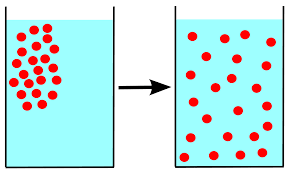
How do the particles move in diffusion?

a)

From a region of low concentration to a region of high concentration
b)

From a region of high concentration to a region of low concentration

c)

From a region of low concentration to a region of low concentration

d)

From a region of high concentration to a region of high concentration

43.

The picture below is an example of _________________.

a)

osmosis

b)

isotonic

c)

diffusion

d)

active transport

44.
Osmosis is the movement of _____ across a membrane.
a)
food
b)
energy
c)
oxygen
d)
water
45.

All organisms are made of

a)

organs

b)

tissues

c)

cells

46.
Which of the following is necessary for photosynthesis?
a)
Sunlight
b)
Glucose
c)
Oxygen
d)
Soil
47.
Which of the following is a product of photosynthesis?
a)
Water
b)
Sunlight
c)
Glucose
d)
Carbon dioxide
48.
Which of the following organisms use cellular respiration for life and growth?
a)
Plants only
b)
Animals only
c)
Plant and animals
d)
Glucose
49.
How do plants obtain energy for photosynthesis?
a)
Water is absorbed through the flower
b)
Soil is absorbed by the roots
c)
Oxygen is absorbed though the stem
d)
Sunlight is absorbed by the leaves
50.
Which of the following is produced during cellular respiration?
a)
Protein
b)
Oxygen
c)
Carbon dioxide
d)
Glucose
51.
Which of the following are needed for cellular respiration?
a)
Chlorophyll and sunlight
b)
Water and carbon dioxide
c)
Oxygen and Glucose
d)
Money and a ride to Walmart
52.
Without photosynthesis, what would happen to life on this planet?
a)
It would continue as usual
b)
It would end
c)
It would speed up
d)
It would only include animals
53.
The division of the nucleus is known as:
a)
Synthesis
b)
Mitosis
c)
G1
d)
G2
54.
The ___________ holds the replicated sister chromatids together.
a)
centriole
b)
chromosomes
c)
centromere
d)
cycles
55.
The cell spends most of it's life in ________________.
a)
mitosis
b)
cytokinesis
c)
Interphase
d)
None of the above
56.
The structure labeled A is a(n)
a)
chromatid
b)
centriole
c)
centromere
d)
chromophere
57.
The structures labeled B are
a)
centrioles
b)
chromatids
c)
centromeres
d)
chromopheres
58.
Put the following stages of mitosis in order: anaphase, prophase, metaphase, and telophase. 
a)
prophase, metaphase, telophase, anaphase
b)
prophase, anaphase, metaphase, telophase
c)
prophase, metaphase, anaphase, telophase
d)
prophase, telophase, metaphase, anaphase
59.
Identify the Cell Cycle Stage.
a)
Prophase
b)
Interphase
c)
Anaphase
d)
Telophase
60.
Identify the Cell Cycle Stage.
a)
Anaphase
b)
Cytokinesis
c)
Telophase
d)
Metaphase
61.
Identify the Cell Cycle Stage.
a)
Cytokinesis
b)
Interphase
c)
Anaphase
d)
Metaphase
62.
Identify the Cell Cycle Stage.
a)
Interphase
b)
Anaphase
c)
Telophase
d)
Prophase
63.
Traits that are passed from generation to generation are called ____________________
a)
Excited Traits
b)
Inherited Traits
c)
Inclined Traits
d)
Special Traits
64.
_____________________ carries information for inherited traits.
a)
DNA
b)
FBI
c)
RNA
d)
CBS
65.
A strand of DNA that looks like a twisted ladder is called a _____________________
a)
triple twist
b)
corkscrew
c)
double helix
d)
chain reaction
66.
____________________ is to make copies of DNA
a)
replicate
b)
recycle
c)
reuse
d)
rejoice
67.
Adenine bonds with ______________.
a)
Guanine
b)
Thymine
c)
Cytosine
d)
Adenine
68.
Guanine bonds with ______________.
a)
Adenine
b)
Guanine
c)
Cytosine
d)
Thymine
69.

The sides of DNA contain

a)

Sugar and phosphate

b)

Sugar and base pairs

c)

Phosphate and base pairs

d)

DNA does not have any sides

70.
Why is DNA important?
a)
it is very small and very complicated
b)
it's in everything
c)
it serves as the blueprint for traits of all living things
d)
because we eat it every day for energy
71.
Which of the following responses is a plant growing toward or leaning toward light?
a)
thigmotropism
b)
hydrotropism
c)
phototropism
d)
gravitropism
72.
A plant's root grow in a downward direction in response to what force? 
a)
sunlight
b)
gravity
c)
soil
d)
turgor pressure
73.
If a plant experiences a gravitropism, then it will do what?
a)
Grow toward or away from light. 
b)
Grow away from light. 
c)
Grow toward light.
d)
Grow in response to gravity. 
74.

A vine plant brushes against a fence and wraps itself around the fence. To what response is the stimulus is the plant responding to?

a)

phototropism

b)

gravitropism

c)

hydrotropism

d)

thigmotropism