wayground logo

Free Printable Worksheets

Font size

S
M
L
XL
Worksheets

18-1-22 p567 y11

Total questions: 80

Worksheet time: 2hrs 51mins

Name
Class
Date
1.

A contact force is from

a)

objects physically touching

b)

far apart objects

c)

not touching object

d)

always a pull

2.

A non-contact force is between

a)

two objects that aren't touching

b)

two objects that are touching

c)

the ground and wheels

d)

you and me

3.

Gravity is a

a)

Contact Force

b)

Myth

c)

Non-contact Force

4.

Which is an example of a non-contact force?

a)

elastic force

b)

normal force

c)

applied force

d)

electric force

5.

You are pulled to the surface of the earth due to the force of _________________

a)

gravity

b)

friction

c)

normal force

d)

contact force

6.

Air Resistance Force

a)

Contact Force

b)

Non-Contact Force

7.
What will happen when these magnets are brought close together?
a)
They will attract each other.
b)
They will repel each other.
c)
Both magnets will turn to the left
d)
Both magnets will turn to the right
8.
True or False: All metals are attracted to magnet.
a)
True
b)
False
9.
Earth acts like a giant magnet because its center is made up MOSTLY of
a)
granite
b)
limestone
c)
iron
d)
nickel
10.
How is a permanent magnet DIFFERENT from a temporary magnet?
a)
A permanent magnet attracts materials made of iron.
b)
A permanent magnet has poles.
c)
A permanent magnet has a magnetic field.
d)
A permanent magnet keeps its magnetism for a long time.
11.
Where is the force of attraction the strongest on a magnet?
a)
at the poles
b)
in the middle
c)
above the magnet
d)
below the magnet
12.
The magnet's shown will
a)
not move
b)
attract
c)
repel
d)
all of the above
13.
What do the lines around this magnet represent?
a)
North Pole
b)
South Pole
c)
Magnetic Declination
d)
Magnetic Field
14.
If you cut a magnet in half, what happens to the poles?
a)
One half gets the North Pole, the other half gets the South Pole
b)
Both halves get only a North Pole
c)
Both halves get only a South Pole
d)
Both halves get a North pole and a South Pole
15.
If you placed the south pole of one bar magnet near the south pole of another bar magnet, the two magnets would __________ each other.
a)
attract
b)
cancel
c)
repel
d)
discharge
16.
The material best attracted by a magnet is ________________.
a)
silver
b)
copper
c)
iron
d)
glass
17.
A magnetized iron nail is called a ________ magnet.
a)
permanent
b)
temporary
c)
horseshoe
d)
industrial
18.

What happens when a steel nail behaves like a magnet when it is touching a permanent magnet?

a)

magnetism is induced

b)

it becomes iron

c)

nothing is attracted to it

d)

it repels

19.
Which statement about mass and weight is correct?
a)
Mass and weight are both forces
b)
Neither mass nor weight is a force
c)
Only mass is a force
d)
Only weight is a force
20.
Which quantity is measured in newtons?
a)
density
b)
energy
c)
pressure
d)
weight
21.

What is the equation that links gravitational field strength, mass and weight?

a)

weight = mass x gravitational field strength

b)

weight = mass ÷ gravitational field strength

c)

weight = gravitational field strength ÷ mass

22.

What is the equation that links distance, force and work done?

a)

work done = force x distance

b)

work done = force ÷ distance

c)

work done = distance ÷ force

23.

What is the equation that links distance, time and velocity?

a)

velocity = time x distance

b)

velocity = distance ÷ time

c)

velocity = time ÷ distance

24.

What is the equation that links acceleration, change in velocity and time?

a)

acceleration = change in velocity x time

b)

acceleration = change in velocity ÷ time

c)

acceleration = time ÷ change in velocity

25.

What is the equation that links acceleration, mass, and resultant force?

a)

resultant force = mass x acceleration

b)

resultant force = mass ÷ acceleration

c)

resultant force = acceleration ÷ mass

26.

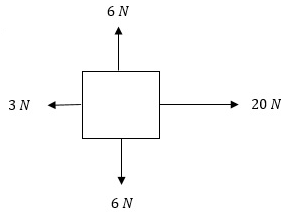
What is the resultant force in this diagram?

a)

17 N, right

b)

17 N, left

c)

23 N, right

d)

12 N, up

27.
Which of the following is a unit for acceleration?
a)
km/s
b)
m/s2
c)
mi/hr
d)
ft
28.
Of the following, which is a vector?
a)
Mass
b)
Time
c)
Speed
d)
Velocity
29.
Wind blowing at 20 mph.Vector or scalar?
a)
Scalar
b)
Vector
30.
30 m/sec, East. Scalar or Vector
a)
Scalar
b)
Vector
c)
Neither
31.
A deer running 15 meters per second due west.Vector or scalar?
a)
Scalar
b)
Vector
32.
Distance and direction of an object's change in position from a starting point
a)
displacement
b)
distance
c)
motion
d)
reference point
33.
 Amy runs 2 miles south, then turns around and runs 3 miles north. What is displacement?
a)
5 miles
b)
1 mile 
c)
2 miles south
d)
1 mile north 
34.
What is magnitude?
a)
The direction that describes a quantity.
b)
A numerical value
c)
A unit of force
35.
A quantity that has both magnitude and direction is called a scalar quantity.
a)
True
b)
False
36.

What is the unit for mass?

a)

kilogram (kg)

b)

meter (m)

c)

Newton (N)

d)

Joule (J)

37.

What is the unit for force?

a)

kilogram (kg)

b)

meter (m)

c)

Newton (N)

d)

Joule (J)

38.

What is the unit for energy?

a)

kilogram (kg)

b)

meter (m)

c)

Newton (N)

d)

Joule (J)

39.

What is the formula for kinetic energy?

a)

distance / time

b)

mass x acceleration

c)

velocity / time

d)

½(mass) x (velocity)2

e)

(mass) x (acceleration of gravity) x (height)

40.

What is the formula for gravitational potential energy?

a)

distance / time

b)

mass x acceleration

c)

velocity / time

d)

½(mass) x (velocity)2

e)

(mass) x (acceleration of gravity) x (height)

41.

__________ energy is stored energy.

a)

Potential

b)

Kinetic

c)

Force

d)

Gravity

42.

Gravitational potential energy depends on the ________ and ________ of the object.

a)

Position (height) and mass

b)

Friction and movement

c)

Mass and Movement

d)

Height and Friction

43.
Which statement describes a vector?
a)
It has magnitude but no direction
b)
It has direction but no magnitude
c)
It has both direction and magnitude
d)
It has constant magnitude but no
 direction
44.
What is 'drag' another name for?
a)
dressing up
b)
air resistance
c)
friction
d)
weight
45.
What are balanced forces?
a)
forces of the same size, in opposite directions
b)
the same size in the same direction
c)
forces in opposite directions
d)
forces at right angles to each other
46.
What is the name for a single force on an object with the same effect as all the forces combined?
a)
big
b)
total
c)
resultant
d)
sum
47.

Just after she jumps out of the plane (before the parachute opens). The relative forces will be

a)

Balanced

b)

Unbalanced

48.

Just after she jumps out of the plane (before the parachute opens). The relative forces will be

a)

Weight force is equal to the friction force

b)

Friction force is constant

c)

Weight force is greater that the friction force

d)

Friction force is greater than the weight force

49.

Just after she jumps out of the plane (before the parachute opens). The net force will be

a)

zero

b)

upward

c)

downward

50.

Just after she jumps out of the plane (before the parachute opens). The sky diver will have

a)

a constant speed

b)

a constant acceleration

c)

a constant velocity

51.

After the 60 seconds, the parachutist pulls the cord and opens her parachute.

Explain how the parachute reduces the speed of the parachutist when it is just opened.

a)

The friction force decreases

b)

The weight force decreases

c)

The weight force increases

d)

The friction force increases

52.
Describe the motion at point a. on the graph.
a)
constant speed
b)
accelerating
c)
decelerating
d)
stationary
53.
If this was the journey of a parachutist, what is happening at point e. ?
a)
He is decelerating
b)
He is accelerating
c)
He has reached a faster constant speed
d)
He has reached a lower constant speed. 
54.

When a parachute canopy is opened more drag is created because:

a)

It has a large mass

b)

It has a large surface area

c)

It is travelling at terminal speed

d)

The person is now vertical

55.

What is the speed of segment A?

a)

0.5 m/s

b)

2 m/s

c)

3 m/s

d)

0 m/s

56.

What is the speed of segment B?

a)

0.5 m/s

b)

2 m/s

c)

3 m/s

d)

0 m/s

57.

What is the speed of segment C?

a)

0.5 m/s

b)

2 m/s

c)

3 m/s

d)

0 m/s

58.

What is the speed of segment D?

a)

0.5 m/s

b)

2 m/s

c)

3 m/s

d)

0 m/s

59.
A wave with a large wavelength will have a ______ frequency and _____ energy
a)
high, low
b)
high, high
c)
low, high
d)
low, low
60.
Select the correct order of waves on the EMS 
a)
Radio, Micro, Infra, Visible, Ultra, X-ray, Gamma
b)
Gamma, X-ray, Ultra, Vis, Infra, Micro, Radio
c)
Vis, Micro, Infra, Ultra, X-ray, Gamma, Radio
d)
Micro, Radio, Vis, Infra, Ultra, X-ray, Gamma
61.
Which has the LONGEST wavelength and, therefore, the lowest frequency/energy
a)
Gamma Rays
b)
Radio Waves
c)
Visible Light
d)
Infrared rays
62.
Which has the SHORTEST wavelength and, therefore, the highest frequency/most energy
a)
Radio waves
b)
Ultraviolet Rays
c)
Gamma Rays
d)
X-rays
63.
Which section of the spectrum is the ONLY one we can see?
a)
X-rays
b)
Visible Light
c)
Gamma Rays
d)
Ultraviolet Rays
64.
As the frequency of an electromagnetic wave increases, the amount of energy in that wave...
a)
increases.
b)
decreases.
c)
stays the same.
65.
The height of the wave is known as the _____________.
a)
amplitude
b)
crest
c)
trough
d)
wavelength
66.
The blue section of the wave is measuring _________________.
a)
wavelength
b)
crest
c)
trough
d)
amplitude 
67.

What is the name of this piece of equipment?

a)

Ripple tank

b)

Wave machine

c)

Frequency calculator

d)

Wave speed apparatus

68.

Why should you measure the distance covered by 10 waves and then divide by 10 to find the wavelength?

a)

Because dividing by 10 is easy

b)

To make it a fair test

c)

To get a more accurate result

69.

Between which two letters is one wavelength?

a)

A and C

b)

B and D

c)

A and D

d)

A and E

70.
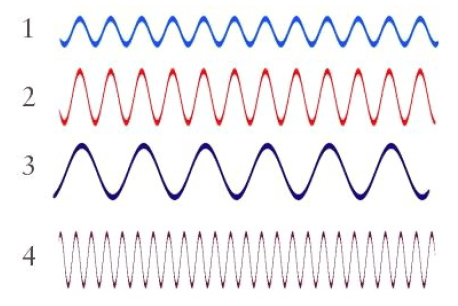
Which wave in the diagram has the greatest frequency?
a)
1
b)
2
c)
3
d)
4
71.

Which image represents a longitudinal wave?

a)

A

b)

B

72.

Sound waves are which type of waves?

a)

transverse

b)

seismic

c)

longitudinal

d)

frequency

73.

What does a wave carry from place to place?

a)

energy

b)

matter

c)

people

74.
The units for frequency are measured in _____________.
a)
hertz
b)
seconds
c)
m/s
d)
m
75.

the number of waves that pass a certain point.

a)

wave speed

b)

frequency

76.

A wave that can travel through matter and empty space is a:

a)

electromagnetic wave

b)

longitudinal wavy

c)

transverse wave

77.

Forces act in equal and opposite...

a)

pairs?

b)

groups?

c)

packs?

d)

schools?

78.

Which type of energy is in a spring and relates to which force?

a)

EPE

b)

GPE

c)

ABC

79.

What is meant by spring constant?

a)

weakness of spring

b)

strength of a spring

c)

stiffness of a spring

80.

Name 2 types of ionising radiation

a)

Gamma and xray

b)

radio and microwaves