
 Worksheets
CA#5 Re-Test
Total questions: 103
Worksheet time: 2hrs 33mins
A change in a DNA sequence that affects genetic information
mutation
fitness
transformation
An inherited characteristic that increases an organism's chance of survival
adaptation
evolution
fitness

By looking at the genes of some animals we can determine which living species are most closely related to each other. This also reveals which species most recently diverged from their common ancestor.
Based on the partial gene segments shown, which pair of animals are genetically most closely related and therefore most recently diverged from their common ancestor?
Chimpanzee and Mouse
Rat and Mouse
Rat and Chimpanzee
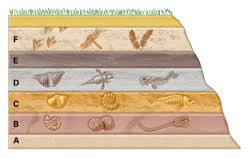
Which rock layer contains the newest fossils?
have the ability to interbreed.

Images of the embryo and adult stages of three different organisms are shown.
Which of the following is the best conclusion that can be drawn from this evidence?
Having similar embryos indicates that these organisms eat the same types of food.
Having similar embryos indicates that these organisms live in a similar environment.
Having similar embryos indicates that these organisms share a recent common ancestor.
Having similar embryos indicates that a certain protein controls how many legs the adult organisms will have.

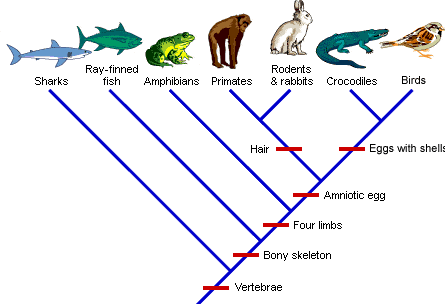
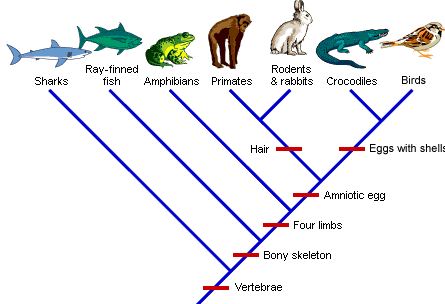
Please select all correct answers that apply, based on the cladogram shown
Sharks and Primates do not have a common ancestor.
Crocodiles and Amphibians are more closely related than Birds and Sharks.
Rodents and Rabbits do have Eggs with Shells.
Sharks have more of the traits shown than of all of the other organisms.
Birds have all of the shown traits that Sharks have, but Sharks do not have all of the shown traits that Birds have.

In the table shown, the DNA found in five primate species was compared to the DNA found in humans. The number of sequence differences was recorded. Based on the data in this table, what inference could you make about these species compared to humans?
Lemurs are most like humans.
Gorillas are most like humans.
None of the species are similar to humans.
Only the lemur differs from humans in any way.
Researchers discovered that the legs of birds are homologous to the feet of reptiles. Which claim is BEST supported by this fact?
Birds do not require legs
Birds and reptiles have a common ancestor
They randomly developed the same structures
Selection pressures have acted on birds, but not on reptiles

Select ALL the parts of Natural Selection.
overproduction
evolution
variation
selection
competition
What happens to new traits that HELP organisms survive over time?
They become MORE COMMON
They become LESS COMMON
They are EQUALLY COMMON

What evidence presented here supports the argument that vertebrates and insects evolved from a common ancestor?
The fact that the eye structures of vertebrates and insects are analogous
The fact that the genes encoding the eye structures of vertebrates and insects are analogous
The fact that the eye developmental genes of vertebrates and insects are homologous

What does it mean that the eye structures and specific genes for those structures are analogous but the genes that control eye development are homologous?
Select all that apply
It means vertebrates and insects had a common ancestor that possessed genes that coded for a primitive eye
It means every species that descended from the common ancestor developed additional genes that made changed the structure of their eye
It means that vertebrates and insects are not related to each other but developed eyes in a similar pattern
Sequence of DNA that determines structures of proteins
Mutation
Gene
Molecule
Protein
The ability to be unaffected by something usually harmful
Resistance
Mutation
Natural Selection
Adaptation
Process in which traits become more/less common due to some traits making it more likely for individuals to survive and reproduce
Natural Selection
Mutation
Distribution
Adaptation
What needs to be true for adaptation to occur?
A trait exists in a population
Organism's ability to survive and reproduce are increased
Trait is heritable
The trait needs to be predominant in a population
Why/how do population change over time?
The environment changes
There is a heritable trait which doesn't help survival
Natural selection causes a trait to become more common in the population
The organism decides to have a mutation occur
What does it take for organisms to change? Response should be in the correct order.
New trait, mutation, protein structure, protein function
Mutation, protein structure, protein function, new trait
Protein structure, protein function, mutation, new trait
New trait, protein structure, protein function, mutation
Why is it beneficial for a species to have varying traits?
They can't be seen by predators
It is helpful in asexual reproduction
If the environment changes, the population might be better able to adapt
They don't recognize each other.
Traits become more common in a population when it increases the probability of
survival
mutations
reproduction
dying
Peppered moths were able to adapt to their environment because
They decided to change colors in order to survive
The population had varying traits
Pollution covered the trees
The trees camouflaged all moths

Which of the following is an example of the bottleneck effect?
Cheetah populations reach their lowest levels with reduced diversity and as they rebound are so genetically similar they appear to be inbred.
Affected individuals with blue skin can trace their ancestry back to one of the first settlers in the region.
The environment of a fox population changes and over time foxes who are white survive and pass on their genes to their offspring.
Humans choose two dogs they like the characteristics of and breed them together.

All of the genetic information found in a population.
population
genetic drift
evolution
gene pool
Hunting reduced the population size of the northern elephant seal to as few as 20 individuals at the end of the 19th century. Their population has since rebounded to over 30,000, but much have less genetic variation than a population of southern elephant seals that were not intensely hunted. How is the lack of genetic variation related to the hunting episodes of the 1800's?
Genetic Drift Occurred/Genetic Bottleneck: the few individuals left behind were the seals that passed on the specific gene pool.
Genetic Drift Occurred/Founder Effect: the few individuals left behind were the seals that passed on the specific gene pool.
Natural Selection Occurred/Survival of the Fittest: only the strongest northern elephant seals survived in the 1800's and that restricted gene pool exists today.
Adaptation Occurred: Some seals were able to adapt to the hunting environment and they survived to pass on their genes.
Genetic Drift:
Happens Randomly
Decreases the Genetic Diversity of Populations
Does NOT 'select' the most adapted individual
Has the most drastic affect on smaller populations
In Genetic Drift, both Genetic Bottleneck and the Founder Effect, the end result is
less genetic diversity withing a population
a smaller population size
a new gene pool created by random chance
a population of organisms that are best fit for their environment


Cichlid fishes in lakes of the East African Rift. The lakes in this area are believed to support and sustain about 2,000 different species of these fish, each with different ecological and morphological characteristics such as body size. These lakes form a fragmented landscape that bio-geographically isolates the different species of cichlid fish from one another, allowing them, and many of the organisms they live with, to evolve separately.
Phyletic Speciation
Adaptive Radiation
Convergent Evoltion
Divergent Evoltuion
Co-evolution
In the frigid waters of the ocean surrounding Antarctica, fish have a special trait which allows them to survive the big chill. As scientists discovered in the 1960s, the fish have adapted by evolving a kind of antifreeze. It's composed of molecules called glycoproteins that circulate in the blood of the fishes, slightly lowering the temperature at which their body fluids would otherwise freeze and kill them. The glycoproteins surround tiny ice crystals and keep them from growing. The fish at the other pole of the globe also have a similar protein. It was, however, seen as a mutation after they had diverged from the southern species.
Phyletic Speciation
Adaptive Radiation
Convergent Evoltion
Divergent Evoltuion
Co-evolution

Phyletic Speciation
Adaptive Radiation
Convergent Evoltion
Divergent Evoltuion
Co-evolution

Phyletic Speciation
Adaptive Radiation
Convergent Evoltion
Divergent Evoltuion
Co-evolution
The Rough-skinned newt produces a potent neurotoxin that concentrates in their skin. Garter snakes, have evolved resistance to this toxin through a series of genetic mutations, and prey upon the newts. The relationship between these animals has resulted in an evolutionary arms race that has driven toxin levels in the newt to extreme levels.
Phyletic Speciation
Adaptive Radiation
Convergent Evoltion
Divergent Evoltuion
Co-evolution
The Apple Maggot Fly infests the fruit of a native North American Hawthorn Apple tree. In the 1860s some maggot flies began to infest apples. Now there are two populations of the fly feeding on the two food sources. The populations rarely interbreed and are showing genetic differences and therefore are becoming two separate species.
Phyletic Speciation
Adaptive Radiation
Convergent Evoltion
Divergent Evoltuion
Co-evolution

How is genetic drift different from natural selection?
Genetic drift prevents natural selection.
Genetic drift occurs by chance alone.
Genetic drift only occurs in marine species.
Genetic drift is a method used for breeding.

What type of evolution is described in the following scenario: Porcupines in the United States have quills (spines) that are attached to their skins. When they feel threatened, they can tense up their bodies, causing the quills to “shoot out.” These spiny quills can pierce the skin of attacking animals, causing injury and pain. Although not closely related to the porcupine, hedgehogs that live throughout parts of Europe also have protective spines that they use to defend themselves from attacking animals.
Coevolution
Divergent Evolution
Convergent Evolution
What type of evolution is described in the following scenario: King Snakes are a family of snakes that usually eat other snakes in the wild. Even though many of the snakes they eat are very poisonous, King Snakes have adapted the ability to not be affected by their poisons. In response, some of these poisonous snakes, like rattlesnakes, have adapted other defensive behaviors (other than biting) to try and “scare off” the King Snakes.
Coevolution
Divergent Evolution
Convergent Evolution
What type of evolution is described in the following scenario: The flowers that bloom from the saguaro cactus have evolved a bright, white coloration to attract many of the bats they rely on to pollinate their flowers. Since they rely on the bats, they have also adapted to opening their flowers at night, when the bats are active. The bats have also adapted to the cactus by a.) developing the ability to hover above the flowers, and b.) developing a long tongue that can reach deep inside the flower.
Coevolution
Divergent Evolution
Convergent Evolution
What type of evolution is described in the following scenario: Chameleons, a type of lizard (reptile), have two eyes they can move in completely different directions, so they can see all the way around themselves. Sand lances are a type of fish that can also move their eyes like the chameleon, even though they are not related to one another.
Coevolution
Divergent Evolution
Convergent Evolution
What type of evolution is described in the following scenario: In the ocean surrounding Antarctica, there are fish that survive the cold water by using a molecule made of glycoproteins that circulates the blood and keeps it from freezing. Certain kinds of worms that live in the Arctic ocean also make antifreeze proteins that help them live in icy water
Coevolution
Divergent Evolution
Convergent Evolution
What type of evolution is described in the following scenario: A kit fox lives in the desert and has large ears with greater surface area that keep the fox from getting overheated. The red fox lives in the forest and has a red coat that keeps it camouflaged.
Coevolution
Divergent Evolution
Convergent Evolution
What type of evolution is described in the following scenario: The Galloti atlantica and Galloti galloti lizards evolved through natural selection from a common ancestor into a wide variety of different looking lizards.
Coevolution
Divergent Evolution
Convergent Evolution
What type of evolution is described in the following scenario: Bees don’t see red, but do see yellow, blue, and ultra-violet light. Thus, bee-pollinated flowers are mostly yellow or blue with UV nectar guides (landing patterns) to guide the bee.
Coevolution
Divergent Evolution
Convergent Evolution
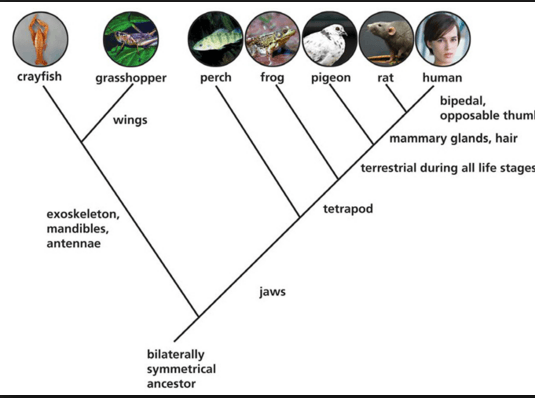
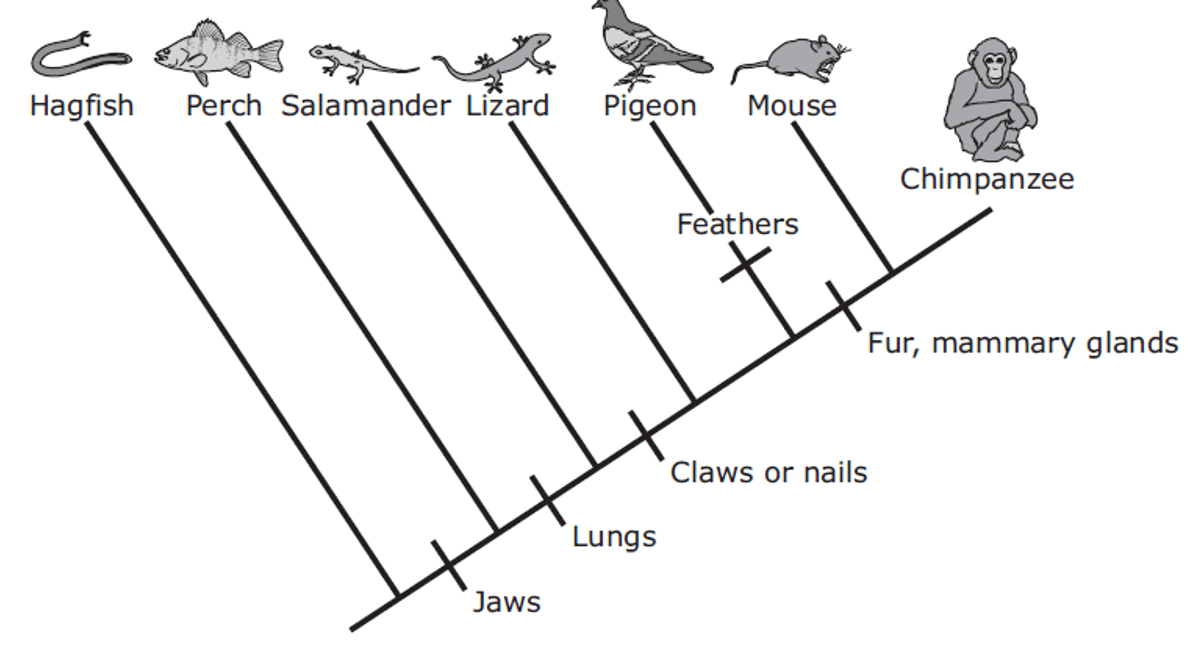
All the animals to the right of the salamander would have the common characteristic of...
Fur
Claws or nails
Lungs
Jaws


The similarities of organisms in which two areas numbered above provide the best evidence for common ancestry between the organisms in both locations?

These limbs provide evidence of common ancestry because they —

The fact that both these mammals incubate their immature offspring in a pouch provides evidence that they —

Which statement is best supported by the information in this dendrogram?

Which statement about the ancestry of the lizards from the genus Gallotia is best supported by this information?

What is the most reasonable conclusion one can draw from a comparison of these structures?
Survival of the fittest can best be described as –
the process by which only the strongest of a species will be able to survive and reproduce
the process in which organisms that are better adapted to their environment will have a better chance of surviving and reproducing
the reason the strongest of the species will not be able to reproduce as often as others
the reason weaker organisms in a species will always be killed by predators

Scientists can determine relatedness among organisms by comparing partial amino acid sequences. The table shows four partial amino acid sequences from four organisms. Which organism is the LEAST related to the other three organisms?
Organism 1
Organism 2
Organism 3
Organism 4

The relationships among different orders of millipedes are shown in the cladogram. Based on this cladogram, which statement best describes relationships among millipede orders?
Stemmiulida is more closely related to Merocheta than Penicillata is to Merocheta.
Spirostreptida is more closely related to Glomerida than Sphaerotheriida is to Glomerida.
Polyzoniida is more closely related to Glomeridesmida than Sphaerotheriida is to Glomeridesmida.
Merocheta is more closely related to Glomeridesmida than Glomerida is to Glomeridesmida.


