
 Worksheets
Rocks
Total questions: 81
Worksheet time: 53mins

Describe the texture of the following igneous rock.
glassy
rough
vesicular
coarse

Describe the texture of the following igneous rock.
smooth
coarse
vesicular
glassy

Describe the texture of the following igneous rock (grain size 1-10 mm).
vesicular
glassy
fine
coarse

Describe the texture of the following igneous rock (grain size < 1mm).
glassy
fine
coarse
vesicular

Describe the environment of formation for the following igneous rock (grain size > 10 mm).
intrusive
extrusive

Describe the environment of formation for the following igneous rock.
intrusive
extrusive

Describe the rate of cooling for the following igneous rock (grain size 1-10 mm).
slow cooling
rapid cooling

Describe the rate of cooling for the following igneous rock.
slow cooling
rapid cooling

Describe the environment of formation for the following igneous rock (grain size 1-10 mm).
above ground
below ground
How do coarse-grained intrusive igneous rocks form?
from sedimentary rocks changed under pressure
from large rock particles cemented together
from rapidly cooling lava
from slow cooling magma
Extrusive rocks have larger grains than intrusive rocks.
True
False
When all the grains in a rock are large and easy to see, the rock is described as
Fine-grained
Coarse-Grained
Glassy
An igneous rock that is formed from lava is called an
Extrusive
Intrusive
The slower magma cools, the smaller the mineral crystals form.
True
False
Extremely rapid cooling of lava in which no crystals form, creates what type of texture?
Fine-Grained
Coarse-Grained
Glassy
High silica content in magma=
Darker-colored rock
Lighter-colored rock
Low silica content in lava=
Darker-colored rock
Lighter-colored rock
Where is magma found?
inside Earth
on the surface of the Earth
How do intrusive igneous rocks form?
from lava that erupted onto Earth's surface
from magma that hardened beneath Earth's surface
Fine-grained igneous rocks with small crystals formed from
rapidly cooling lava
slowly cooling magma

Is this igneous rock, porphyry, fine-grained or coarse-grained?
fine-grained
coarse-grained

Rhyolite is a fine-grained, extrusive, igneous rock. How did it form?
rapidly cooling lava
slowly cooling magma

Pegmatite is a coarse-grained, intrusive, igneous rock. How did it form?
rapidly cooling lava
slowly cooling magma

Basalt is an extrusive igneous rock. What does this tell you about it?
it was formed from lava that erupted onto Earth's surface
it was formed from slowly cooling magma
it was formed from magma that hardened beneath Earth's surface
Describe the texture of the following igneous rock.
smooth
coarse
vesicular
glassy

Chemical rocks are...
Made from heat
Made when water evaporates and minerals crystallize
Made from dead animals/plants
Made from pieces of other rocks
Organic rocks are...
Made from heat
Made when water evaporates and minerals crystallize
Made from the remains of dead animals/plants
Made from pieces of other rocks


Which process best describes compaction?
particles are squeezed together under pressure
particles glue together as minerals harden
sediment settles
Which best describes deposition?
sediment pressing together
dissolved minerals crystallize and glue particles together
particles settle as loosely packed sediment
running water or wind carry away fragments of rock
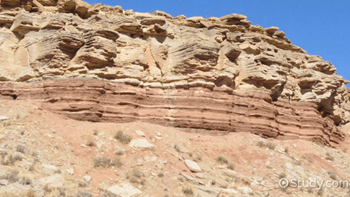
What factors can lead to the formation of a sedimentary rock?
melting and solidification
extreme heat and pressure
compaction and cementation
Clay or Silt
Boulder or Cobble

Term used to describe metamorphic rocks that have grains arranged in parallel layers or bands.
exfoliated
foliated
nonfoliated
unfoliated


Which texture best describes this rock?
porphyritic
nonfoliated
foliated
clastic


At which location is metamorphic rock most likely to be found?
A
B
C
D


Any rock that forms from another rock as a result of changes in heat or pressure (or both) is a:
chemical rock
igneous rock
sedimentary rock
metamorphic rock
Which of the following lists the steps an igneous rock undergoes in order to become a sedimentary rock, in the correct order?
Deposition, erosion, melting, cooling
Erosion, weathering, eruption, cooling
Dissolving, deposition, cooling, fracture
Weathering, erosion, deposition, cementation
Limestone is a sedimentary rock. During the rock cycle, limestone is changed into marble, a metamorphic rock. The processes that act on limestone and change it into marble are
weather and erosion
heat and pressure
compacting and cementing
melting, cooling, and hardening

According to the diagram, what process is shown by letter A?
extrusion
erosion
crystallization
intrusion
According to the diagram, what process is shown by letter B?
compaction & cementation
weather & erosion
heat & pressure
melting
If you found a rock that appeared to have been formed directly from volcanic activity, how would you classify it?
Sedimentary rock.
Igneous rock.
Volcanic rock.
Metamorphic rock.
If you wanted to collect sedimentary rocks, what sort of characteristics would you look for in a rock's composition?
Rock made from eroded material broken off other rocks and cemented together.
Rock that formed from magma or lava during a volcanic eruption.
Rock that includes sparkly crystals and other types of gemstones
Rock that has been transformed into new substances due to intense heat and pressure.
Coal is NOT a mineral because
It is not solid.
It is not naturally occurring.
It is organic.
It is inorganic.

Read the description below. Which detail(s) show that Sulfur is a mineral?
At room temperature Sulfur is a yellow crystalline solid. It's has a chemical formula of S8 and is found near volcanic vents.
HINT: There may be more than one answer!
It is yellow.
It is a solid.
It can be defined by a chemical formula.
All of the above.

Plastic is a clear substance that is a solid. Plastic has a fixed chemical formula and is a man - made product.
Is plastic a mineral or not?
Please select two answers.
Yes, plastic is a mineral because it is formed from a man - made substance.
No, plastic is not a mineral because it is not naturally occurring in the environment.
Yes, plastic is a mineral because it is a solid substance that has a fixed chemical formula.
No, plastic is not a mineral because it does not have a crystal structure.
Read the description below. Use the definition of minerals to choose the correct statement about ivory.
Ivory is a hard, solid, white material that comes from the tusks, or teeth, of animals, usually elephants.
Ivory is a mineral because minerals either come from living things or are man - made.
Ivory is a mineral because minerals are always white in color.
Ivory is not a mineral because minerals don't come from living things.
Ivory is not a mineral because minerals are not solids.
When a mineral breaks along rough, jagged surfaces it's called
fracture
cleavage
hardness
streak
The least accurate way to identify a mineral.
color
hardness
streak
density
The measure of how easily a mineral can be scratched.
streak
color
luster
hardness
The way that a mineral reflects light. It can be metallic or non-metallic.
streak
hardness
fracture
luster
The color left by a mineral in its powdered form.
streak
density
hardness
smudge
What equipment would you need to do a mineral streak test?
a long pointed iron rod
a rough white ceramic tile
a disposable sample of talc
a low powered microscope


