
 Worksheets
Evolution Quiz Practice
Total questions: 74
Worksheet time: 1hrs 1mins
An anatomical feature that no longer seams to have a purpose in the current form of an organism
Homologous structure
Analogous structure
Vestigial structure
None of the above
An anatomical feature that no longer seams to have a purpose in the current form of an organism
Homologous structure
Analogous structure
Vestigial structure
None of the above
Which is not evidence for evolution?
Many animals have homologous structures due to common ancestry
The study of species living across the world
We can observe changes in life forms by observing the fossil record
All of these are evidence for evolution

What type of evidence are shown in the picture above?
Fossils
Embryology
Homologous Structures
Vestigial Structures
The ability of an individual organism to survive and reproduce in its natural environment is called
natural selection
evolution
descent with modification
fitness
1. A farmer’s use of the best livestock for breeding is an example of
natural selection
artificial selection
extinction
adaptation
In a population of lizards, only the lizards with the longest tails survive and reproduce. What type of selection is described?
directional
stabilizing
disruptive

Whales have pelvic bones. What type of structure does this best represent?
Homologous structure
Analogous structure
Vestigial structure
None of the above
In elephants, babies that are too big or too small do not survive. Only the average (middle) size baby elephants survive. What type of selection is this?
directional
stabilizing
disruptive
What unique animals did Darwin find on the islands? (choose all that apply)
Tortoises
Lions
Finches
Frogs
Rabbits
A population of finches have beak sizes from 5-10 cm. After a change in the environment, the population of finches splits so that only the smallest and largest beak birds survive. This is an example of what type of selection?
directional
stabilizing
disruptive
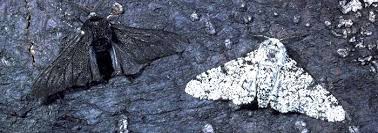
Which of the following traits might help the species survive?




Which of the following can be determined by observing the embryos shown in the diagram
Recently, scientists have been able to use ___________to find common proteins and amino acids to determine how closely related species are.
DNA
Vestigial structures
Fossils
Homologous structures
Which IS NOT used as evidence for evolution?
Fossils
Natural Selection
Early Development/Embryos
Body Structure/Anatomy
DNA/Proteins

Who was the Scientist most famous for his study of natural selection and evolution?
Theodor Schwann
Robert Hooke
Charles Darwin
Rudolf Virchow

What is the process in which populations CHANGE gradually over time?
evolution
species
variation
competition

How do we measure the age of a fossil in years?
variation
absolute dating
selection
mutation

What do you call similar structures that related species have inherited from a common ancestor?
Natural Selection
Analogous Structure
Vestigial Structure
Homologous Structure

What do we call structures that no longer perform their original function?
Natural Selection
Analogous Structure
Vestigial Structure
Homologous Structure

Select ALL the parts of Natural Selection.
overproduction
evolution
variation
selection
competition

Select ALL that show evidence of evolution.
DNA
mutations
fossils
skeletal structures
What is the study of organisms at the early stages of development?
DNA studies
embryology
extinction
fossil record
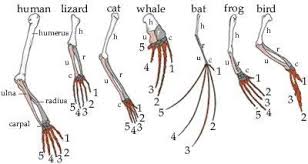
Structures that are similar to function.
Homologous
Analogous
Vestigial
DNA

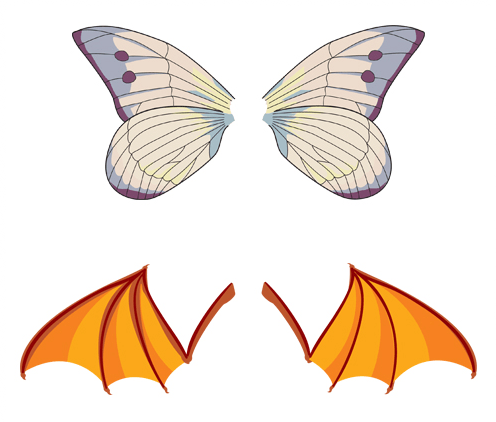
What is this an example of?
Homologous structure
Analogous structure
Vestigial organs
Functional adaption
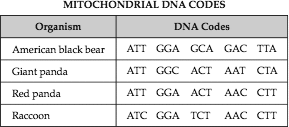
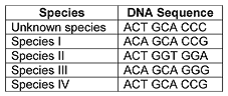
What conclusions can be made based on this table shown?
the American black bear and the giant panda are most closely related
the giant panda and the red panda are most closely related
the red panda and the racoon are the most closely related
the giant panda and the racoon are most closely related
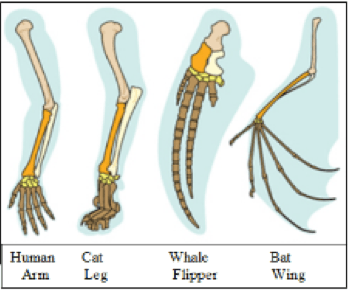
The bones in the figure above are-
Evidence of a common ancestor
Evidence that animals can walk
Evidence that fossils are old
Evidence of nothing
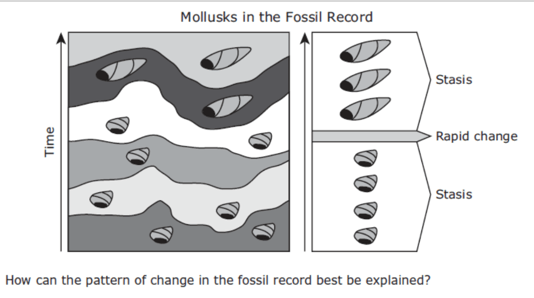
How can the pattern of change in the fossil record best be explained?
The mollusks were well adapted to their stable environment. A large, sudden change occurred in their environment. After the change the mollusks with the bigger shells were better adapted for the new environment.
The mollusks were well adapted to their stable environment. The mollusks hybridized with a smaller species of mollusk. A new species of mollusk with a bigger shell resulted.
The mollusks were not well adapted to their environment. The length of the mollusks' shells changed gradually over time. The mollusks in the original population that had small shells died over a period of many years.
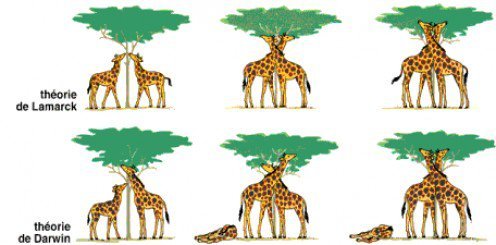
use or disuse
acquired characteristics are inherited
Who would have stated "acquired traits" such as a giraffe needing a long neck so they stretch it over time
Darwin
Lamarck
The remains of Mesosaurs are found in eastern South America and in southern Africa. What type of evidence for continental drift is this?
rock types and structures
matching fossils
continental puzzle
ancient climates

Scientist who is credited with one of the first theories of evolution. He believed - incorrectly - that organisms changed over time from simple to complex by acquiring and passing traits to offspring.
Jean-Baptiste de Lamark
Charles Darwin
Charles Lyell
Louis Pasteur
Father of evolution who believed that a process called natural selection explains how organisms evolved over time.
Carolus Linnaeus
Charles Darwin
Charles Lyell
Thomas Malthus
Scientist who believed that human population growth would lead to poverty and famine.
Charles Lyell
Thomas Malthus
Charles Darwin
Lazzaro Spallanzini
Scientists who formed amino acids and other simple organic compounds in a laboratory experiment with ammonia, methane, hydrogen and H2O
Hutton and Lyell
Miller and Urey
Chapman and Kaufman
Oparin and Haldane
States that some of the organelles in eukaryotic cells were once prokaryotic microbes because mitochondria and chloroplasts are the same size as prokaryotic cells, have theor own DNA and divide by binary fission
Organic Evolutionary Theory
Cell Theory
Cellular Selection
Endosymbiotic Theory
Father of taxonomy (naming organisms) who classified organisms using groups within groups.
Charles Darwin
Jean-Baptiste de Lammark
Charles Lyell
Carolus Linnaeus

