
 Worksheets
Acid base review
Total questions: 57
Worksheet time: 56mins
A sour taste is a characteristic of:
acids
bases
neutral
pH scale
Which is a characteristic of a base?
tastes sour
found mostly in foods
feels slippery
turn litmus paper red
pH is the measure of the concentration of ______.
Acids
H+ ion
OH- ion
Bases
According to Arrhenius, what is the definition of an ACID?
a substance that contains hydroxide and ionizes to produce OH-
a substance that contains hydrogen and ionizes to produce H+
a substance that contains hydrogen and ionizes to produce OH-
a substance that contains hydroxide and ionizes to produce H+
According to Bronsted-Lowry, what is the definition of an BASE?
a substance that donates a hydrogen (H+) ion
a substance that donates a hydroxide (OH-) ion
a substance that accepts a hydrogen (H+) ion
a substance that accepts a hydroxide (OH-) ion
What is being donated/accepted between conjugate acid-base pairs?
a hydrogen (H+) ion
a hydroxide (OH-) ion
water
a neutron

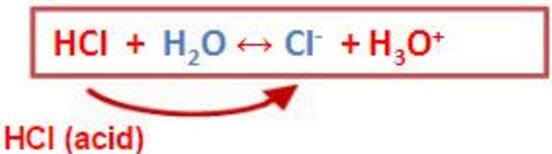
What is the conjugate base in the following reaction?
HCO3-
HCl
H2CO3
Cl-

Which of the following correctly identifies an Acid-Base Pair?
HH4+ , OH-
H2O , OH-
CaCO3 ,CaCl2
HNO3 , H2SO4
Which of the following is an Arrhenius Acid?
LiOH
CO32-
OH-
H3PO4
NaOH is:
an Arrhenius base
an Arrhenius acid
neither an acid nor a base
both an acid and a base
Which of the following is a strong acid?
oxalic acid
nitric acid
carbonic acid
acetic acid
CsOH is classified as a:
strong acid
weak acid
strong base
weak base
produces a salt and water
Acids are __________, which means they "eat away" at other materials.
transitional metal
alkaline
flammable
corrosive
Acidic solutions exhibit a higher ratio of H3O+ ions, known as...
neutrons
hydroxide
electrons
hydronium
When you place blue litmus paper into an unknown clear solution, the blue litmus paper turns red.
Which of the following represents the most logical conclusion?
The substance has a pH value of "2".
The substance is a base.
The substance has a pH value of "7".
The substance is acidic.
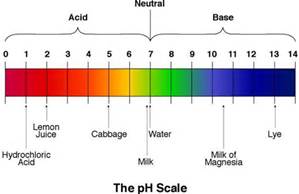
What range of values on the pH scale represent solutions with a higher ratio of hydroxide (OH-) ions?
below 7
7
above 7
0-14
Do acids and bases conduct electricity?
Only acids conduct electricity
Only bases conduct electricity
Bases and acids conduct electricity
Neither conduct electricity
Identify the gas evolved.
Hydrogen
Nitrogen
Carbon dioxide
Oxygen
Why is water neutral?
It does not have any H+ ions in it
It has equal concentrations of H+ and OH- ions
It does not have any OH- ions in it
Because it has a pH=7
A pH of 3 is how many times more acidic than a pH of 5?
2
20
10
100
A pH of 8 is how many times more acidic than a pH of 11?
3
30
100
1000

The picture below shows the relative concentrations of H+ and OH- in a solution. Is the solution an acid or a base?
acid
base
As one moves down the pH scale from 14 to 1, what happens to the concentration of H+ in the solution?
concentration of H+ decreases
concentration of H+ increases
concentration of H+ stays the same
As one moves down the pH scale from 14 to 1, what happens to the concentration of OH- in the solution?
concentration of OH- decreases
concentration of OH- increases
concentration of OH- stays the same
The pH scale is an inverse function. This means the ___________ the concentration of hydrogen ions, the ___________ the pH is. (select all that apply)
higher, lower
lower, higher
higher, higher
lower, lower
According to Bronstead-Lowery, acids are proton (a) .
According to Bronstead-Lowery, bases are proton (a) .
True or false: Water is amphoteric, which means it can act as both a Brønsted-Lowry acid and a Brønsted-Lowry base.
True
False
What is the hydrogen ion (H+) concentration of 2.5 M H2SO4?
4.0 M
5.0 M
1.0 x 10⁻⁴ M
2.5 x 10⁻¹⁵ M
A solution of Ca(OH)2 is 3.0 x 10⁻⁵ M. What is the hydroxide ion concentration?
1.0 x 10⁻⁵ M
1.0 x 10⁻⁹ M
5.0 x 10⁻¹⁰ M
6.0 x 10⁻⁵ M
If the hydronium ion H3O+ concentration is equal to the hydroxide ion OH- concentration, the solution is a(n)
acid
base
salt
neutral solution
What is the pH of a solution that has a [H+] of 2.5 x 10⁻⁵?
pH = -log [H+]
What is the pH of a solution where the [H+] is 1.0 x 10⁻⁹?
pH = -log [H+]
9
What is the [H+] if the pH is 4.0?
[H+] = 10-pH
What is the pOH of a solution that has a pH of 2?
pH + pOH = 14
What is the [OH-] if the pH is 4.9?
pH + pOH = 14
pH = -log [H+]
[H+] = 10-pH
pOH = -log [OH-]
[OH-] = 10-pOH
What is the pOH of a solution where the [OH-] is 7.3 x 10⁻² M?
pH + pOH = 14
pH = -log [H+]
[H+] = 10-pH
pOH = -log [OH-]
[OH-] = 10-pOH
What is the equation for calculating pH?
pH = [H+]
pH = log [H+]
pH = -log[OH-]
pH = -log [H+]
If we dissolve 20.0 grams of HCl in 1.2 L of water, what is the pH of that solution?
0.34
4.21
7.20
10.34
The pH of a solution is 8.43. What is the hydronium ion H3O+ concentration?
pH + pOH = 14
pH = -log [H+]
[H+] = 10-pH
pOH = -log [OH-]
[OH-] = 10-pOH
3.7 x 10⁻⁹ M
2.7 x 10⁻⁶ M
1.0 x 10-8.43 M
1.0 x 10⁻¹⁴
Challenge:
The pH of a solution is 8.43. What is the hydroxide ion OH- concentration?
pH + pOH = 14
pH = -log [H+]
[H+] = 10-pH
pOH = -log [OH-]
[OH-] = 10-pOH
3.7 x 10⁻⁹ M
2.7 x 10⁻⁶ M
antilog (-pH)
1.0 x 10⁻¹⁴/-pH
How do you enter antilog on your calculator?
push -log
push ln (natural log)
push 10^
push second log
What is the hydronium ion concentration of 4.0 M H2SO4?
4.0 M
8.0 M
1.0 x 10⁻⁴ M
2.5 x 10⁻¹⁵ M
A solution has 1.0 x 10⁻⁸ M hydronium ions. Another solution has 1.0 x 10⁻³ M hydronium ions. Which solution has a larger number of hydronium ions? Hint this solution is an acid.
1.0 x 10⁻³ M hydronium ion solution
1.0 x 10⁻⁸ M hydronium ion solution
Neither solution is an acid
For a solution, pH + pOH =
7
14
1.0 x 10⁻¹⁴
-log (1.0 x 10 -14)
If the [H3O+] of a solution is 1 x 10⁻³ M, the pH is
11
-3
3
1
A 1.0 x 10⁻⁴ M solution of HNO3 has a [H+] concentration of:
1.0 x 10⁻¹⁴
log 1.0 x 10⁻⁴
1.0 x 10⁻¹⁰
1.0 x 10⁻⁴

