Wayground logo

Free Printable Worksheets

Font size

S
M
L
XL
Worksheets

Genetics Review

Total questions: 101

Worksheet time: 2hrs 48mins

Name
Class
Date
1.
Identify the mutation in the picture.
a)
Inversion
b)
Deletion
c)
Duplication
d)
Translocation
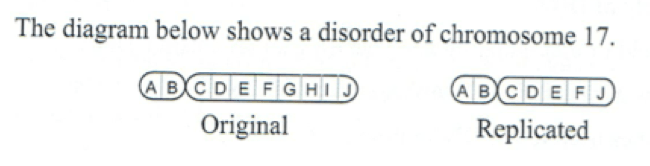
2.
Identify the mutation in the picture.
a)
Inversion
b)
Duplication
c)
Deletion
d)
Translocation
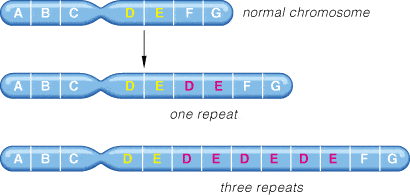
3.
Identify the mutation in the picture.
a)
Deletion
b)
Inversion
c)
Duplication
d)
Translocation
4.
When can a mutation be passed on to offspring?
a)
only when the mutation is present during or occurs during mitosis
b)
only when the mutation is present during or occurs during meiosis
c)
when the mutation occurs during mitosis or meiosis
d)
when the mutation occurs in somatic cells
5.
What type of chromosomal mutation has occurred?
a)
substitution
b)
insertion
c)
deletion
d)
nondisjunction
6.
What process occurs during meiosis that can result in chromosomal disorders?
a)
crossing over
b)
non-disjunction
c)
anaphase I
d)
prophase II
7.
A chromosome is found to be shorter than it's homologous match.  Which type of mutation would this most likely be?
a)
insertion
b)
deletion
c)
translocation
d)
inversion
8.
An example of a mutation where a piece of chromosome breaks off and attaches to another chromosome is called ___.
a)
trisomy
b)
translocation
c)
inversion
d)
deletion
9.

Notice the abnormal 23rd chromosome. This individual has an extra X chromosome. What type of mutation is this?

a)

Translocation

b)

Nondisjunction

c)

Dublication

d)

Inversion

e)

Deletion

10.

Deletion

a)

When a segment of a chromosome breaks off.

b)

When a segment of a chromosome breaks off, flips, and reattaches.

c)

When a segment of a chromosome is copied or doubles.

d)

When a segment of a chromosome breaks and attaches to a non homologous chromosome.

e)

When entire chromosomes don't separate evenly during meiosis.

11.

Inversion

a)

When a segment of a chromosome breaks off.

b)

When a segment of a chromosome breaks off, flips, and reattaches.

c)

When a segment of a chromosome is copied or doubles.

d)

When a segment of a chromosome breaks and attaches to a non homologous chromosome.

e)

When entire chromosomes don't separate evenly during meiosis.

12.

Duplication

a)

When a segment of a chromosome breaks off.

b)

When a segment of a chromosome breaks off, flips, and reattaches.

c)

When a segment of a chromosome is copied or doubles.

d)

When a segment of a chromosome breaks and attaches to a non homologous chromosome.

e)

When entire chromosomes don't separate evenly during meiosis.

13.

Translocation

a)

When a segment of a chromosome breaks off.

b)

When a segment of a chromosome breaks off, flips, and reattaches.

c)

When a segment of a chromosome is copied or doubles.

d)

When a segment of a chromosome breaks and attaches to a non homologous chromosome.

e)

When entire chromosomes don't separate evenly during meiosis.

14.

Nondisjunction

a)

When a segment of a chromosome breaks off.

b)

When a segment of a chromosome breaks off, flips, and reattaches.

c)

When a segment of a chromosome is copied or doubles.

d)

When a segment of a chromosome breaks and attaches to a non homologous chromosome.

e)

When entire chromosomes don't separate evenly during meiosis.

15.

Deletion

a)

A

b)

B

c)

C

d)

D

16.

Translocation

a)

A

b)

B

c)

C

d)

D

17.

Duplication

a)

A

b)

B

c)

C

d)

D

18.

Inversion

a)

A

b)

B

c)

C

d)

D

19.

Duplication

a)

A

b)

B

c)

C

d)

D

e)

E

20.

Inversion

a)

A

b)

B

c)

C

d)

D

e)

E

21.

Translocation

a)

A

b)

B

c)

C

d)

D

e)

E

22.

Deletion

a)

A

b)

B

c)

C

d)

D

23.

Duplication

a)

A

b)

B

c)

C

d)

D

24.

Inversion

a)

A

b)

B

c)

C

d)

D

25.

Translocation

a)

A

b)

B

c)

C

d)

D

26.

How many alleles does a person carry for a trait?

a)

1

b)

2

c)

3

d)

4

27.

How many alleles does a child get from each parent for a trait?

a)

1

b)

2

c)

3

d)

4

28.
What do we use pedigrees for?
a)
To look at families
b)
To make determinations about the offspring
c)
To track traits in families
d)
Nothing
29.

In a pedigree, which shape represents a male?

a)

circle

b)

square

30.

On a pedigree, this symbol represents a ---

a)

not affected female.

b)

not affected male.

c)

affected male.

d)

affected female.

31.

On a pedigree, this symbol represents a ----

a)

not affected male.

b)

not affected female.

c)

affected male.

d)

affected female.

32.

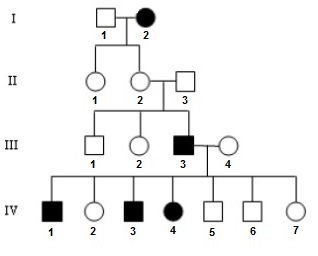
How many individuals are there in the 3rd generation?

a)

1

b)

2

c)

4

d)

6

33.

How are individuals III-2 and II-4 related?

a)

Brother and sister

b)

Dad and daughter

c)

Uncle and niece

d)

Grandfather and granddaughter

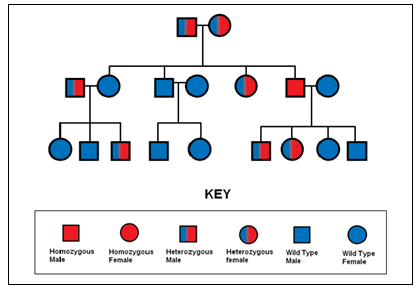
34.

The trait this pedigree traces is recessive because it skips a generation and individuals can be carriers. What is the most likely genotype for person III-3?

a)

GG

b)

Gg

c)

gg

35.
If this pedigree shows an autosomal recessive disorder, what MUST the genotype of individual II-3 be?
a)
HH
b)
Hh
c)
hh
d)
None of the above
36.

If this pedigree shows a recessive disorder, what MUST the genotype of individual 4 be?

a)

HH

b)

Hh

c)

hh

37.
How many kids did the mother and father from the first generation have?
a)
2
b)
4
c)
5
d)
6
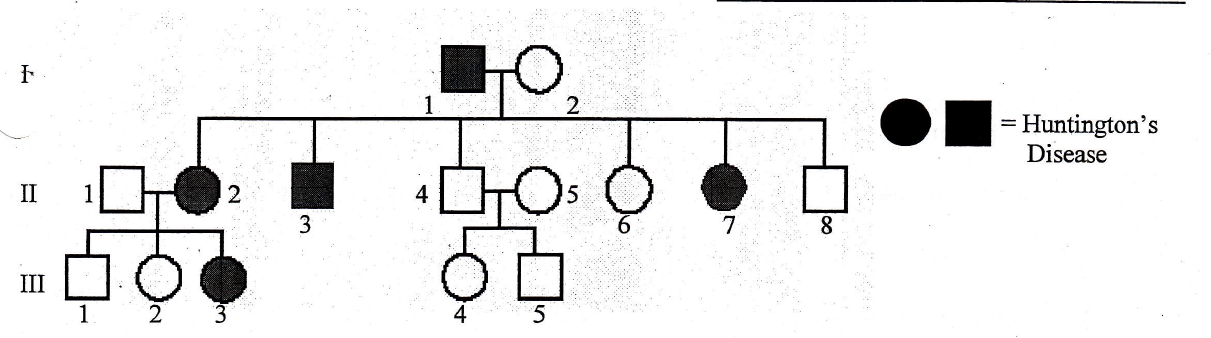
38.
There are no carriers for Huntington's Disease- you either have it or you don't. Is Huntington's disease caused by a dominant or recessive trait?
a)
Dominant
b)
Recessive
39.
How are individuals I-2 and III-5 related?
a)
Grandpa and grandson
b)
Mom and son
c)
Uncle and nephew
d)
Grandma and grandson
40.
This pedigree represents the inheritance of hemophilia in this family. How many of the females have the hemophilia trait?
a)
8
b)
5
c)
2
d)
3
41.
Huntington's Disease is a dominant trait.
What is the correct genotype for individual I-2?
a)
HH
b)
Hh
c)
hh
d)
H_
42.
Does this pedigree show a dominant or recessive trait?
a)
Dominant
b)
Recessive
43.
What is the genotype of the mother?
a)
BB
b)
bb
c)
Bb
d)
BB or Bb
44.
What is the genotype of the father?
a)
AA
b)
aa
c)
Aa
d)
AA or aa
45.

Generation 2 individuals 5 and 6 are

a)

brother and sister.

b)

cousins.

c)

married.

d)

not related.

46.
A red flowered plant (RR) is crossed with a white flowered plant (WW). The gene for petal color in these plants expresses incomplete dominance.  What percentage of the offspring will have pink (RW) flowers?
a)
0%
b)
25%
c)
50%
d)
100%
47.
What type of inheritance do two alleles have if their traits blend together? 
a)
Incomplete Dominance
b)
Co-Dominance
48.
This is an example of ___________?
a)
Incomplete dominance
b)
Co-Dominance
49.

What type of inheritance do two alleles have if their traits blend together?

a)

Incomplete Dominance

b)

Co-Dominance

c)

Mendelian Inheritance (Complete Dominance)

d)

Homozygous Inheritance

50.
This is an example of ___________.
a)
 Incomplete Dominance
b)
 Codominance
51.
A calico cat shows both the traits for orange fur and black fur. What kind of allele expression is this?
a)
Incomplete Dominance
b)
Co dominance
52.
This is an example of ___________.
a)
Incomplete Dominance
b)
Codominance
53.
This type of inheritance pattern is a MIXTURE of both traits.
a)
incomplete dominance
b)
co-dominance
c)
complete dominance
54.
If you cross a black chicken with a white chicken, only checkered chickens would be produced.  What kind of inheritance pattern does this follow?
a)
incomplete Dominance
b)
Co-Dominance
55.
Which type of inheritance causes both traits to be expressed equally in the heterozygote?
a)
Complete Dominance
b)
Incomplete Dominance
c)
Co-Dominance
d)
Sex-linked
56.
In chickens, feather color is codominant.  If a black chicken BB is mated with one that is black and white (BW) what are the chances of having a chicken that is black and white?
a)
50%
b)
0%
c)
25%
d)
100%
57.
In some carnations, flower color exhibits codominance.  Identify the correct genotypes for red, white, and speckled carnations.
a)
Red = RR, white = rr, speckled = Rr
b)
Red = RR, white = WW, speckled = rw
c)
Red = RR, white = ww, Speckled = Rw
d)
Red = RR, white = WW, speckled = RW
58.
Which of the following is a hybrid?
a)
BB
b)
bb
c)
Bb
59.
In Andalusian fowls, black individuals (BB) and white individuals (bb) are homozygous. Heterozygous individuals are grey (Bb).  
Cross a black fowl with a white fowl. What is the phenotype ratio?
a)
4 black: 0 grey: 0 white
b)
2 black: 2 grey: 0 white
c)
0 black: 4 grey: 0 white
d)
0 black: 2 grey: 2 white
60.
In Andalusian fowls, black individuals (BB) and white individuals (bb) are homozygous. Heterozygous individuals are grey (Bb).  
What is the genotype ratio for a cross between a grey fowl and a white fowl?
a)
2 BB: 2 Bb: 0 bb
b)
0 BB: 4 Bb: 0 bb
c)
0 BB: 2 Bb: 2 b
d)
1 BB: 2 Bb: 1 bb
61.
In some carnations, flower color exhibits codominance. When crosses, Red (R) and white (W) flowers make speckled flowers (RW) that show both colors.
Complete a cross between 2 speckled flowers and find the genotype ratio.
a)
0 RR: 4 RW: 0 WW
b)
2 RR: 2 RW: 0 WW
c)
1 RR: 2 RW: 1 WW
d)
0 RR: 2 RW: 2 WW
62.

Name the proteins on the surface of red blood cells.

a)

Antibodies

b)

Antigens

c)

Plasma

d)

Collagen

63.

What type of antigens can be found on the surface of RBC's when someone has blood type O?

a)

A

b)

B

c)

AB

d)

none

64.

What type of antigens can be found on the surface of RBC's when someone has blood type AB?

a)

A

b)

B

c)

AB

d)

none

65.

Where are antibodies located?

a)

surface of red blood cells

b)

surface of white blood cells

c)

plasma

d)

surface of platelets

66.

What antibodies can be found in the plasma when someone has blood type A?

a)

none

b)

A

c)

B

d)

A and B

67.
What type of blood is the universal donor?
a)
O
b)
AB
68.
What is NOT a possible genotype for someone with type B blood?
a)
IBIB
b)
IAIB
c)
IB i
69.
which blood type is the universal donor (all people can receive it)?
a)
O
b)
AB
c)
A
d)
B
70.

Blood type is determined by the antigens present on the surface of RBCs.

a)

True

b)

False

71.

___________ is when both the dominant trait and recessive trait are seen in the phenotype.

a)

Codominance

b)

Punnett squares

c)

Complete dominance

d)

Incomplete dominance

72.

Which of the following is true about blood type O?

a)

It contains antigen A only.

b)

It contains antigen B only.

c)

It contains both antigen A and antigen B.

d)

It doesn’t contain antigen A or antigen B.

73.

In the image above, what is the percentage of the offspring has the possibility of inheriting blood type O?

a)

0%

b)

25%

c)

50%

d)

100%

74.

Which of the following codes for blood type O?

a)

IA IA

b)

IB i

c)

IA IB

d)

ii

75.
Which blood type is the UNIVERSAL DONOR?
a)
O+
b)
O-
c)
AB+
d)
AB-
76.
Which blood type is the universal recipient?
a)
AB+ 
b)
AB-
c)
O+
d)
O-
77.

What inheritance patterns makes the blood type AB possible?

a)

incomplete dominance

b)

multiple alleles

c)

codominance

d)

total dominance

78.

Why are there so many phenotypes for human blood types (what causes there to be more than just 2 phenotypes)?

a)

multiple alleles

b)

incomplete dominance

c)

total dominance

d)

non dominance

79.

If your blood type is Rh + (such as A+) then you have _____ on your red blood cells.

a)

antibodies

b)

Rh antigens

c)

no Rh antigens

d)

multiple alleles

80.

What blood type is this?

a)

A+

b)

B+

c)

AB+

d)

AB-

81.

What ANTIBODIES would this person produce in his/her plasma?

a)

A

b)

B

c)

A and B

d)

no antibodies

82.
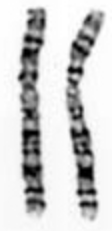
Determine the sex of the individual whose karyotype is displayed in the image.
a)
female
b)
male
83.
Determine the sex of the individual whose karyotype is displayed in the image.
a)
female
b)
male
84.
Which structure is labeled as A in the diagram?
a)
Centromere
b)
Chromosome
c)
Sister chromatids
85.
Which structure is labeled as B in the diagram?
a)
Centromere
b)
Chromosome
c)
Sister chromatids
86.
Which structure is labeled as C in the diagram?
a)
Centromere
b)
Chromosome
c)
Sister chromatids
87.
What is the structure that holds the sister chromatids together called?
a)
homologous chromosome
b)
centromere
c)
chromatid
d)
nondisjunction
88.
When chromosomes fail to separate correctly during anaphase of meiosis, what can occur?
a)
extra chromosomes are found in the sex cell
b)
chromosomes of the sex cell are doubled
c)
chromosomes of the sex cell are halved
d)
meiosis never completes
89.
Nondisjunction can result in 
a)
trisomy conditions
b)
monosomy conditions
c)
additional sex chromosomes
d)
all of these
90.
A pair of identical chromosomes shown in a karyotype, one inherited from mom, and one inherited from dad are called
a)
sister chromotids
b)
centromeres
c)
homologous chromosomes
d)
autosomes
91.
A sperm contains
a)
Both an X and a Y chromosome
b)
Two X chromosomes
c)
An X OR a Y chromosome
d)
only a Y chromosome
92.
An egg contains
a)
22 autosomes and an X chromosome
b)
22 autosomes and an Y chromosome
c)
44 autosomes and 2 X chromosomes
d)
44 autosomes and an X and a Y chromosome
93.
What makes this individual's karyotype not normal?
a)
An extra sex chromosome
b)
An extra autosome
c)
A missing sex chromosome
d)
A missing autosome
94.
What is the sex of this individual?
a)
female
b)
male
95.
What is the sex of this individual?
a)
female
b)
male
96.
What is the sex of this individual?
a)
female
b)
male
97.
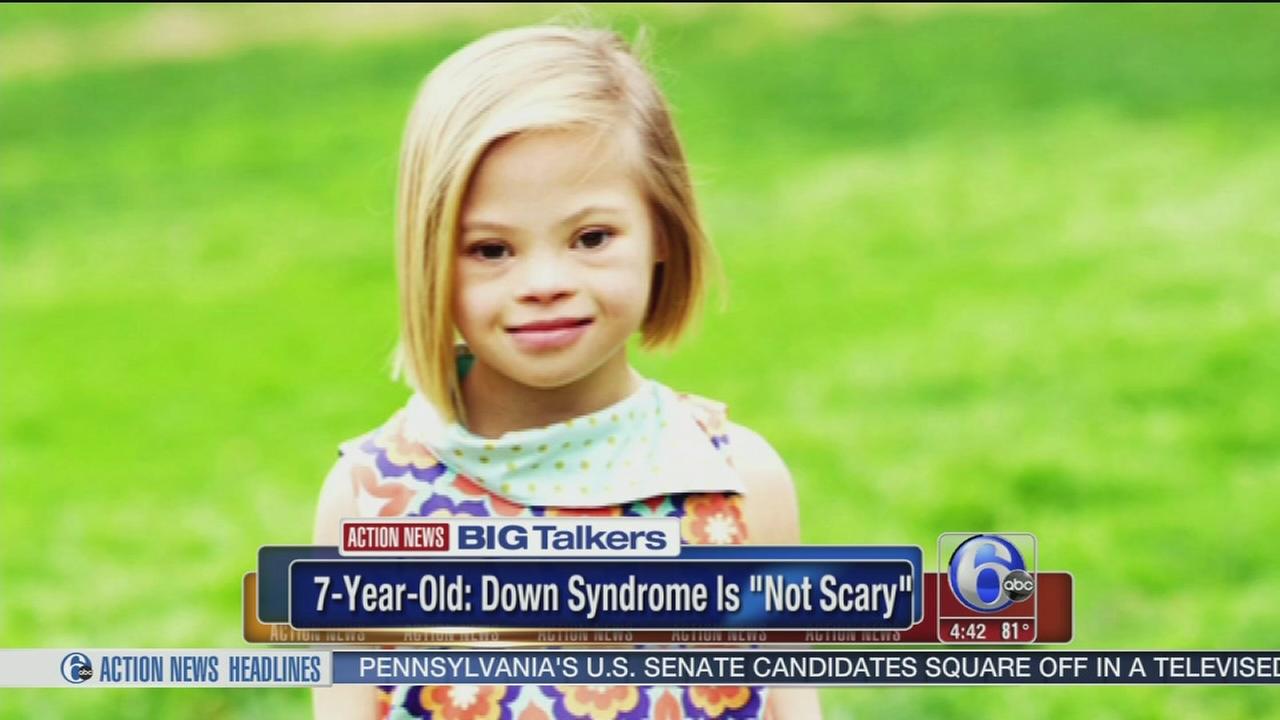
Down's syndrome occurs because of a(n)
a)
missing sex chromosome
b)
extra sex chromosome
c)
additional 21st chromosome
d)
additional 18th chromosome
98.
Turner's Syndrome has a karyotype notation of
a)
47XX+21
b)
47XXY
c)
45XO
d)
44XX
99.
Klinefelter's Syndrome has the karyotype notation of 
a)
47XX+21
b)
47XXY
c)
45XO
d)
44XX
100.
Chromosome pairs 1-22 are referred to as
a)
sex chromosomes
b)
sister chromatids
c)
a karyotype
d)
autsomes
101.
A picture of paired chromosomes is a
a)
sister chromatid
b)
centromere
c)
syndrome
d)
karyotype