wayground logo

Free Printable Worksheets

Font size

S
M
L
XL
Worksheets

AP Bio Chp 16 and 17 DNA replication and protein synthesis

Total questions: 74

Worksheet time: 1hrs 4mins

Name
Class
Date
1.
Which choice describes DNA after replication has taken place?
a)
one molecule with two original strands and one molecule with two new strands
b)
two molecules, each with one original and one new strand
c)
two molecules, each with two new strands
d)
 two molecules, each with two old strands
2.
The sequence of DNA below is part of a gene. How many amino acids are coded for by this segment? 
a)
4
b)
8
c)
12
d)
20
3.
Which of the following would most likely cause a mutation?
a)
 the placement of ribosomes on the endoplasmic reticulum
b)
the insertion of a nucleotide into DNA
c)
the movement of transfer RNA out of the nucleus
d)
 the release of messenger RNA from DNA
4.
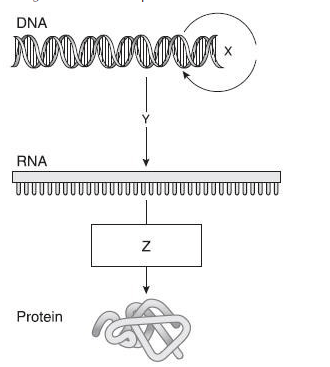
 A diagram of a cellular process is shown below. Which of the following identifies the process shown at point Z?
a)
Translation
b)
Translocation
c)
Replication
d)
Transcription
5.
Which of the following carries amino acids to the site of protein synthesis? 
a)
mRNA
b)
rRNA
c)
tRNA
d)
nRNA
6.
Base your answer to the following question on the structures represented in the diagram below. What is the relationship between these three structures?
a)
 DNA is made up of proteins that are synthesized in the cell.
b)
Protein is composed of DNA that is stored in the cell.
c)
DNA controls the production of protein in the cell.
d)
 The cell is composed only of DNA and protein.
7.
Genes for medically important proteins can be cloned and inserted into bacteria, as shown in the diagram below. Why can bacteria recognize a human gene and then produce a human protein?
a)
 DNA replication in bacteria and humans is the same.
b)
. Bacterial cells contain the same organelles as human cells. 
c)
The basic components of DNA are the same in humans and bacteria.
d)
Bacterial cells and human cells contain the same kind of chromosomes.
8.
The molecule represented is found in living things. Which statement describes one characteristic of this molecule?
a)
It is the template for the replication of genetic information
b)
Organic catalysts are made up of these molecules
c)

It is different in each cell of an organism
d)
Cell membranes contain many of these molecules.
9.
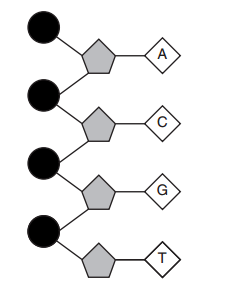
The diagram below represents a portion of a DNA molecule. The letters represent different types of 
a)
sugar molecules
b)
nitrogen bases
c)
enzymes
d)
proteins
10.

A molecule that stores genetic information

a)

DNA

b)

RNA

11.

The codon that signals the start of translation (AUG)

a)

codon

b)

start codon

c)

anticodon

d)

stop codon

12.

Units or monomers that make up DNA. They have three parts, a phosphate group, a nitrogenous base, and a sugar.

a)

nitrogen bases

b)

double helix

c)

nucleotide

d)

ATCG

13.

A group of three nucleotides that code for an amino acid

a)

anticodon

b)

stop codon

c)

codon

d)

start codon

14.

RNA turns into protein...The process that reads an mRNA message and turns it into a polypeptide

a)

replication

b)

translation

c)

transcription

d)

central dogma

15.

A compound containing one phosphorus and four oxygen atoms. It helps make up the backbone of DNA.

a)

central dogma

b)

RNA

c)

nucleotides

d)

phosphate group

16.

An RNA molecule that transfers amino acids in the cytoplasm to the growing polypeptide.

a)

rRNA

b)

mRNA

c)

tRNA

d)

RNA

17.

A 5-carbon ring shaped sugar molecule that also helps make the backbone of DNA

a)

phosphate

b)

deoxyribose

c)

ribose

d)

DNA polymerase

18.

An RNA molecule that forms part of a ribosome.

a)

mRNA

b)

rRNA

c)

tRNA

d)

RNA

19.

A single or double ring molecule built primarily of nitrogen and carbon. It connects to to deoxyribose and helps form the "rungs" of the DNA ladder

a)

nitrogen bases

b)

phosporous

c)

deoxyribose

20.

An RNA molecule that carries a message, which later gets translated into a protein

a)

RNA

b)

mRNA

c)

rRNA

d)

tRNA

21.

TWO stands of DNA wrapped around each other like a twisted ladder.

a)

double helix

b)

central dogma

c)

deoxyribose

d)

transcription

22.

The enzyme that helps with transcription.

a)

DNA polymerase

b)

RNA polymerase

23.

Two scientists credited for defining the shape of DNA which would help us understand how DNA passes on genetic information.

a)

Hershey and Chase

b)

Watson and Crick

c)

Baby Ruth and Fitzgerald

24.

A bonds to T and C bonds to G.

a)

nucleotides

b)

ATCG

c)

nitrogen bases

d)

Chargaff's Base pairing rules

25.

Ribonucleic acid

a)

DNA

b)

RNA

26.

DNA makes DNA... the process where a cell uses both strands of DNA to make a copy of DNA. This occurs in the nucleus

a)

replication

b)

transcription

c)

translation

d)

central dogma

27.

An enzyme that bonds nucleotides together

a)

RNA polymerases

b)

DNA polymerase

28.

A description of how DNA is used to make proteins.

a)

replication

b)

central dogma

c)

transcription

d)

translation

29.

A mutation that occurs when a single nucleotide is added or deleted.

a)

point mutation

b)

frameshift mutation

c)

substitution

30.

The complement to an mRNA codon, and it is attached to a tRNA molecule.

a)

anticodon

b)

codon

c)

stop codon

d)

start codon

31.

The codon that signals the end of an amino acid chain

a)

start codon

b)

codon

c)

stop codon

d)

anticodon

32.

A type of mutation that occurs if a nucleotide is changed. (substitution)

a)

frameshift mutation

b)

point mutation

c)

insertion

d)

deletion

33.

DNA makes RNA... the process of copying a sequence of DNA to produce a complementary strand of RNA.

a)

replication

b)

trascription

c)

translation

d)

central dogma

34.
At what point in the cell cycle does DNA replication occur and why?
a)

during M phase

b)

during S phase

c)

during G0 phase

d)

during G1 phase

35.
Which 2 molecules forms the sides (backbone) of the DNA ladder?
a)
deoxyribose and adenine
b)
deoxyribose and a hydrogen bond
c)
sugar and the nucleus
d)
deoxyribose (sugar) and phosphate
36.
Which sequence of DNA bases would pair with this partial strand
ATG TGA CAG
a)
ATG TGA CAG
b)
TAC ACT GTC
c)
GTA AGT GAC
d)
CAT TCA CTG
37.
The two strands of DNA run in opposite directions. This is called
a)
Double helix
b)
Anti parallel
c)
Anti perpendicular
d)
double stranded
38.
Name this structure
a)
double helix
b)
nucelotide
c)
twisted ladder
d)
hydrogen bond
39.
Which enzyme seals okazaki fragments together on the lagging strand?
a)
Topoisomerase
b)
Helicase
c)
Polymerase
d)
Ligase
40.

This enzyme is capable of breaking Hydrogen bonds found between the bases of DNA

a)

Topoisomerase

b)

DNA Helicase

c)

DNA Polymerase

d)

Exonuclease

41.

The separation of the two single strands of DNA creates a ‘Y’ shape?

a)

enzyme

b)

unzip

c)

A replication fork

42.

This enzyme helps helicase unzip DNA by relieving supercoiling

a)

Topoisomerase

b)

Exonuclease

c)

DNA Primase

d)

DNA Polymerase

43.

This enzyme is responsible for creating telomeres added to the ends of DNA

a)

Topoisomerase

b)

Telomerase

c)

DNA Helicase

d)

DNA Primase

44.

The strands in a DNA molecule are:

a)

held together by hydrogen bonds between base pairs

b)

antiparallel

c)

parallel

d)

complementary

e)

made of proteins

45.

On the leading strand, DNA is:

a)

not copied

b)

copied continuously

c)

copied backwards in pieces

d)

discarded

46.

What are Okazaki fragments?

a)

pieces of new DNA forming on the lagging strand

b)

pieces of new DNA forming on that leading strand

c)

pieces of DNA that are discarded

d)

pieces of RNA that serve as primers

47.

DNA can only be copied in the:

a)

eukaryotic cell

b)

5' to 3' direction

c)

3' to 5' direction

d)

reverse order

48.

Which enzyme is responsible for adding nucleotides?

a)

Ligase

b)

Helicase

c)

DNA polymerase I

d)

DNA polymerase III

49.

Which type of cells actively produce telomerase?

a)

cancer cell

b)

somatic cell

50.

Nitrogenous bases are held together by ______________ bonds.

a)

carbon

b)

hydrogen

c)

phosphate

d)

nitrogen

51.
synthesizes a short fragment of RNA that allows DNA polymerase III to bind
a)
ligase
b)
DNA polymerase I
c)
primase
d)
helicase
52.
removes the RNA primer and adds DNA nucleotides to fill in the gap
a)
DNA polymerase III
b)
ligase
c)
primase
d)
DNA polymerase I
53.
repetitive sequences of DNA on the ends of chromosomes (TTAGGG)
a)
telomeres
b)
telomerase
c)
Okazaki fragments
d)
primer
54.
Experiment that radioactively labeled the proteins and DNA of bacteriophages to determine if DNA or protein was the transforming agent
a)
Avery
b)
Watson & Crick
c)
Messelson & Stahl
d)
Hershey & Chase
55.
The table shows the results of measuring the percentages of the four bases in the DNA of several different organisms. Some of the values are missing from the table. Based on Chargaff’s rule, the percentages of guanine bases in chicken DNA should be approximately what?
a)
28.8%
b)
19.9%
c)
21.5%
d)
13.4%
56.
Based on Chargaff’s rule, the percentage of cytosine in the DNA of the bacterium, S. lutea in the table, should be approximately what?
a)
26.6%.
b)
73.2%.
c)
36.6%.
d)
29.4%.
57.

The region of DNA tightly packed in which no gene expression can occur is called

a)

nucleosome

b)

chromatid

c)

euchromatin

d)

heterochromatin

58.

a region of DNA that is uncoiled and undergoing gene expression

a)

genome

b)

euchromatin

c)

lac operon

d)

pre-mRNA

59.

Wrapping of charged DNA around a histone is called

a)

Nucleosome

b)

Chromatin

c)

Chromosome

d)

Histone

60.

A nitrogenous base that has a double-ring structure; one of the general categories of nitrogenous bases found in DNA or RNA; either adenine or guanine

a)

purine

b)

nucleotide

c)

pyrimidine

d)

trascription

61.

a nitrogenous base that has a single ring structure; one of the the two general categories of nitrogenous bases found in DNA or RNA; thymine, cytosine, or uracil

a)

purine

b)

pyrimidine

c)

translation

d)

transcription

62.

The base shown on the left side of the diagram is a _____________ and is most likely _______________.

a)

Purine, cytosine

b)

Purine, Guanine

c)

Pyrimidine, Thymine

d)

Pyrimidine, Adenine

63.
What is meant by the description "antiparallel" regarding the strands that make up DNA?
a)
The twisting nature of DNA creates nonparallel strands.
b)
One strand is positively charged and the other is negatively charged.
c)
The 5' to 3' direction of one strand runs counter to the 5' to 3' direction of the other strand.
d)
Base pairings create unequal spacing between the two DNA strands
64.

Which protein binds to each unzipped strand to keep DNA strands from forming a double helix?

a)

Toipoisomerase

b)

Single-Strand Binding Protein

c)

Helicase

d)

sspb

65.

Who used x-rays to figure out the structure of DNA?

a)

Rosalind Franklin

b)

Oswald Avery

c)

A$AP Rocky

d)

Alfred Hershey

66.

Who worked along side Rosalind Franklin?

a)

James Watson

b)

Erwin Chargaff

c)

Oswald Avery

d)

Maurice Walkins

67.
From his work with mice and pneumonia-causing bacteria, Frederick Griffith discovered what?
a)
Replication
b)
Transcription
c)
Transformation
d)
Translation
68.
By using radioactive isotopes, Hershey and Chase were able to conclude that _____ is the carrier of genetic information.
a)
DNA
b)
Protein
c)
Carbohydrate
d)
Lipid
69.
What is the complement to the DNA strand below:
5'-ATGCCAT-3'
a)
5'-TACGGTA-3'
b)
3'-TACGGTA-5'
c)
3'-ATGGCAT-5'
d)
5'-ATGGCAT-3'
70.
The enzyme that removes RNA Primers and fills in the gaps with DNA Nucleotides is
a)
DNA Polymerase III
b)
DNA Polymerase I
c)
DNA Polymerase II
d)
Primase
71.
Which of the following statements is true?
a)
DNA is single-stranded
b)
RNA is single-stranded
c)
DNA contains uracil
d)
RNA contains deoxyribose
72.
What is the difference between DNA and RNA in terms of bases?
a)
RNA contains uracil in place of thymine
b)
RNA contains uracil in place of adenine
c)
RNA contains uracil in place of guanine
d)
RNA contains uracil in place of  cytosine
73.
I travel outside of the nucleus.
a)
DNA
b)
RNA
74.

What type of nucleotide is added to the growing DNA chain?

a)

nucleotide monophosphates

b)

nucleotide diphosphates

c)

nucleotide triphosphates

d)

Double stranded nucleotides