
 Worksheets
Ecology Review Game
Total questions: 123
Worksheet time: 2hrs 3mins
The high level of pesticide in birds of prey is an example of
the principle of exclusion
cycling of nutrients
exponential grown
biological magnification
Which of the following best explains why there are usually no more than five trophic levels in a food chain
there are not enough organisms to fill more than five levels
there is too much competition among the organsims at the lower levels to support high levels
the statement is not true: there can be unlimited trophic levels
energy is lost at each trophic level
Which of the following is not an abiotic factor
air
water
decomposers
temperature
which of the following encompasses all the others
ecosystem
community
population
individual

Which best describes K-strategist
A
B
C
none

Which best describes an organism that fertilizes externally?
a
b
c
none

Which curve best describes an organism that invests a lot of energy into caring for their offspring?
a
b
c
none
a species described as r-strategist would definitely NOT have which of the following characteristics
clumped population pattern
much parenting
many offpsring
random population pattern
which of the following is a density independent factor limiting human population growth?
famine
disease
competition
naturally occurring fires
What would most likely be the cause of bushes of one species growing in one area in a uniform spacing pattern.
random distribution of seeds
interactions among individuals in the population
chance
varied nutrient supplies in that area
Animals from 2 different species utilize the same source of nutrition in one area. It is most accurate to say that the animals
will learn to get along
will compete for food
will die
will learn to eat different food
Two animals live together in close association. One benefits, while the other is unaware of the first animal. The relationship is best described as
parasitism
mutualism
commensalism
predation
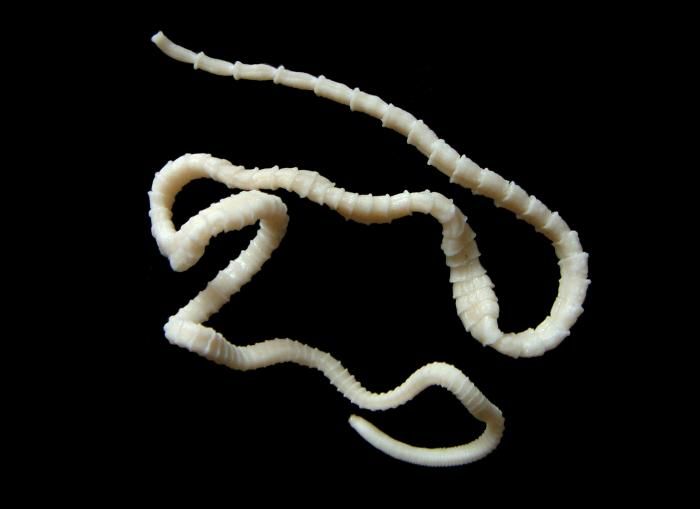
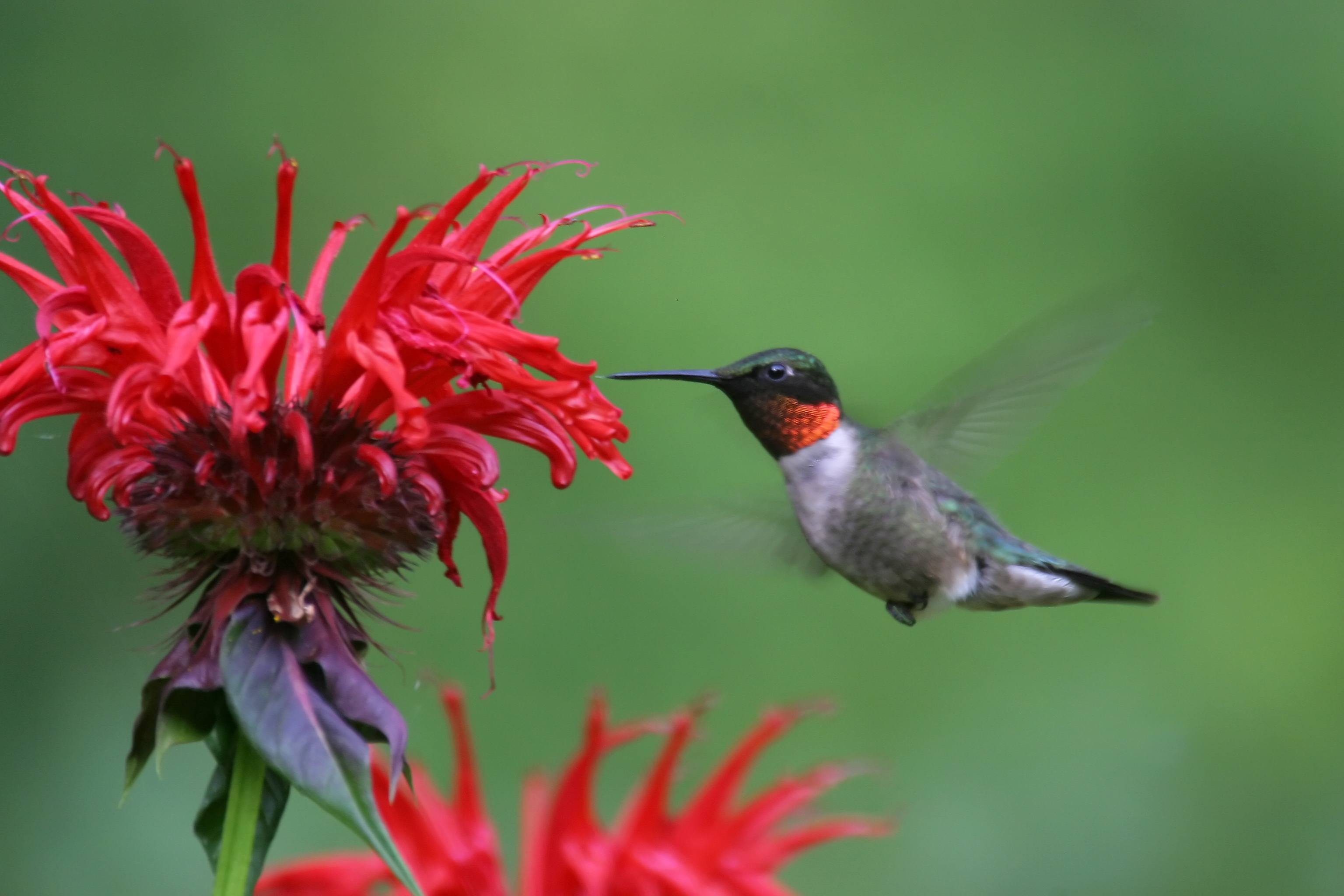
Type of symbiosis: Hummingbirds feed on nectar from flowers. The flowers are pollinated by hummingbirds as they move from flower to flower.
commensalism
mutualism
parasitism
predation
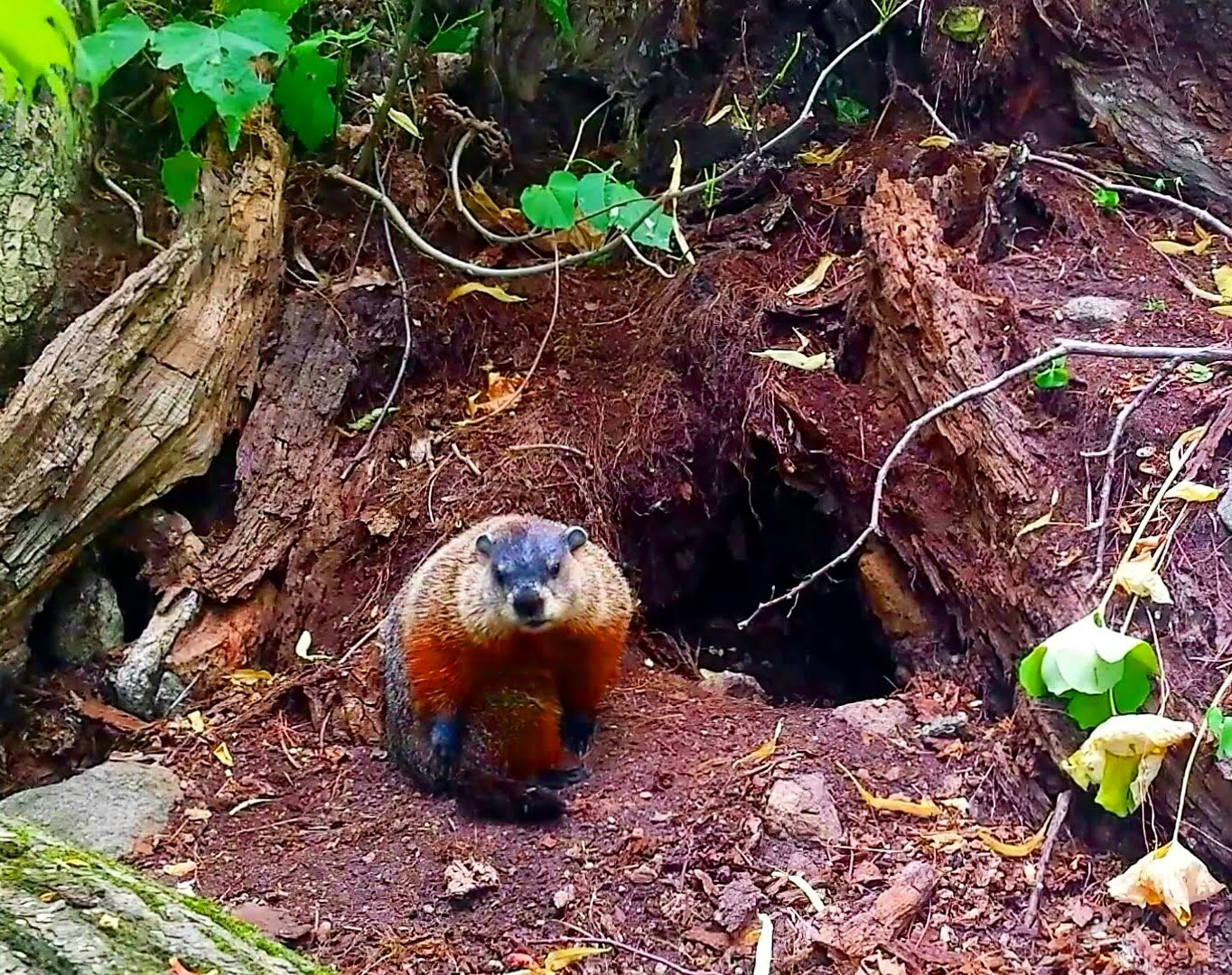
Type of symbiosis: Skunks often live in burrows that have been dug and abandoned by woodchucks.
commensalism
mutualism
parasitism
predation

What level of ecological organization would include all squirrels that live in the same area?
biome
community
ecosystem
population
The black rhinoceros is a mammal found in Africa. Weighing in at up to 1,350 kg, these rhinos can live roughly 35 years. Gestation in the black rhino lasts for 15-16 months, with calves staying under the mother’s parental care for up to four years.
Black rhinos have been hunted extensively by humans for their horns. Poaching pressure has reduced the black rhino population to an endangered level. Ongoing efforts are attempting to save the animal from extinction.
How can the black rhino survivorship strategy be categorized?
K-selection, type I
K-selection, type III
r-selection, type I
r-selection, type III
In 1976, the dominant finch on Daphne Major in the Galapagos Islands was the medium ground finch, with a population of 1,200. In 1977, a drought struck the island negatively affecting most of the vegetation. As a result, the population of medium ground finch dropped to 180 due to starvation. In 1983, however, a large amount of rainfall fell on the island creating optimal conditions for vegetation. The medium ground finch population increased to 1,100. What type of factor affected medium ground finch populations in 1977 and 1983?
Density independent
Logistic
Density dependent
Biotic
In 1976, the dominant finch on Daphne Major in the Galapagos Islands was the medium ground finch, with a population of 1,200. In 1977, a drought struck the island negatively affecting most of the vegetation. As a result, the population of medium ground finch dropped to 180 due to starvation. In 1983, however, a large amount of rainfall fell on the island creating optimal conditions for vegetation. The medium ground finch population increased to 1,100. After the rainfall of 1983, what type of population growth did the medium ground finch experience?
Logistic
Quantitative
Exponential
Abiotic
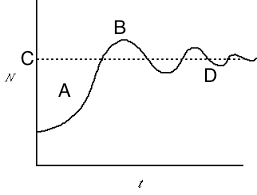
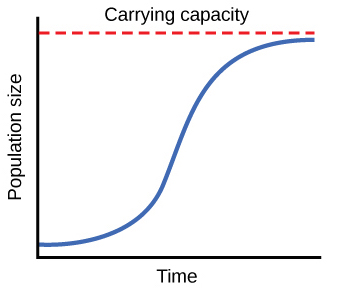
A certain population of mice is growing exponentially. The growth rate of the population (r) is 2.0 and the current population size (N) is 2,500 individuals. How many mice are added to the population each year?
1250
2500
500
5000
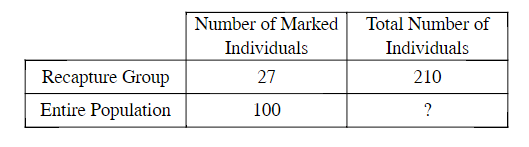
Researchers used the mark-recapture method to estimate the number of individuals in a population. Using the results presented in the table below, estimate the total number of individuals in the population. Give your answer to the nearest whole number.
500
665
778
889
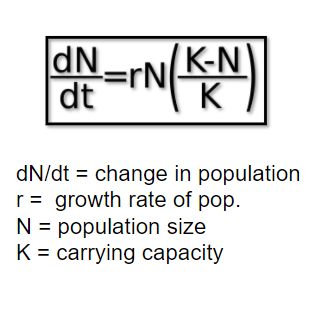
If a population has a carrying capacity (K) of 1000, and the growth rate (r) is 1.1, what is the population growth when the population (N) is 500?
147
227
337
1124

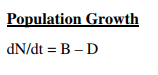
There are 300 falcons living in a certain forest at the beginning of 2013. Suppose that every year there are 50 falcons born and 30 falcons that die.
What is the population growth rate (include units)? Interpret the value.
100
50
20
10
Ecology is the scientific study of organism's ______ and their __________.
Interactions and environment
habitat and food-webs
Trophic levels and environment
Interactions and species

Which of the following statements best describes carrying capacity (K)?


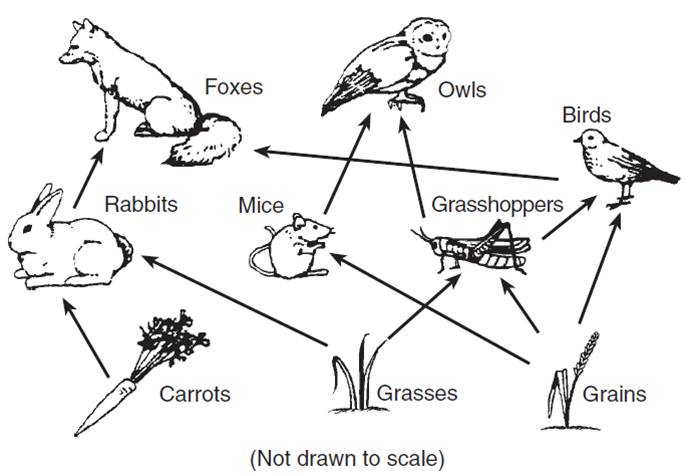

Where is energy converted from light energy to chemical energy
rabbits
snakes
eagle
grass
Only a small amount of the energy consumed by an organism is available to flow to the next organism in a food web. Which of the following statements explains the reason for this?
Most of the energy is used for life processes.
Primary and secondary consumers compete for food
There are many more producers than consumers in a food web.
There are many more consumers than producers in a food web.
In which trophic pyramid are the organisms correctly displayed?


Which organisms compete for food?
hawk, lynx, and fox
hawk, lynx, and willow
hawk, shrew, and willow
hawk, insect, and willow
Which of these is a threat to the survival of an ecosystem?
predator-prey population cycles
less biomass at higher levels of the food web
a shrinking variety of animal and plant species
competition among some consumer populations

Clownfish, sea anemone, coral, sea urchins, sponges and parrot fish are just a few examples of the large variety of organisms that can be found in a coral reef.
The coral reef and its inhabitants are suffering due to several factors such as pollution. coastal development and destructive fishing practices.
What would be the most likely result if some of the species in the coral reef are destroyed?
Other organisms would move into the coral reef area.
The coral reef would be allowed to expand without so many fish and plants living in and around it.
The waters surrounding the coral reef will become cool with the decreasing number of organisms living there.
The coral reef would begin to deteriorate and decrease without the variety of fish and plants needed to maintain stability.
Which of these explains why an ecosystem is healthy when it has a variety of species?
An increased number of species allows for fewer food chains.
A larger number of species reduces competition for abiotic resources.
A larger number of species allows for greater diversity in interdependence.
A larger number of species allows for less diversity in interdependence.
Over a long period of time, some flowering plants have become dependent on nectar wasp to fertilize their seeds. In recent years, a form of mite has infected and killed nectar wasps in many areas of the country.
Since this has happened, the plants that are dependent on nectar wasps for pollination will have the best chance of surviving if
they grow taller so that the few remaining nectar wasps will find them
they change their flowers so that the wind will fertilize them
they have always attracted many other insects as well as nectar wasps
they have seeds that stay alive for a long time in the environment
Which of the following is most likely to cause a change in the genetic traits in an isolated population of a ground-dwelling lizard species?
The exposure of an individual lizard in the population to radiation that causes a mutation that is not passed on to its offspring, but gives it ninja powers and cravings for pizza.
An unusually dry summer in the lizard population’s ecosystem.
The introduction of an invasive predator that preys on the brightest colored-individuals in the lizard population.
A fast-moving wildfire that burns the canopy of the trees in the lizard population’s ecosystem.

What type of distribution is this?
Uniform
Random
Clumped
Why does increasing producers increase the populations of all trophic levels?
Producers increase the size of a habitat
Producers help keep predator populations in check
With more energy available the carrying capacity increases
Producers do not have a large impact on population sizes
What types of organisms are producers?
autotrophs
apex predators
heterotrophs
keystone species
What are limiting factors?
The maximum number of organisms an area can sustain
Scarce resources that limit the size of a population
Conditions that limit how much energy flows to the next trophic level
How diverse the populations of a community are
If the producer level of an ecosystem has 750,000 J of energy, how much energy would be passed on to the secondary consumers?
75,000 J
7,500 J
750 J
75 J
What type of graph represents exponential population growth?
A fluctuating graph
W - shaped curve
S-shaped curve
J - shaped curve
Frogs lay ~4000 eggs at a time. Based on this frogs would be classified as -
R-strategists
K-strategists
The carrying capacity for a population of lizards is 2700. If the current population is 1340 and the rmax for the population was found to be 0.83, what would the population size be after 1 year?
2356
2100
1825
1900
There is a population of 75 wolves in a forest that has a carrying capacity of 120. What is the maximum population growth rate if the population grows to 92 in one year?
0.833
1.00
0.604
0.523
How does competition affect population?
Most populations do not have competition
It maximizes the carrying capacity of an ecosystem
It limits population sizes and drives natural selection
It benefits both species and increases their populations
How do ecosystems obtain energy in environments that have no light?
Through chemosynthetic organisms
Without light the organisms will need to move or they may go extinct
Through photosynthetic organisms
All ecosystems have some light
Why are decomposers necessary in ecosystems?
They recycle essential nutrients back down to producers
They enrich soil with nitrogen
They help keep ecosystems clean
All of the above
Why does high biodiversity increase ecosystem stability?
Ecosystems do best when populations are as large as possible
High biodiversity increases the carrying capacity of an ecosystem
More diversity increases the chances that organisms can survive changes to an ecosystem
Ecosystems are most stable when biodiversity is low
How do invasive species impact ecosystems?
The increase density dependent limiting factors
They establish themselves as new keystone species in an area
The open up new niches in the ecosystem
They outcompete native species and overpopulate the area
What are keystone species?
Non-native species that have adapted to a new environment
Species that have disproportionate effects on ecosystem stability
The first species to return to an area after a natural disaster
Organisms that can collapse an ecosystem if they overpopulate an area


Which is correct about the effect of pesticides sprayed on a large area of land on biomass accumulation of the pesticides?
The two species, Paramecium aurelia and Paramecium caudatum, which do not prey upon each other, fighting to grow in the same test tube is an example of which of the following?

What is the rate of change for the population grown without a parasite from day 200 to day 400?
200 days
a loss of approximately 15 beetles/200 days
a loss of approximately 30 beetles/200 days
30 beetles
Species richness is the measure of the number of different species living in an ecosystem. Which of the following would be indicated by species richness?
dispersal patterns
amount of biodiversity
density of a population
level of productivity exhibited within the ecosystem
In most ecosystems, net primary productivity is important because it represents the
Energy used in respiration by herbivores
Total solar energy converted to chemical energy by producers
Biomass for all producers
Energy available for trophic levels above producers
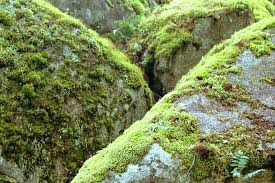

What is the most important function of pioneer species?
To function as decomposers
To create soil and add nutrients
Facilitation of the water cycle
Food for animals


A plant species produces a chemical that is toxic to herbivores. Over time, herbivores that can detoxify the chemical increase in frequency. A mutation in the plant produces a new, different toxic chemical that the herbivores cannot detoxify. This is an example of
a mutualism
resource partitioning
coevolution
commensalism


A rabbit would show _______ survivorship.
Type 1
Type 2
Type 3

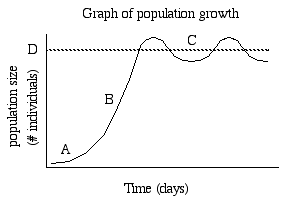
This graph has an S shape. What type of growth does this represent?
Exponential
Logistic


Which organism do the owl and the weasel compete for in the food web?
Hawk
Spider
Grasshopper
Shrew
Which of the following examples demonstrate an ecological effect leading to an evolutionary effect?
When seeds are not plentiful, trees produce more seeds.
A few individuals with denser fur survive the coldest years of an ice age, and the offspring of the reproducing survivors of the ice age will likely have more dense fur.
Fish that swim the fastest in running water catch the most prey and more easily escape predation.
The insects that spend the most time exposed to sunlight have the most mutations from UV light, and thus evolve the fastest
The oceans affect the biosphere in all of the following ways EXCEPT
producing a substantial amount of the biosphere's oxygen.
removing carbon dioxide from the atmosphere.
moderating the climate of terrestrial biomes.
regulating the pH of freshwater biomes and terrestrial groundwater.
To measure the population of lake trout in a 250-hectare lake, 400 individual trout were netted and marked with a fin clip, then returned to the lake. The next week, the lake was netted again, and out of the 200 lake trout that were caught, 50 had fin clips. Using the mark-recapture estimate, the lake trout population size could be closest to which of the following?
200
400
1,600
80,000
As N approaches K for a certain population, which of the following outcomes is predicted by the logistic equation?
The population growth rate will not change.
The population growth rate will approach zero.
The population size will increase exponentially.
The carrying capacity of the environment will increase.
Which of the following causes populations to shift most quickly from an exponential to a logistic population growth?
favorable climatic conditions
removal of predators
decreased death rate
competition for resources
The symbols +, -, and 0 are to be used to show the results of interactions between individuals and groups of individuals. The symbol + denotes a positive interaction, - denotes a negative interaction, and 0 denotes where individuals are not affected by interacting. The first symbol refers to the first organism mentioned.
What interactions exist between mycorrhizae (type of fungi) and evergreen tree roots?
+/+
+/0
+/-
0/0

Use the graph to answer the following question.
What does the graph tell you about the effect of a keystone species?
A keystone species has little interaction with other species in an environment.
Removing a keystone species from the community drastically reduces species richness.
Adding a keystone species to the community will make it more diverse.
Removing a keystone species from the community will eventually allow for the invasion of a new species.

Use the figure to answer the following question.
In the figure, species A through F are found among four communities, with the number of circles representing their abundance.
Which community has the highest species richness but does not have the highest diversity overall because of the relative abundance of the different species?
Community 1
Community 2
Community 1 and community 3 have the highest species diversity.
Community 4
Which of the following statements is a likely explanation for why invasive species take over communities into which they have been introduced?
Invasive species are less efficient than native species in competing for the limited resources of the environment.
Invasive species are not held in check by the predators and agents of disease that have always been in place for native species.
Invasive species have a higher reproductive potential than native species.
Invasive species come from geographically isolated regions, so when they are introduced to regions where there is more competition, they thrive.

In the figure, what could the jagged arrow leaving microorganisms and other detritivores represent?
organic compounds broken down by bacteria
energy consumed by bacteria
energy lost from a worm during cellular respiration
CO2 and heat loss from decomposing materials due to the effects of solar radiation and precipitation
To recycle nutrients, an ecosystem must have, at a minimum, ________.
producers
producers and decomposers
producers, primary consumers, and decomposers
producers, primary consumers, secondary consumers, and decomposers
Consider the food chain of grass ® grasshopper ® mouse ® snake ® hawk. About how much of the chemical energy fixed by photosynthesis of the grass (100 percent) is available to the hawk?
0.01%
0.1%
1%
10%
In a population of 100 individuals, 20 individuals are born and there are 5 deaths. What is the r value?
Recall: r = per capita growth rate of population
.05
.15
.20
.25
Which of the following describes the relationship of the mistletoe that gains resources and harms the mesquite tree that it grows on?
parasitism
commensalism
mutualism
predator/prey

Two species of paramecia are grown separately and together. Pick the best supported claim.
P. caudatum and P. aurelia engage in mutualistic interactions
P. caudatum and P. aurelia occupy the same ecological niche
P. caudatum is fitter than P. aurelia
P. aurelia parasitizes P. caudatum

Choose the best response.
This is an example of primary succession
Shrubs contribute to quantity and quality of soil, allowing for the colonization of the area by pine trees
Annual plants have evolved into hardwood trees
The changing community of plants will have no effect on the animal community

