wayground logo

Free Printable Worksheets

Font size

S
M
L
XL
Worksheets

Biology Review

Total questions: 76

Worksheet time: 3570secs

Name
Class
Date
1.

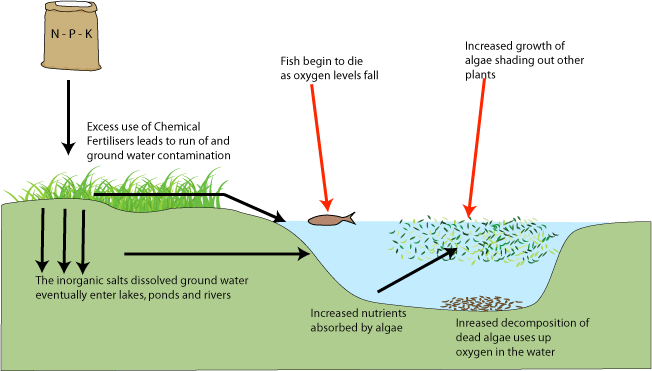
What is the very next thing that happens after fertilisers enter a river in eutrophication?

a)

Fish die due to a lack of oxygen

b)

Plants below the surface die due to a lack of sunlight

c)

The number of aerobic bacteria increases

d)

Fast growth of plants

2.

An increase in the amount of nutrients in a lake is known as

a)

calcification

b)

cellular respiration

c)

eutrophication

d)

photosynthesis

3.

The size of hypoxic/dead zones will ________ with more nitrogen run-off.

a)

Increase

b)

Stay the same

c)

Decrease

4.

In a dead zone, _________ levels are really low such that living organisms are not able survive.

a)

nitrogen

b)

oxygen

c)

fertilizer

d)

carbon dioxide

5.

What are the components of blood?

a)

white blood cells

b)

red blood cells

c)

platelets

d)

plasma

6.

What are the 4 major blood types?

a)

Blood type A

b)

Blood type B

c)

Blood type C

d)

Blood type AB

e)

Blood type O

7.

What type of antigens can be found on the surface of RBC's when someone has blood type O?

a)

A

b)

B

c)

AB

d)

none

8.
An individual's blood type is determined by
a)
environment
b)
genetics
c)
both environment and genetics
d)
your children's blood type
9.
In pea plants, the tall allele is dominant to the short allele. What key would demonstrate this?
a)
Tall = T
Short = S
b)
Tall = T
Short = t
c)
Tall = t
Short = T
d)
Tall = TT
Short = tt
10.
What should students use to identify the percent chance of a trait being passed down from a parent to its offspring?
a)
a graph
b)
a flow chart
c)
a data table
d)
a Punnett square
11.
What are the possible combinations of a pea plant with the alleles PP and a male pea plant with the alleles pp.
P= purple
p= white
a)
all Pp
b)
all PP
c)
Pp,PP,Pp,PP
d)
all pp
12.
Homozygous is when...
a)
the alleles are the same
b)
the alleles are different
c)
the alleles are absent
d)
the alleles are present
13.
B = brown fur  b = white fur
In the punnett square, what is the probability for white fur? 
a)
0%
b)
25%
c)
50%
d)
75%
14.
In natural selection, the selective agent is the
a)
humans
b)
mutations
c)
breeders
d)
environment
15.
This scientist came up with the idea of natural selection.
a)
Jean Baptiste Lamarck
b)
Gregor Mendel
c)
Charles Darwin
d)
Thomas Malthus
16.
Inherited trait that helps an organism survive is a(n) __________.
a)
Fossil
b)
Adaptation
c)
Ancestor
d)
Natural selection
17.

What do we call a change in a species over time?

a)

Adaptation

b)

Evolution

c)

Extinction

d)

Environmental influences

18.

Select the example of an antibiotic.

a)

vaccine

b)

pathogen

c)

penicillin

d)

antibody

19.

Select the disease which can be treated with antibiotics.

a)

Cold

b)

Influenza

c)

COVID 19

d)

Bacterial infection

20.

What can we do to reduce the rate of development of antibiotic resistant strains of bacteria

a)

Always finish a course of antibiotics

b)

Only take antibiotics when they are really needed

c)

Take antibiotics whenever it is possible

d)

Reduce the amount of antibiotics given to animals in the farming industry

21.
The flu is caused by
a)
bacteria
b)
virus
22.
Viruses are the smallest disease-causing organisms.  Fact or Fiction
a)
Fact
b)
Fiction
23.
A doctor would most likely prescribe an antibiotic to treat what type of pathogen?
a)
Fungi
b)
Helminth
c)
Virus
d)
Bacteria
24.
The ________ is the first line of defense.
a)
eyes
b)
stomach
c)
t-cells
d)
skin
25.
What are the products of photosynthesis?
a)
water and carbon dioxide
b)
oxygen and glucose
c)
oxygen and carbon dioxide
d)
oxygen and water
26.
Which gas is removed from the atmosphere during photosynthesis?
a)
hydrogen
b)
oxygen
c)
nitrogen
d)
carbon dioxide
27.
Which statement about photosynthesis is correct?
a)
Plants get the energy they need for photosynthesis from water.
b)
Plants get the energy they need for photosynthesis from soil.
c)
Plants get the energy they need for photosynthesis from sunlight.
d)
Plants do not require energy to perform photosynthesis.
28.
The main source of energy for all life comes from ____.
a)
the Earth
b)
the moon
c)
the sun
d)
the food we eat/make
29.
Green plants reflect ________ light.
a)
Red
b)
Green
c)
All
d)
Red and Violet
30.

Lions eat zebras. What would happen to the zebra population if all the lions died?

a)

The population would grow.

b)

The population would shrink.

31.

How do consumers get energy to live?

a)

They make their own food from the soil.

b)

They break down decaying matter.

c)

They make their own food from the sun.

d)

They eat other plants and animals.

32.

Seals eat fish. What would happen to the seal population if almost all of the fish died?

a)

The population would grow.

b)

The population would shrink.

33.
What does NOT produce carbon dioxide?
a)
Photosynthesis
b)
Burning Fossil Fuels
c)
Animal respiration
d)
Plants decaying
34.
Combustion is another word for __________.
a)
Transportation
b)
Respiration
c)
Fossil Fuels
d)
Burning
35.
TRUE or FALSE?
All of the carbon in existence is continually recycled in the carbon cycle.
a)
True
b)
False
36.
Organisms that do not decompose can be buried and become what?
a)
water
b)
nutrients
c)
air
d)
fossil fuels
37.
Respiration is the process by which animals take in _____ and release _____. 
a)
photosynthesis, air
b)
carbon, oxygen
c)
oxygen
d)
oxygen, carbon dioxide
38.
The average temperature of the surface of Earth has increased approximately 1°C in the past century. Which reason best explains this increase in temperature?
a)
lower levels of ozone in the atmosphere
b)
lower levels of nitrogen in the atmosphere
c)
higher levels of carbon dioxide and other greenhouse gases in the atmosphere
d)
higher levels of oxygen in the atmosphere
39.

Why are too many greenhouse gases bad for the environment?

a)

They cause trees to die.

b)

They release heat and will be the cause of the next ice age.

c)

They trap heat in our atmosphere causing the planet to warm up.

d)

They are fossil fuels which pollute our environment.

40.

Which of these is considered a non renewable energy source? (choose all that apply)

a)

solar power

b)

gasoline

c)

geothermal power

d)

coal

41.

Which of the following is a consequence of global warming? (Choose all that apply)

a)

Seas rising (flooding)

b)

Loss of habitat for animals.

c)

More severe storms and weather.

d)

Increased forest fires and drought.

42.
Why is solar energy considered renewable energy?
a)
It's cheaper than fossil fuels
b)
The sun's energy would not run out for billions of years
c)
Solar energy recharges batteries
d)
All of them
43.

Renewable energy resources produce less_____________ than fossil fuels.

a)

pollution

b)

energy

c)

wind

d)

light

44.
What does biodiversity mean?
a)
Only one species in an area.
b)
The different amount of species in an area
c)
All abiotic life
d)
Nitrogen fixation
45.

Image "B" shows more biodiversity than image "A". Why?

a)

Because "B" shows more different species than image "A"

b)

Because image "B" has less different species than "A"

c)

"A" has a greater number of same species plants so this statement is wrong.

d)

Both images show the same biodiversity

46.

Food Web B is an example of...

a)

Low biodiversity and low sustainability. If the producer dies then all the food web will suffer.

b)

High biodiversity and high sustainability. If an organism is removed the food web will continue with no effect.

47.
Why is biodiversity so important?
a)
Because all species depend on each other to survive, so if one becomes extinct another species that relies on it could go extinct as well
b)
Because it’s better to have only one variation of each species.
c)
Because it better to only have a few species on Earth.
d)
Honestly, I have no idea what biodiversity is!
48.

High biodiversity makes it more likely that the ecosystem will be able to keep functioning after a disturbance, such as disease or natural disaster.

a)

True

b)

False

49.

High biodiversity is a sign of a healthy ecosystem.

a)

True

b)

False

50.

What are some ways we can help in maintaining biodiversity?

a)

Get involved with ecological restoration in your area.

b)

Prevent invasive species from overpopulating.

c)

Don't use chemical pesticides on crops.

d)

All of the above

51.
Chemicals used to kill insects, weeds, and other pests
a)
Salinization
b)
Pesticide
c)
Biological pest control
d)
Genetic engineering
52.

What is a pollinator?

a)

A type of plant that grows fruit

b)

Anything that moves pollen from the male to the female part of the plant

c)

A tool that farmers use to grow crops

d)

The hair on bees' knees

53.

True or False

Without pollination, plants would be in big trouble!

a)

True

b)

False

54.

Which of the following creatures are pollinators? Check all that apply.

a)

birds

b)

butterflies

c)

bats

d)

moths

55.
What is deforestation?
a)
Clearing Earth's forests on a massive scale
b)
Eating too much vegetables
c)
Going to a forest and pulling weeds
d)
Clearing the five trees in my backyard
56.

Deforestation causes an increase in atmospheric carbon dioxide

a)

true

b)

false

57.
What are the effects of deforestation ?
a)
loss of habitat
b)
increased green house gasses 
c)
soil erosion and flooding
d)
all of the above
58.
Does deforestation contribute to global warming?
a)
No, trees aren't that important
b)
Sometimes because only the cutting down of Maple trees contributes to global warming
c)
No, deforestation adds methane to the atmosphere, which makes the Earth cooler
d)
Yes; less trees means less CO2 is turned into oxygen.
59.
These two scientists developed the first model of DNA.
a)
Hershey and Chase
b)
Franklin and Wilkins
c)
Watson and Crick
d)
Davis and Lee
60.
Which of the following systems protects the body from disease?
a)
Digestive System
b)
Nervous System
c)
Immune System
d)
Skeletal System
61.

Sleeping just one hour less a night can prevent you from learning or functioning normally.

a)

True

b)

False

62.

Can getting healthy amounts of sleep improve school results?

a)

True

b)

False

63.

Do teenagers need more sleep than adults?

a)

True

b)

False

64.
Define the term 'balanced diet'.
a)
A diet containing some nutrients in the correct proportions.
b)
A diet containing most nutrients in the correct proportions.
c)
A diet containing none nutrients in the correct proportions.
d)
A diet containing all nutrients in the correct proportions.
65.

Carbohydrates help elite Marathon runners by...

a)

Giving the body nutrients to repair itself

b)

Giving the body nutrients for energy to the muscles

c)

Giving the body nutrients for health

d)

Carbohydrates are bad for the body

66.

Eating liver is a great source of____________ which helps the body produce red blood cells to carry Oxygen

a)

Vitamin C

b)

Fibre

c)

Calcium

d)

Iron

67.

They give us energy. They are in butter, oil and cheese.

a)

protein

b)

fats

c)

fibre

d)

carbohydrates

68.

It helps us to grow. It is in meat, milk and nuts.

a)

carbohydrates

b)

fats

c)

protein

d)

fibre

69.

It helps us to digest our food. It's in vegetables and fruit.

a)

fats

b)

fibre

c)

carbohydrates

d)

protein

70.

What is the smallest unit of life in the human body?

a)

organ

b)

cell

c)

body system

d)

tissue

71.

Which system provides structure and support for the body?

a)

skeletal

b)

muscular

c)

digestive

d)

excretory

72.

Which system breaks down food?

a)

excretory

b)

circulatory

c)

respiratory

d)

digestive

73.

Which gas do humans breathe in so our cells can make energy?

a)

oxygen

b)

carbon dioxide

c)

nitrogen

d)

water vapor

74.

Which system works to transport oxygen and other nutrients throughout the body?

a)

nervous

b)

circulatory

c)

excretory

d)

muscular

75.

Which system is the control center of the body?

a)

immune

b)

circulatory

c)

nervous

d)

muscular

76.

Which system enables movement of the body?

a)

skeletal

b)

nervous

c)

muscular

d)

respiratory