
 Worksheets
end sem
Total questions: 119
Worksheet time: 1hrs 28mins
Why are advantageous traits more likely to be passed onto offspring?
Because they are more likely to survive and reproduce.
Because they come from dominant alleles.
Because they come from recessive alleles.
Because the organism knew it needed that trait, survives, and passes it on.
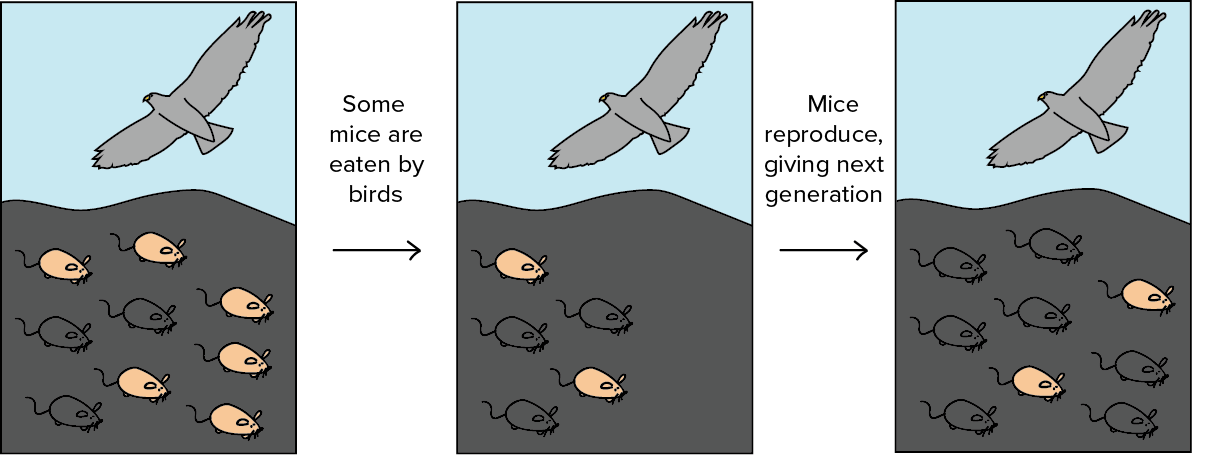

"Organisms that are better adapted to the environment survive to pass traits to their offspring" is the definition of
Natural Selection
Evolution
Selective Breeding
Artificial Selection

All rabbits of the same species living in a particular area would be an example of a(n)
population
species
community
ecosystem

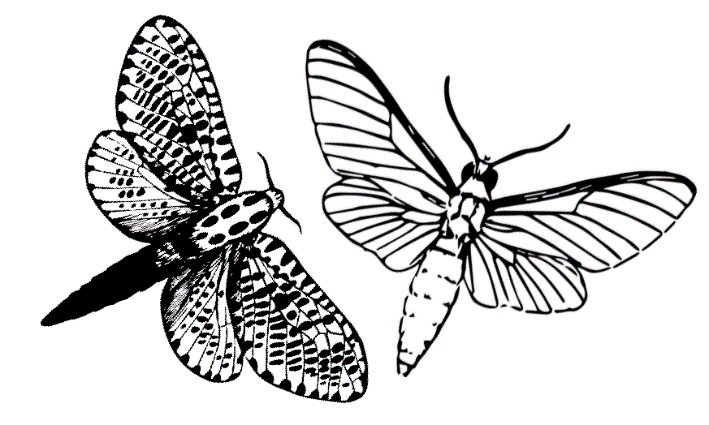
What is most likely to happen to moth populations in the picture shown?
Light moths--hunted easily, dark moths--population increase
Dark moths--hunted easily, dark moths--population increase
Light moths--hunted easily, light moths--population increase
Lights moths will change their color to match dark moths.
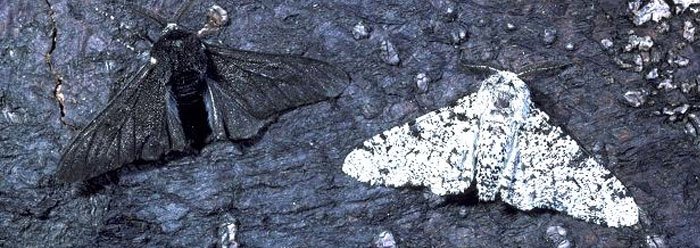
According to natural selection, light colored tree trunks would favor
light colored moths
dark colored moths
red colored moths
red and light colored moths

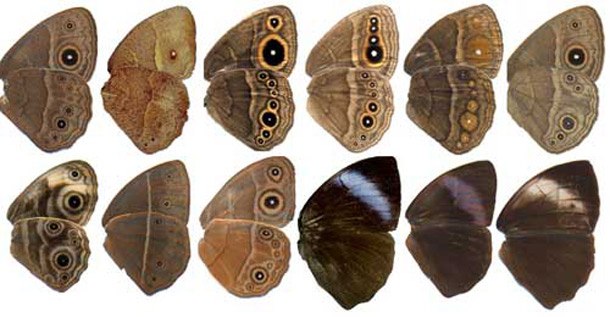
What happened to the peppered moth population after the Industrial Revolution?
There were MORE LIGHT moths because the bird couldn't see them on the DARK TREES
There were MORE DARK moths because the bird couldn't see them on the DARK TREES
There were MORE DARK moths because the bird couldn't see them on the LIGHT TREES
Which Hardy-Weinberg factor represents the frequency of heterozygous individuals in a population?
p2
2pq
q2
p2 + 2pq
The allele frequency of p=.20 What is the percentage of recessive genotype?
.80
.04
.32
.64

In a population of humans, the frequency of no dimples is 0.36. If having no dimples is the recessive phenotype, which variable do you now have?
p
p2
q
q2
Which of these is a condition that must be met for Hardy-Weinberg equilibrium?
extremely small population size
no natural selection
gene flow
nonrandom mating
Which of the following is the equation that you would use for Hardy-Weinberg?
p + 2q = 1
2p + 2q = 1
2p + q = 1
p + q = 1
Which of the following is the equation that you use for Hardy-Weinberg equilibrium?
p2 + 2pq + q2 = 1
p2 + q2 = 1
p3 + q3 = 1
p3 + 3pq + q3 = 1
In generation 1, the recessive allele has a frequency of 0.6 and in generation 40, the recessive phenotype has a frequency of 0.36. Is the population is Hardy-Weinberg?
No, the frequency changed from one generation to another.
Yes, the frequency changed from one generation to another
No, the frequency remained the same from one generation to another
Yes, the frequency remained the same from one generation to another
If there are 400 red flowers, 200 pink flowers, and 100 white flowers. Solve for the frequency of the dominant allele.
0.76
0.86
0.57
0.71
If there are 400 red flowers, 200 pink flowers, and 100 white flowers. Solve for the frequency of the recessive allele.
0.28
0.14
0.38
0.42
Check all of the options below that are SELECTION FACTORS, which determine whether a trait helps or hurts an organism. (choose more than one)
Obtaining food
Surviving climate changes
Escaping predators
Moving fast
What happens to new traits that HELP organisms survive over time?
They become MORE COMMON
They become LESS COMMON
They are EQUALLY COMMON
If a new trait DOES help an organism survive, what may happen to it?
It dies and its DNA is not passed on
It survives and its DNA is passed on
It changes its traits to adapt and survive
If a new trait DOES NOT help an organism survive, what may happen to it?
It dies and its DNA is not passed on
It survives and its DNA is passed on
It changes its traits to adapt and survive
Check all of the options below that are SELECTION FACTORS, which determine whether a trait helps or hurts an organism. (choose more than one)
Obtaining food
Surviving climate changes
Escaping predators
Moving fast
New traits usually occur due to:
Random genetic mutations
An organism adapting
Effects from the environment
The Hardy-Weinberg principle specifies the conditions under which a population of diploid organisms achieves ____.
Dimorphism
genetic equilibrium
Population size
Allele frequencies
In an isolated population of fruit flies, 4 percent of the individuals have pink eyes, a homozygous recessive condition, and 96 percent have the dominant black eye phenotype. What percentage of the population are heterozygotes?
48%
4%
88%
32%
16%
Which moth was the most common form before the industrial revolution?


What change did the industrial revolution cause?
Mutations to DNA
Color staining of moths
Color change to trees
Decreased environmental temperature.
Which moth was benefited from the pollution?
The white one
The dark one
The salt moth
The hummingbird moth
What caused the white moth to make a rebound?
Humans hunting
Climate change
Increased pollution
Pollution regulation

What effect did burning coal during the Industrial Revolution in England have on forests around cities?
Trees became covered in dark soot
Trees grew taller and had more branches
Trees had fewer places for birds (predators) to nest

The "peppered" and "dark" forms of moths were found to be _____ - moths passed their pattern onto their offspring
Inherited
Acquired
Unrelated

In England, during the Industrial Revolution, _____ moths became more common in forests around cities
Dark-colored
Peppered
Both types (dark colored and peppered)

If you place 50% light and 50% dark colored moths in a "Light Forest," you would expect the number of light colored moths to _____
Increase
Decrease

If you place 50% light and 50% dark colored moths in a "Dark Forest," you would expect the number of light colored moths to _____
Increase
Decrease
Which of the following does DDT kill?
Anopheles
Plasmodium
Malaria can reccur.
True
False
Sporozoites enter the human through..
Mosquito blood
Mosquito saliva

Malaria is cause by the bite of:-
Female Anopheles mosquito.
House fly.
Ant
Honey bee.

Which diseases are caused by Mosquito.
Dengue
Chikungunya
Malaria
Cholera
Mary Mallon was a carrier of Typhoid.
A carrier is a _____________________
A person who carries a baby.
A person who carries a disease without getting sick herself.
A person who carries a basket of fruit.

a contagious bacterial fever with red spots and intestinal irritation
Typhoid
Confined
Transfer
Lunged
Identify Infectious /Communicable diseases-
Typhoid,Cholera,T.B,
Malaris
Cancer,Cholera, Typhoid
High B.P,Typhoid,Malaria
Diabetes,Beri-Beri,Cholera,AIDS
High B.P,Cancer,Diabetes,Scurvy,Rickets these all disease are-
Non-Communicable Diseases
Communicable Diseases
Acute Diseases
Chronic Diseases
Causes of Diseases are-
Genetic Disorders
Environmental Pollution
Poor health and nourishment
All of above
Which of the following is not transferred by houseflies?
Typhoid
Cholera
Dysentry
AIDS
The causative agent of Typhoid is
Salmonella typhii
Ecoli
All groups of bacteria
Shigella
The chemical test that is used for diagnosis of typhoid is
ELISA-Test
ESR-Test
PCR-Test
Widal test
Pneumonia causes inflammation of?
alveoli/lung sacs
bronchi
trachea
bronchioles
what is the most common cause of pneumonia?
Streptococcus hemolyticus
Streptococcus pneumoniae
Staphylococcus aureus
Klebsiella
Malignant Malaria is caused by
Plasmodium vivax
Plasmodium malaria
Plasmodium falciparum
Amoebiasis is caused by (a)
Ascariasis is caused by (a)
Wuchereria also known as filarial worms infects ________and causes elephantiasis
blood vessels
legs
lymphatic vessels
Pneumonia is caused by (a)
malaria is which type of pathogen?
virus
protozoa
fungus
bacteria
parasite
The common cold is what type of pathogen?
virus
protozoa
fungus
bacteria
parasite
What is the most common term phrase for communicable disease
infectious disease
plague
outbreak
air borne pathogen
Infectious diseases are caused by _________ in the body.
pathogens
decomposers
Pathogens spread from person to person by objects (chairs, medical equipment, office supplies, doorknobs, etc.)
Direct Contact
Indirect Contact
Airborne Transmission
Foodborne Tranmission
Vector-Borne Transmission
When a pathogen is moved from person to person through physical touch (kissing, hugging, close-up sneezing, shaking hands).
Transmission
Translation
Emission
Direct Contact
Indirect Contact
How can the rate of an infectious disease be reduced?
By preventing transmission between people
By wearing clean clothing
Sabrina has the flu. Her neighbor suggests she get a prescription for an antibiotic, but Sabrina's mothers says that antibiotics would not help in this situation. Why?
the flu is caused by a virus, and it cannot be treated with an antibiotic.
the flu is caused by a fungus, and it must be treated with antifungal medication
the flu is caused by a parasitic worm, and must be treated with an anti-parasitic medication
the flu is caused by a bacterium, and it cannot be treated with an antibiotic.
Which type of pathogen is responsible for causing the flu, chicken pox, and yellow fever?
viruses
parasites
fungi
bacteria
A disease that moves from one continent to another new continent is known as a/an ______________________ disease.
epidemic
endemic
pandemic
sporadic
What is population distribution?
Population distribution shows how the organisms of the same species are able to spread out in a habitat.
The number of organisms present in a population
The number of individuals of a species per unit area of a habitat
Which of the following are factors that affect population distribution in plants?
(Choose 3)
Breeding site
Mineral salt content
Food supply
Light
pH of soil
Which are NOT factors that affect the population distribution of animals?
(Choose 2)
Food supply
Light
Breeding site
pH of soil
Temperature

Which are the THREE patterns of population distribution above?
(Choose 3)
Clumped
Distributed
Grouped
Random
Uniform
Which are the TWO methods for estimating population size?
(Choose 2)
Quadrat sampling technique
Census taking
Counting population technique
Capture-mark-release-recapture technique
Which are the THREE parameters of sampling quadrat?
(Choose 3)
Frequency
Density
Size
Coverage percentage
How to increase/ improve the accuracy of quadrat sampling technique?
Use smaller quadrat size
Use more quadrats
Use larger quadrat size
Place quadrat more randomly

The picture represents a sunny, dry desert. Which factor most likely limits the desert’s carrying capacity for plant life?
the number of animals that eat plants
the availability of space to grow
the amount of sunlight
the availability of water
A population of salamanders that live in a river require clear, fresh water to survive. New housing developments have caused tons of sediment to muddy the river. Which of these most likely will happen to the salamander population?
The salamanders will decrease in number because of the water quality.
The salamanders will move across land to another river.
The salamanders will quickly adapt to living in the muddy water.
The salamanders go live on land.

This is the most commonly seen distribution pattern. Example: wolves. This is usually because there are resources found in particular areas and the organisms need more space to survive.
random
clumped
uniform
What is a square called that we use to sample populations?
grid
quarter
square
quadrat

Diagram below shows the result of an activity to determine the population size of dandelion in the school field.
What is the frequency of dandelion?
50.2%
30%
44.5%
66.7%

Aini carried out a study on the population of Mimosa pudica in the school’s field. She used the quadrat sampling technique in the study. The area of each quadrat is 1 m².
The results is shown in table below.
The percentage coverage of grass P in the school’s field is …
44%
20%
65%
88%
What type of population would you measure using a quadrat?


Limpets were found in 25 out of 50 quadrats. What is coverage percentage of limpets?
50%
25%
75%
100%

Table below shows the number of plant A present in 10 different quadrats, each quadrat measuring 1 m x 1 m.
Calculate the density of plant A.
6/m2
5/m2
4.3/m2
6.1/m2
What is a tool to determine soil texture using 3 percentages?
Ribbon Test
Texture Triangle
pH Test
Jar Test
Which soil particle is the largest and feels gritty?
Sand
Silt
Clay
Which soil particle is the smallest, feels smooth, and gets heavy when wet (like a sponge)?
Sand
Silt
Clay
What is a mixture of sand, silt and clay called?
Loam
Humus
Sandy Clay
Silty Sand
As soil particle size decreases, the water holding capacity of the soil
decreases
increases
stays the same
Definition of Soil Structure:
Ability of a soil to retain water for use by plants
Ease with which air and water may pass through the soil
Grouping or arrangement of soil particles
Fineness or coarseness of a soil (particle size)
What percent of soil is pore space? (air and water)
5%
25%
50%
55%

