wayground logo

Free Printable Worksheets

Font size

S
M
L
XL
Worksheets

Classification Review

Total questions: 90

Worksheet time: 2hrs 36mins

Name
Class
Date
1.
What can a classification system show about an organism?
a)
absolute age of an organism
b)
what an organism is made of
c)
its relationship to other organisms
d)
which organisms are the strongest
2.
Use the phylogenetic tree.  Which hypothetical organism is the most recent ancestor for Organisms A and G?
a)
1
b)
2
c)
3
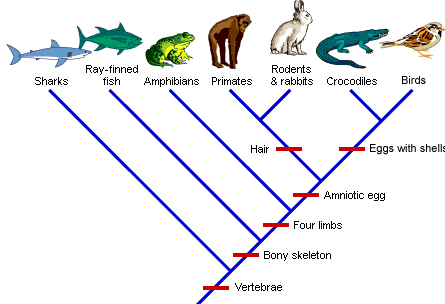
d)
4
3.
Which domain includes all multicellular plants and animals?
a)
Archaea
b)
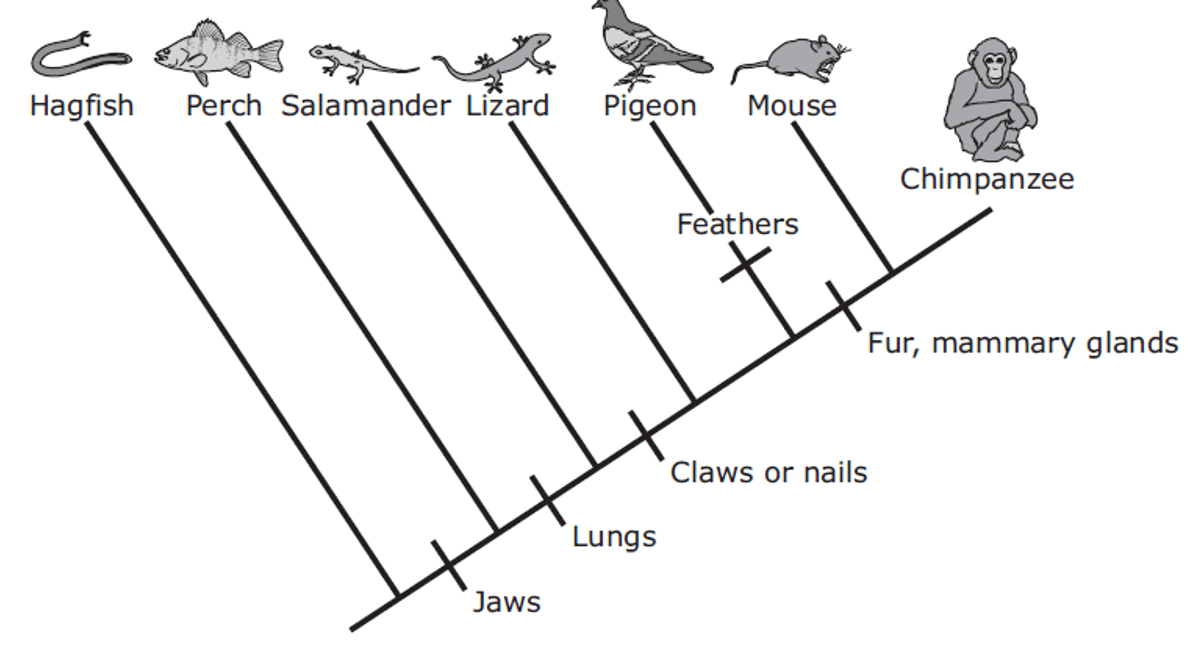
Eukarya
c)
Eubacteria
d)
Protista
4.
Panthera leo, the scientific name for a lion, is a member of which species?
a)
leo
b)
Animalia
c)
Panthera
d)
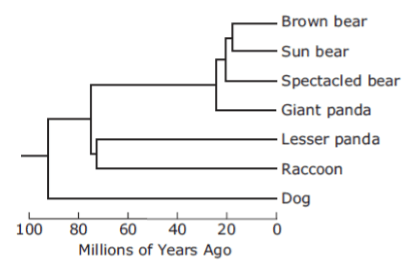
mammalia
5.
Which taxonomic category is higher than the others?
a)
class
b)
genus
c)
order
d)
phylum
6.
An organism identified with binomial nomenclature includes which two taxa?
a)
class and order
b)
family and genus
c)
genus and species
d)
kingdom and phylum
7.
Canis lupus, the scientific name for a wolf, is in which genus?
a)
Canis
b)
lupus
c)
Animalia
d)
mammalia
8.
Which two organisms are least closely related?
a)
two organisms from the same kingdom
b)
two organisms from the same order
c)
two organisms from the same family
d)
two organisms from the same genus
9.
Which is used most to determine a true common ancestor for a group of organisms?
a)
karyotype
b)
dichotomous key
c)
phylogenetic tree
d)
mRNA codon chart
10.
How would a dichotomous key be used?
a)
by inserting it into a chamber at a 45 degree angle
b)
by observing specimens and then answering questions about them
c)
by comparing the colors on a strip to the colors obtained during testing
d)
by analyzing a gel agar and recording the distance each fragment had traveled
11.
Examine the phylogenetic tree.
Which two organisms are most closely related?
a)
wolves and sharks
b)
starfish and sharks
c)
protists and sharks
d)
gorillas and sharks
12.
Which can be inferred by viewing a phylogenetic tree?
a)
ancestral lineages
b)
color variation in species
c)
food choice of an organism
d)
probability of extinction in a population
13.
Which is used to classify and name an organism?
a)
karyotype
b)
cladogram
c)
dichotomous key
d)
phylogenetic tree
14.
Examine the dichotomous key.
What features does a Platyspiza have?
a)
stout and heavy beak with a curved lower beak
b)
long, slender beak with a flat and straight lower beak
c)
flat and straight beak with a bend in the lower edge of the upper beak
d)
long and slender beak with the lower edge of the upper beak being flat
15.
What goal does Taxonomy accomplish?
a)
explains the differences between living organisms
b)
classifies living organisms into groups
c)
predicts the types of undiscovered organisms
d)
establishes relationships of organisms with their habitat
16.
Which of the following shows the taxa in the correct order?
a)
kingdom-phylum-order-class-family-genus-species
b)
kingdom-class-order-family-phylum-genus-species
c)
kingdom-phylum-class-order-family-genus-species
d)
kingdom-phylum-family-order-class-genus-species
17.
I have cell walls
I am an autotroph
I am multicellular
What am I?
a)
Plant
b)
Animal
c)
Eubacteria
d)
Unicorn
18.
I am unicellular
I am prokaryotic
I am found in extreme ecosystems
What kingdom do I belong to?
a)
The Candy Kingdom
b)
Kingdom Plantae
c)
Kingdom Animalia
d)
Kingdom Archaebacteria
19.
Kingdom Animalia is
a)
Eukayotic
b)
Prokaryotic
c)
Pick me!
d)
No, Pick me!!
20.
Kingdom Archaebacteria is...
a)
unicellular
b)
multicellular
c)
bigger than life!
d)
really pretty, just so pretty.
21.
Members of  Kingdom Animalia are...
a)
heterotrophs.
b)
autotrophs
22.
All living things are divided into three groups called 'domains'. They include, Domain Bacteria, Domain Archaea, and ____________.
a)
Domain Ikea
b)
Domain Eukarya
c)
Domain Romain (Lettuce-based organisms)
d)
Domain of Spain Rains only on the Plane!
23.
My Kingdom includes mushrooms and yeast!
a)
Animalia
b)
Plantae
c)
Eubacteria
d)
Fungi
24.
Do prokaryotes have a nucleus? 
a)
yes
b)
no
25.
In my kingdom, we have strange and amazing members that don't seem to fit well in any of the other kingdoms.
Who am I?
a)
Plantae
b)
Animalia
c)
Oz
d)
Protista
26.
Which kingdom is prokaryotic?
a)
Animalia
b)
Archaebacteria
c)
Planta
d)
Fungi
27.
In what kingdom would you find trees and flowers?
a)
Plantae
b)
Fungi
c)
Eubacteria
d)
Animalia
28.
Which Kingdom is referring to "old" bacteria?
a)
Eubacteria
b)
Archeabacteria
c)
Fungi
d)
Plantae
29.

A cell that does not have a nucleus is a

a)

Multicelular

b)

Prokaryotic

c)

Eukaryotic

d)

Unicellular

30.
I sometimes get confused by others to be a plant. I'm heterotrophic and digest decaying material. What kingdom to I belong to?
a)
Archaebacteria
b)
Animalia
c)
Fungi
d)
Protista
31.

Phylogeny is...

a)

The study of classification of different species

b)

The study of the evolutionary history of a species

c)

The study of prehistoric life

d)

The study of the distribution of different species

32.
What trait separates sharks from ray-finned fish?
a)
Vertebrae
b)
Bony skeleton
c)
Four limbs
d)
None
33.
What traits do crocodiles and amphibians have in common?
a)
Vertebrae and hair
b)
Four limbs and amniotic eggs
c)
Bony skeleton and vertebrae
d)
Amniotic eggs and hair
34.
The science of describing, classifying, and naming living things is called:
a)
Geology
b)
Biology
c)
Taxonomy
d)
Chemistry
35.
According to the cladogram, which organism is most distantly related to the human?
a)
crayfish
b)
grasshopper
c)
perch
d)
frog
36.
The first part of the scientific name is ALWAYS
a)
italicized
b)
underlined
c)
capitalized
d)
lowercased
37.
Most recently evolved trait?
a)
Amniotic egg
b)
Walking legs
c)
Jaws
d)
Hair
38.

According to this cladogram, primates share a common ancestor with

a)

amphibians

b)

rodents and rabbits

c)

crocodiles

d)

birds

39.

All the animals to the right of the salamander would have the common characteristic of...

a)

Fur

b)

Claws or nails

c)

Lungs

d)

Jaws

40.

In the blank cladogram, what type of information would go on the lines labeled A?

a)

derived characteristics

b)

common ancestors

c)

DNA analysis

d)

organisms

41.

In the cladogram, what type of information would go in

the area labeled B (hash lines)?

a)

shared characteristics

b)

DNA analysis

c)

common ancestors

d)

organisms

42.

According to this image, which two domains of life are most related?

a)

Bacteria & Archaea

b)

Archaea & Eukarya

c)

Eukarya & Bacteria

43.
All the animals to the right of the hagfish would have the common characteristic of -
a)
Fur
b)
Claws or nails
c)
Lungs
d)
Jaws
44.

Which of these animals does not have/produce an amniotic egg?

a)

Turtle

b)

Leopard

c)

Lamprey

d)

All three of these animals produce the amniotic egg
45.

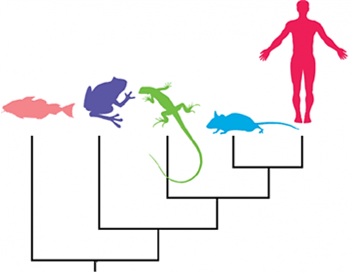
According to this phylogenetic tree, which creature is the least related out of all pictured?

a)

Fish

b)

Frog

c)

Salamander

d)

Human

46.

What do you call the traits shown on phylogenetic trees, such as "four limbs" or "vertebrae"?

a)

Derived characteristics

b)

Speedy Lambofeeties

c)

Branching elements

d)

Harmonious changes

47.

Which group of animals on this tree are most closely related to birds?

a)

Saurischian dinosaurs

b)

Ornithischian dinosaurs

c)

Crocodiles

d)

None of these are related to birds

48.

What number is the common ancestor of C and D

a)

1

b)

2

c)

3

d)

4

49.

From the picture above, What do the species all have in common?

a)

Back bone

b)

Same father

c)

Common ancestor

d)

Feathers

50.
Which of the following organisms are LEAST closely related?
a)
organisms that share a domain
b)
organisms that share a family 
c)
organisms that share a genus 
d)
organisms that share a species 
51.

Phylogeny is usually represented by a tree diagram called a _________ - _____

a)

Genetic Line

b)

Phylogenetic Tree

c)

Photographic Queue

d)

Future Babies

52.

What is the common ancestor of Letters A, B, C, D, E?

a)

1

b)

2

c)

3

d)

4

53.

Who is the closest relative to the brown bear?

a)

Giant panda

b)

Dog

c)

Lesser panda

d)

Sun bear

54.

Which organism is the most distantly related to all the others?

a)

Raccoon

b)

Dog

c)

Giant Panda

d)

Sun Bear

55.

Which group of animals on this tree are most closely related to birds?

a)

Saurischian dinosaurs

b)

Ornithischian dinosaurs

c)

Crocodiles

d)

None of these are related to birds

56.

On a phylogenetic tree, what do the branch lengths represent?

a)

The age of the organisms

b)

amount of genetic change since divergence

c)

amount of genetic change since convergence

d)

The age of divergence

57.
What goes in box 3
a)
Aabb
b)
AABB
c)
AAbb
d)
aaBb
58.

What goes in box 15

a)

aabb

b)

AABB

c)

aaBB

d)

AAbb

59.
Cross Two Homozygous plants
(
RRYY x rryy)
R = round seeds, r  = wrinkled seeds Y = yellow seeds, y = green seeds
What percent will have Round and Yellow seeds? 
a)
0%
b)
25%
c)
50%
d)
100%
60.
What is the genotype for a pea plant heterozygous for round seeds (R), and homozygous recessive for green seeds (y)?
a)
Ry
b)
RRyy
c)
RrYy
d)
Rryy
61.
Using the dihybrid cross and key provided, what is the probability of the offspring being tall and white?
a)
9
b)
2
c)
3
d)
6
62.
In a dihybrid cross
a)
one trait is crossed.
b)
two traits are crossed.
c)
four boxes are needed for the punnett square.
d)
mom's alleles are dominant.
63.

What is the genotype for a pea plant homozygous for round seeds (R), and heterozygous for yellow seeds?

a)

RrYy

b)

RRyy

c)

RRYy

d)

rryy

64.
What gamete possibilities could come from this parent's genotype?
a)
AB, AB, aB, aB
b)
Ab, AB, Ab, ab
c)
Ab, Ab, Ab, Ab
d)
AB, aB, ab, aB
65.

AA and Aa always show up as

a)

dominant

b)

recessive

66.
What is another way of saying "purebred"?
a)
homozygous
b)
dominant
c)
recessive
d)
heterozygous
67.
What goes in box 2
a)
AABb
b)
AaBb
c)
aabb
d)
AaBB
68.

A white mouse with red eyes is crossed with a black mouse with brown eyes. The white mouse is recessive for both of its traits. The black mouse is dominant for both of its traits.

This cross would be

a)

BBEE x bbee

b)

BBEe x BbEe

c)

BbEE x BbEe

d)

BBee x BBEE

69.

Which diagram demonstrates how crossing-over contributes to genetic variety during meiosis?

a)
b)
c)
d)
70.
Assume mom's gametes are on the left, what is her genotype?
a)
TTZz
b)
TtZz
c)
ttZZ
d)
TtZZ
71.

When crossing two parents who are heterozygous for both traits, what is the phenotypic ratio for their progeny?

a)

4:4:4:4

b)

9:3:3:1

c)

8:8

d)

1:2:1

72.
Which biotechnology is used to make exact DNA copies of an organism?
a)
Gel electrophoresis
b)
Genetic Engineering
c)
Inbreeding
d)
Cloning
73.
When cloning an organism, DNA is removed and placed into an empty
a)
virus
b)
sperm cell
c)
bacteria cell
d)
egg cell
74.
After finding the location of a gene, how can a scientist take it out of a cell?
a)
Using a microscope
b)
Using PCR
c)
Using scissors
d)
Using enzymes
75.
What is 1 significant issue with many Genetically Modified Organisms?
a)
They are too expensive to be useful
b)
Take a long time to make
c)
May affect other organisms in their environment
d)
Might evolve more quickly
76.
What is a major advantage to Genetically Modified Organisms?
a)
They evolve more quickly
b)
They are made in nature
c)
Can make organisms not found in nature
d)
They are not controversial
77.

This laboratory procedure is known as

a)

CLONING

b)

gel electrophoresis

c)

chromatography

d)

use of a dichotomous key

78.
Based on these results whose blood was found in the blood stain at the crime scene?
a)
Bob
b)
Sue
c)
John
d)
Lisa
79.
Which suspect is likely guilty?
a)
Suspect #1
b)
Suspect #2
c)
Suspect #3
80.
DNA fingerprinting works because
a)
Most genes are dominant
b)
All organisms contain RNA
c)
The most important genes are different among most people
d)
No two people, except identical twins, have exactly the same DNA 
81.
Why do the fragments of DNA in gel electrophoresis travel away from the negative electrode?
a)
DNA is negatively charged so attracted to the positive end of the unit
b)
DNA is positively charged to attracted to the negative end of the unit
c)
the agarose gel in negatively charged
d)
the agarose gel is positively charged
82.
Which two bat species are most closely related?
a)
 Bat 1 and Bat 2
b)
Bat 1 and Bat 3
c)
Bat 2 and Bat 3
d)
There’s no way to tell
83.
Is a virus considered living or non-living?
a)
Living
b)
Non-Living
c)
Neither
84.
What is the first step of the virus reproduction cycle?
a)
The viruses genetic material (DNA) starts to take over the functions of the cell
b)
The host cell bursts open, releasing the new viruses
c)
The virus injects its genetic material into the cell
d)
A virus attaches to the surface of a host cell
85.
Viruses are made of
a)
Nucleic Acids and DNA
b)
Nucleic Acids and Proteins
c)
Proteins and Bacteriophages
d)
Proteins and Capsids
86.
A Pathogen is a
a)
disease causing agent
b)
endospore
c)
bacteria
d)
virus
87.
The top arrow is pointing to...
a)
Capsid
b)
Cell Wall
c)
DNA
d)
Flagellum
88.
All bacteria are harmful to humans
a)
True
b)
False
89.

Which one(s) reproduce by hi-jacking a host cell machinery?

a)

Viruses

b)

Bacteria

c)

Both viruses and bacteria

90.

Which cycle kills the host cell immediately?

a)

Lytic

b)

Lysogenic