wayground logo

Free Printable Worksheets

Font size

S
M
L
XL
Worksheets

EOC 3a - Cellular Genetics and Heredity

Total questions: 60

Worksheet time: 1hrs 22mins

Name
Class
Date
1.
The inherited combination of alleles is called the ______
a)
genotype
b)
phenotype
c)
chromosome
d)
DNA
2.
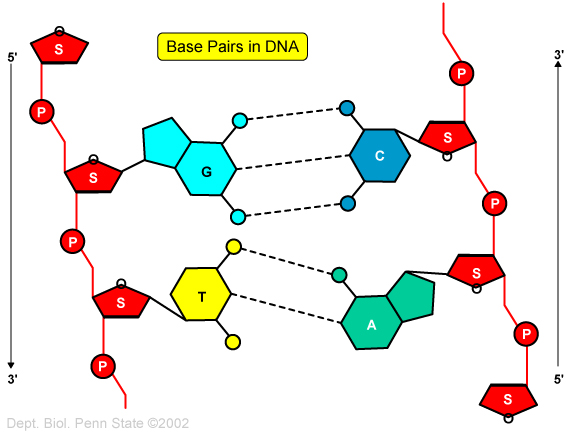
In a strand of DNA, if it contains 20% of Thymine, then how much Guanine would be present?
a)
30%
b)
20%
c)
80%
d)
10%
3.
Which sequence of DNA bases would pair with this partial strand
ATG TGA CAG
a)
ATG TGA CAG
b)
TAC ACT GTC
c)
GTA AGT GAC
d)
CAT TCA CTG
4.
Which 2 molecules form the sides (backbone) of the DNA ladder?
a)
deoxyribose sugar and adenine
b)
deoxyribose sugar and a hydrogen bond
c)
deoxyribose sugar and the nucleus
d)
deoxyribose sugar and phosphate
5.
What are the three components of a nucleotide?
a)
sugar, hydrogen, nitrogen base
b)
sugar, oxygen, nitrogen base
c)
sugar, phosphate, nitrogen base
d)
sugar, phosphate, protein
6.
A process in which DNA has the unique ability to make an exact copy of itself.
a)
Replication
b)
Translation
c)
Transcription
7.
Nitrogenous bases are joined by which type of bond?
a)
polar bonds
b)
ionic bonds
c)
covalent bonds
d)
hydrogen bonds
8.
The enzyme that unzips the DNA to prepare for replication
a)
helicase
b)
replicase
c)
polymerase
d)
synthase
9.
Which of the following statements is true?
a)
DNA is single-stranded
b)
RNA is single-stranded
c)
DNA contains uracil
d)
RNA contains deoxyribose
10.

The backbone of DNA is held together by which type of bond?

a)
polar bonds
b)
ionic bonds
c)
covalent bonds
d)
hydrogen bonds
11.

Mark all the bases that are purines

a)

Adenine

b)

Thymine

c)

Cytosine

d)

Guanine

12.

The picture below shows the steps of DNA replication beginning with step one and ending with step three.


​Because you are reusing the old, or parent, DNA strand DNA replication is said to be

a)

Semi- Conservative

b)

Semi-discontinuous

c)

Continuous

d)

Fully-Conserveative

13.

Which enzyme is responsible for adding the free nucleotides to the replicating DNA? ​

a)

DNA Helicase

b)

DNA Ligase

c)

DNA polyermase

d)

RNA Polymerase

14.

Which letter in the picture below depicts the leading strand in DNA replication?

a)

A

b)

C

c)

B

d)

None of the above

15.

DNA replication runs from ______' to _____' and is said to be ______________________

a)

5, 3, antiparallel

b)

3, 5, antiparallel

c)

5, 3, parallel

d)

3, 5, parallel

16.
How would the DNA sequence GCTATA be transcribed to mRNA?
a)
GCUAUA
b)
CGATAT
c)
CGAUAU
d)
GCUTUT
17.
The process by which the genetic code of DNA is copied into a strand of RNA is called
a)
translation
b)
transcription
c)
transformation
d)
replication
18.

What is the correct order to make a protein?

a)

Protein, DNA, RNA

b)

RNA, DNA, Protein

c)

DNA, RNA, Protein

d)

Protein, RNA, DNA

19.

What enzyme does transcription use?

a)

DNA polymerase

b)

ligase

c)

RNA polymerase

d)

helicase

20.
Where does transcription take place?
a)
nucleus
b)
cytoplasm
c)
ribosome
21.

RNA must be edited before it can be used to make Proteins, what happens during this editing process?

a)

A spliceosome cuts out exons

b)

A spliceosome cuts out the introns

c)

A splicesome pairs nucleotides with the DNA base pairs

d)

The RNA is checked for typos

22.
Brings the amino acids to the ribosome
a)
mRNA
b)
tRNA
c)
rRNA
d)
DNA
23.
What would be the tRNA anticodon for the mRNA codon CAG?
a)
GTC
b)
GUC
c)
CUG
d)
CAG
24.
What is the term for a three-nucleotide sequence that codes for an amino acid?
a)
base
b)
codon
c)
amine
d)
serine
25.
Which phrase best describes translation?
a)
converts mRNA into a polypeptide
b)
catalyzes bonds between amino acids
c)
produces RNA from DNA molecules
d)
recycles tRNA molecules for reuse
26.
What type of bonds are forming during translation?
a)
Peptide bonds
b)
Hydrogen bonds
c)
Acid bonds
27.
How many amino acids are coded for by this sequence of nucleotides:
ATG GGA ACT CCA
a)
4
b)
2
c)
6
d)
12
28.
Which phase of which process does this picture show?
a)
Transcription
b)
Translation
c)
Replication
29.
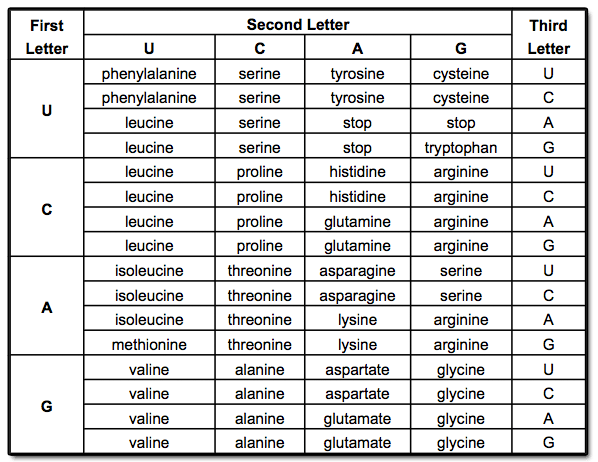
What is the correct amino acid sequence for the mRNA code AUGCCAGUAUGA
a)
Met-Pro-Ala-Val
b)
Met-Pro-Val
c)
Tyr-Gly-His
d)
Tyr-Gly-Arg-His
30.
What mutation has occurred here? 
T-G-A-C-C-A
T-G-A-G-C-A
a)

Substitution (point)

b)
Deletion
c)
Insertion
d)
Frameshift 
31.
Any change in the sequence of DNA is...
a)
transgenic shift
b)
Single Genotype
c)
Monohybrid Trait
d)
Mutation
32.
Why are insertion and deletion (frameshift) mutations so harmful?
a)
They change all of the codons from the mutation on down the line, which changes the amino acid sequence
b)
They insert things that an organism doesn't need.
c)
They often delete things that organisms need.
d)
Insertion and deletions are not any more harmful than substitution mutations.
33.
a change in one DNA triplet that may result in a new triplet that codes for a stop codon instead of an amino acid is known as
a)
missense
b)
nonsense
c)
frameshift
d)
silent
34.
A type of substitution in which no  amino acids change is called 
a)
Missense
b)
Nonsense
c)
Silent
d)
Deletion
35.
Mutations are__________
a)
Harmful
b)
Harmful or beneficial
c)
Neutral
d)
Harmful, neutral, or beneficial
36.
A missense mutation results from...
a)
a base substiution that causes no change in amino acid
b)
a base substitution that causes a change in one amino acid
c)
a base change that codes for a stop 
d)
a base insertion or deletion
37.
How can a person's muscle cells have the same exact DNA sequences as their nerve cells even though the look and perform completely different?
a)
The two different cells become mutated
b)
The proteins expressed in each cell are different
c)
They actually have different DNA in the two types of cells.
d)
The genome of the different cells changes
38.
In the S stage of interphase....
a)
The cell grows
b)
The nucleus divides
c)
The cell membrane divides
d)
The DNA is replicated
39.
Uncontrollable cell growth is known as _____
a)
Obesity
b)
Cancer
c)
Diabetes
d)
Hepatitis
40.
In what phase do the chromosomes get pulled apart into sister chromatid to opposite sides of the cell?
a)
Prophase
b)
Interphase
c)
Metaphase
d)
Anaphase
41.
Name the phase:
a)
Prophase
b)
Metaphase
c)
Anaphase
d)
Telophase
42.

Name the phase:

a)

Prophase

b)

Metaphase

c)

Anaphase

d)

Telophase

43.

What is happening in this series of images?

a)

Mitosis - nucleus divides

b)

Mitosis - DNA replicates

c)

Interphase - the cell prepares for DNA replication

d)

Interphas - the cell divides

44.
The cell spends most of it's life in ________________.
a)
mitosis
b)
cytokinesis
c)
Interphase
d)
None of the above
45.

Most prokaryotic organisms reproduce mainly by the process of

a)

regeneration

b)

binary fission

c)

budding

d)

production of spores

46.

The diploid chromosome compliment of human somatic cell consists of how many chromosomes?

a)

14

b)

23

c)

46

d)

58

47.

The phase of mitosis during which the nuclear envelope fragments and the nucleoli disappear is called

a)

interphase

b)

prophase

c)

metaphase

d)

telophase

48.

During which phase of mitosis do the chromosomes line up on a plane located equidistant from the two spindle poles?

a)

interphase

b)

prophase

c)

metaphase

d)

anaphase

49.
The haploid number of human chromosomes is
a)
11
b)
12
c)
23
d)
46
50.
Each identical side of a chromosome is the 
a)
centromere
b)
chromatin
c)
centriole
d)
chromatid
51.
Autosomes are
a)
chromosomes found in autotrophs, only
b)
chromosomes that automatically correct all errors in the DNA
c)
chromosomes that determine traits other than sex
d)
chromosomes that determine the sex of the individual
52.
A male shark has 40 chromosomes in each of its sex cells. How many would be present in its body cells?
a)
20
b)
40
c)
80
d)
160
53.
Chromosomes exchange genetic material during 
a)
crossing over
b)
replication
c)
synthesis
d)
translation
54.
Diploid Cells are represented by
a)
2n
b)
n
c)
4n
d)
1/2 n
55.

If the diploid number of carrots is 18, the haploid number is

a)

18

b)

9

c)

27

d)

36

56.
The result of meiosis is:
a)
two diploid cells
b)
two haploid cells
c)
four diploid cells
d)
four haploid cells
57.

Crossing over occurs in what phase of Meiosis?

a)

Prophase I

b)

Prophase II

c)

Metaphase I

d)

Interphase

58.

Homologous pairs line up in the middle of the cell in what phase of Meiosis?

a)

Metaphase I

b)

Metaphase II

c)

Mitosis

d)

Prophase II

59.

Homologous pairs are separated in what phase of Meiosis?

a)

Anaphase I

b)

Anaphase II

c)

Metaphase I

d)

Prophase II

60.

Sister chromatids are separated in what phase of Meiosis?

a)

Anaphase I

b)

Anaphase II

c)

Metaphase I

d)

Prophase II